Species · Reptiles
Senegal Flapshell Turtle Cyclanorbis senegalensis
The scientific name of the Senegal Flapshell Turtle is Cyclanorbis senegalensis. It is a species of reptile in the family Trionychidae (softshell turtles), order Testudines. The name dates from 1835.
- Scientific name
- Cyclanorbis senegalensis (Duméril & Bibron, 1835)
- Common name
- Senegal Flapshell Turtle
- Genus
- Cyclanorbis
- Family
- Trionychidae (Softshell Turtles)
- Order
- Testudines
- Class
- Reptilia
- Red List category
- VU Vulnerable
- Environment
- freshwater, terrestrial
- Recorded in
- 19 countries
- Name status
- accepted in the Catalogue of Life

Overview
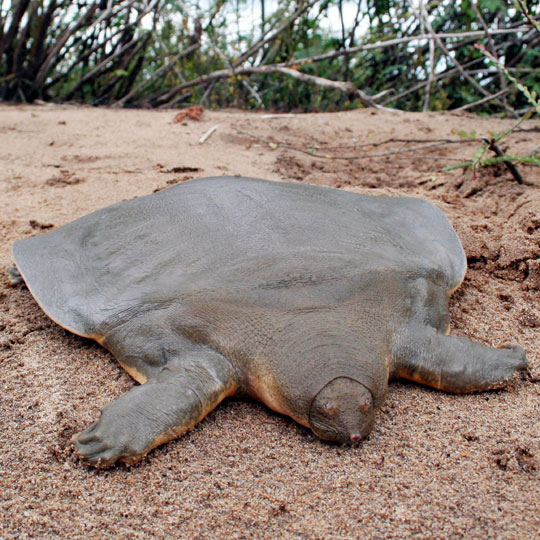
The Senegal Flapshell Turtle is one of two softshell turtle species classified in the genus Cyclanorbis within the Trionychidae family. It occurs in Benin, Burkina Faso, Cameroon, the Central African Republic, Chad, Ivory Coast, Ethiopia, Gambia, Ghana, Guinea-Bissau, Liberia, Mali, Niger, Nigeria, Senegal, Sierra Leone, South Sudan, Sudan and Togo, and is endemic to Africa. It has an olive-colored head marked with numerous white dots and an olive-colored carapace that may be uniformly colored or marked with small dark blotches.
Written 26 November 2026 from the sources listed below. Each statement was checked against the passage it cites; statements that could not be supported were removed.
Appearance
The Senegal Flapshell Turtle has an olive-colored head marked with numerous white dots. Its carapace is olive-colored and may be uniformly colored or marked with small dark blotches.[1][2]
Hatchlings have longitudinal rows of small tubercles on their carapaces. The plastron is yellowish and clouded with brown, and the plastral callosities have a finely granular texture.[3][4][5]
The species can reach a straight-line carapace length of 35 cm.[6]
Habitat
Its preferred natural habitats include freshwater wetlands and savanna.[7][8]
Diet
The Senegal Flapshell Turtle preys on tadpoles, other amphibians and fish.[9][10][11]
Large adults can also consume freshwater clams and snails.[12][13]
Similar species
The Senegal Flapshell Turtle is one of two softshell turtle species classified in the genus Cyclanorbis within the Trionychidae family.[14][15]
Classification of the Senegal Flapshell Turtle
| Kingdom | Animalia |
|---|---|
| Phylum | Chordata |
| Subphylum | Vertebrata |
| Infraphylum | Gnathostomata |
| Parvphylum | Osteichthyes |
| Megaclass | Tetrapoda |
| Class | Reptilia (Reptile) |
| Order | Testudines (Turtle) |
| Suborder | Cryptodira |
| Superfamily | Trionychoidea |
| Family | Trionychidae (Softshell Turtles) |
| Genus | Cyclanorbis (Sub-Saharan Flapshell Turtles) |
| Species | Cyclanorbis senegalensis (Duméril & Bibron, 1835) |
Where the Senegal Flapshell Turtle is found
Checklists and occurrence records place Cyclanorbis senegalensis in 19 countries across Africa. GBIF holds 96 georeferenced records of it.
Countries
- Benin 39
- Cameroon 1
- Central African Republic 7
- Chad
- Ethiopia 5
- Gambia 3
- Ghana 1
- Guinea 2
- Guinea-Bissau
- Ivory Coast 5
- Liberia
- Mali 3
- Mauritania
- Nigeria 2
- Senegal 19
- Sierra Leone
- South Sudan
- Sudan 9
- Togo
Regions and cities with the most records
- Atakora, Benin 38
- Tanguiéta, Benin 12
- Natitingou, Benin 11
- Toukountouna, Benin 7
- Matéri, Benin 5
- Boukoumbé, Benin 3
- Tambacounda, Senegal 3
Range as the checklists state it
Sudan (Jumhūriyyat), Republic of South Sudan (RSS), W Ethiopia, Chad, Cameroon, Central African Republic, Nigeria, Togo, Benin, Ghana, Ivory Coast, Liberia, Sierra Leone, Mauritania, Guinea, Guinea-Bissau, Senegal, Mali, Gambia (MacCarthy Island, HÅKANSSON 1981)
A number beside a place is its count of GBIF occurrence records. A place without a number comes from a checklist alone. Records show where a species has been observed or collected, which can include escapes and vagrants.
Common names
English
- Senegal Flapshell Turtle
- Sahelian Flapshell Turtle
- Senegal Soft-shelled Turtle
- Senegal Softshell
Names in 7 other languages
- Arabic
- سلحفاة رفرافية الدرقة السنغالية
- Chinese
- 塞內加爾盤鱉
- Czech
- kožitka senegalská
- Danish
- Senegalesisk Klapblødskildpadde
- German
- Senegal-Klappen-Weichschildkröte
- Hungarian
- szenegáli leffentyűsteknős
- Russian
- Сенегальская лопастная черепаха
Synonyms
11 other scientific names have been used for this species and are now treated as synonyms of Cyclanorbis senegalensis.
- Cryptopus senegalensis Duméril & Bibron, 1835
- Cyclanorbis petersii Gray, 1855
- Cyclanosteus senegalensis callosa Gray, 1865
- Cyclanosteus senegalensis equilifera Gray, 1865
- Cyclanosteus senegalensis normalis Gray, 1865
- Cyclanosteus senegalensis var. callosa Gray, 1865
- Cyclanosteus senegalensis var. equilifera Gray, 1865
- Cyclanosteus senegalensis var. normalis Gray, 1865
- Cycloderma senegalense Duméril, 1861
- Tetrathyra baikii Gray, 1865
- Tetrathyra vaillantii Rochebrune, 1884
Related species
-
 Nubian Flapshell TurtleCyclanorbis elegans
-
 Yangtze Giant Softshell TurtleRafetus swinhoei
-
 Indian Flapshell TurtleLissemys punctata
-
 Florida Softshell TurtleApalone ferox
-
 Chinese Softshell TurtlePelodiscus sinensis
-
 Asian Giant Softshell TurtlePelochelys cantorii
-
 Spiny Softshell TurtleApalone spinifera
-
 Indian Softshell TurtleNilssonia gangetica
Compare
Questions and answers
What is the scientific name of the Senegal Flapshell Turtle?
The scientific name of the Senegal Flapshell Turtle is Cyclanorbis senegalensis. Written with its author, the full name is Cyclanorbis senegalensis (Duméril & Bibron, 1835).
Which family does the Senegal Flapshell Turtle belong to?
Cyclanorbis senegalensis belongs to the family Trionychidae, in the order Testudines and the class Reptilia.
Where is the Senegal Flapshell Turtle found?
Checklists and occurrence records place Cyclanorbis senegalensis in 19 countries, including Benin, Senegal, Sudan, Central African Republic, Ethiopia and Ivory Coast.
What is the conservation status of the Senegal Flapshell Turtle?
The IUCN Red List category recorded for Cyclanorbis senegalensis is Vulnerable (VU).
What other names does the Senegal Flapshell Turtle have?
Cyclanorbis senegalensis is also known in English as Sahelian Flapshell Turtle, Senegal Soft-shelled Turtle and Senegal Softshell.
Sources
Passages the profile rests on
- The turtle has an olive-colored head marked with numerous white dots. Source passage: “The head is olive, with numerous white dots.” — English Wikipedia
- Its carapace is olive-colored and may be uniformly colored or marked with small dark blotches. Source passage: “The carapace is olive, either uniform or with small dark blotches.” — English Wikipedia
- Hatchlings have longitudinal rows of small tubercles on their carapaces. Source passage: “Hatchlings have longitudinal rows of small tubercles on the carapace.” — English Wikipedia
- The plastron is yellowish and clouded with brown. Source passage: “The plastron is yellowish, clouded with brown.” — English Wikipedia
- The plastral callosities have a finely granular texture. Source passage: “The plastral callosities are finely granular.” — English Wikipedia
- The species can reach a straight-line carapace length of 35 cm. Source passage: “C. senegalensis may attain a straight-line carapace length of 35 cm (14 in).” — English Wikipedia
- Its preferred natural habitats include freshwater wetlands. Source passage: “The preferred natural habitats of C. senegalensis are freshwater wetlands and savanna.” — English Wikipedia
- Its preferred natural habitats include savanna. Source passage: “The preferred natural habitats of C. senegalensis are freshwater wetlands and savanna.” — English Wikipedia
- The species preys on tadpoles. Source passage: “C. senegalensis preys upon tadpoles, other amphibians, and fishes.” — English Wikipedia
- The species feeds on amphibians other than tadpoles. Source passage: “C. senegalensis preys upon tadpoles, other amphibians, and fishes.” — English Wikipedia
- The species preys on fish. Source passage: “C. senegalensis preys upon tadpoles, other amphibians, and fishes.” — English Wikipedia
- Large adults can also consume freshwater clams. Source passage: “Large adults of C. senegalensis have jaws strong enough to also eat freshwater clams and snails.” — English Wikipedia
- Large adults can also consume snails. Source passage: “Large adults of C. senegalensis have jaws strong enough to also eat freshwater clams and snails.” — English Wikipedia
- The species is one of two softshell turtle species classified in the genus Cyclanorbis. Source passage: “The species, which is one of two species of softshell turtles in the genus Cyclanorbis, is endemic to Africa.” — English Wikipedia
- The species is one of two softshell turtle species in the genus Cyclanorbis within the Trionychidae family. Source passage: “The Senegal flapshell turtle (Cyclanorbis senegalensis) is one of two species of softshell turtle in the genus Cyclanorbis of the Trionychidae family.” — inaturalist.org
- The species is endemic to Africa. Source passage: “The species, which is one of two species of softshell turtles in the genus Cyclanorbis, is endemic to Africa.” — English Wikipedia
Data
- Catalogue of Life, 2026-10-16 XR cc by
- Global Biodiversity Information Facility CC BY 4.0
- Wikidata CC0
- GeoNames CC BY 4.0
- Wikimedia Commons per image; credit shown with each image
- Within the Catalogue of Life, this name comes from The Reptile Database cc by
References
- Duméril, A.M.C.; Bibron, G. (1835). Erpétologie Générale ou Histoire Naturelle Complète des Reptiles, Vol. 2. Librairie Encyclopédique de Roret, Paris, iv + 680 p. where the name was published
- Duméril, A.M.C., and G. Bibron. (1835). Erpétologie Générale ou Histoire Naturelle Complète des Reptiles, Vol. 2. Librairie Encyclopédique de Roret, Paris, Iv + 680 P.
- Gray, J. E. (1852). Description of a new genus and some new species of tortoises. Proc. Zool. Soc. London 1852: 133-135.
- Gray, J. E. (1855). Description of a new genus and some new species of tortoises. Ann. Mag. Nat. Hist. (2) 15: 67-69.
- Gray, J. E. (1860). On the African Trionyces with hidden feet (Emyda). Ann. Mag. Nat. Hist. (3) 6: 440-441.
- Gray, J. E. (1865). On the development of the sternal callosities in Cyclanosteus senegalensis, and on the synonyms of Cyclanosteus and its allied genera. Proc. Zool. Soc. London 1865: 422-428.
- Gray, J. E. (1865). Notice of a new genus and species of the family Trionychidae from Western Africa. Proc. Zool. Soc. London 1865: 323-324.
- Siebenrock, Friedrich. (1897). Das Kopfskelet der Schildkröten. Sitzungsberichte Der Kaiserlichen Akademie Der Wissenschaften. Mathematisch-Naturwissenschaftliche Klasse. 106 (4): 245-328.
- Siebenrock, F. (1902). Zur Systematik der Schildkrotenfamilie Trionychidae Bell nebst der Beschreibung einer neuen CycIanorbis-Art. Anzeiger Der Kaiserlichen Akademie Der Wissenschaften, Mathematisch-Naturwissenschaftliche Classe, Wien 39: 289-291.
- Siebenrock, F. (1902). Zur Systematik der Schildkrötenfamilie Trionychidae Bell, nebst der Beschreibung einer neuen Cyclanorbis - Art. Sitzungsber. K. Akad. Wiss. Wien. Math-Naturwiss. Cl. 111: 807-846.
- Siebenrock, F. (1905). Chelonologische Notizen. Zool. Anz. 29: 460-468.
- Siebenrock, F. (1913). Schildkröten aus Syrien und Mesopotamien. Ann. Naturhist. Mus. Wien 27: 171-225.
- Hughes, B. (1979). Occurrence of the freshwater trionychid turtles Cyclanorbis elegans and C. senegalensis in Ghana. Bull. IFAN 41 (Sér. 1, 1): 193-205.
- Hughes, B. (1986). Longevity Records of African Captive Amphibians and Reptiles: Part 1: Introduction and Species List 1 - Amphibians and Chelonians. J. Herp. Assoc. Africa (32): 1-5.
- Ernst,C.H. and Barbour,R.W. (1989). Turtles of the World. Smithsonian Institution Press, Washington D.C. - London.
- McCord, W. P., & Joseph-Ouni, M. (2003). Chelonian Illustrations #6. Flapshell and Giant Asian Softshell Turtles. Reptilia (GB) (26): 59-64.
- Barnett, Linda K. & Emms, Craig. (2005). Common reptiles of The Gambia. Rare Repro, Hailsham, East Sussex, 24 Pp.
- Chirio, & Laurent and Ivan Ineich. (2006). Biogeography of the reptiles of the Central African Republic. African Journal of Herpetology 55(1):23-59.
- Padial, J. M. (2006). COMMENTED DISTRIBUTIONAL LIST OF THE REPTILES OF MAURITANIA (WEST AFRICA). Graellsia, 62(2): 159-178.
- Bonin, F., Devaux, B., & Dupré, A. (2006). Turtles of the World. English translation by P.C.H. Pritchard. Johns Hopkins University Press, 416 Pp.
- Chirio, L., & Lebreton, M. (2007). Atlas des reptiles du Cameroun. MNHN, IRD, Paris 688 Pp.
- Bour, R. (2008). Global diversity of turtles (Chelonii; Reptilia) in freshwater. Hydrobiologia 595:593–598.
- Chirio, L. (2009). Inventaire des reptiles de la région de la Réserve de Biosphère Transfrontalière du W (Niger/Bénin/Burkina Faso: Afrique de l’Ouest). [Herpetological survey of the W Transfrontier Biosphere Reserve area (Niger/Benin/Burkina Faso: West Africa]. Bull. Soc. Herp. France (132): 13-41.
- Trape, J.F.; Trape, S. & Chirio, L. (2012). Lézards, crocodiles et tortues d’Afrique occidentale et du Sahara. IRD Orstom, 503 Pp.
- TTWG [Peter Paul van Dijk, John B. Iverson, Anders G.J. Rhodin, H. Bradley Shaffer, and Roger Bour]. (2014). Turtles of the World, 7th Edition: Annotated Checklist of Taxonomy, Synonymy, Distribution with Maps, and Conservation Status. 000.v7. Chelonian Research Monographs (ISSN 1088-7105) No. 5, Doi:10.3854/Crm.5.000.Checklist.V7.2014.
This species in other databases
- Catalogue of Life 32SPK
- Wikidata Q304585
- iNaturalist 39544
- WoRMS urn:lsid:marinespecies.org:taxname:1440708
- ITIS 551957
Page built on 27 November 2026. See how the catalog is made and all sources and licences.
Cite this page
ScientificNames.org. (2026). Cyclanorbis senegalensis (Senegal Flapshell Turtle). Retrieved November 27, 2026, from https://scientificnames.org/species/cyclanorbis-senegalensis
“Cyclanorbis senegalensis (Senegal Flapshell Turtle).” ScientificNames.org, 2026, scientificnames.org/species/cyclanorbis-senegalensis. Accessed 27 Nov. 2026.
ScientificNames.org. “Cyclanorbis senegalensis (Senegal Flapshell Turtle).” Accessed November 27, 2026. https://scientificnames.org/species/cyclanorbis-senegalensis.
@misc{scientificnames_cyclanorbis_senegalensis_senegal_flapshell_turtle,
  author = {{ScientificNames.org}},
  title = {Cyclanorbis senegalensis (Senegal Flapshell Turtle)},
  year = {2026},
  url = {https://scientificnames.org/species/cyclanorbis-senegalensis},
  note = {Accessed 2026-11-27}
}