Species · Birds
Song Wren Cyphorhinus phaeocephalus
The scientific name of the Song Wren is Cyphorhinus phaeocephalus. It is a species of bird in the family Troglodytidae (wren), order Passeriformes. The name dates from 1860.
- Scientific name
- Cyphorhinus phaeocephalus P. L. Sclater, 1860
- Common name
- Song Wren
- Genus
- Cyphorhinus
- Family
- Troglodytidae (Wren)
- Order
- Passeriformes
- Class
- Aves
- Red List category
- LC Least Concern
- Recorded in
- 6 countries
- Name status
- accepted in the Catalogue of Life
Overview
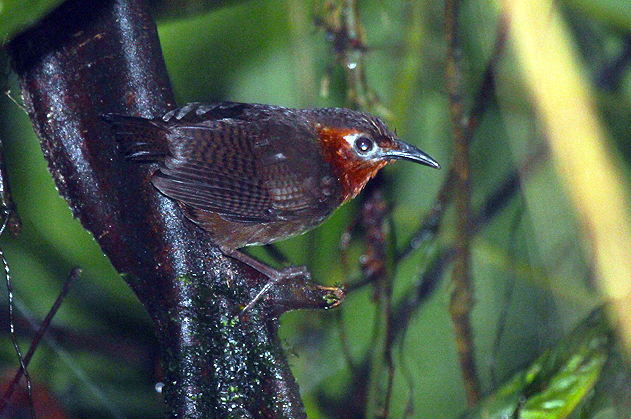
The Song Wren occurs in Colombia, Costa Rica, Ecuador, Honduras, Nicaragua, and Panama. It is distinguished by a patch of pale blue bare skin surrounding its eye, a feature distinctive among wrens.
Written 26 November 2026 from the sources listed below. Each statement was checked against the passage it cites; statements that could not be supported were removed.
Similar species
The Song Wren was formerly classified as conspecific with the musician wren (Cyphorhinus arada). The Song Wren, musician wren, and possibly chestnut-breasted wren form a superspecies.[1][2]
Appearance
The Song Wren has an almost uniformly brown body, sometimes with paler breast coloration, and a chestnut-colored throat. Its wings have black bars, and its tail is very short.[3][4][5]
The Song Wren has a chunky body, short tail, and long bill. A patch of pale blue bare skin surrounds its eye, a distinctive feature among wrens.[6][7][8]
The coloration and intensity of coloration vary among Song Wren subspecies.[9]
The Song Wren measures 11.5–12.5 cm in length and weighs 25–26 g.[10][11]
Habitat
The Song Wren inhabits the interior of lowland primary and secondary forests, particularly those with abundant undergrowth. It avoids dry landscapes and well-lit areas.[12][13]
Diet
Spiders constitute almost half of the prey recorded in the only detailed study of the Song Wren's diet. Other small invertebrates make up most of the remainder.[14][15]
Behaviour
The Song Wren forages almost exclusively on the forest floor, tossing and probing leaf litter. It is usually observed in pairs or small family groups.[16][17][18]
The Song Wren's song consists of clear, melodious whistles combined with harsh, henlike clucking. Both males and females sing throughout the year to defend their territory.[19][20]
Song variations have been noted between the sexes and among different parts of the Song Wren's range.[21]
Reproduction and life cycle
The Song Wren constructs separate gourd-shaped dormitory nests for roosting and breeding nests. These nests are made mainly from rootlets, palm-frond strips, and small twigs, with leaf skeletons as lining.[22][23][24]
Breeding nests have a distinct cup that is sometimes lined with small feathers. They are located in understory trees, often in Acacia trees that also host Pseudomyrmex ants.[25][26]
Song Wren nests are constructed and maintained during nearly the entire year. Females alone incubate the eggs and brood the young.[27][28]
Conservation
The Song Wren is classified as Least Concern by the IUCN and is fairly common throughout its extensive geographical range.[29][30]
Habitat disturbance and fragmentation appear to negatively affect the Song Wren. Its population is thought to be declining.[31][32]
Classification of the Song Wren
| Kingdom | Animalia |
|---|---|
| Phylum | Chordata |
| Subphylum | Vertebrata |
| Infraphylum | Gnathostomata |
| Parvphylum | Osteichthyes |
| Megaclass | Tetrapoda |
| Class | Aves (Bird) |
| Order | Passeriformes (Passerine) |
| Family | Troglodytidae (Wren) |
| Genus | Cyphorhinus (Song Wrens) |
| Species | Cyphorhinus phaeocephalus P. L. Sclater, 1860 |
Where the Song Wren is found
Checklists and occurrence records place Cyphorhinus phaeocephalus in 6 countries. GBIF holds 16,324 georeferenced records of it.
Countries
Regions and cities with the most records
- Alcalde Díaz, Panama 7,185
- Chilibre, Panama 6,996
- Colón, Panama 6,492
- Alajuela Province, Costa Rica 3,406
- Panamá, Panama 1,672
- Panama City, Panama 859
- El Oro, Ecuador 769
- San Miguelito, Panama 765
- Piñas, Ecuador 763
- Arraiján, Panama 719
- Limón Province, Costa Rica 715
- Ancón, Panama 697
- Curundú, Panama 696
- Tocumen, Panama 586
- Juan Díaz, Panama 505
- Panamá Oeste Province, Panama 471
- Turrialba, Costa Rica 418
- Coclé, Panama 402
- Guanacaste Province, Costa Rica 398
- Guápiles, Costa Rica 263
- Heredia Province, Costa Rica 243
- Cartago Province, Costa Rica 240
- Esmeraldas, Ecuador 232
- Siquirres, Costa Rica 204
- Veracruz, Panama 191
- Colón, Panama 171
- Paraíso, Costa Rica 167
- Cativá, Panama 162
- Sabanitas, Panama 161
- Quesada, Costa Rica 141
- Antioquia, Colombia 131
- Darién, Panama 112
- Chocó, Colombia 93
- Santander Department, Colombia 48
- Manabí, Ecuador 40
- Limón, Costa Rica 33
A number beside a place is its count of GBIF occurrence records. A place without a number comes from a checklist alone. Records show where a species has been observed or collected, which can include escapes and vagrants.
Common names
English
- Song Wren
Names in 23 other languages
- Catalan
- cargolet cantaire
- Chinese
- 鳴唱鷦鷯, 鸣鹪鹩
- Croatian
- mrki palčić
- Czech
- střízlík rezavohrdlý
- Danish
- Sangsmutte
- Dutch
- Pacifische Orpheuswinterkoning
- Esperanto
- kanta troglodito
- Finnish
- kolumbianlaulupeukaloinen
- French
- Troglodyte chanteur
- German
- Brillenzaunkönig, Singzaunkönig
- Italian
- Scricciolo canoro
- Japanese
- キタウタミソサザイ
- Lithuanian
- giedančioji storasnapė karietaitė
- Norwegian
- sangsmett
- Polish
- strzyżoń śpiewny
- Portuguese
- carriça-canora, uirapuru-gaiteiro
- Russian
- Певчий крапивник
- Serbian
- Carić pevač
- Slovak
- oriešok koledníček
- Spanish
- Cucarachero canoro, Cucarachero gaitero, Soterrey Canoro
- Swedish
- sånggärdsmyg
- Turkish
- Ötücü Çıtkuşu
- Ukrainian
- тріскопліт співочий
Synonyms
One other scientific name has been used for this species and is now treated as a synonym of Cyphorhinus phaeocephalus.
- Cyphorhinus aradus phaeocephalus Sclater, PL, 1860
Subspecies and varieties
- Cyphorhinus phaeocephalus chocoanus subspecies
- Cyphorhinus phaeocephalus infuscatus subspecies
- Cyphorhinus phaeocephalus lawrencii subspecies
- Cyphorhinus phaeocephalus phaeocephalus subspecies
- Cyphorhinus phaeocephalus propinquus subspecies
- Cyphorhinus phaeocephalus richardsoni subspecies
Related species
-
 Musician WrenCyphorhinus arada
-
 Southern Chestnut-breasted WrenCyphorhinus thoracicus
-
 Carolina WrenThryothorus ludovicianus
-
 Eurasian WrenTroglodytes troglodytes
-
 Cactus WrenCampylorhynchus brunneicapillus
-
 Northern House WrenTroglodytes aedon
-
 Bewick's WrenThryomanes bewickii
-
 Winter WrenTroglodytes hiemalis
Compare
Questions and answers
What is the scientific name of the Song Wren?
The scientific name of the Song Wren is Cyphorhinus phaeocephalus. Written with its author, the full name is Cyphorhinus phaeocephalus P. L. Sclater, 1860.
Which family does the Song Wren belong to?
Cyphorhinus phaeocephalus belongs to the family Troglodytidae, in the order Passeriformes and the class Aves.
Where is the Song Wren found?
Checklists and occurrence records place Cyphorhinus phaeocephalus in 6 countries: Panama, Costa Rica, Ecuador, Colombia, Nicaragua and Honduras.
What is the conservation status of the Song Wren?
The IUCN Red List category recorded for Cyphorhinus phaeocephalus is Least Concern (LC).
Sources
Passages the profile rests on
- The Song Wren was formerly classified as conspecific with the musician wren (Cyphorhinus arada). Source passage: “At one time the song wren and the musician wren (Cyphorhinus arada) were considered conspecific.” — English Wikipedia
- The Song Wren, musician wren, and possibly chestnut-breasted wren form a superspecies. Source passage: “They, and possibly chestnut-breasted wren (C. thoracicus), form a superspecies.” — English Wikipedia
- The Song Wren has an almost uniformly brown body, sometimes with paler breast coloration. Source passage: “Its body is nearly uniformly brown, though sometimes paler on the breast.” — English Wikipedia
- The Song Wren has a chestnut-colored throat. Source passage: “It has a chestnut throat” — English Wikipedia
- The Song Wren has black bars on its wings and very short tail. Source passage: “black bars on the wings and its very short tail.” — English Wikipedia
- The Song Wren has a patch of bare blue skin surrounding its eye. Source passage: “It has a patch of bare blue skin around the eye.” — English Wikipedia
- The Song Wren is characterized by a chunky body, short tail, and long bill. Source passage: “Chunky short-tailed wren with long bill.” — ebird.org
- The pale blue skin surrounding the Song Wren's eye is distinctive among wrens. Source passage: “Pale blue skin around eye is distinctive among wrens.” — ebird.org
- The coloration and intensity of coloration vary among Song Wren subspecies. Source passage: “The subspecies have some variations in color and intensity” — English Wikipedia
- The Song Wren measures 11.5–12.5 cm in length. Source passage: “The song wren is 11.5 to 12.5 cm (4.5 to 4.9 in) long” — English Wikipedia
- The Song Wren weighs 25–26 g. Source passage: “weighs 25 to 26 g (0.88 to 0.92 oz).” — English Wikipedia
- The Song Wren inhabits the interior of lowland primary and secondary forests, particularly those with abundant undergrowth. Source passage: “The song wren inhabits the interiors of lowland primary and secondary forest, especially those with much undergrowth.” — English Wikipedia
- The Song Wren avoids dry landscapes and well-lit areas. Source passage: “It shuns dry landscapes and well lighted areas.” — English Wikipedia
- Spiders constitute almost half of the prey recorded in the only detailed study of the Song Wren's diet. Source passage: “almost half of the prey was spiders” — English Wikipedia
- Other small invertebrates make up most of the remainder of the Song Wren's recorded prey. Source passage: “with other small invertebrates making up most of the rest.” — English Wikipedia
- The Song Wren forages almost exclusively on the forest floor. Source passage: “The song wren forages almost exclusively on the forest floor” — English Wikipedia
- While foraging, the Song Wren tosses and probes leaf litter. Source passage: “tossing and probing leaf litter.” — English Wikipedia
- The Song Wren is usually observed in pairs or small family groups. Source passage: “It is usually seen in pairs or small family groups.” — English Wikipedia
- The Song Wren's song consists of clear, melodious whistles combined with harsh, henlike clucking. Source passage: “clear, melodious whistles superimposed on harsh, henlike clucking” — English Wikipedia
- Both male and female Song Wrens sing throughout the year to defend their territory. Source passage: “Both sexes sing year round to defend a territory.” — English Wikipedia
- Song variations have been noted between the sexes and among different parts of the Song Wren's range. Source passage: “Variations in song between the sexes and in different parts of the range have been noted” — English Wikipedia
- The Song Wren constructs separate dormitory nests for roosting and breeding nests. Source passage: “The song wren constructs both dormitory nests for roosting and breeding nests.” — English Wikipedia
- Both types of Song Wren nests are gourd-shaped. Source passage: “Both are gourd-shaped” — English Wikipedia
- Song Wren nests are constructed mainly from rootlets, palm-frond strips, and small twigs, with leaf skeletons as lining. Source passage: “constructed mostly of rootlets, strips of palm frond, and small twigs lined with leaf skeletons.” — English Wikipedia
- Song Wren breeding nests have a distinct cup that is sometimes lined with small feathers. Source passage: “Breeding nests have a well-defined cup that is sometimes lined with small feathers.” — English Wikipedia
- Song Wren breeding nests are located in understory trees, often in Acacia trees that also host Pseudomyrmex ants. Source passage: “Breeding nests are placed in understory trees, often Acacia trees that also host Pseudomyrmex ants.” — English Wikipedia
- Song Wren nests are constructed and maintained during nearly the entire year. Source passage: “Nests are constructed and maintained almost year-round.” — English Wikipedia
- Female Song Wrens alone incubate the eggs and brood the young. Source passage: “The female alone incubates the eggs and broods the young.” — English Wikipedia
- The Song Wren is classified as Least Concern by the IUCN. Source passage: “The IUCN has assessed the song wren as being of Least Concern.” — English Wikipedia
- The Song Wren is fairly common throughout its extensive geographical range. Source passage: “They are fairly common throughout their large range.” — English Wikipedia
- Habitat disturbance and fragmentation appear to negatively affect the Song Wren. Source passage: “habitat disturbance and fragmentation appear to negatively effect them” — English Wikipedia
- The Song Wren population is thought to be declining. Source passage: “their population is thought to be declining.” — English Wikipedia
Data
- Catalogue of Life, 2026-10-16 XR cc by
- Global Biodiversity Information Facility CC BY 4.0
- Wikidata CC0
- GeoNames CC BY 4.0
- Wikimedia Commons per image; credit shown with each image
- Within the Catalogue of Life, this name comes from The Integrated Taxonomic Information System cc0
References
- Gill, Frank, & and Minturn Wright. (2006). Birds of the World: Recommended English Names.
This species in other databases
Page built on 29 November 2026. See how the catalog is made and all sources and licences.
Cite this page
ScientificNames.org. (2026). Cyphorhinus phaeocephalus (Song Wren). Retrieved November 29, 2026, from https://scientificnames.org/species/cyphorhinus-phaeocephalus
“Cyphorhinus phaeocephalus (Song Wren).” ScientificNames.org, 2026, scientificnames.org/species/cyphorhinus-phaeocephalus. Accessed 29 Nov. 2026.
ScientificNames.org. “Cyphorhinus phaeocephalus (Song Wren).” Accessed November 29, 2026. https://scientificnames.org/species/cyphorhinus-phaeocephalus.
@misc{scientificnames_cyphorhinus_phaeocephalus_song_wren,
  author = {{ScientificNames.org}},
  title = {Cyphorhinus phaeocephalus (Song Wren)},
  year = {2026},
  url = {https://scientificnames.org/species/cyphorhinus-phaeocephalus},
  note = {Accessed 2026-11-29}
}