Species · Birds
Northern House Wren Troglodytes aedon
The scientific name of the Northern House Wren is Troglodytes aedon. It is a species of bird in the family Troglodytidae (wren), order Passeriformes. The name dates from 1809.
- Scientific name
- Troglodytes aedon Vieillot, 1809
- Common name
- Northern House Wren
- Genus
- Troglodytes
- Family
- Troglodytidae (Wren)
- Order
- Passeriformes
- Class
- Aves
- Red List category
- LC Least Concern
- Environment
- terrestrial
- Recorded in
- 34 countries
- Name status
- accepted in the Catalogue of Life

Overview
Troglodytes aedon occurs in southern Canada, the United States, and Mexico, and migrates to the southern United States and Mexico for winter. It has brown upperparts, lighter underparts, blackish wing and tail barring, and a short tail typically held upright.
Written 26 November 2026 from the sources listed below. Each statement was checked against the passage it cites; statements that could not be supported were removed.
Appearance
Adult birds have upperparts ranging from greyish-brown to reddish-brown and underparts ranging from brown to white. The wings and tail have blackish barring.[1][2]
The short tail is typically held in an upright, cocked position. Males and females have identical plumage coloration.[3][4]
Adults measure approximately 11–13 cm in length, have a wingspan of approximately 15 cm, and weigh approximately 10–12 g.[5][6][7]
The wing chord measures approximately 4.7–5.3 cm, the tail measures approximately 3.9–4.4 cm, and the tarsus measures approximately 1.6–1.8 cm.[8][9][10]
Habitat
The species inhabits open, shrubby woodlands, small woodlots, and forest edges. It also frequently occupies suburban backyards and human-made bird houses.[11][12][13]
During winter, birds use thickets, brushy areas, riparian forests, and savannas in the southern United States. In Mexico, they use tropical evergreen and semideciduous forests.[14][15]
The species frequently nests in cavities created by woodpeckers.[16]
Diet
The species primarily eats small terrestrial insects. Adult and independent young birds consume mostly spiders, beetles, and bugs.[17][18]
Nestlings are primarily fed grasshoppers, crickets, and caterpillars. Adult birds commonly consume Hemiptera, including cicadas and leafhoppers.[19][20]
Adults supplement their diet and their young's food with calcium sources such as mollusk shells.[21]
Behaviour
The species is diurnal and migratory. House wrens are highly territorial and commonly occur alone, in pairs, or in small family groups.[22][23]
Males primarily defend territories by chasing intruders away. Both sexes produce songs and calls, although males have more complex songs.[24][25]
Unmated males can sing continuously for as long as ten minutes. The species forages mainly in woodland subcanopies, shrubs, and herbaceous ground cover.[26][27]
House wrens sometimes destroy the eggs of other birds nesting within their territories.[28]
Reproduction and life cycle
House wrens generally form socially monogamous breeding pairs that share parental responsibilities. Approximately 10% of males in one study were polygynous.[29][30]
Breeding generally occurs between late April and early September. Females generally lay clutches of four to eight eggs, usually six.[31][32]
Females incubate their eggs for approximately 12 days. Both parents feed the chicks, which generally fledge after 15–17 days.[33][34]
Parents continue feeding their offspring for approximately 13 days after fledging. House wrens reach sexual maturity at approximately one year of age.[35][36]
The oldest recorded house wren lived for at least seven years.[37]
Conservation
The Northern House Wren is not considered threatened by the IUCN. House wrens have benefited from forest fragmentation and other human-induced habitat changes.[38][39]
Uses
House wrens help control insect populations by consuming insects that humans may regard as pests.[40][41]
Classification of the Northern House Wren
| Kingdom | Animalia |
|---|---|
| Phylum | Chordata |
| Subphylum | Vertebrata |
| Infraphylum | Gnathostomata |
| Parvphylum | Osteichthyes |
| Megaclass | Tetrapoda |
| Class | Aves (Bird) |
| Order | Passeriformes (Passerine) |
| Family | Troglodytidae (Wren) |
| Genus | Troglodytes (Wrens) |
| Species | Troglodytes aedon Vieillot, 1809 |
Where the Northern House Wren is found
Checklists and occurrence records place Troglodytes aedon in 34 countries across North America and South America. GBIF holds 7,869,207 georeferenced records of it.
Countries
- Argentina 225,820
- Bahamas 5
- Belize 31,654
- Bermuda 25
- Bolivia 13,126
- Brazil 298,321
- Canada 639,918
- Chile 168,260
- Colombia 249,382
- Costa Rica 191,904
- Dominica 999
- Ecuador 64,807
- El Salvador 7,665
- Falkland Islands 7
- French Guiana 2,884
- Grenada 3,342
- Guadeloupe 47
- Guatemala 44,967
- Guyana 3,758
- Honduras 23,739
- Martinique 22
- Mexico 71,080
- Nicaragua 7,665
- Panama 79,854
- Paraguay 11,817
- Peru 73,797
- Saint Lucia 561
- Saint Pierre and Miquelon 8
- Saint Vincent and the Grenadines 722
- Suriname 2,251
- Trinidad and Tobago 11,576
- United States 5,534,481
- Uruguay 26,008
- Venezuela 78,735
Regions and cities with the most records
- California, United States 553,426
- New York, United States 386,739
- Pennsylvania, United States 368,122
- Ontario, Canada 366,174
- Ohio, United States 339,816
- Wisconsin, United States 326,476
- Illinois, United States 290,675
- Colorado, United States 254,488
- Florida, United States 240,063
- Michigan, United States 218,639
- Texas, United States 206,457
- New Jersey, United States 177,208
- Massachusetts, United States 174,397
- Maryland, United States 164,823
- Minnesota, United States 163,816
- Indiana, United States 132,969
- Arizona, United States 129,205
- Virginia, United States 128,245
- São Paulo, Brazil 112,791
- Connecticut, United States 95,532
- Iowa, United States 85,237
- North Carolina, United States 82,542
- Alberta, Canada 80,619
- Quebec, Canada 77,991
- Oregon, United States 75,683
- Washington, United States 71,479
- McLean, United States 67,826
- Potomac, United States 66,500
- Vermont, United States 66,029
- Bethesda, United States 62,446
- Nebraska, United States 62,366
- Radnor, United States 61,768
- Arlington, United States 60,191
- Missouri, United States 59,798
- Englewood, United States 59,789
- North Bethesda, United States 59,600
2 more countries have a few records outside this range
These countries hold a few records of Troglodytes aedon but lie outside the range the checklists give for it. Such records are often zoo or garden specimens, museum material or vagrants, so the species is not counted as occurring there.
Range as the checklists state it
North America
A number beside a place is its count of GBIF occurrence records. A place without a number comes from a checklist alone. Records show where a species has been observed or collected, which can include escapes and vagrants.
Common names
English
- Northern House Wren
- House Wren
Names in 35 other languages
- Catalan
- Caragolet comú americà, cargolet nord-americà
- Chinese
- 北方鶯鷦鷯, 莺鹪鹩, 鶯鷦鷯
- Croatian
- američki palčić
- Czech
- střízlík zahradní
- Danish
- Husgærdesmutte
- Dutch
- Huiswinterkoning, Noordelijke Huiswinterkoning
- Esperanto
- Domtroglodito, nordamerika troglodito
- Estonian
- Aedkäblik
- Finnish
- pihapeukaloinen
- French
- troglodyte familier
- German
- Hauszaunkönig, Nördlicher Hauszaunkönig
- Hungarian
- indiánökörszem
- Italian
- Scricciolo delle case
- Japanese
- イエミソサザイ
- Latvian
- mājas paceplītis
- Lithuanian
- naminė karietaitė
- Norwegian
- hussmett
- Persian
- الیکایی خانگی
- Polish
- strzyżyk śpiewny
- Portuguese
- Curruira-de-casa, carriça-doméstica, corruíra-de-casa, corruíra-do-norte
- Russian
- Домовый крапивник
- Serbian
- Kućni carić
- Slovak
- oriešok domový
- Spanish
- Chercán de Norteamérica, Chivirín saltapared, Chochín criollo, Cucarachero común, Ratona común, Ratona del Norte, Ratonera, Ruiseñor
- Swedish
- husgärdsmyg
- Turkish
- Ev Çıtkuşu
- Ukrainian
- волоочко співоче
- Welsh
- dryw'r ardd
- akz
- Chilòyha
- ciw
- O-du-na'-mis-sug-ud-da-we'-shi
- grn
- Masakaragua'i
- nav
- Jádídlǫ́ʼii
- oji
- Aanak (Anaamisagadoweshiinh)
- que
- Ch'iqullu
- srn
- futubangigadofowru
Synonyms
4 other scientific names have been used for this species and are now treated as synonyms of Troglodytes aedon.
- Motasilla familiaris Stone, W, 1913
- Sylvia domestica Wilson, A, 1808
- Troglodytes aedon americanus Audubon, JJ, 1839
- Troglodytes americana Audubon, JJ, 1833
Subspecies and varieties
- Troglodytes aedon aedon (Eastern House Wren) subspecies
- Troglodytes aedon albicans subspecies
- Troglodytes aedon atacamensis subspecies
- Troglodytes aedon atopus subspecies
- Troglodytes aedon audax subspecies
- Troglodytes aedon beani (Cozumel Wren) subspecies
- Troglodytes aedon bonariae subspecies
- Troglodytes aedon brunneicollis (Brown-throated House Wren) subspecies
- Troglodytes aedon cahooni subspecies
- Troglodytes aedon carabayae (South Peruvian House Wren) subspecies
- Troglodytes aedon carychrous (Coiba House Wren) subspecies
- Troglodytes aedon chilensis subspecies
- Troglodytes aedon clarus subspecies
- Troglodytes aedon columbae subspecies
- Troglodytes aedon effutitus subspecies
- Troglodytes aedon grenadensis (Grenada Wren) subspecies
- Troglodytes aedon guadeloupensis (Guadeloupe House Wren) subspecies
- Troglodytes aedon inquietus subspecies
- Troglodytes aedon intermedius subspecies
- Troglodytes aedon martinicensis (Kalinago Wren) subspecies
- Troglodytes aedon mesoleucus (St Lucia House Wren) subspecies
- Troglodytes aedon musculus (Southern House Wren) subspecies
- Troglodytes aedon musicus (St. Vincent Wren) subspecies
- Troglodytes aedon nitidus subspecies
- Troglodytes aedon pallidipes subspecies
- Troglodytes aedon parkmanii (Western House Wren) subspecies
- Troglodytes aedon peninsularis subspecies
- Troglodytes aedon puna subspecies
- Troglodytes aedon rex subspecies
- Troglodytes aedon rufescens (Dominican Wren) subspecies
- Troglodytes aedon striatulus subspecies
- Troglodytes aedon tecellatus subspecies
- Troglodytes aedon tobagensis (Tobago House Wren) subspecies
Related species
-
 Eurasian WrenTroglodytes troglodytes
-
 Winter WrenTroglodytes hiemalis
-
 Pacific WrenTroglodytes pacificus
-
 Cobb's WrenTroglodytes cobbi
-
 Tepui WrenTroglodytes rufulus
-
 Socorro WrenTroglodytes sissonii
-
 Clarión WrenTroglodytes tanneri
-
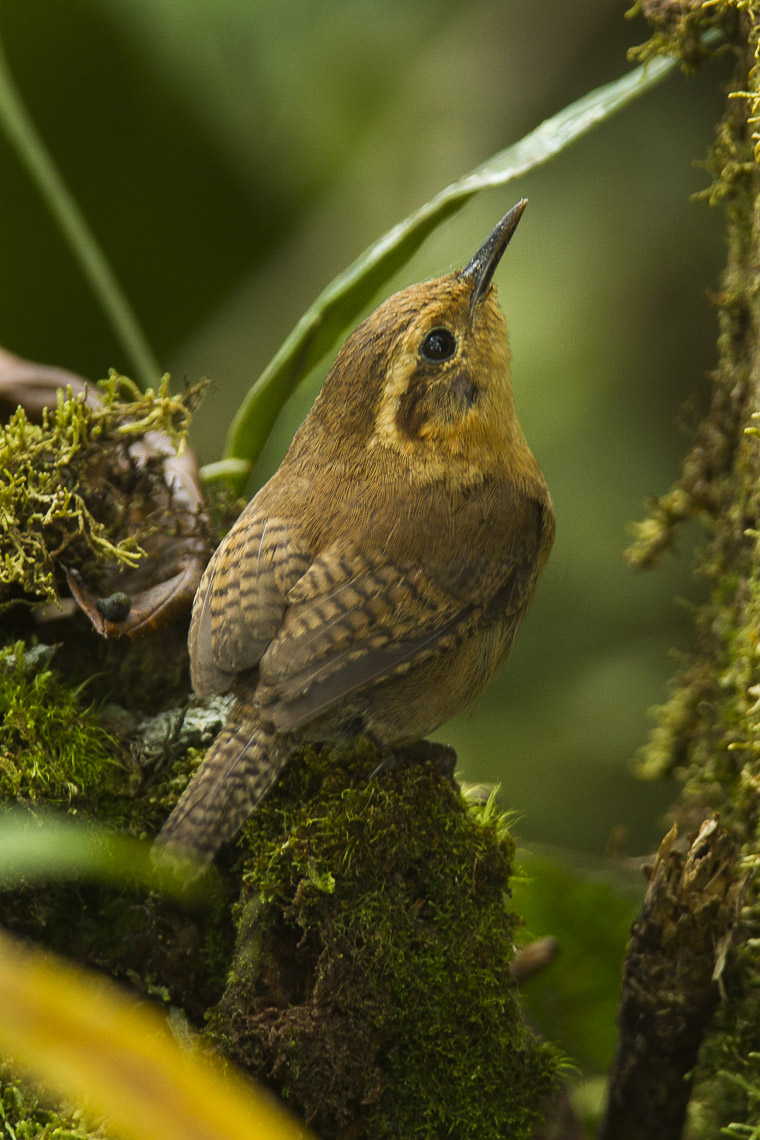 Mountain WrenTroglodytes solstitialis
Compare
Questions and answers
What is the scientific name of the Northern House Wren?
The scientific name of the Northern House Wren is Troglodytes aedon. Written with its author, the full name is Troglodytes aedon Vieillot, 1809.
Which family does the Northern House Wren belong to?
Troglodytes aedon belongs to the family Troglodytidae, in the order Passeriformes and the class Aves.
Where is the Northern House Wren found?
Checklists and occurrence records place Troglodytes aedon in 34 countries, including United States, Canada, Brazil, Colombia, Argentina and Costa Rica.
What is the conservation status of the Northern House Wren?
The IUCN Red List category recorded for Troglodytes aedon is Least Concern (LC).
What other names does the Northern House Wren have?
Troglodytes aedon is also known in English as House Wren.
Why are they called House Wrens?
The genus name Troglodytes means hole dweller and refers to the bird's habit of entering crevices. The species frequently occupies suburban backyards and human-made bird houses.[13][42]
What does a Northern House Wren eat?
It primarily eats small terrestrial insects. Adults and independent young consume mostly spiders, beetles, and bugs, while nestlings are primarily fed grasshoppers, crickets, and caterpillars.[17][18][19]
What is a wrens habitat?
Northern House Wrens inhabit open, shrubby woodlands, small woodlots, and forest edges. They also use suburban backyards and human-made bird houses. During winter, they occupy thickets, brushy areas, riparian forests, and savannas in the southern United States, as well as tropical evergreen and semideciduous forests in Mexico.[11][12][13][14][15]
Why are wrens called Troglodytes?
The genus name Troglodytes means hole dweller and refers to the bird's habit of entering crevices.[42]
Sources
Passages the profile rests on
- Adult birds have upperparts ranging from greyish-brown to reddish-brown and underparts ranging from brown to white. Source passage: “upper parts ranging from dull greyish-brown to rich rufescent-brown, and the underparts ranging from brown, over buff and pale grey, to pure white.” — English Wikipedia
- The wings and tail have blackish barring. Source passage: “All subspecies have blackish barring to the wings and tail” — English Wikipedia
- The short tail is typically held in an upright, cocked position. Source passage: “The short tail is typically held cocked.” — English Wikipedia
- Males and females have identical plumage coloration. Source passage: “Males and females are identical in coloration” — animaldiversity.org
- Adults measure approximately 11–13 cm in length. Source passage: “Adult northern house wrens are about 11 to 13 cm (4.3 to 5.1 in) long” — English Wikipedia
- The wingspan is approximately 15 cm. Source passage: “with a 15 cm (5.9 in) wingspan” — English Wikipedia
- Adults weigh approximately 10–12 g. Source passage: “House wrens are usually 11 to 13 cm long and weigh 10 to 12 g.” — animaldiversity.org
- The wing chord measures approximately 4.7–5.3 cm. Source passage: “the wing chord is 4.7 to 5.3 cm” — English Wikipedia
- The tail measures approximately 3.9–4.4 cm. Source passage: “the tail is 3.9 to 4.4 cm” — English Wikipedia
- The tarsus measures approximately 1.6–1.8 cm. Source passage: “the tarsus is 1.6 to 1.8 cm” — English Wikipedia
- The species inhabits open, shrubby woodlands and forest edges. Source passage: “In the wild, house wrens live in open, shrubby woodlands.” — animaldiversity.org
- Small woodlots and forest edges are commonly used habitats. Source passage: “Small wood-lots and forest edges are also common habitats for these birds.” — animaldiversity.org
- The species frequently occupies suburban backyards and human-made bird houses. Source passage: “they were named for their preference for small town and suburban backyards and human-made bird houses.” — animaldiversity.org
- During winter, birds use thickets, brushy areas, riparian forests, and savannas in the southern United States. Source passage: “During the winter, wrens live in thickets, shrubby and brushy areas, riparian forests, and savannas in the southern United States.” — animaldiversity.org
- In Mexico, the species uses tropical evergreen and semideciduous forests during winter. Source passage: “In Mexico, they prefer tropical evergreen and semideciduous forests.” — animaldiversity.org
- The species frequently nests in cavities created by woodpeckers. Source passage: “where it uses woodpecker holes as nesting sites.” — English Wikipedia
- The species primarily eats small terrestrial insects. Source passage: “House wrens feed primarily on small, terrestrial insects” — animaldiversity.org
- Adult and independent young birds consume mostly spiders, beetles, and bugs. Source passage: “The independent young and adults consume mostly spiders , beetles , and bugs” — animaldiversity.org
- Nestlings are primarily fed grasshoppers, crickets, and caterpillars. Source passage: “the nestlings are fed mostly grasshoppers , crickets , and caterpillars” — animaldiversity.org
- Adult birds commonly consume Hemiptera, including cicadas and leafhoppers. Source passage: “The most common diet in the adults were Hemiptera (cicadas, leafhoppers, etc)” — pages.vassar.edu
- Adults supplement their diet and their young's food with calcium sources such as mollusk shells. Source passage: “Adults feed their young and supplement their own diet with sources of calcium such as mollusk shells.” — animaldiversity.org
- The species is diurnal and migratory. Source passage: “They are diurnal and migratory.” — animaldiversity.org
- House wrens are highly territorial and commonly occur alone, in pairs, or in small family groups. Source passage: “House wrens are very territorial and are usually found alone, in pairs, or in small family groups.” — animaldiversity.org
- Males primarily defend territories by chasing intruders away. Source passage: “Males take primary responsibility for defending the territory and will chase away intruders.” — animaldiversity.org
- Both sexes produce songs and calls, although males have more complex songs. Source passage: “While both sexes produce calls and songs, the males' songs are more complex.” — animaldiversity.org
- Unmated males can sing continuously for as long as ten minutes. Source passage: “Unmated males can sing for up to 10 minutes.” — animaldiversity.org
- The species forages mainly in woodland subcanopies, shrubs, and herbaceous ground cover. Source passage: “House wrens forage primarily in the woodland subcanopy, in shrubs and among herbaceous ground cover.” — animaldiversity.org
- House wrens sometimes destroy the eggs of other birds nesting within their territories. Source passage: “They are known to occasionally destroy the eggs of other birds nesting in their territory by puncturing the eggshell.” — English Wikipedia
- House wrens generally form socially monogamous breeding pairs that share parental responsibilities. Source passage: “House wrens are socially monogamous, meaning that one male and one female mate together and share parental responsibilities.” — animaldiversity.org
- Approximately 10% of males in one study were polygynous. Source passage: “About 10% of the males in one study were polygynous.” — animaldiversity.org
- Breeding generally occurs between late April and early September. Source passage: “House wrens breed between late April and early September” — animaldiversity.org
- Females generally lay clutches of four to eight eggs, usually six. Source passage: “The female lays a clutch of 4 to 8 (usually 6) eggs” — animaldiversity.org
- Females incubate their eggs for approximately 12 days. Source passage: “which she incubates for about 12 days.” — animaldiversity.org
- Both parents feed the chicks, which generally fledge after 15–17 days. Source passage: “Both parents feed the chicks, which fledge after 15 to 17 days.” — animaldiversity.org
- Parents continue feeding their offspring for approximately 13 days after fledging. Source passage: “both parents continue to feed them for about 13 days.” — animaldiversity.org
- House wrens reach sexual maturity at approximately one year of age. Source passage: “House wrens are able to breed (have reached sexual maturity) when they are 1 year old” — animaldiversity.org
- The oldest recorded house wren lived for at least seven years. Source passage: “The oldest known house wren lived to be at least 7 years old.” — animaldiversity.org
- The northern house wren is not considered threatened by the IUCN. Source passage: “It is not considered threatened by the IUCN.” — English Wikipedia
- House wrens have benefited from forest fragmentation and other human-induced habitat changes. Source passage: “They have benefited from forest fragmentation and other human-induced habitat changes.” — animaldiversity.org
- House wrens help control insect populations. Source passage: “House wrens help to control insect populations.” — animaldiversity.org
- House wrens consume insects that humans may regard as pests. Source passage: “House wrens eat insects that may be considered to be pests by humans.” — animaldiversity.org
- The genus name Troglodytes means hole dweller and refers to the bird's habit of entering crevices. Source passage: “The name troglodytes means "hole dweller", and is a reference to the bird's tendency to disappear into crevices” — English Wikipedia
Data
- Catalogue of Life, 2026-10-16 XR cc by
- Global Biodiversity Information Facility CC BY 4.0
- Wikidata CC0
- GeoNames CC BY 4.0
- Wikimedia Commons per image; credit shown with each image
- Within the Catalogue of Life, this name comes from The Integrated Taxonomic Information System cc0
References
- Hist. Nat. Ois. Am. Sept., 2(1807): 52, pl. 107. 1808 where the name was published
- Banks, R. C., R. W. McDiarmid, and A. L. Gardner. (1987). Checklist of Vertebrates of the United States, the U.S. Territories, and Canada. Resource Publication, No. 166.
- Banks, R. C., R. W. McDiarmid, A. L. Gardner, and W. C. Starnes. (2003). Checklist of Vertebrates of the United States, the U.S. Territories, and Canada.
- Gill, Frank, & and Minturn Wright. (2006). Birds of the World: Recommended English Names.
This species in other databases
- Catalogue of Life 598SY
- Wikidata Q524799
- iNaturalist 7562
- WoRMS urn:lsid:marinespecies.org:taxname:1484608
- Avibase houwre
Page built on 26 November 2026. See how the catalog is made and all sources and licences.
Cite this page
ScientificNames.org. (2026). Troglodytes aedon (Northern House Wren). Retrieved November 26, 2026, from https://scientificnames.org/species/troglodytes-aedon
“Troglodytes aedon (Northern House Wren).” ScientificNames.org, 2026, scientificnames.org/species/troglodytes-aedon. Accessed 26 Nov. 2026.
ScientificNames.org. “Troglodytes aedon (Northern House Wren).” Accessed November 26, 2026. https://scientificnames.org/species/troglodytes-aedon.
@misc{scientificnames_troglodytes_aedon_northern_house_wren,
  author = {{ScientificNames.org}},
  title = {Troglodytes aedon (Northern House Wren)},
  year = {2026},
  url = {https://scientificnames.org/species/troglodytes-aedon},
  note = {Accessed 2026-11-26}
}