Species · Birds
Southern Chestnut-breasted Wren Cyphorhinus thoracicus
The scientific name of the Southern Chestnut-breasted Wren is Cyphorhinus thoracicus. It is a species of bird in the family Troglodytidae (wren), order Passeriformes. The name dates from 1844.
- Scientific name
- Cyphorhinus thoracicus Tschudi, 1844
- Common name
- Southern Chestnut-breasted Wren
- Genus
- Cyphorhinus
- Family
- Troglodytidae (Wren)
- Order
- Passeriformes
- Class
- Aves
- Red List category
- LC Least Concern
- Recorded in
- 4 countries
- Name status
- accepted in the Catalogue of Life

Overview
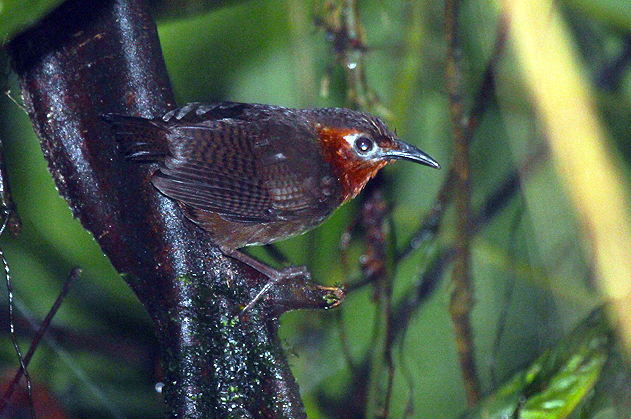
Cyphorhinus thoracicus occurs in southern Peru and the extreme northwest of Bolivia. It has a sooty black crown, a rich dark brown back and rump, and a deep orange-brown face, throat, and upper belly.
Written 27 November 2026 from the sources listed below. Each statement was checked against the passage it cites; statements that could not be supported were removed.
Appearance
Juveniles have a paler lower belly than adults. The species measures 11.5–15 cm in length and weighs 26.5–41 g.[1][2][3]
Habitat
The Southern Chestnut-breasted Wren inhabits wet montane forests, including cloud forests with abundant epiphytes and moss. It is mostly found at elevations between 1,200 and 2,700 m.[4][5]
In Peru's Manú Province, it occurs at elevations as low as 800 m.[6]
Diet
The species forages in leaf litter for invertebrates, including beetles and spiders.[7]
Behaviour
The species typically remains within one metre of the ground while foraging. It hunts alone, in pairs, or in presumed small family groups and only rarely joins mixed-species foraging flocks.[8][9][10]
The species' call is described as a low, somewhat frog-like and wooden sound.[11]
Reproduction and life cycle
The species has a regionally variable and generally prolonged nesting season. A photographed nest in Peru was a domed structure made mostly of live material and positioned very close to the ground.[12][13]
A documented nest in Peru contained two eggs.[14]
Conservation
The IUCN classifies the Southern Chestnut-breasted Wren as Least Concern. It is uncommon to locally common in Peru and rare to uncommon in Bolivia.[15][16][17]
The species occurs in several protected areas.[18]
Similar species
The Southern Chestnut-breasted Wren was formerly considered conspecific with the northern chestnut-breasted wren, Cyphorhinus dichrous. The southern and northern chestnut-breasted wrens are now recognized as separate taxa because of significant vocal differences despite minor plumage color differences.[19][20]
Classification of the Southern Chestnut-breasted Wren
| Kingdom | Animalia |
|---|---|
| Phylum | Chordata |
| Subphylum | Vertebrata |
| Infraphylum | Gnathostomata |
| Parvphylum | Osteichthyes |
| Megaclass | Tetrapoda |
| Class | Aves (Bird) |
| Order | Passeriformes (Passerine) |
| Family | Troglodytidae (Wren) |
| Genus | Cyphorhinus (Song Wrens) |
| Species | Cyphorhinus thoracicus Tschudi, 1844 |
Where the Southern Chestnut-breasted Wren is found
Checklists and occurrence records place Cyphorhinus thoracicus in 4 countries. GBIF holds 11,054 georeferenced records of it.
Countries
Regions and cities with the most records
- Valle del Cauca Department, Colombia 4,214
- Risaralda Department, Colombia 3,729
- Cali, Colombia 3,692
- Yumbo, Colombia 3,236
- Circasia, Colombia 1,834
- Dosquebradas, Colombia 1,497
- Pereira, Colombia 1,456
- Santa Rosa de Cabal, Colombia 1,454
- Belén de Umbría, Colombia 748
- Cuzco Department, Peru 653
- Chocó, Colombia 497
- Ciudad Bolívar, Colombia 456
- Anserma, Colombia 454
- Quinchía, Colombia 393
- Antioquia, Colombia 361
- Amazonas, Peru 360
- Darien, Colombia 217
- Napo, Ecuador 205
- Caldas Department, Colombia 192
- Jamundí, Colombia 158
- Andes, Colombia 140
- Chinchiná, Colombia 120
- Quindío Department, Colombia 110
- San Martín Department, Peru 108
- Riosucio, Colombia 103
- Huánuco Department, Peru 95
- Cauca Department, Colombia 90
- Villamaría, Colombia 85
- Manizales, Colombia 81
- Calarcá, Colombia 63
- Puerto Tejada, Colombia 57
- Frontino, Colombia 51
- Tolima Department, Colombia 48
- Candelaria, Colombia 47
- Florida, Colombia 47
- Miranda, Colombia 47
A number beside a place is its count of GBIF occurrence records. A place without a number comes from a checklist alone. Records show where a species has been observed or collected, which can include escapes and vagrants.
Common names
English
- Southern Chestnut-breasted Wren
- Chestnut-breasted Wren
Names in 24 other languages
- Catalan
- cargolet de pit castany
- Chinese
- 南栗胸歌鹪鹩, 栗胸歌鷦鷯
- Croatian
- narančastolici palčić
- Czech
- střízlík kaštanovoprsý
- Danish
- Brunbrystet Smutte
- Dutch
- Bruinborstwinterkoning, Zuidelijke Bruinborstwinterkoning
- Esperanto
- kaŝtanbrusta troglodito
- Finnish
- kastanjapeukaloinen
- French
- Troglodyte ferrugineux
- German
- Kastanienbrust-Zaunkönig, Kastanienbrustzaunkönig, Rostzaunkönig
- Hungarian
- barnamellű ökörszem
- Italian
- Scricciolo pettocastano
- Japanese
- クリムネウタミソサザイ
- Lithuanian
- kaštoninė storasnapė karietaitė
- Norwegian
- kastanjebrystsmett
- Polish
- strzyżoń andyjski
- Portuguese
- carriça-de-peito-castanho, uirapuru-ferruginoso, uirapuru-ferruginoso-do-sul
- Russian
- Каштановогрудый крапивник, Коричневогрудый толстоклювый крапивник
- Serbian
- Carić kestenjastih grudi
- Slovak
- oriešok hudobník
- Spanish
- Cucarachero dorsicastaño del sur, cucarachero pechicastaño
- Swedish
- drillgärdsmyg, kastanjebröstad gärdsmyg
- Turkish
- Kestane Göğüslü Çıtkuşu
- Ukrainian
- тріскопліт андійський
Synonyms
One other scientific name has been used for this species and is now treated as a synonym of Cyphorhinus thoracicus.
- Cyphorinus thoracicus thoracicus Tschudi, JJ, 1844
Subspecies and varieties
- Cyphorhinus thoracicus dichrous (Northern Chestnut-breasted Wren) subspecies
- Cyphorhinus thoracicus thoracicus subspecies
Related species
-
 Musician WrenCyphorhinus arada
-
 Song WrenCyphorhinus phaeocephalus
-
 Carolina WrenThryothorus ludovicianus
-
 Eurasian WrenTroglodytes troglodytes
-
 Cactus WrenCampylorhynchus brunneicapillus
-
 Northern House WrenTroglodytes aedon
-
 Bewick's WrenThryomanes bewickii
-
 Winter WrenTroglodytes hiemalis
Compare
Questions and answers
What is the scientific name of the Southern Chestnut-breasted Wren?
The scientific name of the Southern Chestnut-breasted Wren is Cyphorhinus thoracicus. Written with its author, the full name is Cyphorhinus thoracicus Tschudi, 1844.
Which family does the Southern Chestnut-breasted Wren belong to?
Cyphorhinus thoracicus belongs to the family Troglodytidae, in the order Passeriformes and the class Aves.
Where is the Southern Chestnut-breasted Wren found?
Checklists and occurrence records place Cyphorhinus thoracicus in 4 countries: Colombia, Peru, Ecuador and Bolivia.
What is the conservation status of the Southern Chestnut-breasted Wren?
The IUCN Red List category recorded for Cyphorhinus thoracicus is Least Concern (LC).
What other names does the Southern Chestnut-breasted Wren have?
Cyphorhinus thoracicus is also known in English as Chestnut-breasted Wren.
Sources
Passages the profile rests on
- The species measures 11.5–15 cm in length. Source passage: “11.5 to 15 cm (4.5 to 5.9 in) long” — English Wikipedia
- The species weighs 26.5–41 g. Source passage: “weighs 26.5 to 41 g (0.93 to 1.45 oz).” — English Wikipedia
- Juveniles have a paler lower belly than adults. Source passage: “The juvenile differs from the adult in having a paler lower belly.” — English Wikipedia
- The species inhabits wet montane forests, including cloud forests with abundant epiphytes and moss. Source passage: “It inhabits wet montane forest including cloud forest with abundant epiphytes and moss.” — English Wikipedia
- The species is mostly found at elevations between 1,200 and 2,700 m. Source passage: “It is mostly found between 1,200 and 2,700 m (3,900 and 8,900 ft)” — English Wikipedia
- In Peru's Manú Province, the species occurs at elevations as low as 800 m. Source passage: “but down to 800 m (2,600 ft) in Peru's Manú Province.” — English Wikipedia
- The species forages in leaf litter for invertebrates, including beetles and spiders. Source passage: “foraging in leaf litter for invertebrates such as beetles and spiders.” — English Wikipedia
- The species typically remains within one metre of the ground while foraging. Source passage: “typically remains within 1 m (3.3 ft) of the ground,” — English Wikipedia
- The species hunts alone, in pairs, or in presumed small family groups. Source passage: “It hunts alone, in pairs, or in what are assumed to be small family groups.” — English Wikipedia
- The species only rarely joins mixed-species foraging flocks. Source passage: “It only rarely joins mixed-species foraging flocks.” — English Wikipedia
- The species' call is described as a low, somewhat frog-like and wooden sound. Source passage: “a low, somewhat frog-like and wooden 'krol'” — English Wikipedia
- The species has a regionally variable and generally prolonged nesting season. Source passage: “Its nesting season appears to differ regionally; overall it is protracted.” — English Wikipedia
- A photographed nest in Peru was a domed structure made mostly of live material and positioned very close to the ground. Source passage: “it was a domed structure of mostly live material set very close to the ground.” — English Wikipedia
- A documented nest in Peru contained two eggs. Source passage: “It contained two eggs.” — English Wikipedia
- The IUCN classifies the species as Least Concern. Source passage: “The IUCN treats the southern chestnut-breasted wren as being of Least Concern.” — English Wikipedia
- The species is uncommon to locally common in Peru. Source passage: “uncommon to locally common in Peru,” — English Wikipedia
- The species is rare to uncommon in Bolivia. Source passage: “and rare to uncommon in Bolivia.” — English Wikipedia
- The species occurs in several protected areas. Source passage: “It does occur in several protected areas.” — English Wikipedia
- The species was formerly considered conspecific with the northern chestnut-breasted wren, Cyphorhinus dichrous. Source passage: “The southern chestnut-breasted wren was formerly treated as conspecific with the northern chestnut-breasted wren (Cyphorhinus dichrous)” — English Wikipedia
- The southern and northern chestnut-breasted wrens are now recognized as separate taxa because of significant vocal differences despite minor plumage color differences. Source passage: “The two taxa are now split based on the significant vocal differences despite the minor difference in the color of the plumage.” — English Wikipedia
Data
- Catalogue of Life, 2026-10-16 XR cc by
- Global Biodiversity Information Facility CC BY 4.0
- Wikidata CC0
- GeoNames CC BY 4.0
- Wikimedia Commons per image; credit shown with each image
- Within the Catalogue of Life, this name comes from The Integrated Taxonomic Information System cc0
References
- Gill, Frank, & and Minturn Wright. (2006). Birds of the World: Recommended English Names.
This species in other databases
Page built on 27 November 2026. See how the catalog is made and all sources and licences.
Cite this page
ScientificNames.org. (2026). Cyphorhinus thoracicus (Southern Chestnut-breasted Wren). Retrieved November 27, 2026, from https://scientificnames.org/species/cyphorhinus-thoracicus
“Cyphorhinus thoracicus (Southern Chestnut-breasted Wren).” ScientificNames.org, 2026, scientificnames.org/species/cyphorhinus-thoracicus. Accessed 27 Nov. 2026.
ScientificNames.org. “Cyphorhinus thoracicus (Southern Chestnut-breasted Wren).” Accessed November 27, 2026. https://scientificnames.org/species/cyphorhinus-thoracicus.
@misc{scientificnames_cyphorhinus_thoracicus_southern_chestnut_breasted_wren,
  author = {{ScientificNames.org}},
  title = {Cyphorhinus thoracicus (Southern Chestnut-breasted Wren)},
  year = {2026},
  url = {https://scientificnames.org/species/cyphorhinus-thoracicus},
  note = {Accessed 2026-11-27}
}