Species · Spiders and other arachnids
Winter Tick Dermacentor albipictus
The scientific name of the Winter Tick is Dermacentor albipictus. It is a species of arachnid in the family Ixodidae (hard ticks), order Ixodida. The name dates from 1869.
- Scientific name
- Dermacentor albipictus Packard, 1869
- Common name
- Winter Tick
- Genus
- Dermacentor
- Family
- Ixodidae (Hard Ticks)
- Order
- Ixodida
- Class
- Arachnida
- Recorded in
- 4 countries
- Name status
- accepted in the Catalogue of Life

Overview
Winter ticks occur throughout North America. Adult females have reddish-brown bodies and patterned dorsal shields, while adult males have dark brown bodies with white markings.
Written 26 November 2026 from the sources listed below. Each statement was checked against the passage it cites; statements that could not be supported were removed.
Appearance
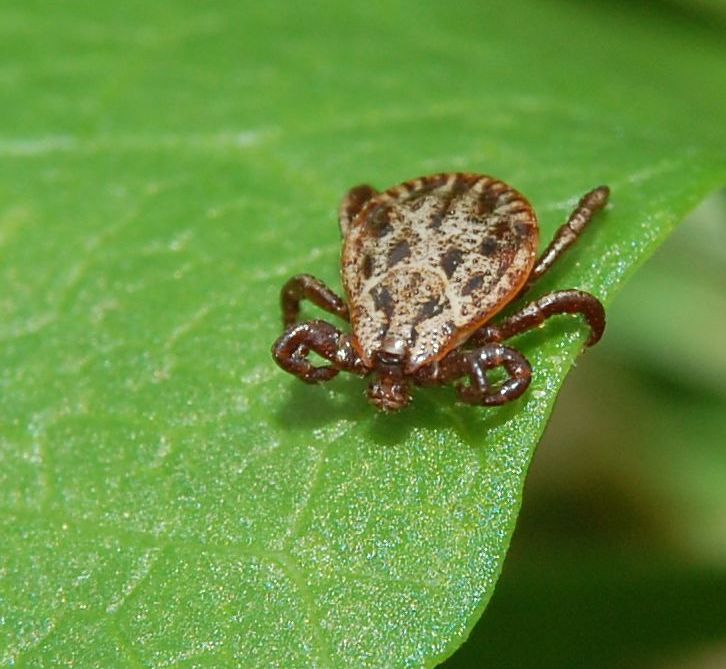
Adult female Winter ticks are predominantly reddish-brown and have a white dorsal shield behind the head. Their dorsal shields are patterned, and their elongated oval bodies are widest near the spiracles and narrow toward the scapulae.[1][2][3]
Adult males are dark brown with white markings, commonly including cream-colored crosshatching or swirl patterns on their backs. Their teardrop-shaped bodies have narrower front halves and broader rear portions.[4][5][6]
The coloration of male and female Winter ticks is typically brown with gray patterning. Unfed larvae have nearly circular bodies.[7][8]
Habitat
Winter ticks are frequently found in habitats occupied by moose. They prefer vegetation no taller than approximately 1.25 m when locating hosts.[9][10]
Larval groups remain inactive during summer at the soil-vegetation surface.[11]
Diet
Winter ticks obtain blood meals from a single host animal throughout their life cycle. Primary host species include cattle, horses, mules, deer, elk, and moose.[12][13]
Dogs, feral swine, and humans have occasionally been recorded as hosts.[14]
Behaviour
Winter ticks are one-host parasites that complete their feeding development on a single animal. Feeding is generally completed within 21–28 days.[15][16]
Winter ticks can feed simultaneously at different developmental stages on the same host. They can infest the axillaries, dewlap, escutcheon, and udder or scrotum regions.[17][18]
Reproduction and life cycle
Fully engorged female Winter ticks detach from their hosts in late winter or early spring to lay eggs. A female can lay as many as 3,000 eggs.[19][20]
Female Winter ticks lay eggs on the ground during midsummer. The eggs hatch from late summer into fall.[21][22]
Adult male Winter ticks remain on their original host and die there rather than detaching to reproduce.[23]
Conservation
Severe Winter tick infestations can cause anemia, hair loss, emaciation, and death in ungulate hosts. Severe infestations can cause the death of moose.[24][25]
Warmer autumn temperatures and delayed snowfall can extend larval host-seeking activity and potentially increase tick abundance. Elk may act as reservoirs that contribute to Winter tick population dynamics and indirectly compete with moose.[26][27]
Similar species
The tropical horse tick, Dermacentor (Anocentor) nitens, resembles the Winter tick in appearance and also has a one-host life cycle. The American dog tick, Dermacentor variabilis, can be confused with patterned adult Winter ticks.[28][29]
Classification of the Winter Tick
| Kingdom | Animalia |
|---|---|
| Phylum | Arthropoda |
| Subphylum | Chelicerata |
| Class | Arachnida (Arachnid) |
| Superorder | Parasitiformes |
| Order | Ixodida (Tick) |
| Family | Ixodidae (Hard Ticks) |
| Genus | Dermacentor (Hard Tick) |
| Species | Dermacentor albipictus Packard, 1869 |
Where the Winter Tick is found
Checklists and occurrence records place Dermacentor albipictus in 4 countries across North America. GBIF holds 2,994 georeferenced records of it.
Countries
Regions and cities with the most records
- Illinois, United States 229
- Marion, United States 42
- East Peoria, United States 38
- Morton, United States 38
- North Peoria, United States 38
- Pekin, United States 38
- Peoria, United States 38
- Washington, United States 38
- Iowa, United States 32
- Texas, United States 29
- Utah, United States 29
- Macomb, United States 26
- Alberta, Canada 25
- California, United States 19
- Ontario, Canada 15
- Wisconsin, United States 11
- Burlington, United States 9
- Maine, United States 9
- New Mexico, United States 9
- Albany, United States 8
- Berkeley, United States 8
- El Cerrito, United States 8
- Lafayette, United States 8
- Orinda, United States 8
- Richmond, United States 8
- Alameda, United States 7
- Missouri, United States 7
- Moraga, United States 7
- Oakland, United States 7
- Walnut Creek, United States 7
- Yukon, Canada 7
- Loves Park, United States 6
- Machesney Park, United States 6
- Minnesota, United States 6
- Pleasant Hill, United States 6
- Rockford, United States 6
Range as the checklists state it
United States, Guatemala, Mexico
A number beside a place is its count of GBIF occurrence records. A place without a number comes from a checklist alone. Records show where a species has been observed or collected, which can include escapes and vagrants.
Common names
English
- Winter Tick
- Elk Tick
- Moose Tick
- White Fern Winter Tick
Names in 2 other languages
- Czech
- piják losí
- French
- Tique de l'orignal, Tique du wapiti
Synonyms
15 other scientific names have been used for this species and are now treated as synonyms of Dermacentor albipictus.
- Cynorhaestes albipictus Schulze, 1929
- Dermacentor (Americentor) albipictus Santos Dias, 1963
- Dermacentor albipictus kamtschadalus Filippova, 1984
- Dermacentor erraticus albipictus Bequaert, 1946
- Dermacentor kamtschadalus Emel'yanova, 1966
- Dermacentor nigrolineatus Packard, 1869
- Dermacentor salmoni Stiles, 1910
- Dermacentor variegatus Marx & Neumann, 1897
- Dermacentor varius Schulze, 1933
- Ixodes albipictus Packard, 1869
- Ixodes oregonensis Stiles, 1910
- Dermacentor albipictus kamshadalus Arthur, 1960 misapplied
- Dermacentor variegatus kamshadalus Arthur, 1960 misapplied
- Dermacentor variegatus kamtschadalus Olenev, 1931 misapplied
- Dermacentor varius kamtschadalus Schulze, 1933 misapplied
Related species
-
 American Dog TickDermacentor variabilis
-
 Marsh TickDermacentor reticulatus
-
 Elephant TickDermacentor circumguttatus
-
 Pacific Coast TickDermacentor occidentalis
- Western Dog TickDermacentor similis
-
 Ornate Sheep TickDermacentor marginatus
-
 Rhinoceros TickDermacentor rhinocerinus
- Dermacentor nuttalli
Compare
Questions and answers
What is the scientific name of the Winter Tick?
The scientific name of the Winter Tick is Dermacentor albipictus. Written with its author, the full name is Dermacentor albipictus Packard, 1869.
Which family does the Winter Tick belong to?
Dermacentor albipictus belongs to the family Ixodidae, in the order Ixodida and the class Arachnida.
Where is the Winter Tick found?
Checklists and occurrence records place Dermacentor albipictus in 4 countries: United States, Canada, Mexico and Guatemala.
What other names does the Winter Tick have?
Dermacentor albipictus is also known in English as Elk Tick, Moose Tick and White Fern Winter Tick.
What type of habitat do ticks live in?
Winter ticks are frequently found in habitats occupied by moose. They prefer vegetation no taller than approximately 1.25 m for locating hosts.[9][10]
Sources
Passages the profile rests on
- Adult female ticks are predominantly reddish-brown and have a white dorsal shield behind the head. Source passage: “The adult female is mostly reddish-brown, but with a white dorsal shield behind the head.” — English Wikipedia
- Adult females are generally reddish-brown and have a patterned dorsal shield. Source passage: “Adult females are reddish brown with a patterned dorsal shield” — extension.psu.edu
- Unfed female ticks have elongated oval bodies that are widest near the spiracles and narrow toward the scapulae. Source passage: “Bodies of unfed females are oval and elongated in shape, widest across the spiracles and narrowing gradually towards the scapulae.” — tickapp.tamu.edu
- Adult males are dark brown and have white markings. Source passage: “The smaller adult male is dark brown with some white markings.” — English Wikipedia
- Adult males commonly have cream-colored crosshatching or swirl patterns on their backs. Source passage: “In most areas, winter tick males are highly patterned with cream crosshatching or swirls on the back” — extension.psu.edu
- Adult male ticks have teardrop-shaped bodies with narrower front halves and broader rear portions. Source passage: “Bodies of adult males are teardrop shaped; the front half of male ticks is narrower than the broader shaped rear portion” — tickapp.tamu.edu
- Unfed larvae have a nearly circular body shape. Source passage: “Unfed larvae are sub-circular in shape” — tickapp.tamu.edu
- The coloration of male and female winter ticks is typically brown with gray patterning. Source passage: “Coloration among males and females is typically brown with gray color patterning.” — tickapp.tamu.edu
- Winter ticks are frequently found in habitats occupied by moose. Source passage: “While it can be found in several different habitats, it is often located in areas with a presence of moose.” — English Wikipedia
- Winter ticks prefer vegetation no taller than approximately 1.25 m for locating hosts. Source passage: “The tick prefers vegetation up to 1.25 m in height, for ease of finding a host.” — English Wikipedia
- Larval groups remain inactive during summer at the soil-vegetation surface. Source passage: “Hatching larval groups in spring remain inactive over summer (a process called aestivation at the soil-vegetation surface” — tickapp.tamu.edu
- Winter ticks obtain their blood meals from a single host animal throughout their life cycle. Source passage: “meaning that this species takes all the blood meals it requires throughout its lifetime from one host animal.” — extension.psu.edu
- Primary host species include cattle, horses, mules, deer, elk, and moose. Source passage: “Cattle, horses, mules, deer, elk, and moose are primary hosts” — tickapp.tamu.edu
- Dogs, feral swine, and humans have occasionally been recorded as hosts. Source passage: “but infrequent collections from dogs, feral swine, and humans have been recorded.” — tickapp.tamu.edu
- Winter ticks are one-host parasites that complete their feeding development on a single animal. Source passage: “Winter ticks (Dermacentor albipictus) are an aggressive one-host tick that infest a wide-diversity of ungulates.” — pmc.ncbi.nlm.nih.gov
- Feeding by winter ticks is generally completed within 21–28 days. Source passage: “feeding is generally completed in 21-28 days.” — tickapp.tamu.edu
- Winter ticks can feed simultaneously at different developmental stages on the same host. Source passage: “All stages may be found feeding on individual hosts at the same time” — tickapp.tamu.edu
- Winter ticks can infest the axillaries, dewlap, escutcheon, and udder or scrotum regions of their hosts. Source passage: “the axillaries, dewlap, escutcheon, and udder/scrotum regions most often infested.” — tickapp.tamu.edu
- Fully engorged females detach from their hosts in late winter or early spring to lay eggs. Source passage: “it falls off the host in late winter to early spring into the leaf litter and lays its eggs” — English Wikipedia
- A female winter tick can lay as many as 3,000 eggs. Source passage: “lays its eggs in mass of up to 3,000.” — English Wikipedia
- Female winter ticks lay eggs on the ground during midsummer. Source passage: “Female ticks lay eggs on the ground in midsummer” — extension.psu.edu
- Winter tick eggs hatch from late summer into fall. Source passage: “and the eggs hatch in late summer into the fall.” — extension.psu.edu
- Adult male winter ticks remain on their original host and die there rather than detaching to reproduce. Source passage: “The male ticks live their entire nymph to adult lives on the single host, never falling off to reproduce like the female; they die on the host.” — English Wikipedia
- Severe winter tick infestations can cause the death of moose. Source passage: “In recent years, heavy infestations up to 150,000 ticks have been seen on single moose, which can lead to the death of the animal.” — English Wikipedia
- Severe winter tick infestations can cause anemia, hair loss, emaciation, and death in ungulate hosts. Source passage: “Infestations can result in anemia, alopecia, emaciation, and death.” — pmc.ncbi.nlm.nih.gov
- Warmer autumn temperatures and delayed snowfall can extend larval host-seeking activity and potentially increase tick abundance. Source passage: “Warmer temperatures in Autumn months and delays in snow fall extend time larval winter ticks can quest, potentially increasing their abundance on ungulates.” — pmc.ncbi.nlm.nih.gov
- Elk may act as reservoirs that contribute to winter tick population dynamics and indirectly compete with moose. Source passage: “elk may be critical drivers of winter tick population dynamics and indirectly compete with moose” — usgs.gov
- The tropical horse tick, Dermacentor (Anocentor) nitens, resembles the winter tick in appearance and also has a one-host life cycle. Source passage: “The tropical horse tick, Dermacentor (Anocentor) nitens is a one-host tick species similar in appearance” — tickapp.tamu.edu
- The American dog tick, Dermacentor variabilis, can be confused with patterned adult winter ticks. Source passage: “Patterned adults may be confused for another common species in this genus, the American dog tick (Dermacentor variabilis; Figure 2)” — extension.psu.edu
- Winter ticks occur throughout North America. Source passage: “The tick can be found all across North America” — English Wikipedia
- The winter tick's North American range extends from Alaska through Canada, Mexico, and Central America. Source passage: “In North America, the winter tick ranges from Alaska through Canada, Mexico and Central America.” — tickapp.tamu.edu
Data
- Catalogue of Life, 2026-10-16 XR cc by
- Global Biodiversity Information Facility CC BY 4.0
- Wikidata CC0
- GeoNames CC BY 4.0
- Wikimedia Commons per image; credit shown with each image
- Within the Catalogue of Life, this name comes from TicksBase cc by
References
- Packard, A. S. (1869) Report of the curator of Articulata. First Annual Report of the Trustees of the Peabody Academy of Sciences, pp. 56 - 69. where the name was published
This species in other databases
Page built on 27 November 2026. See how the catalog is made and all sources and licences.
Cite this page
ScientificNames.org. (2026). Dermacentor albipictus (Winter Tick). Retrieved November 27, 2026, from https://scientificnames.org/species/dermacentor-albipictus
“Dermacentor albipictus (Winter Tick).” ScientificNames.org, 2026, scientificnames.org/species/dermacentor-albipictus. Accessed 27 Nov. 2026.
ScientificNames.org. “Dermacentor albipictus (Winter Tick).” Accessed November 27, 2026. https://scientificnames.org/species/dermacentor-albipictus.
@misc{scientificnames_dermacentor_albipictus_winter_tick,
  author = {{ScientificNames.org}},
  title = {Dermacentor albipictus (Winter Tick)},
  year = {2026},
  url = {https://scientificnames.org/species/dermacentor-albipictus},
  note = {Accessed 2026-11-27}
}