Species · Spiders and other arachnids
Marsh Tick Dermacentor reticulatus
The scientific name of the Marsh Tick is Dermacentor reticulatus. It is a species of arachnid in the family Ixodidae (hard ticks), order Ixodida. The name dates from 1794.
- Scientific name
- Dermacentor reticulatus Fabricius, 1794
- Common name
- Marsh Tick
- Genus
- Dermacentor
- Family
- Ixodidae (Hard Ticks)
- Order
- Ixodida
- Class
- Arachnida
- Recorded in
- 27 countries
- Name status
- accepted in the Catalogue of Life
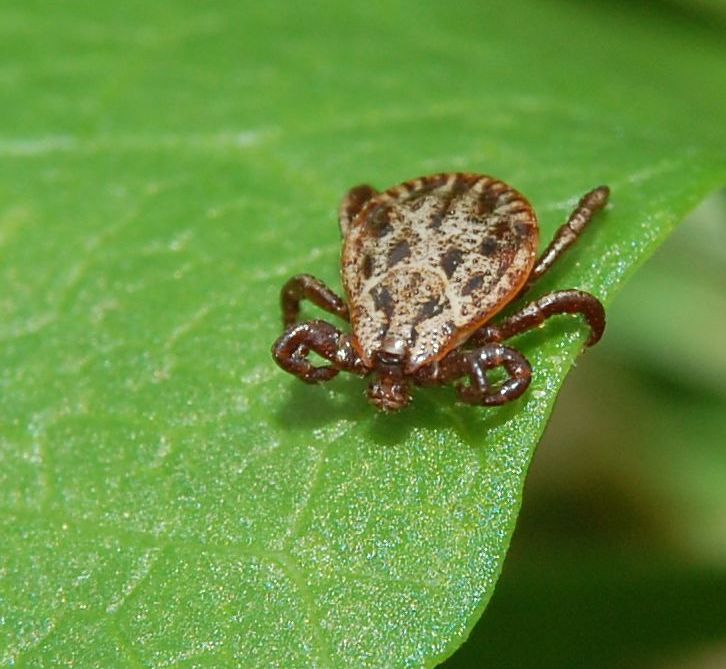
Overview
The Marsh Tick is an ornate tick in the family Ixodidae, order Ixodida, and class Arachnida. It occurs in Europe and Western Asia. It has a three-host development cycle and acts as a vector of Babesia canis, Francisella tularensis, and several Rickettsia species.
Written 26 November 2026 from the sources listed below. Each statement was checked against the passage it cites; statements that could not be supported were removed.
Appearance
The Marsh Tick is an ornate tick. Unfed females measure 3.8–4.2 mm in length, while engorged females can reach 10 mm. Unfed males measure 4.2–4.8 mm in length.[1][2][3][4]
Habitat
Immature stages probably remain in animal burrows, nests, or their immediate surroundings.[5]
Behaviour
The Marsh Tick combines nest-questing and pasture-questing strategies depending on its developmental stage. Larvae and nymphs exhibit nest-questing behaviour, while adults exhibit pasture-questing behaviour.[6][7][8]
The highest abundance and activity of immature stages occur during summer. Larvae most frequently attack their hosts in June, and nymphs remain active for approximately one month during July and August.[9][10][11]
Adults in Central Europe remain active throughout the year except during frosty winter weather with snow cover. During winter, the species enters a hormonally regulated diapause with reduced metabolic activity, and adults resume activity when temperatures become positive.[12][13][14]
Adult activity has a spring peak in March or April following winter diapause and a second peak in September and October.[15][16]
Adult ticks wait for hosts on grass or weeds at an average height of up to 55 cm. They are highly sensitive to the smell of potential hosts.[17][18]
Adult females are more aggressive and determined to find hosts than adult males. Adult ticks can remain in their habitat for extended periods and undertake repeated host-seeking activities.[19][20]
Reproduction and life cycle
The Marsh Tick has a three-host development cycle. Adult females remain attached to a host for 9–15 days and can lay between 3,000 and 4,500 eggs, with the number depending on the female's size.[21][22][23][24]
Larvae hatch from eggs after 14–21 days. Engorged larvae moult and produce a new generation of nymphs within a month.[25][26]
Diet
Immature stages usually feed on small rodents and less frequently on birds. Adult ticks most frequently attack medium-sized and large mammals.[27][28][29]
Classification of the Marsh Tick
| Kingdom | Animalia |
|---|---|
| Phylum | Arthropoda |
| Subphylum | Chelicerata |
| Class | Arachnida (Arachnid) |
| Superorder | Parasitiformes |
| Order | Ixodida (Tick) |
| Family | Ixodidae (Hard Ticks) |
| Genus | Dermacentor (Hard Tick) |
| Species | Dermacentor reticulatus Fabricius, 1794 |
Where the Marsh Tick is found
Checklists and occurrence records place Dermacentor reticulatus in 27 countries across Europe. GBIF holds 8,633 georeferenced records of it.
Countries
- Austria 434
- Belarus 66
- Belgium 2,052
- Bosnia and Herzegovina 5
- Bulgaria 8
- Croatia 46
- Czechia 59
- France 669
- Germany 875
- Hungary 212
- Italy 32
- Latvia 37
- Lithuania 146
- Luxembourg 759
- Moldova 4
- Poland 375
- Portugal 26
- Romania 48
- Russia 1,588
- Serbia 10
- Slovakia 97
- Spain 200
- Sweden 6
- Switzerland 14
- The Netherlands 260
- Ukraine 253
- United Kingdom 352
Regions and cities with the most records
- Coudekerque-Branche, France 2,030
- Dunkirk, France 2,030
- Koksijde, Belgium 2,030
- Saint-Pol-sur-Mer, France 2,030
- Grande-Synthe, France 2,027
- Luxembourg, Luxembourg 697
- Dudelange, Luxembourg 493
- Luxembourg, Luxembourg 474
- Esch-sur-Alzette, Luxembourg 301
- Lower Austria, Austria 293
- Grevenmacher, Luxembourg 281
- Kursk Oblast, Russia 246
- Thionville, France 241
- Malacky, Slovakia 194
- Moscow Oblast, Russia 177
- England, United Kingdom 165
- Centre-Val de Loire, France 158
- Yutz, France 158
- Saxony-Anhalt, Germany 139
- Chelyabinsk, Russia 133
- Saxony, Germany 126
- Burgenland, Austria 112
- Barnstaple, United Kingdom 111
- Bideford, United Kingdom 111
- Brandenburg, Germany 107
- Île-de-France, France 92
- Wales, United Kingdom 91
- Zheleznogorsk, Russia 91
- Heemskerk, The Netherlands 88
- Castricum, The Netherlands 87
- Lower Saxony, Germany 87
- Bergen, The Netherlands 86
- Heiloo, The Netherlands 86
- Hesse, Germany 86
- Krommenie, The Netherlands 86
- Alkmaar, The Netherlands 85
4 more countries have a few records outside this range
These countries hold a few records of Dermacentor reticulatus but lie outside the range the checklists give for it. Such records are often zoo or garden specimens, museum material or vagrants, so the species is not counted as occurring there.
Range as the checklists state it
Spain, France, Portugal
A number beside a place is its count of GBIF occurrence records. A place without a number comes from a checklist alone. Records show where a species has been observed or collected, which can include escapes and vagrants.
Common names
English
- Marsh Tick
- Meadow Tick
- Ornate Cow Tick
- Ornate Dog Tick
Names in 16 other languages
- Chinese
- 網紋革蜱
- Czech
- piják lužní
- Danish
- Engflåt
- Dutch
- Vlekkenteek
- French
- Ixode réticulé
- German
- Auwaldzecke, Auzecke, Buntzecke, Kuhzecke, Wiesenzecke, Winterzecke
- Hungarian
- kutyakullancs
- Italian
- Zecca degli acquitrini
- Korean
- 그물무늬광대참진드기
- Latvian
- Ornamentētā pļavērce
- Lithuanian
- Pievinė erkė
- Polish
- Kleszcz łąkowy
- Russian
- Луговой клещ
- Slovak
- pijak lužný
- Swedish
- brokig hundfästing
- Ukrainian
- Кліщ лучний
Synonyms
13 other scientific names have been used for this species and are now treated as synonyms of Dermacentor reticulatus.
- Acarus reticulatus Fabricius, 1794
- Cynorhaestes pictus Hermann, 1804
- Dermacentor (Dermacentor) reticulatus Camicas et al., 1998
- Dermacentor ferrugineus Koch, 1844
- Dermacentor pardalinus Koch, 1844
- Dermacentor pictus Schulze, 1933
- Dermacentor reticulatus reticulatus Neumann, 1911
- Ixodes pictus Gervais, 1844
- Ixodes reticulatus Fabricius, 1805
- Dermacentor (Dermacentorites) marginatus Olenev, 1931 misapplied
- Dermacentor reticularis Anderson, 1909 misapplied
- Ixodes holsatus Klenati, 1857 misapplied
- Ixodes marmoratus Mégnin, 1880 misapplied
Related species
-
 American Dog TickDermacentor variabilis
-
 Winter TickDermacentor albipictus
-
 Elephant TickDermacentor circumguttatus
-
 Pacific Coast TickDermacentor occidentalis
- Western Dog TickDermacentor similis
-
 Ornate Sheep TickDermacentor marginatus
-
 Rhinoceros TickDermacentor rhinocerinus
- Dermacentor nuttalli
Compare
Questions and answers
What is the scientific name of the Marsh Tick?
The scientific name of the Marsh Tick is Dermacentor reticulatus. Written with its author, the full name is Dermacentor reticulatus Fabricius, 1794.
Which family does the Marsh Tick belong to?
Dermacentor reticulatus belongs to the family Ixodidae, in the order Ixodida and the class Arachnida.
Where is the Marsh Tick found?
Checklists and occurrence records place Dermacentor reticulatus in 27 countries, including Belgium, Russia, Germany, Luxembourg, France and Austria.
What other names does the Marsh Tick have?
Dermacentor reticulatus is also known in English as Meadow Tick, Ornate Cow Tick and Ornate Dog Tick.
Where are Dermacentor ticks found?
The Marsh Tick occurs in Europe and Western Asia.[30]
Sources
Passages the profile rests on
- Dermacentor reticulatus is an ornate tick. Source passage: “Dermacentor reticulatus is an ornate tick.” — English Wikipedia
- Unfed females measure 3.8–4.2 mm in length. Source passage: “The female varies in size from 3.8–4.2 mm (unfed)” — English Wikipedia
- Engorged females can reach 10 mm in length. Source passage: “to 10 mm when engorged after feeding.” — English Wikipedia
- Unfed males measure 4.2–4.8 mm in length. Source passage: “The unfed male is 4.2–4.8 mm long.” — English Wikipedia
- Immature stages probably remain in animal burrows, nests, or their immediate surroundings. Source passage: “probably stay permanently in their burrows/nests or in their immediate vicinity.” — pmc.ncbi.nlm.nih.gov
- The species combines nest-questing and pasture-questing strategies depending on its developmental stage. Source passage: “Some tick species, e.g., Dermacentor reticulatus, combine the characteristics of both groups described above in their host-seeking strategy, depending on their developmental stage.” — pmc.ncbi.nlm.nih.gov
- Larvae and nymphs exhibit nest-questing behaviour. Source passage: “Larvae and nymphs of this species are characterised by the “nest-questing” behaviour.” — pmc.ncbi.nlm.nih.gov
- Adult ticks exhibit pasture-questing behaviour. Source passage: “Adult stages of D. reticulatus species exhibit the “pasture-questing” behaviour” — pmc.ncbi.nlm.nih.gov
- The highest abundance and activity of immature stages occur during summer. Source passage: “The highest number and activity of immature stages of this species are observed in summer.” — pmc.ncbi.nlm.nih.gov
- Larvae most frequently attack their hosts in June. Source passage: “Larvae most often attack their hosts in June” — pmc.ncbi.nlm.nih.gov
- Nymphs remain active for approximately one month during July and August. Source passage: “At this stage, D. reticulatus individuals remain active only for one month (July-August)” — pmc.ncbi.nlm.nih.gov
- Adults in Central Europe remain active throughout the year except during frosty winter weather with snow cover. Source passage: “In Central Europe, adults are active throughout the year, with the exception of winter in frosty weather and the presence of snow cover” — pmc.ncbi.nlm.nih.gov
- During winter, the species enters a hormonally regulated diapause with reduced metabolic activity. Source passage: “In wintertime, ornate cow ticks enter the hormonally regulated diapause stage with minimised metabolic activity.” — pmc.ncbi.nlm.nih.gov
- Adults resume activity when temperatures become positive. Source passage: “With the return of positive temperatures, they become active again.” — pmc.ncbi.nlm.nih.gov
- The species has a spring activity peak in March or April following winter diapause. Source passage: “The spring peak is mainly a consequence of the emergence of adults after winter diapause in March or April.” — pmc.ncbi.nlm.nih.gov
- A second adult activity peak occurs in September and October. Source passage: “The next peak is observed in autumn (September-October)” — pmc.ncbi.nlm.nih.gov
- Adult ticks wait for hosts on grass or weeds at an average height of up to 55 cm. Source passage: “D. reticulatus adults wait for their hosts on vegetation, mainly on grass or weeds, after climbing to an average height up to 55 cm.” — pmc.ncbi.nlm.nih.gov
- Adults are highly sensitive to the smell of potential hosts. Source passage: “They are very sensitive to the smell of potential hosts” — pmc.ncbi.nlm.nih.gov
- Adult females are more aggressive and determined to find hosts than adult males. Source passage: “D. reticulatus females proved to be more aggressive and determined to find a host than the males of this species.” — pmc.ncbi.nlm.nih.gov
- Adult ticks can remain in their habitat for extended periods and undertake repeated host-seeking activities. Source passage: “Adult D. reticulatus ticks are able to stay in the habitat for a long time and undertake multiple host-seeking activities.” — pmc.ncbi.nlm.nih.gov
- The species has a three-host development cycle. Source passage: “Dermacentor reticulatus has a three-host development cycle.” — English Wikipedia
- Adult females remain attached to a host for 9–15 days. Source passage: “The adult female remains on a host for 9–15 days” — English Wikipedia
- Adult females can lay between 3,000 and 4,500 eggs. Source passage: “can lay 3000–4500 eggs” — English Wikipedia
- The number of eggs laid depends on the female's size. Source passage: “although the total number of eggs depends on the size of the female.” — English Wikipedia
- Larvae hatch from eggs after 14–21 days. Source passage: “The larva hatches from the egg in 14–21 days.” — English Wikipedia
- Engorged larvae moult and produce a new generation of nymphs within a month. Source passage: “Engorged larvae moult, thus producing a new generation of nymphs within a month.” — pmc.ncbi.nlm.nih.gov
- Immature stages usually feed on small rodents. Source passage: “They usually feed on small rodents” — pmc.ncbi.nlm.nih.gov
- Immature stages feed less frequently on birds. Source passage: “or, less frequently, on birds” — pmc.ncbi.nlm.nih.gov
- Adult ticks most frequently attack medium-sized and large mammals. Source passage: “most often attack medium- and large-sized mammals” — pmc.ncbi.nlm.nih.gov
- The species occurs in Europe and Western Asia. Source passage: “D. reticulatus is found in Europe and Western Asia” — English Wikipedia
Data
- Catalogue of Life, 2026-10-16 XR cc by
- Global Biodiversity Information Facility CC BY 4.0
- Wikidata CC0
- GeoNames CC BY 4.0
- Wikimedia Commons per image; credit shown with each image
- Within the Catalogue of Life, this name comes from TicksBase cc by
References
- Fabricius, J. C. (1794) Entomologia sistematica emendata et aucta, secundum classes, ordines, genera, species adjectis synonimis, loci, observationibus, descriptionibus. Vol. 4. impensis Christ. Gottl. Proft, Hafniae, 472 pp. where the name was published
This species in other databases
Page built on 29 November 2026. See how the catalog is made and all sources and licences.
Cite this page
ScientificNames.org. (2026). Dermacentor reticulatus (Marsh Tick). Retrieved November 29, 2026, from https://scientificnames.org/species/dermacentor-reticulatus
“Dermacentor reticulatus (Marsh Tick).” ScientificNames.org, 2026, scientificnames.org/species/dermacentor-reticulatus. Accessed 29 Nov. 2026.
ScientificNames.org. “Dermacentor reticulatus (Marsh Tick).” Accessed November 29, 2026. https://scientificnames.org/species/dermacentor-reticulatus.
@misc{scientificnames_dermacentor_reticulatus_marsh_tick,
  author = {{ScientificNames.org}},
  title = {Dermacentor reticulatus (Marsh Tick)},
  year = {2026},
  url = {https://scientificnames.org/species/dermacentor-reticulatus},
  note = {Accessed 2026-11-29}
}