Species · Spiders and other arachnids
Elephant Tick Dermacentor circumguttatus
The scientific name of the Elephant Tick is Dermacentor circumguttatus. It is a species of arachnid in the family Ixodidae (hard ticks), order Ixodida. The name dates from 1897.
- Scientific name
- Dermacentor circumguttatus Neumann, 1897
- Common name
- Elephant Tick
- Genus
- Dermacentor
- Family
- Ixodidae (Hard Ticks)
- Order
- Ixodida
- Class
- Arachnida
- Recorded in
- 4 countries
- Name status
- accepted in the Catalogue of Life

Overview
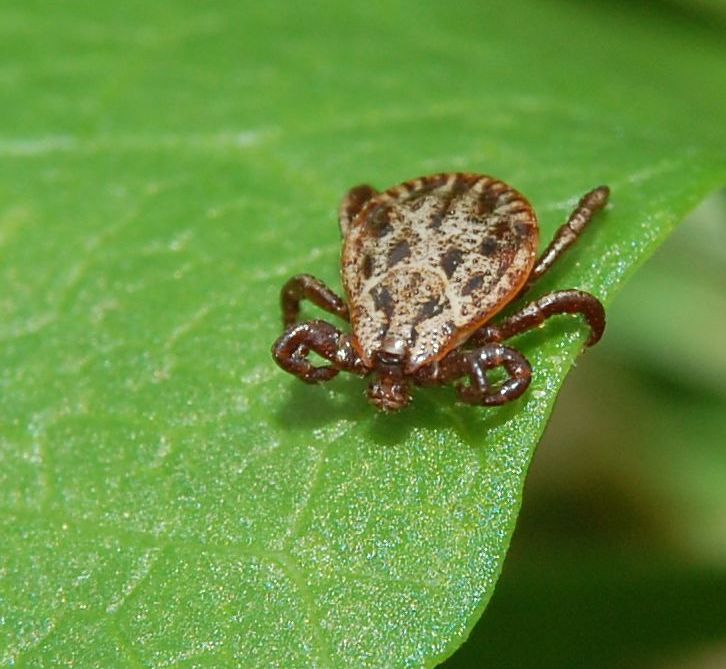
Elephant Tick (Dermacentor circumguttatus) is a hard tick belonging to the family Ixodidae. It is an African tick species. Males have eight pale spots near the periphery of the scutum, while females have a colour pattern consisting of three patches.
Written 26 November 2026 from the sources listed below. Each statement was checked against the passage it cites; statements that could not be supported were removed.
Similar species
Dermacentor circumguttatus is one of two Dermacentor species reported from the Afrotropical region.[1]
Appearance
Adults can reach a length of 3–5 mm.[2]
Males have eight pale spots near the periphery of the scutum. Their festoons and central areas are unornamented.[3][4]
Females have a colour pattern consisting of three patches: one posterior patch and two anterolateral patches.[5]
Habitat
The species is an African tick that has been found on elephants and grey duikers.[6][7]
Diet
The main hosts of Elephant Tick are African bush elephants and African forest elephants. Elephants and grey duikers are recorded as hosts.[8][9]
Classification of the Elephant Tick
| Kingdom | Animalia |
|---|---|
| Phylum | Arthropoda |
| Subphylum | Chelicerata |
| Class | Arachnida (Arachnid) |
| Superorder | Parasitiformes |
| Order | Ixodida (Tick) |
| Family | Ixodidae (Hard Ticks) |
| Genus | Dermacentor (Hard Tick) |
| Species | Dermacentor circumguttatus Neumann, 1897 |
Where the Elephant Tick is found
Checklists and occurrence records place Dermacentor circumguttatus in 4 countries. GBIF holds 92 georeferenced records of it.
Countries
Regions and cities with the most records
- Kwilu, Democratic Republic of the Congo 9
- Bas-Uele, Democratic Republic of the Congo 7
- Buta, Democratic Republic of the Congo 7
- Haut-Uele, Democratic Republic of the Congo 7
- Mai-Ndombe, Democratic Republic of the Congo 7
- Bandundu Province, Democratic Republic of the Congo 6
- Kasai-Central, Democratic Republic of the Congo 6
- Nana-Mambéré, Central African Republic 5
- Ituri, Democratic Republic of the Congo 4
- Maniema, Democratic Republic of the Congo 4
- Nord-Ubangi, Democratic Republic of the Congo 4
- Beni, Democratic Republic of the Congo 3
- Idiofa, Democratic Republic of the Congo 3
A number beside a place is its count of GBIF occurrence records. A place without a number comes from a checklist alone. Records show where a species has been observed or collected, which can include escapes and vagrants.
Common names
English
- Elephant Tick
Names in 2 other languages
- Afrikaans
- Olifantbosluis
- Czech
- piják kroužkovaný
Synonyms
4 other scientific names have been used for this species and are now treated as synonyms of Dermacentor circumguttatus.
- Amblyocentor (Puncticentor) circumguttatus Schulze, 1933
- Dermacentor (Amblyocentor) circumguttatus Camicas et al., 1998
- Dermacentor (Puncticentor) circumguttatus circumguttatus Santos Dias, 1963
- Dermacentor (Puncticentor) circumguttatus cunha-silvai Santos Dias, 1952
Related species
-
 American Dog TickDermacentor variabilis
-
 Marsh TickDermacentor reticulatus
-
 Winter TickDermacentor albipictus
-
 Pacific Coast TickDermacentor occidentalis
- Western Dog TickDermacentor similis
-
 Ornate Sheep TickDermacentor marginatus
-
 Rhinoceros TickDermacentor rhinocerinus
- Dermacentor nuttalli
Compare
Questions and answers
What is the scientific name of the Elephant Tick?
The scientific name of the Elephant Tick is Dermacentor circumguttatus. Written with its author, the full name is Dermacentor circumguttatus Neumann, 1897.
Which family does the Elephant Tick belong to?
Dermacentor circumguttatus belongs to the family Ixodidae, in the order Ixodida and the class Arachnida.
Where is the Elephant Tick found?
Checklists and occurrence records place Dermacentor circumguttatus in 4 countries: Democratic Republic of the Congo, Central African Republic, Cameroon and Republic of the Congo.
Sources
Passages the profile rests on
- Dermacentor circumguttatus is one of two Dermacentor species reported from the Afrotropical region. Source passage: “Only two of the 35 Dermacentor species that occur world-wide are present in the Afrotropical region, Dermacentor circumguttatus and D. rhinocerinus” — pmc.ncbi.nlm.nih.gov
- Adults of Dermacentor circumguttatus can reach a length of 3–5 mm. Source passage: “Dermacentor circumguttatus can reach a length of 3–5 mm (0.12–0.20 in).” — English Wikipedia
- Males have eight pale spots near the periphery of the scutum. Source passage: “Ornamentation of males consists of eight pale spots near the periphery of the scutum.” — English Wikipedia
- The festoons and central areas of males are unornamented. Source passage: “Festoons and central areas are inornate.” — English Wikipedia
- Females have a colour pattern consisting of three patches, with one posterior patch and two anterolateral patches. Source passage: “In the females, the colour pattern is limited to three patches, one posteriorly and one anterolaterally on each side.” — English Wikipedia
- Dermacentor circumguttatus is an African tick species. Source passage: “This African species has been found only on elephants and on the grey duiker (Sylvicapra grimmia).” — English Wikipedia
- The species has been found on elephants and grey duikers. Source passage: “This African species has been found only on elephants and on the grey duiker (Sylvicapra grimmia).” — English Wikipedia
- Elephants and grey duikers are recorded as hosts of this tick species. Source passage: “This African species has been found only on elephants and on the grey duiker (Sylvicapra grimmia).” — English Wikipedia
- The main hosts of Dermacentor circumguttatus are African bush elephants and African forest elephants. Source passage: “The main hosts of these hard ticks are the African bush elephant (Loxodonta africana) and the African forest elephant (Loxodonta cyclotis).” — English Wikipedia
Data
- Catalogue of Life, 2026-10-16 XR cc by
- Global Biodiversity Information Facility CC BY 4.0
- Wikidata CC0
- GeoNames CC BY 4.0
- Wikimedia Commons per image; credit shown with each image
- Within the Catalogue of Life, this name comes from TicksBase cc by
References
- Neumann, L. G. (1897) Revision de la famille des ixodides (2 e memoire). Memoires de la Societe Zoologique de France, 10, 324 - 420. where the name was published
This species in other databases
Page built on 29 November 2026. See how the catalog is made and all sources and licences.
Cite this page
ScientificNames.org. (2026). Dermacentor circumguttatus (Elephant Tick). Retrieved November 29, 2026, from https://scientificnames.org/species/dermacentor-circumguttatus
“Dermacentor circumguttatus (Elephant Tick).” ScientificNames.org, 2026, scientificnames.org/species/dermacentor-circumguttatus. Accessed 29 Nov. 2026.
ScientificNames.org. “Dermacentor circumguttatus (Elephant Tick).” Accessed November 29, 2026. https://scientificnames.org/species/dermacentor-circumguttatus.
@misc{scientificnames_dermacentor_circumguttatus_elephant_tick,
  author = {{ScientificNames.org}},
  title = {Dermacentor circumguttatus (Elephant Tick)},
  year = {2026},
  url = {https://scientificnames.org/species/dermacentor-circumguttatus},
  note = {Accessed 2026-11-29}
}