Species · Flowering plants
Venus Flytrap Dionaea muscipula
The scientific name of the Venus Flytrap is Dionaea muscipula. It is a species of flowering plant in the family Droseraceae (sundew family), order Caryophyllales.
- Scientific name
- Dionaea muscipula J.Ellis
- Common name
- Venus Flytrap
- Genus
- Dionaea
- Family
- Droseraceae (Sundew Family)
- Order
- Caryophyllales
- Class
- Magnoliopsida
- Red List category
- VU Vulnerable
- Recorded in
- 3 countries
- Name status
- accepted in the Catalogue of Life

Overview
The Venus Flytrap is a perennial flowering plant in the carnivorous plant family Droseraceae. The species is naturally restricted to the coastal plain of North Carolina and South Carolina in the United States. The species captures insects and arachnids using specialized leaf traps that close in response to prey movement.
Written 26 November 2026 from the sources listed below. Each statement was checked against the passage it cites; statements that could not be supported were removed.
Appearance
The plant typically consists of a rosette containing four to seven leaves. Each leaf has a flat, heart-shaped petiole and two terminal lobes that form a hinged trap. The upper surfaces of the trap lobes contain red anthocyanin pigments.[1][2][3]
The edges of the trap lobes have stiff, hair-like projections that interlock when the trap closes. Individual stems reach approximately three to ten centimeters in length, depending on the season.[4][5]
Habitat
The species commonly grows alongside grasses, sphagnum and fire-dependent Arundinaria bamboos. It benefits from periodic fires occurring approximately every three to five years in most locations.[6][7]
Diet
The species captures insects and arachnids using specialized leaf traps. Its recorded prey consists primarily of ants, spiders, beetles and grasshoppers. Ants account for approximately 33 percent of its recorded diet.[8][9][10]
Behaviour
The species uses three trigger hairs on each trap lobe to detect prey movement. Two successive trigger-hair stimulations within approximately 20 seconds cause the trap to close. The trap can close in approximately one-tenth of a second after sufficient stimulation.[11][12][13]
A trap that captures prey can reopen within approximately 12 hours if the prey is sufficiently small to escape. The plant generally requires five additional trigger-hair stimulations to initiate digestive enzyme production.[14][15]
The plant's traps can remain electrically stimulated for many hours after capturing moving prey. The species activates jasmonic acid signaling after the second mechanical stimulus and requires more than three action potentials to trigger expression of genes encoding prey-digesting hydrolases.[16][17][18]
The species secretes acidic digestive enzymes into its traps to break down captured insects. When starving, it produces a fruity volatile blend that attracts insects to its traps.[19][20]
Under experimental conditions, the species can record approximately 63 action potentials during the first hour following prey capture.[21]
Reproduction and life cycle
The species produces seeds that germinate immediately without a dormant period. Seeds germinate successfully in ash and sandy soil following fires.[22][23]
The flowers are pollinated by flying insects, including sweat bees, longhorn beetles and checkered beetles.[24]
Conservation
A 2019 survey estimated that approximately 302,000 individuals remained in the wild within the species' native range. This estimated wild population represented a decline of more than 93 percent compared with the 1979 estimate.[25][26]
Only 20 of the 71 known wild sites recorded in 2016 were classified as having excellent or good long-term viability. The species' native population has been rapidly declining.[27][28]
Similar species
The species is closely related to the waterwheel plant, Aldrovanda vesiculosa, and to plants in the genus Drosera. Dionaea muscipula is the only species in the genus Dionaea.[29][30][31]
Classification of the Venus Flytrap
| Kingdom | Plantae |
|---|---|
| Subkingdom | Pteridobiotina |
| Phylum | Tracheophyta |
| Class | Magnoliopsida |
| Order | Caryophyllales |
| Family | Droseraceae (Sundew Family) |
| Genus | Dionaea (Venus Flytrap) |
| Species | Dionaea muscipula J.Ellis |
Where the Venus Flytrap is found
Checklists and occurrence records place Dionaea muscipula in 3 countries across Europe and North America. GBIF holds 3,585 georeferenced records of it.
Countries where it has been introduced
Regions and cities with the most records
- North Carolina, United States 1,765
- Wilmington, United States 582
- Leland, United States 459
- Florida, United States 345
- Havelock, United States 68
- Washington, United States 65
- Arlington, United States 55
- South Carolina, United States 43
- Jupiter, United States 41
- Palm Beach Gardens, United States 39
- Jacksonville, United States 31
- Riviera Beach, United States 29
- Mount Vernon, United States 28
- Myrtle Beach, United States 21
- Socastee, United States 20
- Conway, United States 17
- West Palm Beach, United States 17
- North Myrtle Beach, United States 14
- The Acreage, United States 13
- Royal Palm Beach, United States 6
- Baden-Wurttemberg, Germany 5
- Marysville, United States 5
- Alabama, United States 4
- California, United States 4
- Delaware, United States 3
- Fayetteville, United States 3
- Fort Bragg, United States 3
- Hope Mills, United States 3
- Kernersville, United States 3
- North Rhine-Westphalia, Germany 3
- Pinehurst, United States 3
- Stuart, United States 3
- Winston-Salem, United States 3
- Pennsylvania, United States 1
- New Jersey, United States
- Virginia, United States
4 more countries have a few records outside this range
These countries hold a few records of Dionaea muscipula but lie outside the range the checklists give for it. Such records are often zoo or garden specimens, museum material or vagrants, so the species is not counted as occurring there.
Range as the checklists state it
Germany [I]; USA (North Carolina, South Carolina, Alabama [I], California [I], Pennsylvania [I], Virginia [I], New Jersey [I]); Jamaica [I]
A number beside a place is its count of GBIF occurrence records. A place without a number comes from a checklist alone. Records show where a species has been observed or collected, which can include escapes and vagrants.
Common names
English
- Venus Flytrap
- Venus Fly-trap
- Venus' Flytrap
- Venus's Flytrap
Names in 30 other languages
- Arabic
- خناق الذباب, مصيدة فينوس
- Asturian
- venus atrapamosques
- Chinese
- 捕蝇草, 捕蠅草
- Croatian
- Venerina muholovka
- Czech
- mucholapka podivná
- Danish
- Fluefanger
- Dutch
- Venusvliegenvanger
- Esperanto
- Muŝkaptulo
- Estonian
- kärbsepüünis
- Finnish
- kärpäsloukku
- French
- Dionée Attrape-Mouche
- German
- Venusfliegenfalle
- Greek
- Διωναία
- Hebrew
- דיונאה
- Hungarian
- Vénusz légycsapója
- Indonesian
- Perangkap Lalat Venus
- Italian
- Dionea, Venere acchiappamosche
- Japanese
- ハエジゴク, ハエトリグサ, ハエトリソウ
- Korean
- 파리지옥
- Lithuanian
- Jautrusis musėkautas
- Norwegian Bokmål
- Venusfluefanger
- Polish
- Muchołówka amerykańska
- Portuguese
- Dionéia, Vênus papa-moscas
- Russian
- Венерина мухоловка
- Slovak
- mucholapka obyčajná
- Spanish
- Dionea atrapamoscas, Venus atrapamoscas
- Swedish
- venusflugfälla
- Thai
- กาบหอยแครง
- Turkish
- Sinekkapan Bitkisi, Venüs Sinekkapan
- Vietnamese
- Cây bẫy kẹp
Synonyms
6 other scientific names have been used for this species and are now treated as synonyms of Dionaea muscipula.
- Dionaea corymbosa Raf.
- Dionaea sensitiva Salisb.
- Dionaea sessiliflora Raf.
- Dionaea uniflora Raf.
- Drosera sessiliflora Raf.
- Drosera uniflora Raf. ambiguous synonym
Related species
-
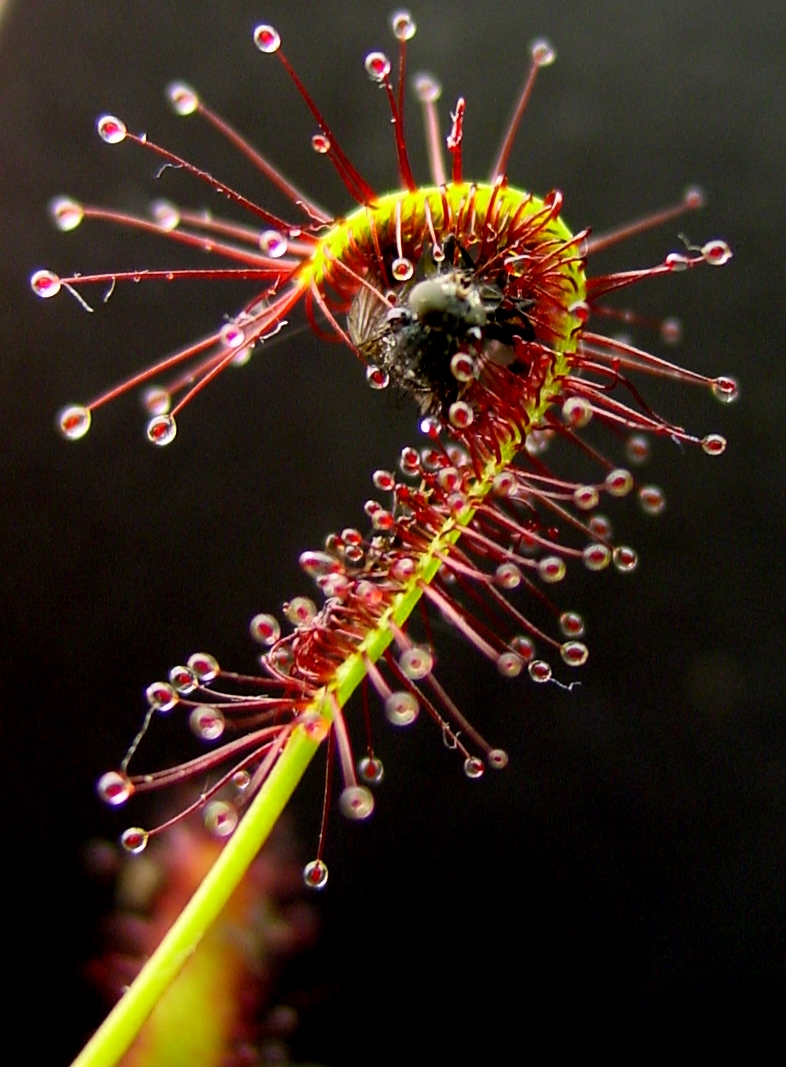 Drosera capensis
-
 WaterwheelAldrovanda vesiculosa
-
 Common SundewDrosera rotundifolia
-
 Rosy SundewDrosera spathulata
-
 English SundewDrosera × anglica
-
 Long-Leaved SundewDrosera intermedia
-
 Fork-leaved SundewDrosera binata
-
 Scarlet SundewDrosera glanduligera
Compare
Questions and answers
What is the scientific name of the Venus Flytrap?
The scientific name of the Venus Flytrap is Dionaea muscipula. Written with its author, the full name is Dionaea muscipula J.Ellis.
Which family does the Venus Flytrap belong to?
Dionaea muscipula belongs to the family Droseraceae, in the order Caryophyllales and the class Magnoliopsida.
Where is the Venus Flytrap found?
Checklists and occurrence records place Dionaea muscipula in 3 countries.
What is the conservation status of the Venus Flytrap?
The IUCN Red List category recorded for Dionaea muscipula is Vulnerable (VU).
What other names does the Venus Flytrap have?
Dionaea muscipula is also known in English as Venus Fly-trap, Venus' Flytrap and Venus's Flytrap.
What is another name for a Venus flytrap?
The original common name of the species was Venus's flytrap.[32]
Sources
Passages the profile rests on
- The plant typically consists of a rosette containing four to seven leaves. Source passage: “a rosette of four to seven leaves” — English Wikipedia
- Each leaf has a flat, heart-shaped petiole and two terminal lobes that form a hinged trap. Source passage: “a flat, heart-shaped photosynthesis-capable petiole, and a pair of terminal lobes hinged at the midrib, forming the trap” — English Wikipedia
- The upper surfaces of the trap lobes contain red anthocyanin pigments. Source passage: “The upper surface of these lobes contains red anthocyanin pigments” — English Wikipedia
- The edges of the trap lobes have stiff, hair-like projections that interlock when the trap closes. Source passage: “The edges of the lobes are fringed by stiff hair-like protrusions or cilia, which mesh together” — English Wikipedia
- Individual stems reach approximately three to ten centimeters in length, depending on the season. Source passage: “Each stem reaches a maximum size of about three to ten centimeters, depending on the time of year” — English Wikipedia
- The species commonly grows alongside grasses, sphagnum and fire-dependent Arundinaria bamboos. Source passage: “It can be found living alongside herbaceous plants, grasses, sphagnum, and fire-dependent Arundinaria bamboos.” — English Wikipedia
- The species benefits from periodic fires occurring approximately every three to five years in most locations. Source passage: “required every 3–5 years in most places for D. muscipula to thrive.” — English Wikipedia
- The species captures insects and arachnids using specialized leaf traps. Source passage: “Dionaea catches its prey—chiefly insects and arachnids” — English Wikipedia
- Its recorded prey consists primarily of ants, spiders, beetles and grasshoppers. Source passage: “The Dionaea diet is 33% ants, 30% spiders, 10% beetles, and 10% grasshoppers” — English Wikipedia
- Ants account for approximately 33 percent of its recorded diet. Source passage: “The Dionaea diet is 33% ants” — English Wikipedia
- The species uses three trigger hairs on each trap lobe to detect prey movement. Source passage: “three hair-like trichomes that are found on the upper surface of each of the lobes” — English Wikipedia
- Two successive trigger-hair stimulations within approximately 20 seconds cause the trap to close. Source passage: “two trigger hairs must be touched in succession within 20 seconds of each other” — English Wikipedia
- The trap can close in approximately one-tenth of a second after sufficient stimulation. Source passage: “typically in about one-tenth of a second.” — English Wikipedia
- A trap that captures prey can reopen within approximately 12 hours if the prey is sufficiently small to escape. Source passage: “If the prey is too small and escapes, the trap will usually reopen within 12 hours.” — English Wikipedia
- The plant generally requires five additional trigger-hair stimulations to initiate digestive enzyme production. Source passage: “After closing, the flytrap counts additional stimulations of the trigger hairs, to five total, to start the production of digesting enzymes.” — English Wikipedia
- The plant's traps can remain electrically stimulated for many hours after capturing moving prey. Source passage: “Once trapped, the still-moving victim continues to activate these mechanosensors, prolonging the electrical stimulation for many hours” — pmc.ncbi.nlm.nih.gov
- The species activates jasmonic acid signaling after the second mechanical stimulus. Source passage: “the touch hormone jasmonic acid (JA) signaling pathway is activated after the second stimulus” — pmc.ncbi.nlm.nih.gov
- The species requires more than three action potentials to trigger expression of genes encoding prey-digesting hydrolases. Source passage: “more than three APs are required to trigger an expression of genes encoding prey-degrading hydrolases” — pmc.ncbi.nlm.nih.gov
- The species secretes acidic digestive enzymes into its traps to break down captured insects. Source passage: “Secretion of acid and digestive enzymes into the stomach breaks the entire insect down.” — pmc.ncbi.nlm.nih.gov
- The species produces a fruity volatile blend that attracts insects to its traps when it is starving. Source passage: “Insects are attracted to the capture organs by a fruity volatile blend emitted by starving flytraps” — pmc.ncbi.nlm.nih.gov
- The species can record approximately 63 action potentials during the first hour following prey capture under experimental conditions. Source passage: “we recorded 63 ± 13 APs during the first hour after prey capture (n = 5, mean ± SE).” — pmc.ncbi.nlm.nih.gov
- The species produces seeds that germinate immediately without a dormant period. Source passage: “The seeds germinate immediately without a dormant period.” — English Wikipedia
- Seeds germinate successfully in ash and sandy soil following fires. Source passage: “After fire, D. muscipula seeds germinate well in ash and sandy soil” — English Wikipedia
- The flowers are pollinated by flying insects, including sweat bees, longhorn beetles and checkered beetles. Source passage: “The flower is pollinated from various flying insects such as sweat bees, longhorn beetles and checkered beetles.” — English Wikipedia
- A 2019 survey estimated that approximately 302,000 individuals remained in the wild within the species' native range. Source passage: “estimating a total of 302,000 individuals remaining in the wild in its native range.” — English Wikipedia
- The estimated wild population represented a decline of more than 93 percent compared with the 1979 estimate. Source passage: “This represents a reduction of more than 93% from a 1979 estimate of approximately 4,500,000 individuals.” — English Wikipedia
- Only 20 of the 71 known wild sites recorded in 2016 were classified as having excellent or good long-term viability. Source passage: “Of these 71 sites, only 20 were classified as having excellent or good long-term viability.” — English Wikipedia
- The species' native population has been rapidly declining. Source passage: “the population of the Venus flytrap has been rapidly declining in its native range.” — English Wikipedia
- The species is closely related to the waterwheel plant, Aldrovanda vesiculosa. Source passage: “It is closely related to the waterwheel plant (Aldrovanda vesiculosa)” — English Wikipedia
- The species is closely related to plants in the genus Drosera. Source passage: “and the cosmopolitan sundews (Drosera)” — English Wikipedia
- Dionaea muscipula is the only species in the genus Dionaea. Source passage: “D. muscipula is the only species of the monotypic genus Dionaea.” — English Wikipedia
- The original common name of the species was Venus's flytrap. Source passage: “The plant's common name (originally "Venus's flytrap")” — English Wikipedia
Data
- Catalogue of Life, 2026-10-16 XR cc by
- Global Biodiversity Information Facility CC BY 4.0
- Wikidata CC0
- GeoNames CC BY 4.0
- Wikimedia Commons per image; credit shown with each image
- Within the Catalogue of Life, this name comes from Synonymic Checklists of the Vascular Plants of the World cc by
References
- Ellis, J. (1773). Nova Acta Regiae Soc. Sci. Upsal. 1: 98 (1773). where the name was published
This species in other databases
- Catalogue of Life VLP9L
- Wikidata Q155825
- iNaturalist 52666
- World Flora Online wfo-0000943687
- GRIN 405268
Page built on 28 November 2026. See how the catalog is made and all sources and licences.
Cite this page
ScientificNames.org. (2026). Dionaea muscipula (Venus Flytrap). Retrieved November 28, 2026, from https://scientificnames.org/species/dionaea-muscipula
“Dionaea muscipula (Venus Flytrap).” ScientificNames.org, 2026, scientificnames.org/species/dionaea-muscipula. Accessed 28 Nov. 2026.
ScientificNames.org. “Dionaea muscipula (Venus Flytrap).” Accessed November 28, 2026. https://scientificnames.org/species/dionaea-muscipula.
@misc{scientificnames_dionaea_muscipula_venus_flytrap,
  author = {{ScientificNames.org}},
  title = {Dionaea muscipula (Venus Flytrap)},
  year = {2026},
  url = {https://scientificnames.org/species/dionaea-muscipula},
  note = {Accessed 2026-11-28}
}