Species · Reptiles
Malayan Softshell Turtle Dogania subplana
The scientific name of the Malayan Softshell Turtle is Dogania subplana. It is a species of reptile in the family Trionychidae (softshell turtles), order Testudines. The name dates from 1809.
- Scientific name
- Dogania subplana (Geoffroy Saint-Hilaire, 1809)
- Common name
- Malayan Softshell Turtle
- Genus
- Dogania
- Family
- Trionychidae (Softshell Turtles)
- Order
- Testudines
- Class
- Reptilia
- Red List category
- LC Least Concern
- Environment
- freshwater
- Recorded in
- 6 countries
- Name status
- accepted in the Catalogue of Life

Overview
The Malayan Softshell Turtle belongs to the family Trionychidae and is the sole member of the genus Dogania. It occurs in Myanmar, Thailand, Peninsular Malaysia, Sabah, Sarawak, the Riau Islands, the Bangka Belitung Islands of Indonesia and the Philippines. It has a large, muscular head and a relatively flat carapace with straight sides.
Written 26 November 2026 from the sources listed below. Each statement was checked against the passage it cites; statements that could not be supported were removed.
Appearance
The Malayan Softshell Turtle has a large, muscular head and a relatively flat carapace with straight sides. Adults may reach a carapace length of 35 cm.[1][2][3]
Juveniles have reddish coloration on the sides of their necks and several round black spots on their carapaces. These distinctive markings become less conspicuous as individuals age.[4][5][6]
Habitat
The Malayan Softshell Turtle prefers clean running water in rocky streams at higher elevations. It primarily inhabits primary and secondary forests.[7][8]
The species has also been recorded in semi-urban areas and abandoned mining ponds.[9][10]
Diet
The Malayan Softshell Turtle feeds on snails and other molluscs. It crushes the shells of its molluscan prey using its powerful jaws.[11][12]
Classification of the Malayan Softshell Turtle
| Kingdom | Animalia |
|---|---|
| Phylum | Chordata |
| Subphylum | Vertebrata |
| Infraphylum | Gnathostomata |
| Parvphylum | Osteichthyes |
| Megaclass | Tetrapoda |
| Class | Reptilia (Reptile) |
| Order | Testudines (Turtle) |
| Suborder | Cryptodira |
| Superfamily | Trionychoidea |
| Family | Trionychidae (Softshell Turtles) |
| Genus | Dogania (Malayan Softshell Turtles) |
| Species | Dogania subplana (Geoffroy Saint-Hilaire, 1809) |
Where the Malayan Softshell Turtle is found
Checklists and occurrence records place Dogania subplana in 6 countries across Asia. GBIF holds 354 georeferenced records of it.
Countries
Regions and cities with the most records
- Sarawak, Malaysia 40
- Sabah, Malaysia 28
- Ampang, Malaysia 21
- Bangsar, Malaysia 21
- Bukit Bintang, Malaysia 21
- Bukit Kerinchi, Malaysia 21
- Cheras, Malaysia 21
- Desa Petaling, Malaysia 21
- Kuala Lumpur, Malaysia 21
- Kuchai Lama, Malaysia 21
- Mont Kiara, Malaysia 21
- SS2, Malaysia 21
- Sentul, Malaysia 21
- Seputeh, Malaysia 21
- Setapak, Malaysia 21
- Sri Petaling, Malaysia 21
- Taman Desa, Malaysia 21
- Taman Melati, Malaysia 21
- Taman Melawati, Malaysia 21
- Taman OUG, Malaysia 21
- Taman Sri Sinar, Malaysia 21
- Taman Tun Dr Ismail, Malaysia 21
- Titiwangsa, Malaysia 21
- Ulu Kelang, Malaysia 21
- Wangsa Maju, Malaysia 21
- Alam Damai, Malaysia 20
- Bandar Kinrara, Malaysia 20
- Bandar Sri Damansara, Malaysia 20
- Bandar Tun Hussein Onn, Malaysia 20
- Bandar Utama, Malaysia 20
- Bukit Jalil, Malaysia 20
- Desa Parkcity, Malaysia 20
- Kampung Baru Balakong, Malaysia 20
- Seri Kembangan, Malaysia 20
- Taman Greenwood, Malaysia 20
- Taman Petaling, Malaysia 20
Range as the checklists state it
S Myanmar (= Burma), Mergui Islands, Thailand (incl. Phuket), West Malaysia (incl. Pulau Tioman),
A number beside a place is its count of GBIF occurrence records. A place without a number comes from a checklist alone. Records show where a species has been observed or collected, which can include escapes and vagrants.
Common names
English
- Malayan Softshell Turtle
- Forest Soft-shell Turtle
- Malayan Soft-shelled Turtle
Names in 10 other languages
- Arabic
- سلحفاة لينة الدرقة المالايوية
- Chinese
- 馬來鱉
- Czech
- kožnatka světlooká
- Danish
- Rødkindet Blødskildpadde
- Dutch
- Maleise weekschildpad
- German
- Malayische Weichschildkröte
- Hungarian
- maláj lágyhéjúteknős
- Malay
- Labi-labi Hutan
- Russian
- Догания, Малайский трионикс
- Thai
- ตะพาบแก้มแดง
Synonyms
6 other scientific names have been used for this species and are now treated as synonyms of Dogania subplana.
- Dogania guentheri Gray, 1863
- Trionyx dillwynii Gray, 1873
- Trionyx frenatus Gray, 1855
- Trionyx pecki Bartlett, 1895
- Trionyx subplanus Geoffroy Saint-Hilaire, 1809
- Trionyx vertebralis Strauch, 1890
Related species
-
 Yangtze Giant Softshell TurtleRafetus swinhoei
-
 Indian Flapshell TurtleLissemys punctata
-
 Florida Softshell TurtleApalone ferox
-
 Chinese Softshell TurtlePelodiscus sinensis
-
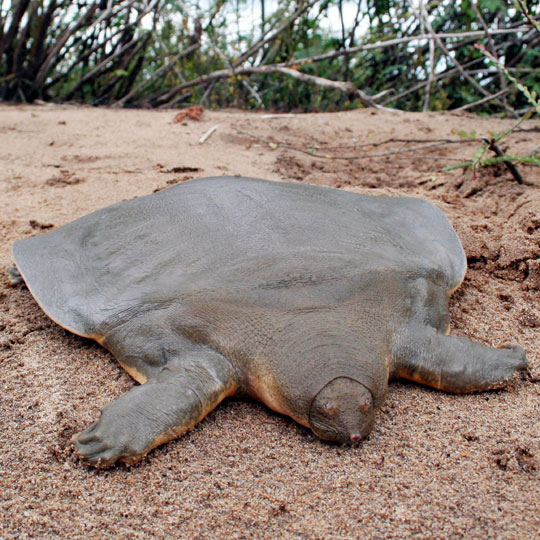 Asian Giant Softshell TurtlePelochelys cantorii
-
 Spiny Softshell TurtleApalone spinifera
-
 Indian Softshell TurtleNilssonia gangetica
-
 African Softshell TurtleTrionyx triunguis
Compare
Questions and answers
What is the scientific name of the Malayan Softshell Turtle?
The scientific name of the Malayan Softshell Turtle is Dogania subplana. Written with its author, the full name is Dogania subplana (Geoffroy Saint-Hilaire, 1809).
Which family does the Malayan Softshell Turtle belong to?
Dogania subplana belongs to the family Trionychidae, in the order Testudines and the class Reptilia.
Where is the Malayan Softshell Turtle found?
Checklists and occurrence records place Dogania subplana in 6 countries: Malaysia, Indonesia, Thailand, Singapore, Brunei and Myanmar.
What is the conservation status of the Malayan Softshell Turtle?
The IUCN Red List category recorded for Dogania subplana is Least Concern (LC).
What other names does the Malayan Softshell Turtle have?
Dogania subplana is also known in English as Forest Soft-shell Turtle and Malayan Soft-shelled Turtle.
Sources
Passages the profile rests on
- Adult individuals may reach a carapace length of 35 cm. Source passage: “Malayan softshell turtles may attain a carapace length of 35 cm (14 in) as adults.” — English Wikipedia
- The species has a large, muscular head. Source passage: “The head is large and muscular.” — English Wikipedia
- The carapace is relatively flat with straight sides. Source passage: “The carapace is flat, and has straight sides.” — English Wikipedia
- Juveniles have reddish coloration on the sides of their necks. Source passage: “Juveniles are reddish on the sides of the neck” — English Wikipedia
- Juveniles have several round black spots on their carapaces. Source passage: “have a few round black spots (ocelli) on the carapace.” — English Wikipedia
- The distinctive markings found in juveniles become less conspicuous as individuals age. Source passage: “These markings become obscure as the turtles age.” — English Wikipedia
- The species prefers clean running water in rocky streams at higher elevations. Source passage: “The species prefers to live in the clean running water which is found in rocky streams at higher elevations.” — English Wikipedia
- The species primarily inhabits primary and secondary forests. Source passage: “It primarily inhabits forests, both primary and secondary ones” — English Wikipedia
- The species has also been recorded in semi-urban areas. Source passage: “but has also been found in semi-urban areas” — English Wikipedia
- The species has also been recorded in abandoned mining ponds. Source passage: “abandoned mining ponds.” — English Wikipedia
- The species feeds on snails and other molluscs. Source passage: “The turtle feeds on snails and other molluscs” — English Wikipedia
- The species crushes the shells of its molluscan prey using its powerful jaws. Source passage: “crushing their shells with its powerful jaws.” — English Wikipedia
- The species belongs to the family Trionychidae. Source passage: “is a species of turtle in the family Trionychidae, the softshell turtles.” — English Wikipedia
- The species is the sole member of the genus Dogania. Source passage: “It is monotypic in its genus Dogania.” — English Wikipedia
Data
- Catalogue of Life, 2026-10-16 XR cc by
- Global Biodiversity Information Facility CC BY 4.0
- Wikidata CC0
- GeoNames CC BY 4.0
- Wikimedia Commons per image; credit shown with each image
- Within the Catalogue of Life, this name comes from The Reptile Database cc by
References
- Geoffroy Saint-Hilaire, E. (1809). Mémoire sur les tortues molles. Nouv. Bull. Soc. Philom. Paris 1 (22): 363-367 [Published in August].
- Geoffroy Saint-Hilaire, E. (1809). Sur les tortues molles, nouveau genre sous le nom de Trionyx, et sur la formation des carapaces. Ann. Mus. Hist. Nat. Paris 14: 1-20 [Published in July, Fide Smith 1963].
- Duméril, A.M.C., and G. Bibron. (1835). Erpétologie Générale ou Histoire Naturelle Complète des Reptiles, Vol. 2. Librairie Encyclopédique de Roret, Paris, Iv + 680 P.
- Temminck, C. J., and H. Schlegel. (1838). Reptilia elaborantibus. Saurii et batrachii. in Ph. Fr. de Siebold: Pp. 85-144. Fauna Japonica auctore. L. Batavorum.
- Gray, J. E. (1844). Catalogue of Tortoises, Crocodilians, and Amphisbaenians in the Collection of the British Museum. British Museum (Natural History), London. Viii + 80 P.
- Gray, J. E. (1856). Catalogue of Shield Reptiles in the Collection of the British Museum. Part I. Testudinata (Tortoises). British Museum, London, 79 Pp. [1855].
- Gray, J. E. (1863). Notice of a new species of Dogania from Asia. Ann. Mag. Nat. Hist. (3) 12: 158-159.
- Gray, J. E. (1873). Observations on chelonians, with descriptions of new genera and species. Ann. Mag. Nat. Hist. (4) 11: 289-308.
- Boulenger, G. A. (1889). Catalogue of the chelonians, rhynchocephalians, and crocodiles in the British Museum (Natural History). British Museum, London, 311 Pp.
- Baur, G. (1893). Notes on the classification and taxonomy of the Testudinata. Proc. Amer. Philos. Soc. 31: 210-225.
- Siebenrock, Friedrich. (1897). Das Kopfskelet der Schildkröten. Sitzungsberichte Der Kaiserlichen Akademie Der Wissenschaften. Mathematisch-Naturwissenschaftliche Klasse. 106 (4): 245-328.
- Siebenrock, F. (1902). Zur Systematik der Schildkrötenfamilie Trionychidae Bell, nebst der Beschreibung einer neuen Cyclanorbis - Art. Sitzungsber. K. Akad. Wiss. Wien. Math-Naturwiss. Cl. 111: 807-846.
- Stejneger, LEONHARD H. (1907). Herpetology of Japan and adjacent territory. Bull. US Natl. Mus. 58: Xx, 1-577.
- de Rooij, & de, N. (1915). The Reptiles of the Indo-Australian Archipelago. I. Lacertilia, Chelonia, Emydosauria. Leiden (E. J. Brill), Xiv + 384 Pp.
- Smedley, N. (1931). On some reptiles and a frog from the Natuna Islands. Bull. Raffles Mus. No 5: 46-48.
- Smith, Hobart M.; Smith, Philip W. (1963). Amyda Fitzinger, 1843 (Reptilia, Testudines): proposed suppression under the Plenary powers. Z.N.(S.) 229. Bull. Zool. Nomenclature 20 (2): 121-127.
- Hendrickson, J. R. (1966). Observations on the fauna of Pulau Tioman and Pulau Tulai. 5. The Reptiles. Bull. Nat. Mus. Singapore 34: 53-71.
- Alderton, D. (1988). Turtles and tortoises of the world. Facts on File, New York.
- Ernst,C.H. and Barbour,R.W. (1989). Turtles of the World. Smithsonian Institution Press, Washington D.C. - London.
- Pritchard, Peter C.H. (1993). Carapacial pankinesis in the Malayan softshell turtle, Dogania subplana. Chelonian Conserv. Biol. 1 (1): 31-36.
- Teo, R. C. H., & Rajathurai, S. (1997). Mammals, reptiles and amphibians in the Nature Reserves of Singapore - diversity, abundance and distribution. Proc. Nature Reserves Survey Seminar. Gardens’ Bulletin Singapore 49: 353-425.
- Manthey, U., & Grossmann, W. (1997). Amphibien & Reptilien Südostasiens. Natur Und Tier Verlag (Münster), 512 Pp. (ISBN 3-931587-12-6).
- Grossmann, W. & U. Grychta. (1998). Bemerkungen zur Größe der Malayen - Weichschildkröte Dogania subplana (Geoffroy, 1809). Sauria 20 (2): 11-13.
- Cox, Merel J.; Van Dijk, Peter Paul; Jarujin Nabhitabhata & Thirakhupt,Kumthorn. (1998). A Photographic Guide to Snakes and Other Reptiles of Peninsular Malaysia, Singapore and Thailand. Ralph Curtis Publishing, 144 Pp.
- Lim, K. K. P., & Ng, H. H. (1999). The terrestrial herpetofauna of Pulau Tioman, Peninsular Malaysia. Raffles Bull. Zool., Suppl. No. 6: 131-155.
This species in other databases
- Catalogue of Life 373V4
- Wikidata Q2078114
- iNaturalist 39587
- WoRMS urn:lsid:marinespecies.org:taxname:1464491
- ITIS 551962
Page built on 29 November 2026. See how the catalog is made and all sources and licences.
Cite this page
ScientificNames.org. (2026). Dogania subplana (Malayan Softshell Turtle). Retrieved November 29, 2026, from https://scientificnames.org/species/dogania-subplana
“Dogania subplana (Malayan Softshell Turtle).” ScientificNames.org, 2026, scientificnames.org/species/dogania-subplana. Accessed 29 Nov. 2026.
ScientificNames.org. “Dogania subplana (Malayan Softshell Turtle).” Accessed November 29, 2026. https://scientificnames.org/species/dogania-subplana.
@misc{scientificnames_dogania_subplana_malayan_softshell_turtle,
  author = {{ScientificNames.org}},
  title = {Dogania subplana (Malayan Softshell Turtle)},
  year = {2026},
  url = {https://scientificnames.org/species/dogania-subplana},
  note = {Accessed 2026-11-29}
}