Species · Flowering plants
Alice Sundew Drosera aliciae
The scientific name of the Alice Sundew is Drosera aliciae. It is a species of flowering plant in the family Droseraceae (sundew family), order Caryophyllales.
- Scientific name
- Drosera aliciae Raym.-Hamet
- Common name
- Alice Sundew
- Genus
- Drosera
- Family
- Droseraceae (Sundew Family)
- Order
- Caryophyllales
- Class
- Magnoliopsida
- Recorded in
- 2 countries
- Name status
- accepted in the Catalogue of Life

Overview
The species is native to the Cape Provinces of South Africa. It forms compact rosettes of wedge-shaped leaves and produces pink flowers on stalks approximately 30 cm away from its carnivorous leaves.
Written 26 November 2026 from the sources listed below. Each statement was checked against the passage it cites; statements that could not be supported were removed.
Appearance
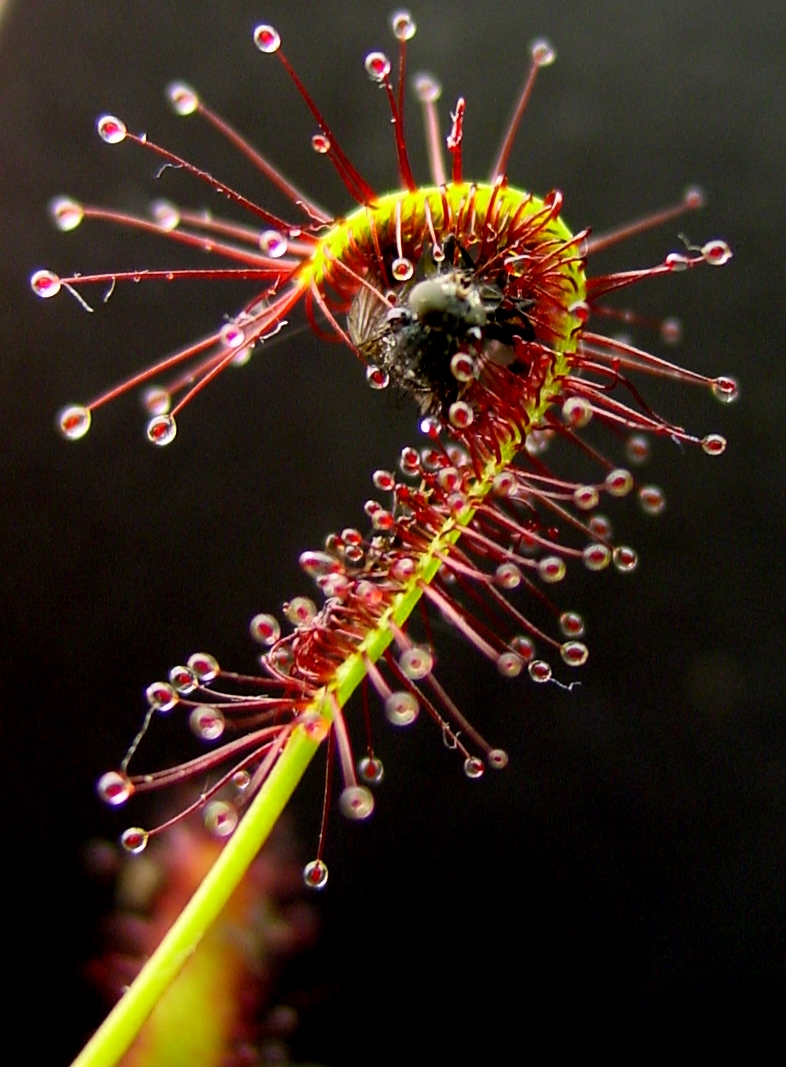
Alice Sundew forms small, compact rosettes of wedge-shaped leaves that can reach 5 cm in diameter. Under good lighting, its insect-catching tentacles develop deep coloration from anthocyanin pigments.[1][2][3]
The plant produces pink flowers on flower stalks that hold them approximately 30 cm away from the carnivorous leaves.[4][5]
Diet
Alice Sundew catches insect prey using its tentacles.[6]
Reproduction and life cycle
The flowers are positioned away from the carnivorous leaves to reduce the risk of pollinators being caught.[7]
Habitat
Alice Sundew is native to the Cape Provinces of South Africa.[8]
Similar species
Drosera aliciae closely resembles Drosera slackii and Drosera natalensis in form. Drosera slackii has a larger rosette diameter of approximately 8 cm and a somewhat different growth habit.[9][10]
Drosera natalensis differs by having hairier stipules and a greater distance between the leaf base and sticky trichomes.[11]
Conservation
Drosera aliciae has received the Royal Horticultural Society's Award of Garden Merit.[12]
Uses
Alice Sundew is among the most commonly cultivated sundews.[13]
Classification of the Alice Sundew
| Kingdom | Plantae |
|---|---|
| Subkingdom | Pteridobiotina |
| Phylum | Tracheophyta |
| Class | Magnoliopsida |
| Order | Caryophyllales |
| Family | Droseraceae (Sundew Family) |
| Genus | Drosera (Sundew) |
| Species | Drosera aliciae Raym.-Hamet |
Where the Alice Sundew is found
Checklists and occurrence records place Drosera aliciae in 2 countries across Africa and North America. GBIF holds 1,554 georeferenced records of it.
Countries where it is native or its origin is not stated
Countries where it has been introduced
Regions and cities with the most records
- Western Cape, South Africa 1,439
- Grabouw, South Africa 286
- Hermanus, South Africa 241
- Muizenberg, South Africa 224
- Retreat, South Africa 202
- Rondebosch, South Africa 192
- Cape Town, South Africa 189
- Somerset West, South Africa 145
- George, South Africa 137
- Caledon, South Africa 92
- Franschhoek, South Africa 73
- Stellenbosch, South Africa 58
- Le Roux, South Africa 50
- Bredasdorp, South Africa 44
- Eastern Cape, South Africa 38
- Swellendam, South Africa 33
- Knysna, South Africa 24
- Plettenberg Bay, South Africa 24
- Riversdale, South Africa 16
- Wellington, South Africa 12
- Groot-Brakrivier, South Africa 10
- Robertson, South Africa 6
- Paarl, South Africa 5
- Ashton, South Africa 4
- Gansbaai, South Africa 4
- California, United States 3
2 more countries have a few records outside this range
These countries hold a few records of Drosera aliciae but lie outside the range the checklists give for it. Such records are often zoo or garden specimens, museum material or vagrants, so the species is not counted as occurring there.
Range as the checklists state it
South Africa (W-Cape Prov., E-Cape Prov.); USA [I] (California [I])
A number beside a place is its count of GBIF occurrence records. A place without a number comes from a checklist alone. Records show where a species has been observed or collected, which can include escapes and vagrants.
Common names
English
- Alice Sundew
- Australian Sundew
- Shepherds Crook Sundew
Names in 4 other languages
- Chinese
- 地毡草, 小毛氈苔, 毛氈苔, 爱丽斯毛毡苔
- French
- Drosera d'Alice, Rossolis d'Alice
- Slovak
- rosička Alicina
- Spanish
- Rocío del sol sudafricano
Synonyms
5 other scientific names have been used for this species and are now treated as synonyms of Drosera aliciae.
- Drosera curviscapa Salter
- Drosera curviscapa var. esterhuysenae Salter
- Drosera curviscapa var. esterhuyseniae T.M.Salter
- Drosera esterhuyseniae (Salter) Debbert
- Drosera rubrifolia Debbert
Related species
-
 Drosera capensis
-
 Common SundewDrosera rotundifolia
-
 Rosy SundewDrosera spathulata
-
 English SundewDrosera × anglica
-
 Long-Leaved SundewDrosera intermedia
-
 Fork-leaved SundewDrosera binata
-
 Scarlet SundewDrosera glanduligera
-
 Northern Threadleaf SundewDrosera filiformis
Compare
Questions and answers
What is the scientific name of the Alice Sundew?
The scientific name of the Alice Sundew is Drosera aliciae. Written with its author, the full name is Drosera aliciae Raym.-Hamet.
Which family does the Alice Sundew belong to?
Drosera aliciae belongs to the family Droseraceae, in the order Caryophyllales and the class Magnoliopsida.
Where is the Alice Sundew found?
Checklists and occurrence records place Drosera aliciae in 2 countries, including South Africa.
What other names does the Alice Sundew have?
Drosera aliciae is also known in English as Australian Sundew and Shepherds Crook Sundew.
What are some interesting facts about Australian sundews?
Alice Sundew forms compact rosettes of wedge-shaped leaves that can reach 5 cm in diameter. Its tentacles develop deep coloration from anthocyanin pigments under good lighting, and its pink flowers are held approximately 30 cm away from its carnivorous leaves.[1][2][3][4][5]
What do sundews eat?
Alice Sundew catches insect prey using its tentacles.[6]
Sources
Passages the profile rests on
- The plant forms small, compact rosettes of wedge-shaped leaves. Source passage: “The plant forms small, tight rosettes of wedge-shaped leaves” — English Wikipedia
- The leaf rosettes can reach 5 cm in diameter. Source passage: “up to 5 cm in diameter.” — English Wikipedia
- Under good lighting, the plant's insect-catching tentacles develop deep coloration from anthocyanin pigments. Source passage: “Under conditions of good lighting, the insect-snagging tentacles will become deeply coloured with anthocyanin pigments” — English Wikipedia
- The plant produces pink flowers on attractive flower stalks. Source passage: “produces attractive scapes of pink flowers” — English Wikipedia
- The flower stalks hold the flowers approximately 30 cm away from the carnivorous leaves. Source passage: “which are held about 30 cm away from the carnivorous leaves” — English Wikipedia
- The plant catches insect prey using its tentacles. Source passage: “the insect-snagging tentacles” — English Wikipedia
- The flowers are positioned away from the carnivorous leaves to reduce the risk of pollinators being caught. Source passage: “so as to prevent pollinators from becoming ensnared.” — English Wikipedia
- The species is native to the Cape Provinces of South Africa. Source passage: “It is native to the Cape Provinces of South Africa” — English Wikipedia
- Drosera aliciae closely resembles Drosera slackii and Drosera natalensis in form. Source passage: “D. aliciae is very similar in form to a number of other closely related species such as D. slackii, and D. natalensis:” — English Wikipedia
- Drosera slackii differs from Drosera aliciae by having a larger rosette diameter of approximately 8 cm and a somewhat different growth habit. Source passage: “the former is rather larger with a slightly different growth habit (8 cm diameter);” — English Wikipedia
- Drosera natalensis differs from Drosera aliciae by having hairier stipules and a greater distance between the leaf base and sticky trichomes. Source passage: “the latter has hairier stipules and a larger distance between leaf base and the “sticky” trichomes.” — English Wikipedia
- Drosera aliciae has received the Royal Horticultural Society's Award of Garden Merit. Source passage: “Drosera aliciae has received the Royal Horticultural Society's Award of Garden Merit.” — English Wikipedia
- The species is among the most commonly cultivated sundews. Source passage: “is one of the most common sundews in cultivation.” — English Wikipedia
Data
- Catalogue of Life, 2026-10-16 XR cc by
- Global Biodiversity Information Facility CC BY 4.0
- Wikidata CC0
- GeoNames CC BY 4.0
- Wikimedia Commons per image; credit shown with each image
- Within the Catalogue of Life, this name comes from Synonymic Checklists of the Vascular Plants of the World cc by
References
- Raym.-Hamet. (1905). J. Bot. [Morot] 19: [114] (1905). where the name was published
This species in other databases
- Catalogue of Life VLP9Q
- Wikidata Q138152
- iNaturalist 52654
- World Flora Online wfo-0000945812
- GRIN 495733
Page built on 26 November 2026. See how the catalog is made and all sources and licences.
Cite this page
ScientificNames.org. (2026). Drosera aliciae (Alice Sundew). Retrieved November 26, 2026, from https://scientificnames.org/species/drosera-aliciae
“Drosera aliciae (Alice Sundew).” ScientificNames.org, 2026, scientificnames.org/species/drosera-aliciae. Accessed 26 Nov. 2026.
ScientificNames.org. “Drosera aliciae (Alice Sundew).” Accessed November 26, 2026. https://scientificnames.org/species/drosera-aliciae.
@misc{scientificnames_drosera_aliciae_alice_sundew,
  author = {{ScientificNames.org}},
  title = {Drosera aliciae (Alice Sundew)},
  year = {2026},
  url = {https://scientificnames.org/species/drosera-aliciae},
  note = {Accessed 2026-11-26}
}