Species · Flowering plants
Drosera brevifolia
Drosera brevifolia has no English name on record in the checklists used here. It is a species of flowering plant in the family Droseraceae (sundew family), order Caryophyllales.
- Scientific name
- Drosera brevifolia Pursh
- Genus
- Drosera
- Family
- Droseraceae (Sundew Family)
- Order
- Caryophyllales
- Class
- Magnoliopsida
- Recorded in
- 9 countries
- Name status
- accepted in the Catalogue of Life

Overview
Drosera brevifolia occurs in the southeastern United States. It is distinguished from Drosera capillaris by its wedge-shaped leaves and deeper red to reddish-purple coloration.
Written 26 November 2026 from the sources listed below. Each statement was checked against the passage it cites; statements that could not be supported were removed.
Appearance
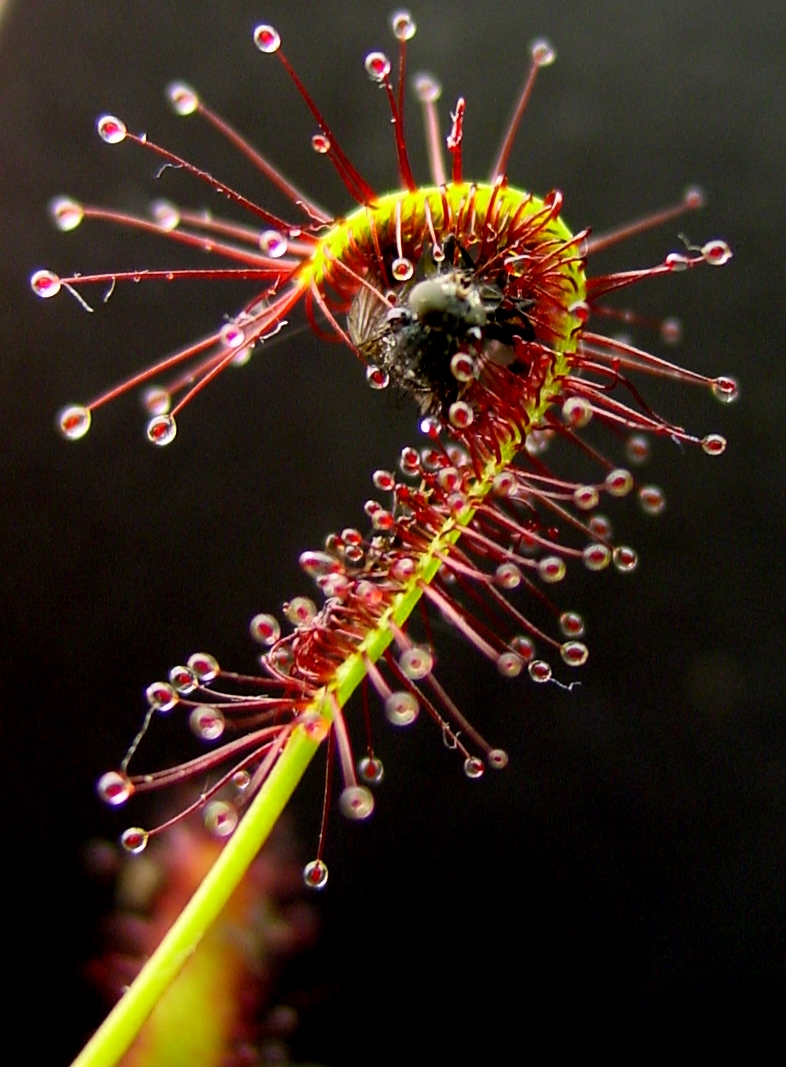
The plant typically measures no more than 3 centimeters across, although some plants grow up to 5 centimeters across. Its flower spikes can reach 15 centimeters in length.[1][2][3]
Its coloration is deeper red to reddish-purple than that of Drosera capillaris. Its flowers can be pink or white and are large relative to its rosette.[4][5]
Habitat
Drosera brevifolia occurs in wet, peaty, or sandy soils and grows in moist, acidic soils. It is found along the edges of marshes, ponds, and swamps.[6][7][8]
It can grow in areas drier than those preferred by most carnivorous plants.[9]
Reproduction and life cycle
Drosera brevifolia produces flowers in spring.[10]
Conservation
Drosera brevifolia is classified as endangered in Kentucky and threatened in Tennessee according to the USDA.[11][12]
Similar species
Drosera capillaris differs from Drosera brevifolia in leaf shape and coloration. Drosera brevifolia has wedge-shaped leaves and a deeper red to reddish-purple coloration.[13][4][14]
Classification of Drosera brevifolia
| Kingdom | Plantae |
|---|---|
| Subkingdom | Pteridobiotina |
| Phylum | Tracheophyta |
| Class | Magnoliopsida |
| Order | Caryophyllales |
| Family | Droseraceae (Sundew Family) |
| Genus | Drosera (Sundew) |
| Species | Drosera brevifolia Pursh |
Where Drosera brevifolia is found
Checklists and occurrence records place Drosera brevifolia in 9 countries across North America and South America. GBIF holds 5,514 georeferenced records of it.
Countries
- Argentina 22
- Belize 4
- Brazil 480
- Cuba 4
- Jamaica 3
- Mexico 17
- Paraguay 3
- United States 4,843
- Uruguay 138
Regions and cities with the most records
- Texas, United States 963
- Florida, United States 839
- Mississippi, United States 342
- Louisiana, United States 262
- Alabama, United States 212
- North Carolina, United States 206
- South Carolina, United States 176
- Georgia, United States 149
- Ocean Springs, United States 149
- Gautier, United States 134
- Arkansas, United States 118
- Rio Grande do Sul, Brazil 115
- Pascagoula, United States 114
- College Station, United States 78
- Titusville, United States 74
- Bryan, United States 72
- New Caney, United States 67
- Tennessee, United States 64
- Biloxi, United States 61
- Alafaya, United States 59
- Spring, United States 58
- Santa Catarina, Brazil 56
- Humble, United States 55
- Gainesville, United States 45
- Kentucky, United States 44
- Conroe, United States 40
- Houston, United States 38
- Missouri City, United States 38
- Wilmington, United States 37
- Deltona, United States 35
- Winter Springs, United States 34
- The Woodlands, United States 33
- DeBary, United States 32
- Oviedo, United States 32
- Paraná, Brazil 32
- Casselberry, United States 31
Range as the checklists state it
USA (Alabama, Arkansas, Florida, Georgia, Kansas, Kentucky, Louisiana, Mississippi, North Carolina, Oklahoma, South Carolina, Tennessee, Texas, Virginia); Mexico (Chiapas, Oaxaca); ?Belize; Cuba; S-Brazil (Paraná, Rio Grande do Sul, Santa Catarina); Paraguay (Cordillera); Uruguay (Canelones, Lavalleja, Maldonado, Montevideo, Rio Negro, Rocha, San Jose, Soriano, Tacuarembó); Argentina (Corrientes, Entre Rios, Misiones)
A number beside a place is its count of GBIF occurrence records. A place without a number comes from a checklist alone. Records show where a species has been observed or collected, which can include escapes and vagrants.
Common names
Names in 2 other languages
- Portuguese
- Orvalinha
- Spanish
- rocío de sol
Synonyms
7 other scientific names have been used for this species and are now treated as synonyms of Drosera brevifolia.
- Drosera annua E.L.Reed
- Drosera brevifolia var. major Hook.
- Drosera chiapasensis Matuda
- Drosera chiapensis Matuda
- Drosera ferruginea Larrañaga
- Drosera leucantha Shinners
- Drosera maritima A.St.-Hil.
Related species
-
 Drosera capensis
-
 Common SundewDrosera rotundifolia
-
 Rosy SundewDrosera spathulata
-
 English SundewDrosera × anglica
-
 Long-Leaved SundewDrosera intermedia
-
 Fork-leaved SundewDrosera binata
-
 Scarlet SundewDrosera glanduligera
-
 Northern Threadleaf SundewDrosera filiformis
Compare
Sources
Passages the profile rests on
- Drosera brevifolia typically measures no more than 3 centimeters across. Source passage: “typically no more than 3 centimeters (1.2 in) across” — English Wikipedia
- Some Drosera brevifolia plants grow up to 5 centimeters across. Source passage: “some are known to grow up to 5 cm (2.0 in)” — English Wikipedia
- Its flower spikes can reach 15 centimeters in length. Source passage: “with flower spikes up to 15 cm (5.9 in).” — English Wikipedia
- Drosera brevifolia has a deeper red to reddish-purple coloration than Drosera capillaris. Source passage: “distinctly deeper red to reddish purple color, noticeable when side by side with D. capillaris.” — English Wikipedia
- Its flowers can be pink or white and large relative to its rosette. Source passage: “Flowers can be large compared to the rosette and can be pink or white” — English Wikipedia
- Drosera brevifolia occurs in wet, peaty, or sandy soils. Source passage: “D. brevifolia has been observed in environments with wet, peaty, or sandy soils.” — English Wikipedia
- Drosera brevifolia grows along the edges of marshes, ponds, and swamps. Source passage: “It has been found in habitats such as along the edges of marshes, ponds, and swamps.” — English Wikipedia
- Drosera brevifolia grows in moist, acidic soils. Source passage: “Like most insectivorous plants, sundews grow in moist, acidic soils where plant ...” — extension.msstate.edu
- Drosera brevifolia can grow in areas drier than those preferred by most carnivorous plants. Source passage: “It is often found growing in areas drier than what most carnivorous plants prefer.” — English Wikipedia
- Drosera brevifolia produces flowers in spring. Source passage: “Flowers can be large compared to the rosette and can be pink or white and come in the spring.” — English Wikipedia
- Drosera brevifolia is classified as endangered in Kentucky according to the USDA. Source passage: “According to the USDA, it is endangered in the State of Kentucky” — English Wikipedia
- Drosera brevifolia is classified as threatened in Tennessee according to the USDA. Source passage: “and threatened in the State of Tennessee.” — English Wikipedia
- Drosera brevifolia has wedge-shaped leaves that distinguish it from Drosera capillaris. Source passage: “This species differs considerably from the pink sundew, Drosera capillaris, by its wedge-shaped leaves” — English Wikipedia
- Drosera capillaris is identified as a species that differs from Drosera brevifolia in leaf shape and coloration. Source passage: “This species differs considerably from the pink sundew, Drosera capillaris” — English Wikipedia
Data
- Catalogue of Life, 2026-10-16 XR cc by
- Global Biodiversity Information Facility CC BY 4.0
- Wikidata CC0
- GeoNames CC BY 4.0
- Wikimedia Commons per image; credit shown with each image
- Within the Catalogue of Life, this name comes from Synonymic Checklists of the Vascular Plants of the World cc by
References
- Pursh. (1814). Fl. Amer. Sept. [Pursh] 1: 211 (1814). where the name was published
This species in other databases
Page built on 28 November 2026. See how the catalog is made and all sources and licences.
Cite this page
ScientificNames.org. (2026). Drosera brevifolia. Retrieved November 28, 2026, from https://scientificnames.org/species/drosera-brevifolia
“Drosera brevifolia.” ScientificNames.org, 2026, scientificnames.org/species/drosera-brevifolia. Accessed 28 Nov. 2026.
ScientificNames.org. “Drosera brevifolia.” Accessed November 28, 2026. https://scientificnames.org/species/drosera-brevifolia.
@misc{scientificnames_drosera_brevifolia,
  author = {{ScientificNames.org}},
  title = {Drosera brevifolia},
  year = {2026},
  url = {https://scientificnames.org/species/drosera-brevifolia},
  note = {Accessed 2026-11-28}
}