Species · Flowering plants
Drosera burmanni
Drosera burmanni has no English name on record in the checklists used here. It is a species of flowering plant in the family Droseraceae (sundew family), order Caryophyllales.
- Scientific name
- Drosera burmanni Vahl
- Genus
- Drosera
- Family
- Droseraceae (Sundew Family)
- Order
- Caryophyllales
- Class
- Magnoliopsida
- Red List category
- LC Least Concern
- Recorded in
- 20 countries
- Name status
- accepted in the Catalogue of Life

Overview
The natural geographical range includes tropical and subtropical regions of Asia and Australia. Its leaves can curl around an insect within a few seconds, making it one of the fastest trapping sundew species.
Written 26 November 2026 from the sources listed below. Each statement was checked against the passage it cites; statements that could not be supported were removed.
Appearance
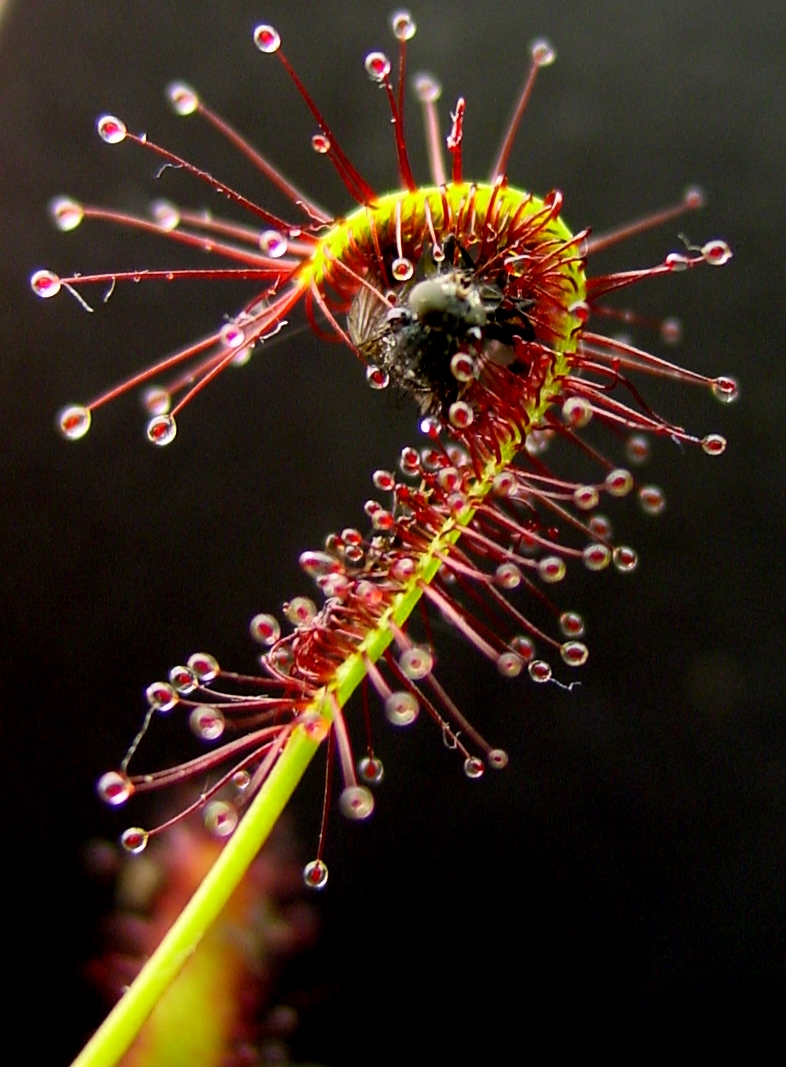
Drosera burmanni has very short stems and red or green leaves arranged in a rosette. The leaves are wedge-shaped or orbicular and grow close to soil level.[1][2]
The plant normally reaches a diameter of approximately 2 cm. Its leaves are typically 6–10 mm long and 4–6 mm wide.[3][4]
The plant produces white flowers in groups of three to ten. These grow on racemose inflorescences measuring 6–15 cm in height.[5][6]
Habitat
Its natural geographical range includes tropical and subtropical regions of Asia and Australia.[7]
Its documented Asian distribution includes India, Taiwan, Southeast Asia, and the Chinese provinces of Guangxi, Guangdong, Yunnan, and Fujian.[8]
Behaviour
Its leaves can curl around an insect within a few seconds. It is described as one of the fastest trapping sundew species.[9][10]
Reproduction and life cycle
Each plant can produce between one and three racemose inflorescences. Its annual growth habit is associated with the production of large quantities of seeds.[11][12]
Uses
Drosera burmanni has been regarded as a powerful rubefacient in Ayurveda.[13]
Similar species
Drosera dietrichiana is currently treated as a synonym of Drosera burmanni. It was described in 1871 by Heinrich Gustav Reichenbach and named after its discoverer Amalie Dietrich.[14][15]
Classification of Drosera burmanni
| Kingdom | Plantae |
|---|---|
| Subkingdom | Pteridobiotina |
| Phylum | Tracheophyta |
| Class | Magnoliopsida |
| Order | Caryophyllales |
| Family | Droseraceae (Sundew Family) |
| Genus | Drosera (Sundew) |
| Species | Drosera burmanni Vahl |
Where Drosera burmanni is found
Checklists and occurrence records place Drosera burmanni in 20 countries across Asia and Oceania. GBIF holds 3,397 georeferenced records of it.
Countries
- Australia 2,199
- Bangladesh 2
- Brunei 17
- Cambodia 45
- China 190
- Hong Kong 48
- India 348
- Indonesia 25
- Japan 3
- Laos 12
- Malaysia 41
- Myanmar 5
- Nepal 1
- Palau 6
- Papua New Guinea 23
- Philippines 2
- Sri Lanka 61
- Taiwan 235
- Thailand 98
- Vietnam 36
Regions and cities with the most records
- Queensland, Australia 921
- Northern Territory, Australia 674
- New South Wales, Australia 377
- Western Australia, Australia 178
- Karnataka, India 113
- Taiwan, Taiwan 109
- Logan City, Australia 91
- Palmerston, Australia 75
- Jinhu, Taiwan 71
- Guangdong, China 59
- Pat Heung, Hong Kong 59
- Tai Po, Hong Kong 54
- Capalaba, Australia 53
- Discovery Park, Hong Kong 53
- Fo Tan, Hong Kong 52
- Tsuen Wan, Hong Kong 52
- Hong Lok Yuen, Hong Kong 51
- Jincheng, Taiwan 51
- Brisbane, Australia 49
- Fanling, Hong Kong 49
- Kwai Chung, Hong Kong 49
- Shenzhen, China 49
- Shenzhen City Centre, China 49
- Sheung Shui, Hong Kong 49
- Kam Tin, Hong Kong 48
- San Tin, Hong Kong 48
- Sha Tin, Hong Kong 48
- Shek Lei, Hong Kong 48
- Tai Shui Hang, Hong Kong 48
- Tai Wo Hau, Hong Kong 48
- Wo Che, Hong Kong 48
- Gangxia, China 47
- Kam Ying, Hong Kong 47
- Ma On Shan, Hong Kong 47
- Shap Pat Heung, Hong Kong 47
- Keng Hau, Hong Kong 46
2 more countries have a few records outside this range
These countries hold a few records of Drosera burmanni but lie outside the range the checklists give for it. Such records are often zoo or garden specimens, museum material or vagrants, so the species is not counted as occurring there.
Range as the checklists state it
China (S-Fujian, Guangdong, Guangxi, Hainan, Yunnan); Taiwan; Nepal; India (Andhra Pradesh, Assam, Bihar, Goa, Jharkhand, Karnataka, Kerala, Madhya Pradesh, Odisha, Sikkim, Tamil Nadu, Tripura, Uttar Pradesh, West Bengal); Sri Lanka; Bangladesh; Myanmar (Yangon); Thailand; Laos; Cambodia; Vietnam; peninsular Malaysia (Penang, Kelantan, Terengganu, Pahang, Johor); Borneo; Sulawesi; Philippines; Lesser Sunda Isl.; Moluccas; New Guinea (Irian Jaya, Papua New Guinea); Bismarck Arch.; Australia (widespread in Northern Territory, Queensland, NE-New South Wales); Palau (Babeldaob)
A number beside a place is its count of GBIF occurrence records. A place without a number comes from a checklist alone. Records show where a species has been observed or collected, which can include escapes and vagrants.
Common names
Names in 1 other language
- Chinese
- 落地金钱, 锦地罗
Synonyms
4 other scientific names have been used for this species and are now treated as synonyms of Drosera burmanni.
- Drosera burmanni var. dietrichiana (Rchb.fil.) Diels
- Drosera dietrichiana Rchb.fil.
- Drosera indica var. dietrichiana (Rchb.fil.) Diels
- Drosera zeylonensis Burm. ex Diels
Related species
-
 Drosera capensis
-
 Common SundewDrosera rotundifolia
-
 Rosy SundewDrosera spathulata
-
 English SundewDrosera × anglica
-
 Long-Leaved SundewDrosera intermedia
-
 Fork-leaved SundewDrosera binata
-
 Scarlet SundewDrosera glanduligera
-
 Northern Threadleaf SundewDrosera filiformis
Compare
Questions and answers
Sources
Passages the profile rests on
- Drosera burmanni is a compact herb with very short stems and red or green leaves arranged in a rosette. Source passage: “Drosera burmanni is an herb that produces very short stems and red or green leaves in a rosette.” — English Wikipedia
- Its leaves are wedge-shaped or orbicular and grow close to soil level. Source passage: “Each leaf is wedge-shaped or orbicular that grows close to the soil level” — English Wikipedia
- The plant normally reaches a diameter of approximately 2 cm. Source passage: “It normally spans only 2 cm (0.8 in) in diameter.” — English Wikipedia
- Its leaves are typically 6–10 mm long and 4–6 mm wide. Source passage: “it is typically 6–10 mm long and 4–6 mm wide.” — English Wikipedia
- The plant produces white flowers in groups of three to ten. Source passage: “White flowers are produced in groups of 3 to 10” — English Wikipedia
- Its flowers grow on racemose inflorescences measuring 6–15 cm in height. Source passage: “on 6–15 cm (2–6 in) tall racemose inflorescences” — English Wikipedia
- Its natural geographical range includes tropical and subtropical regions of Asia and Australia. Source passage: “Its natural geographical range includes the tropical and subtropical regions of Asia (India, Taiwan, Southeast Asia, and China's Guangxi, Guangdong, Yunnan, and Fujian provinces) and Australia.” — English Wikipedia
- Its documented Asian distribution includes India, Taiwan, Southeast Asia, and the Chinese provinces of Guangxi, Guangdong, Yunnan, and Fujian. Source passage: “India, Taiwan, Southeast Asia, and China's Guangxi, Guangdong, Yunnan, and Fujian provinces” — English Wikipedia
- Its leaves can curl around an insect within a few seconds. Source passage: “its leaves can curl around an insect in only a few seconds” — English Wikipedia
- It is described as one of the fastest trapping sundew species. Source passage: “It is one of the fastest trapping sundews as well” — English Wikipedia
- Each plant can produce between one and three racemose inflorescences. Source passage: “of which there can be one to three per plant.” — English Wikipedia
- Its annual growth habit is associated with the production of large quantities of seeds. Source passage: “Since D. burmanni is an annual, it produces large amounts of seed.” — English Wikipedia
- Drosera burmanni has been regarded as a powerful rubefacient in Ayurveda. Source passage: “Drosera burmanni has been considered a powerful rubefacient in Ayurveda.” — English Wikipedia
- Drosera dietrichiana is currently treated as a synonym of Drosera burmanni. Source passage: “Both D. dietrichiana and the variety are now considered synonyms of D. burmanni.” — English Wikipedia
- Drosera dietrichiana was described in 1871 by Heinrich Gustav Reichenbach and named after its discoverer Amalie Dietrich. Source passage: “In 1871 Heinrich Gustav Reichenbach described a new species, D. dietrichiana, named after its discoverer Amalie Dietrich.” — English Wikipedia
- In nature, Drosera burmanni is an annual plant. Source passage: “In nature, D. burmanni is an annual” — English Wikipedia
- When cultivated indoors during cold months, the plant can live for many years. Source passage: “in cultivation, when grown indoors during the cold months, it can live for many years.” — English Wikipedia
Data
- Catalogue of Life, 2026-10-16 XR cc by
- Global Biodiversity Information Facility CC BY 4.0
- Wikidata CC0
- GeoNames CC BY 4.0
- Wikimedia Commons per image; credit shown with each image
- Within the Catalogue of Life, this name comes from Synonymic Checklists of the Vascular Plants of the World cc by
References
- Vahl. (1794). Symb. Bot. [Vahl] 3: 50 (1794). where the name was published
This species in other databases
Page built on 28 November 2026. See how the catalog is made and all sources and licences.
Cite this page
ScientificNames.org. (2026). Drosera burmanni. Retrieved November 28, 2026, from https://scientificnames.org/species/drosera-burmanni
“Drosera burmanni.” ScientificNames.org, 2026, scientificnames.org/species/drosera-burmanni. Accessed 28 Nov. 2026.
ScientificNames.org. “Drosera burmanni.” Accessed November 28, 2026. https://scientificnames.org/species/drosera-burmanni.
@misc{scientificnames_drosera_burmanni,
  author = {{ScientificNames.org}},
  title = {Drosera burmanni},
  year = {2026},
  url = {https://scientificnames.org/species/drosera-burmanni},
  note = {Accessed 2026-11-28}
}