Species · Flowering plants
Indian Sundew Drosera indica
The scientific name of the Indian Sundew is Drosera indica. It is a species of flowering plant in the family Droseraceae (sundew family), order Caryophyllales.
- Scientific name
- Drosera indica L.
- Common name
- Indian Sundew
- Genus
- Drosera
- Family
- Droseraceae (Sundew Family)
- Order
- Caryophyllales
- Class
- Magnoliopsida
- Red List category
- LC Least Concern
- Recorded in
- 49 countries
- Name status
- accepted in the Catalogue of Life

Overview
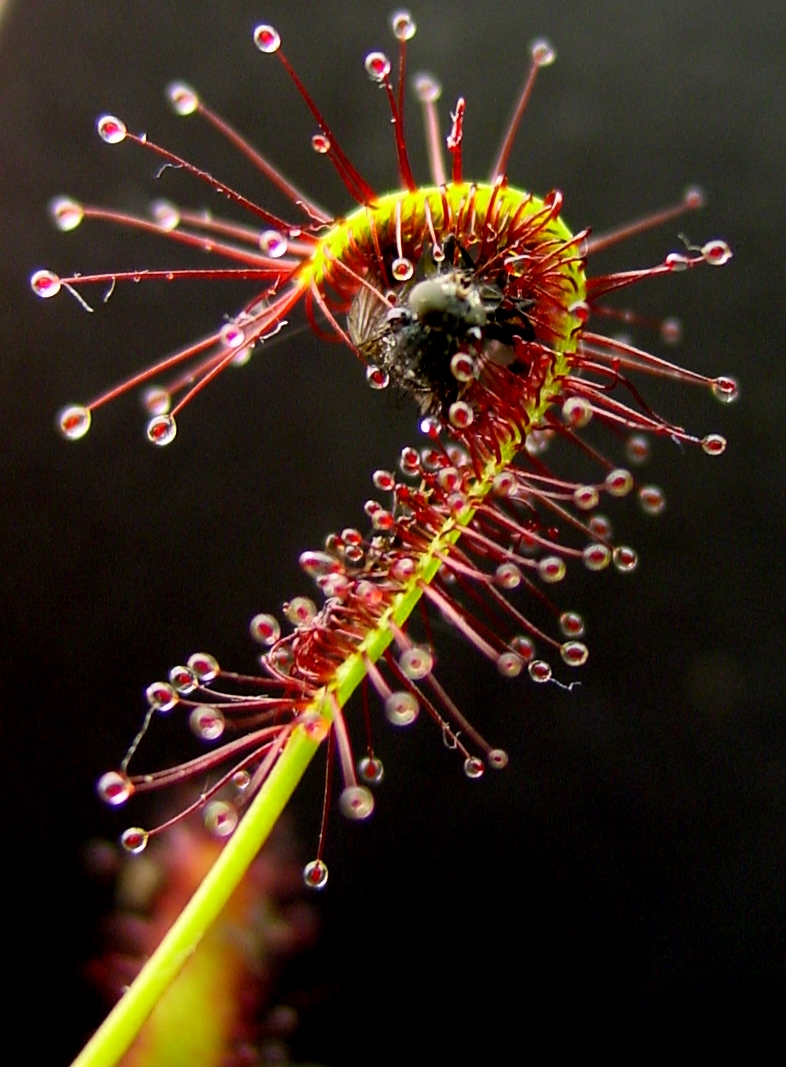
Indian Sundew is an insectivorous flowering plant. It is native to tropical and southern Africa, Madagascar, and tropical and subtropical Asia. It is an unbranched, annual herbaceous plant with a fibrous root system.
Written 26 November 2026 from the sources listed below. Each statement was checked against the passage it cites; statements that could not be supported were removed.
Diet
Indian Sundew is an insectivorous plant.[1]
Appearance
Indian Sundew is an unbranched, annual herbaceous plant with a fibrous root system. It reaches a height of 5–50 cm.[2][3]
Its leaves are narrowly linear and can reach 10 cm in length. Its leaf pedicels measure 1–1.5 cm in length.[4][5]
Young plants grow upright, while older plants develop scrambling stems with only their newest growth remaining upright.[6]
The plant ranges in color from yellow-green to maroon. Its flower petals can be white, pink, orange, or purple.[7][8]
A dwarf form with red tentacles occurs in Thailand.[9]
Habitat
Indian Sundew is native to tropical and southern Africa, Madagascar, and tropical and subtropical Asia. It is considered absent from Australia and is absent from the Neotropics.[10][11][12]
It occurs in tropical countries across Asia and Africa.[12]
Behaviour
The red-tentacled dwarf form in Thailand tolerates drought better than the taller form with white tentacles.[9][13]
Overgrowth by neighbouring plants reduces the growth and seed production of Indian Sundew through increased shading.[14]
Conservation
Collection of Indian Sundew for Herba Drosera production is considered a likely major threat in India.[15][16]
Andhra Pradesh has listed Indian Sundew as vulnerable and likely endangered.[17]
Uses
Chemicals found in Indian Sundew, including plumbagin and the flavonoid quercetin, have been studied for potential pharmaceutical applications.[18]
European countries import Indian Sundew from Asia to prepare the Ayurvedic product Herba Drosera.[15]
Classification of the Indian Sundew
| Kingdom | Plantae |
|---|---|
| Subkingdom | Pteridobiotina |
| Phylum | Tracheophyta |
| Class | Magnoliopsida |
| Order | Caryophyllales |
| Family | Droseraceae (Sundew Family) |
| Genus | Drosera (Sundew) |
| Species | Drosera indica L. |
Where the Indian Sundew is found
Checklists and occurrence records place Drosera indica in 49 countries across Africa, Asia and Oceania. GBIF holds 3,724 georeferenced records of it.
Countries
- Angola 23
- Australia 1,853
- Bangladesh
- Benin 113
- Burkina Faso 38
- Cambodia 14
- Cameroon 13
- Central African Republic 3
- Chad
- China 168
- Democratic Republic of the Congo 22
- Equatorial Guinea 9
- Ethiopia 4
- Gabon 19
- Gambia 4
- Ghana 84
- Guinea 53
- Guinea-Bissau 9
- Hong Kong 5
- India 419
- Indonesia 22
- Ivory Coast 71
- Japan 140
- Kenya 6
- Laos 2
- Liberia 24
- Madagascar 15
- Mali 24
- Mozambique 20
- Myanmar 11
- Namibia 4
- Niger 2
- Nigeria 31
- Papua New Guinea 28
- Philippines 12
- Senegal 29
- Sierra Leone 24
- South Africa 8
- South Sudan
- Sri Lanka 65
- Sudan 3
- Taiwan 136
- Tanzania 24
- Thailand 68
- Togo 35
- Uganda 3
- Vietnam 39
- Zambia 6
- Zimbabwe 19
Regions and cities with the most records
- Queensland, Australia 707
- Northern Territory, Australia 488
- Western Australia, Australia 377
- Maharashtra, India 149
- Satara, India 60
- Telangana, India 55
- Taiwan, Taiwan 52
- Palmerston, Australia 49
- Serilingampalle, India 48
- Amīnpur, India 47
- Hyderabad, India 47
- Kukatpally, India 47
- Rāmachandrapuran, India 47
- Bāspalli, India 45
- Quthbullapur, India 45
- Srīrāmnagar, India 45
- Shamshabad, India 43
- Borgou, Benin 42
- Hainan, China 40
- New South Wales, Australia 38
- Jincheng, Taiwan 34
- Jinhu, Taiwan 34
- Tōgane, Japan 33
- Ōami, Japan 33
- Ōamishirasato, Japan 33
- Chiba, Japan 32
- Pariyāram, India 32
- Cheruthazham, India 31
- Fujian, Taiwan 31
- Karnataka, India 31
- Kunnimangalam, India 31
- Cherukunnu, India 30
- Ezhome, India 30
- Goa, India 30
- Kerala, India 30
- Mādāyi, India 30
Range as the checklists state it
?Senegal; Gambia; Guinea-Bissau; Guinea; Sierra Leone; Liberia; SW-Mali; Burkina Faso; Ivory Coast; Togo; Benin; S-Niger; Nigeria; Cameroon; Central African Republic; S-D. R. Congo [Zaire]; S-Chad; South Sudan; Uganda; Tanzania; Angola; Zambia; Zimbabwe; Mozambique; Namibia; South Africa (Limpopo, Mpulamanga); Madagascar; China (Fujian, Guangdong, Guangxi, Hainan); Japan (Hokkaido, Honshu, Kyushu); Taiwan; India (Andhra Pradesh, Bihar, Goa, Jharkhand, Karnataka, Kerala, Madhya Pradesh, Maharashtra, Odisha, Tamil Nadu, West Bengal); Sri Lanka; Andaman Isl.; Bangladesh; Myanmar (Yangon); Thailand; Laos; Cambodia; Vietnam; +peninsular Malaysia (+Langkawi Isl.); Sumatera; Borneo; Sulawesi; Philippines; Jawa; Lesser Sunda Isl.; New Guinea (Irian Jaya, Papua New Guinea); Australia (widespread in North, New South Wales, Northern Territory, Queensland, South Australia, Victoria, Western Australia)
A number beside a place is its count of GBIF occurrence records. A place without a number comes from a checklist alone. Records show where a species has been observed or collected, which can include escapes and vagrants.
Common names
English
- Indian Sundew
Names in 4 other languages
- Chinese
- 落地金钱, 長葉茅膏菜, 长叶茅膏菜
- Japanese
- ナガバノイシモチソウ
- Marathi
- गवती दवबिंदू
- Thai
- หญ้าน้ำค้าง
Synonyms
14 other scientific names have been used for this species and are now treated as synonyms of Drosera indica.
- Drosera angustifolia F.Muell.
- Drosera angustifolia subsp. purpuriflora F.Muell. ex Diels
- Drosera finlaysoniana Wall. ex Arn.
- Drosera finlaysoniana Wall. ex Stein
- Drosera hexagynia Blanco
- Drosera indica f. albiflora Makino
- Drosera indica f. robusta F.M.Bailey
- Drosera indica var. alba S.A.Parandekar & M.G.Diwan
- Drosera indica var. albiflora (Makino) Makino
- Drosera indica var. makinoi (Masam.) Tamura
- Drosera makinoi Masam.
- Drosera metziana Gand.
- Drosera serpens Planch.
- Drosera minor Schum. & Thonn. ambiguous synonym
Related species
-
 Drosera capensis
-
 Common SundewDrosera rotundifolia
-
 Rosy SundewDrosera spathulata
-
 English SundewDrosera × anglica
-
 Long-Leaved SundewDrosera intermedia
-
 Fork-leaved SundewDrosera binata
-
 Scarlet SundewDrosera glanduligera
-
 Northern Threadleaf SundewDrosera filiformis
Compare
Questions and answers
What is the scientific name of the Indian Sundew?
The scientific name of the Indian Sundew is Drosera indica. Written with its author, the full name is Drosera indica L..
Which family does the Indian Sundew belong to?
Drosera indica belongs to the family Droseraceae, in the order Caryophyllales and the class Magnoliopsida.
Where is the Indian Sundew found?
Checklists and occurrence records place Drosera indica in 49 countries, including Australia, India, China, Japan, Taiwan and Benin.
What is the conservation status of the Indian Sundew?
The IUCN Red List category recorded for Drosera indica is Least Concern (LC).
What do sundews eat?
Indian Sundew is an insectivorous plant.[1]
Sources
Passages the profile rests on
- Drosera indica is an insectivorous plant. Source passage: “Drosera indica is an insectivorous plant” — inaturalist.org
- Drosera indica is an unbranched, annual herbaceous plant with a fibrous root system. Source passage: “an unbranched, annual herbaceous plant, supported by a fibrous root system” — English Wikipedia
- Drosera indica reaches a height of 5–50 cm. Source passage: “reaching a height of 5–50 cm (2–20 in).” — English Wikipedia
- Its leaves are narrowly linear and can reach 10 cm in length. Source passage: “Leaves are narrowly linear, up to 10 cm [4 in] long” — English Wikipedia
- Its leaf pedicels measure 1–1.5 cm in length. Source passage: “with 1–1.5 cm [0.4–0.6 in] pedicels.” — English Wikipedia
- Young plants grow upright, whereas older plants develop scrambling stems with only their newest growth remaining upright. Source passage: “Young plants stand upright, while older ones form scrambling stems with only the newest growth exhibiting an upright habit.” — English Wikipedia
- The plant can range in color from yellow-green to maroon. Source passage: “The plant can be yellow-green to maroon in color.” — English Wikipedia
- Its flower petals can be white, pink, orange, or purple. Source passage: “Flower petals can be white, pink, orange, or purple.” — English Wikipedia
- A dwarf form with red tentacles occurs in Thailand. Source passage: “A red-tentacled dwarf form in Thailand” — English Wikipedia
- Drosera indica is native to tropical and southern Africa, Madagascar, and tropical and subtropical Asia. Source passage: “native to tropical and southern Africa, Madagascar and tropical and subtropical Asia.” — English Wikipedia
- Drosera indica is considered absent from Australia. Source passage: “D. indica itself is now widely considered to be absent from that country.” — English Wikipedia
- Drosera indica occurs in tropical countries across Asia and Africa but is absent from the Neotropics. Source passage: “native to tropical countries throughout the world, from Asia to Africa, but absent from the neotropics.” — inaturalist.org
- The red-tentacled dwarf form in Thailand tolerates drought better than the taller form with white tentacles. Source passage: “has greater tolerance to drought compared to the taller form that has white tentacles.” — English Wikipedia
- Overgrowth by neighbouring plants reduces the growth and seed production of Drosera indica through increased shading. Source passage: “Increased shading caused by overgrowth of neighbouring plants of D. indica reduces both growth and seed production.” — English Wikipedia
- European countries import Drosera indica from Asia to prepare the Ayurvedic product Herba Drosera. Source passage: “European countries import D. indica and D. burmanii from Asia to prepare an Ayurvedic product called "Herba Drosera"” — English Wikipedia
- Collection of Drosera indica for Herba Drosera production is considered a likely major threat in India. Source passage: “Collection of D. indica for this purpose is likely a major threat to the species in countries like India” — English Wikipedia
- Andhra Pradesh has listed Drosera indica as vulnerable and likely endangered. Source passage: “states like Andhra Pradesh have listed the species as vulnerable and likely endangered in the state.” — English Wikipedia
- Chemicals found in Drosera indica, including plumbagin and the flavonoid quercetin, have been studied for potential pharmaceutical applications. Source passage: “Drosera indica contains several chemicals that have been studied for potential pharmaceutical applications, such as plumbagin and flavonoids including quercetin.” — English Wikipedia
Data
- Catalogue of Life, 2026-10-16 XR cc by
- Global Biodiversity Information Facility CC BY 4.0
- Wikidata CC0
- GeoNames CC BY 4.0
- Wikimedia Commons per image; credit shown with each image
- Within the Catalogue of Life, this name comes from Synonymic Checklists of the Vascular Plants of the World cc by
References
- L. (1753). Sp. Pl. [Linnaeus] 1: 282 (1753). where the name was published
This species in other databases
Page built on 26 November 2026. See how the catalog is made and all sources and licences.
Cite this page
ScientificNames.org. (2026). Drosera indica (Indian Sundew). Retrieved November 26, 2026, from https://scientificnames.org/species/drosera-indica
“Drosera indica (Indian Sundew).” ScientificNames.org, 2026, scientificnames.org/species/drosera-indica. Accessed 26 Nov. 2026.
ScientificNames.org. “Drosera indica (Indian Sundew).” Accessed November 26, 2026. https://scientificnames.org/species/drosera-indica.
@misc{scientificnames_drosera_indica_indian_sundew,
  author = {{ScientificNames.org}},
  title = {Drosera indica (Indian Sundew)},
  year = {2026},
  url = {https://scientificnames.org/species/drosera-indica},
  note = {Accessed 2026-11-26}
}