Species · Flowering plants
Drosera kenneallyi
Drosera kenneallyi has no English name on record in the checklists used here. It is a species of flowering plant in the family Droseraceae (sundew family), order Caryophyllales.
- Scientific name
- Drosera kenneallyi Lowrie
- Genus
- Drosera
- Family
- Droseraceae (Sundew Family)
- Order
- Caryophyllales
- Class
- Magnoliopsida
- Recorded in
- 1 country
- Name status
- accepted in the Catalogue of Life

Overview
Drosera kenneallyi Lowrie is a flowering plant in the family Droseraceae, order Caryophyllales and class Magnoliopsida. It is endemic to the Kimberley region of northern Western Australia and is common within a 5 km radius of the Mitchell Plateau Airfield. It has red, insect-catching leaves at the ends of its petioles and adjusts their position to keep them above the water surface during flooding.
Written 27 November 2026 from the sources listed below. Each statement was checked against the passage it cites; statements that could not be supported were removed.
Appearance
The leaves are arranged in a compact basal rosette that lies against the soil. Its petioles are narrowly oblanceolate and emerge from the center of the rosette, measuring typically 1.5–2.2 mm wide at their widest point.[1][2][3]
The carnivorous leaves are red, elliptic to broadly ovate, and located at the ends of the petioles. They measure 2–3 mm in diameter.[4][5]
The inflorescences measure 12.5–20.5 cm in length. The flowers are white and grow in racemes containing 10–20 flowers.[6][7]
Similar species
Drosera falconeri is identified as the species most closely related to Drosera kenneallyi. The two species share many characteristics.[8][9]
Drosera kenneallyi differs from Drosera falconeri through its smaller leaves and shorter inflorescence.[10]
Habitat
The species grows in sandy loam soils along the margins of the Airfield Swamp. The type material was collected beneath a Eucalyptus latifolia near the Airfield Swamp.[11][12]
Behaviour
The species is frequently flooded by high-temperature water during January and February. It responds to changing water levels by adjusting the position of its petioles, keeping its insect-catching leaves above the water surface.[13][14][15]
Reproduction and life cycle
The species produces flowers from November to December.[16]
Classification of Drosera kenneallyi
| Kingdom | Plantae |
|---|---|
| Subkingdom | Pteridobiotina |
| Phylum | Tracheophyta |
| Class | Magnoliopsida |
| Order | Caryophyllales |
| Family | Droseraceae (Sundew Family) |
| Genus | Drosera (Sundew) |
| Species | Drosera kenneallyi Lowrie |
Where Drosera kenneallyi is found
Checklists and occurrence records place Drosera kenneallyi in 1 country across Oceania. GBIF holds 36 georeferenced records of it.
Countries
Regions and cities with the most records
Range as the checklists state it
Australia (Western Australia)
A number beside a place is its count of GBIF occurrence records. A place without a number comes from a checklist alone. Records show where a species has been observed or collected, which can include escapes and vagrants.
Related species
-
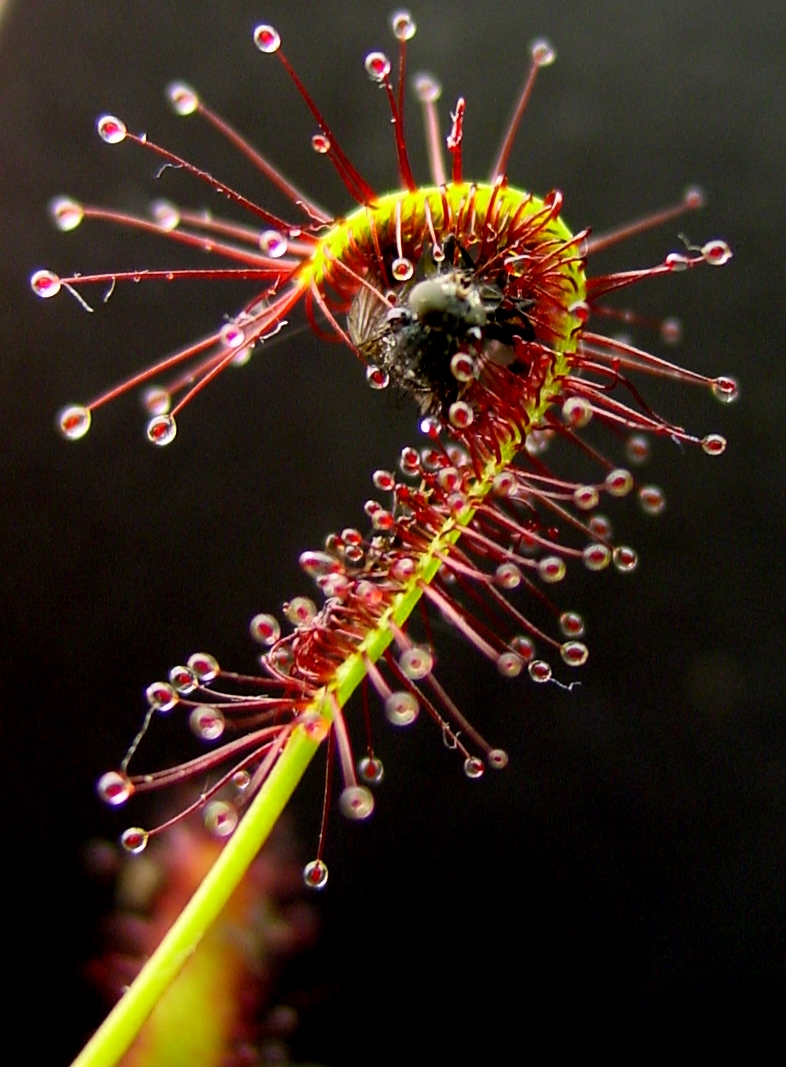 Drosera capensis
-
 Common SundewDrosera rotundifolia
-
 Rosy SundewDrosera spathulata
-
 English SundewDrosera × anglica
-
 Long-Leaved SundewDrosera intermedia
-
 Fork-leaved SundewDrosera binata
-
 Scarlet SundewDrosera glanduligera
-
 Northern Threadleaf SundewDrosera filiformis
Compare
Sources
Passages the profile rests on
- The plant has leaves arranged in a compact basal rosette that lies against the soil. Source passage: “Its leaves are arranged in a compact basal rosette appressed to the soil.” — English Wikipedia
- Its petioles are narrowly oblanceolate and emerge from the center of the rosette. Source passage: “Narrowly oblanceolate petioles emerging from the center of the rosette” — English Wikipedia
- The petioles are typically 1.5–2.2 mm wide at their widest point. Source passage: “typically 1.5–2.2 mm wide at their widest.” — English Wikipedia
- The carnivorous leaves are red, elliptic to broadly ovate, and located at the ends of the petioles. Source passage: “Red carnivorous leaves at the end of the petioles are small at 2–3 mm in diameter and elliptic to broadly ovate.” — English Wikipedia
- The carnivorous leaves measure 2–3 mm in diameter. Source passage: “small at 2–3 mm in diameter” — English Wikipedia
- The inflorescences measure 12.5–20.5 cm in length. Source passage: “Inflorescences are 12.5–20.5 cm (5–8 in) long” — English Wikipedia
- The flowers are white and grow in racemes containing 10–20 flowers. Source passage: “white flowers being produced on 10- to 20-flowered racemes” — English Wikipedia
- Drosera falconeri is identified as the species most closely related to Drosera kenneallyi. Source passage: “D. kenneallyi is most closely related to D. falconeri” — English Wikipedia
- Drosera kenneallyi and Drosera falconeri share many characteristics. Source passage: “but the two species share many characteristics.” — English Wikipedia
- Drosera kenneallyi differs from Drosera falconeri through its smaller leaves and shorter inflorescence. Source passage: “Drosera kenneallyi can be distinguished from D. falconeri by its noticeably smaller leaves and shorter inflorescence” — English Wikipedia
- The species grows in sandy loam soils along the margins of the Airfield Swamp. Source passage: “found in sandy loam soils on the margins of the Airfield Swamp.” — English Wikipedia
- The type material was collected beneath a Eucalyptus latifolia near the Airfield Swamp. Source passage: “The type material was collected under a Eucalyptus latifolia near the Airfield Swamp.” — English Wikipedia
- The species is frequently flooded by high-temperature water during January and February. Source passage: “During January and February, this species is frequently flooded with high-temperature water.” — English Wikipedia
- The plant responds to changing water levels by adjusting the position of its petioles. Source passage: “It survives these conditions by altering the position of its petioles with the rise and fall of the surrounding water.” — English Wikipedia
- The adjustment of its petioles keeps its insect-catching leaves above the water surface. Source passage: “This allows the insect-catching leaves to remain above the water's surface.” — English Wikipedia
- The species produces flowers from November to December. Source passage: “from November to December.” — English Wikipedia
Data
- Catalogue of Life, 2026-10-16 XR cc by
- Global Biodiversity Information Facility CC BY 4.0
- Wikidata CC0
- GeoNames CC BY 4.0
- Wikimedia Commons per image; credit shown with each image
- Within the Catalogue of Life, this name comes from Synonymic Checklists of the Vascular Plants of the World cc by
References
- Lowrie. (1996). Nuytsia 10(3): 420 (1996). where the name was published
This species in other databases
- Catalogue of Life 37QSJ
- Wikidata Q290528
- iNaturalist 929601
- World Flora Online wfo-0000945989
- GRIN 495746
Page built on 29 November 2026. See how the catalog is made and all sources and licences.
Cite this page
ScientificNames.org. (2026). Drosera kenneallyi. Retrieved November 29, 2026, from https://scientificnames.org/species/drosera-kenneallyi
“Drosera kenneallyi.” ScientificNames.org, 2026, scientificnames.org/species/drosera-kenneallyi. Accessed 29 Nov. 2026.
ScientificNames.org. “Drosera kenneallyi.” Accessed November 29, 2026. https://scientificnames.org/species/drosera-kenneallyi.
@misc{scientificnames_drosera_kenneallyi,
  author = {{ScientificNames.org}},
  title = {Drosera kenneallyi},
  year = {2026},
  url = {https://scientificnames.org/species/drosera-kenneallyi},
  note = {Accessed 2026-11-29}
}