Species · Flowering plants
Drosera myriantha
Drosera myriantha has no English name on record in the checklists used here. It is a species of flowering plant in the family Droseraceae (sundew family), order Caryophyllales.
- Scientific name
- Drosera myriantha Planch.
- Genus
- Drosera
- Family
- Droseraceae (Sundew Family)
- Order
- Caryophyllales
- Class
- Magnoliopsida
- Red List category
- LC Least Concern
- Recorded in
- 1 country
- Name status
- accepted in the Catalogue of Life
Overview
Drosera myriantha Planch. is an erect, tuberous sundew species and a perennial flowering plant. It grows in swampy areas with peaty sand soils and is endemic to Western Australia, occurring along the Western Australian coast from south of Perth to Albany. It produces carnivorous leaves along its stems and has white or pink flowers.
Written 27 November 2026 from the sources listed below. Each statement was checked against the passage it cites; statements that could not be supported were removed.
Appearance
Drosera myriantha is an erect, tuberous sundew with carnivorous leaves growing along its stems. Its stems reach 15–35 cm in height.[1][2][3]
Its flowers are white or pink. The species is also known as the starry sundew.[4][5]
Habitat
Drosera myriantha grows in swampy areas with peaty sand soils. It is endemic to Western Australia and occurs along the Western Australian coast from south of Perth to Albany.[6][7][8]
Reproduction and life cycle
Drosera myriantha flowers from October to December.[9]
Uses
Drosera myriantha was first described by Jules Émile Planchon in 1848.[10]
Classification of Drosera myriantha
| Kingdom | Plantae |
|---|---|
| Subkingdom | Pteridobiotina |
| Phylum | Tracheophyta |
| Class | Magnoliopsida |
| Order | Caryophyllales |
| Family | Droseraceae (Sundew Family) |
| Genus | Drosera (Sundew) |
| Species | Drosera myriantha Planch. |
Where Drosera myriantha is found
Checklists and occurrence records place Drosera myriantha in 1 country across Oceania. GBIF holds 99 georeferenced records of it.
Countries
Regions and cities with the most records
Range as the checklists state it
Australia (SW-Western Australia: between Busselton, Augusta and Albany)
A number beside a place is its count of GBIF occurrence records. A place without a number comes from a checklist alone. Records show where a species has been observed or collected, which can include escapes and vagrants.
Synonyms
One other scientific name has been used for this species and is now treated as a synonym of Drosera myriantha.
- Sondera myriantha (Planch.) Chrtek & Slavíková
Related species
-
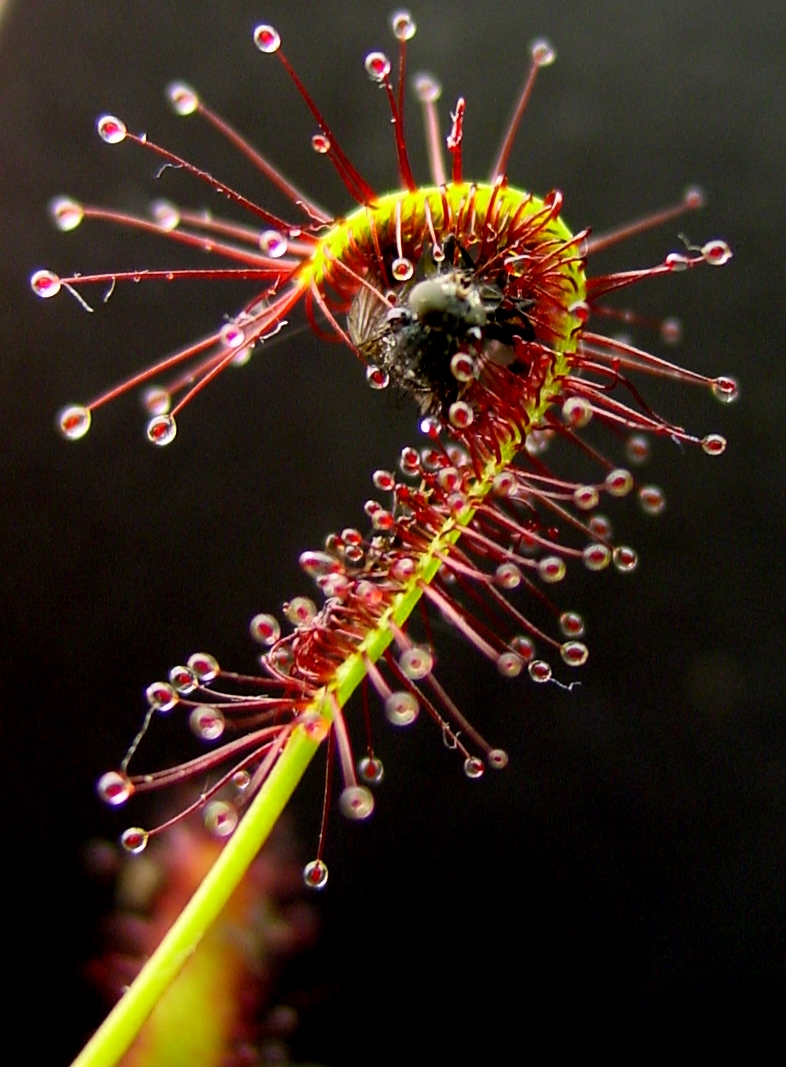 Drosera capensis
-
 Common SundewDrosera rotundifolia
-
 Rosy SundewDrosera spathulata
-
 English SundewDrosera × anglica
-
 Long-Leaved SundewDrosera intermedia
-
 Fork-leaved SundewDrosera binata
-
 Scarlet SundewDrosera glanduligera
-
 Northern Threadleaf SundewDrosera filiformis
Compare
Questions and answers
Sources
Passages the profile rests on
- Drosera myriantha is an erect, tuberous sundew species. Source passage: “is an erect perennial tuberous species in the carnivorous plant genus Drosera.” — English Wikipedia
- Drosera myriantha produces carnivorous leaves along its stems. Source passage: “D. myriantha produces carnivorous leaves along stems” — English Wikipedia
- The stems of Drosera myriantha reach 15–35 cm in height. Source passage: “stems that can be 15–35 cm (6–14 in) high.” — English Wikipedia
- The flowers of Drosera myriantha are white or pink. Source passage: “White or pink flowers bloom from October to December.” — English Wikipedia
- Drosera myriantha is also known as the starry sundew. Source passage: “the star rainbow or starry sundew” — English Wikipedia
- Drosera myriantha grows in swampy areas with peaty sand soils. Source passage: “It grows in swampy areas in peaty sand soils.” — English Wikipedia
- Drosera myriantha is endemic to Western Australia. Source passage: “It is endemic to Western Australia” — English Wikipedia
- Drosera myriantha occurs along the Western Australian coast from south of Perth to Albany. Source passage: “is found along the coast south of Perth to Albany.” — English Wikipedia
- Drosera myriantha flowers from October to December. Source passage: “White or pink flowers bloom from October to December.” — English Wikipedia
- Drosera myriantha was first described by Jules Émile Planchon in 1848. Source passage: “Drosera myriantha was first described by Jules Émile Planchon in 1848.” — English Wikipedia
Data
- Catalogue of Life, 2026-10-16 XR cc by
- Global Biodiversity Information Facility CC BY 4.0
- Wikidata CC0
- GeoNames CC BY 4.0
- Within the Catalogue of Life, this name comes from Synonymic Checklists of the Vascular Plants of the World cc by
References
- Planch. (1848). Ann. Sci. Nat., Bot., Sér. 3, 9: 291 (1848). where the name was published
This species in other databases
Page built on 28 November 2026. See how the catalog is made and all sources and licences.
Cite this page
ScientificNames.org. (2026). Drosera myriantha. Retrieved November 28, 2026, from https://scientificnames.org/species/drosera-myriantha
“Drosera myriantha.” ScientificNames.org, 2026, scientificnames.org/species/drosera-myriantha. Accessed 28 Nov. 2026.
ScientificNames.org. “Drosera myriantha.” Accessed November 28, 2026. https://scientificnames.org/species/drosera-myriantha.
@misc{scientificnames_drosera_myriantha,
  author = {{ScientificNames.org}},
  title = {Drosera myriantha},
  year = {2026},
  url = {https://scientificnames.org/species/drosera-myriantha},
  note = {Accessed 2026-11-28}
}