Species · Flowering plants
Drosera nidiformis
Drosera nidiformis has no English name on record in the checklists used here. It is a species of flowering plant in the family Droseraceae (sundew family), order Caryophyllales.
- Scientific name
- Drosera nidiformis Debbert
- Genus
- Drosera
- Family
- Droseraceae (Sundew Family)
- Order
- Caryophyllales
- Class
- Magnoliopsida
- Recorded in
- 1 country
- Name status
- accepted in the Catalogue of Life

Overview
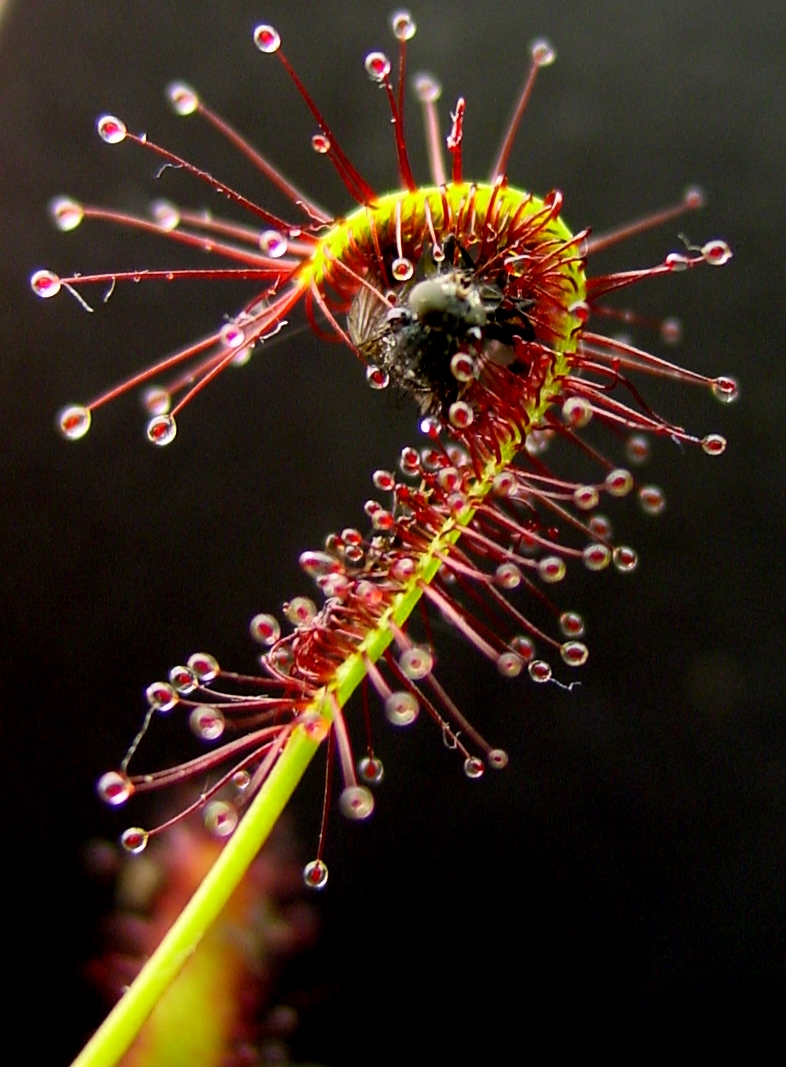
The species is indigenous to KwaZulu-Natal in South Africa. Its leaves curl around captured prey in a response known as thigmotropism.
Written 27 November 2026 from the sources listed below. Each statement was checked against the passage it cites; statements that could not be supported were removed.
Habitat
Drosera nidiformis grows in nutrient-poor, acidic soil. It originates from a subtropical climate.[1][2]
Appearance
Mature plants have obovate leaves measuring between 1 and 2 cm in length. The petioles can reach approximately 5 cm in length.[3][4]
The plant develops a reddish tint under suitable lighting conditions.[5]
Behaviour
After capturing prey, the leaves curl around it to maximize contact with digestive glands. This response is an example of thigmotropism.[6][7]
The species does not tolerate cold temperatures and does not enter dormancy.[8][9]
Reproduction and life cycle
Flowering can have an exhausting effect on the plant when growing conditions are not ideal.[10]
Similar species
Some sources classify Drosera nidiformis as a synonym of Drosera dielsiana, while others recognize it as a separate species. The species was previously known as Drosera maglisburg.[11][12]
Classification of Drosera nidiformis
| Kingdom | Plantae |
|---|---|
| Subkingdom | Pteridobiotina |
| Phylum | Tracheophyta |
| Class | Magnoliopsida |
| Order | Caryophyllales |
| Family | Droseraceae (Sundew Family) |
| Genus | Drosera (Sundew) |
| Species | Drosera nidiformis Debbert |
Where Drosera nidiformis is found
Checklists and occurrence records place Drosera nidiformis in 1 country across Africa. GBIF holds 31 georeferenced records of it.
Countries
Regions and cities with the most records
1 more country has a few records outside this range
These countries hold a few records of Drosera nidiformis but lie outside the range the checklists give for it. Such records are often zoo or garden specimens, museum material or vagrants, so the species is not counted as occurring there.
Range as the checklists state it
South Africa (KwaZulu-Natal)
A number beside a place is its count of GBIF occurrence records. A place without a number comes from a checklist alone. Records show where a species has been observed or collected, which can include escapes and vagrants.
Common names
Names in 1 other language
- Chinese
- 巢型茅膏菜
Related species
-
 Drosera capensis
-
 Common SundewDrosera rotundifolia
-
 Rosy SundewDrosera spathulata
-
 English SundewDrosera × anglica
-
 Long-Leaved SundewDrosera intermedia
-
 Fork-leaved SundewDrosera binata
-
 Scarlet SundewDrosera glanduligera
-
 Northern Threadleaf SundewDrosera filiformis
Compare
Questions and answers
Sources
Passages the profile rests on
- The species grows in nutrient-poor, acidic soil. Source passage: “D. nidiformis, like most carnivorous plants, grows in nutrient-poor, acidic soil.” — English Wikipedia
- The species originates from a subtropical climate. Source passage: “Because it is from a subtropical climate, D. nidiformis does not tolerate cold temperatures and will not enter dormancy.” — English Wikipedia
- Mature plants have obovate leaves measuring between 1 and 2 cm in length. Source passage: “Leaves on mature specimens are obovate and range from 1 to 2 cm in length.” — English Wikipedia
- The petioles can reach approximately 5 cm in length. Source passage: “Petioles can grow 1.5 to a maximum of approximately 5 cm.” — English Wikipedia
- The plant develops a reddish tint under suitable lighting conditions. Source passage: “D. nidiformis exhibits a reddish tint if grown in the correct light conditions.” — English Wikipedia
- After capturing prey, the leaves curl around it to maximize contact with digestive glands. Source passage: “Upon capture of prey, the leaf curls around it to bring it into contact with as many digestive glands as possible.” — English Wikipedia
- The leaf-curling response to prey capture is an example of thigmotropism. Source passage: “This is an example of thigmotropism, or acting in response to a touch stimulus.” — English Wikipedia
- The species does not tolerate cold temperatures. Source passage: “D. nidiformis does not tolerate cold temperatures” — English Wikipedia
- The species does not enter dormancy. Source passage: “will not enter dormancy.” — English Wikipedia
- Flowering can have an exhausting effect on the plant when growing conditions are not ideal. Source passage: “If all growing conditions are not ideal, flowering has an exhausting effect on the plant.” — English Wikipedia
- Some sources classify Drosera nidiformis as a synonym of Drosera dielsiana, while others recognize it as a separate species. Source passage: “some sources refer to it as a synonym of Drosera dielsiana whereas others treat it as a separate species.” — English Wikipedia
- The species was previously known as Drosera maglisburg. Source passage: “This plant was previously known as Drosera "maglisburg".” — English Wikipedia
- Drosera nidiformis is indigenous to KwaZulu-Natal in South Africa. Source passage: “This plant is indigenous to KwaZulu-Natal in South Africa.” — English Wikipedia
Data
- Catalogue of Life, 2026-10-16 XR cc by
- Global Biodiversity Information Facility CC BY 4.0
- Wikidata CC0
- GeoNames CC BY 4.0
- Wikimedia Commons per image; credit shown with each image
- Within the Catalogue of Life, this name comes from Synonymic Checklists of the Vascular Plants of the World cc by
References
- Debbert. (1991). Mitt. Bot. Staatssamml. München 30: 374 (1991 publ. 1992). where the name was published
This species in other databases
- Catalogue of Life 6DKG4
- Wikidata Q5308533
- iNaturalist 741465
- World Flora Online wfo-0000946064
- GRIN 495748
Page built on 27 November 2026. See how the catalog is made and all sources and licences.
Cite this page
ScientificNames.org. (2026). Drosera nidiformis. Retrieved November 27, 2026, from https://scientificnames.org/species/drosera-nidiformis
“Drosera nidiformis.” ScientificNames.org, 2026, scientificnames.org/species/drosera-nidiformis. Accessed 27 Nov. 2026.
ScientificNames.org. “Drosera nidiformis.” Accessed November 27, 2026. https://scientificnames.org/species/drosera-nidiformis.
@misc{scientificnames_drosera_nidiformis,
  author = {{ScientificNames.org}},
  title = {Drosera nidiformis},
  year = {2026},
  url = {https://scientificnames.org/species/drosera-nidiformis},
  note = {Accessed 2026-11-27}
}