Species · Flowering plants
Drosera ordensis
Drosera ordensis has no English name on record in the checklists used here. It is a species of flowering plant in the family Droseraceae (sundew family), order Caryophyllales.
- Scientific name
- Drosera ordensis Lowrie
- Genus
- Drosera
- Family
- Droseraceae (Sundew Family)
- Order
- Caryophyllales
- Class
- Magnoliopsida
- Red List category
- LC Least Concern
- Recorded in
- 2 countries
- Name status
- accepted in the Catalogue of Life

Overview
Drosera ordensis is a perennial rosette-forming herb. It occurs in the northeastern tip of Western Australia near Kununurra and Pago, and in the neighbouring region of the Northern Territory, including Keep River National Park. It has wide petioles covered with silvery hairs and nearly round leaf laminae densely covered with stalked mucilaginous glands.
Written 27 November 2026 from the sources listed below. Each statement was checked against the passage it cites; statements that could not be supported were removed.
Appearance
Drosera ordensis forms clumps of stemless or nearly stemless rosettes. Each leaf consists of a long, hairy petiole supporting a nearly round lamina, which is densely covered with stalked mucilaginous glands.[1][2][3]
The petioles are wide and densely covered with silvery hairs. During the dry season, the plant produces smaller leaves with a dense covering of silvery hairs.[4][5]
The flowers have five petals and range from pink to nearly white. They are approximately 1.5 cm in diameter.[6][7]
Habitat
Drosera ordensis inhabits sandy soils near sandstone outcrops. It is often associated with Sorghum species.[8][9]
Diet
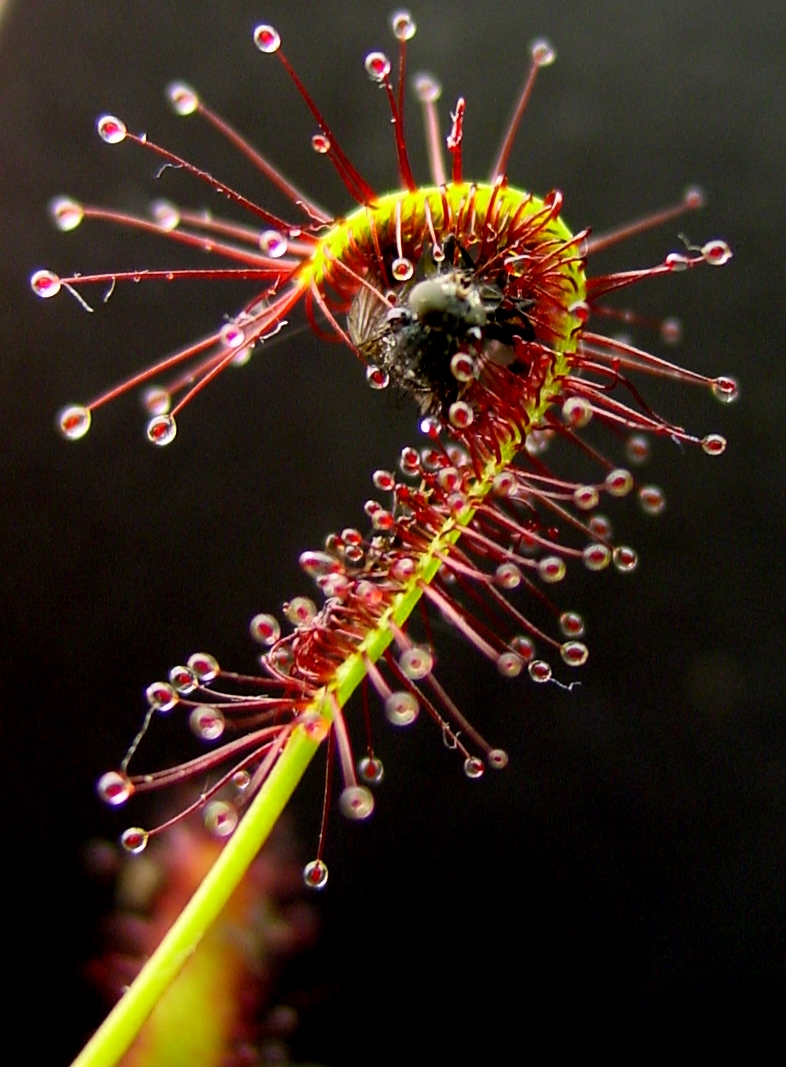
Drosera ordensis captures arthropods using its stalked mucilaginous glands. It digests and absorbs captured arthropods as a source of nutrients.[10][11]
Reproduction and life cycle
Drosera ordensis flowers from December through April. Its flowers grow on crowded racemes and open singly.[12][13]
Classification of Drosera ordensis
| Kingdom | Plantae |
|---|---|
| Subkingdom | Pteridobiotina |
| Phylum | Tracheophyta |
| Class | Magnoliopsida |
| Order | Caryophyllales |
| Family | Droseraceae (Sundew Family) |
| Genus | Drosera (Sundew) |
| Species | Drosera ordensis Lowrie |
Where Drosera ordensis is found
Checklists and occurrence records place Drosera ordensis in 2 countries across Oceania. GBIF holds 241 georeferenced records of it.
Countries
Regions and cities with the most records
Range as the checklists state it
New Guinea (Papua New Guinea); Australia (Western Australia)
A number beside a place is its count of GBIF occurrence records. A place without a number comes from a checklist alone. Records show where a species has been observed or collected, which can include escapes and vagrants.
Common names
Names in 1 other language
- Chinese
- 宽银茅膏菜
Related species
-
 Drosera capensis
-
 Common SundewDrosera rotundifolia
-
 Rosy SundewDrosera spathulata
-
 English SundewDrosera × anglica
-
 Long-Leaved SundewDrosera intermedia
-
 Fork-leaved SundewDrosera binata
-
 Scarlet SundewDrosera glanduligera
-
 Northern Threadleaf SundewDrosera filiformis
Compare
Questions and answers
Sources
Passages the profile rests on
- Drosera ordensis forms clumps of stemless or nearly stemless rosettes. Source passage: “D. ordensis forms clumps of stemless or nearly stemless rosettes.” — English Wikipedia
- Each leaf consists of a long, hairy petiole supporting a nearly round lamina. Source passage: “a long, hairy petiole supporting a nearly round lamina.” — English Wikipedia
- The leaf lamina is densely covered with stalked mucilaginous glands. Source passage: “The lamina is densely studded with stalked mucilaginous glands” — English Wikipedia
- Drosera ordensis has wide petioles densely covered with silvery hairs. Source passage: “it has wide petioles, which are densely covered in silvery hairs.” — English Wikipedia
- During the dry season, Drosera ordensis produces smaller leaves with a dense covering of silvery hairs. Source passage: “During the dry season, the plant produces smaller, somewhat dormant leaves which are protected by their dense covering of silvery hairs.” — English Wikipedia
- Drosera ordensis produces five-petaled flowers that range from pink to nearly white. Source passage: “The five-petaled flowers can be pink to nearly white” — English Wikipedia
- The flowers of Drosera ordensis are approximately 1.5 cm in diameter. Source passage: “are about 1.5 cm in diameter.” — English Wikipedia
- Drosera ordensis inhabits sandy soils near sandstone outcrops. Source passage: “inhabits sandy soils near sandstone outcrops” — English Wikipedia
- Drosera ordensis is often associated with Sorghum species. Source passage: “The plant is often associated with Sorghum species.” — English Wikipedia
- Drosera ordensis captures arthropods using its stalked mucilaginous glands. Source passage: “which serve to attract and trap arthropod prey” — English Wikipedia
- Drosera ordensis digests and absorbs captured arthropods as a source of nutrients. Source passage: “which is subsequently digested and absorbed by the plant as a source of nutrients.” — English Wikipedia
- Drosera ordensis flowers from December through April. Source passage: “Drosera ordensis flowers from December through April.” — English Wikipedia
- Drosera ordensis produces flowers on crowded racemes that open singly. Source passage: “Flowers form on a crowded raceme, opening singly.” — English Wikipedia
Data
- Catalogue of Life, 2026-10-16 XR cc by
- Global Biodiversity Information Facility CC BY 4.0
- Wikidata CC0
- GeoNames CC BY 4.0
- Wikimedia Commons per image; credit shown with each image
- Within the Catalogue of Life, this name comes from Synonymic Checklists of the Vascular Plants of the World cc by
References
- Lowrie. (1994). Nuytsia 9(3): 365 (1994). where the name was published
This species in other databases
- Catalogue of Life 6DKFL
- Wikidata Q290039
- iNaturalist 483429
- World Flora Online wfo-0000946083
- GRIN 495731
Page built on 27 November 2026. See how the catalog is made and all sources and licences.
Cite this page
ScientificNames.org. (2026). Drosera ordensis. Retrieved November 27, 2026, from https://scientificnames.org/species/drosera-ordensis
“Drosera ordensis.” ScientificNames.org, 2026, scientificnames.org/species/drosera-ordensis. Accessed 27 Nov. 2026.
ScientificNames.org. “Drosera ordensis.” Accessed November 27, 2026. https://scientificnames.org/species/drosera-ordensis.
@misc{scientificnames_drosera_ordensis,
  author = {{ScientificNames.org}},
  title = {Drosera ordensis},
  year = {2026},
  url = {https://scientificnames.org/species/drosera-ordensis},
  note = {Accessed 2026-11-27}
}