Species · Flowering plants
Tooth Sundew Drosera sessilifolia
The scientific name of the Tooth Sundew is Drosera sessilifolia. It is a species of flowering plant in the family Droseraceae (sundew family), order Caryophyllales.
- Scientific name
- Drosera sessilifolia A.St.-Hil.
- Common name
- Tooth Sundew
- Genus
- Drosera
- Family
- Droseraceae (Sundew Family)
- Order
- Caryophyllales
- Class
- Magnoliopsida
- Recorded in
- 7 countries
- Name status
- accepted in the Catalogue of Life

Overview
The species is native to Brazil, Guyana, and Venezuela. It forms a rosette of small, wedge-shaped to rounded carnivorous leaves that are generally yellowish and become redder with age.
Written 27 November 2026 from the sources listed below. Each statement was checked against the passage it cites; statements that could not be supported were removed.
Appearance
Tooth Sundew forms a rosette of small, wedge-shaped to rounded carnivorous leaves. Its leaves are generally yellowish but become redder as they age.[1][2][3]
Its inflorescences bear pink-lilac flowers.[4]
Habitat
Tooth Sundew grows in sandy or gravelly soils in seasonal seepages where a thin layer of water accumulates.[5]
Diet
Tooth Sundew has carnivorous leaves.[6]
Similar species
Drosera burmanni is closely related to Tooth Sundew and is the only other species in section Thelocalyx. Drosera burmanni is native to Australia and Southeast Asia.[7][8][9]
Reproduction and life cycle
Tooth Sundew produces pink-lilac flowers in its inflorescences.[10]
Classification of the Tooth Sundew
| Kingdom | Plantae |
|---|---|
| Subkingdom | Pteridobiotina |
| Phylum | Tracheophyta |
| Class | Magnoliopsida |
| Order | Caryophyllales |
| Family | Droseraceae (Sundew Family) |
| Genus | Drosera (Sundew) |
| Species | Drosera sessilifolia A.St.-Hil. |
Where the Tooth Sundew is found
Checklists and occurrence records place Drosera sessilifolia in 7 countries across South America. GBIF holds 703 georeferenced records of it.
Countries
Regions and cities with the most records
- Goiás, Brazil 49
- Rio Grande do Norte, Brazil 43
- Tocantins, Brazil 39
- Mato Grosso, Brazil 33
- Maranhão, Brazil 30
- Paraíba, Brazil 27
- Mamanguape, Brazil 25
- Rio Tinto, Brazil 25
- Itapororoca, Brazil 22
- Pará, Brazil 20
- Vichada Department, Colombia 20
- Bahia, Brazil 18
- Piauí, Brazil 18
- Roraima, Brazil 18
- Upper Takutu-Upper Essequibo, Guyana 16
- Ceará, Brazil 14
- Apure, Venezuela 12
- Parnamirim, Brazil 11
- Ceará-Mirim, Brazil 10
- Amazonas, Brazil 8
- Macaíba, Brazil 8
- Monte Alegre, Brazil 8
- Nísia Floresta, Brazil 8
- São José de Mipibu, Brazil 8
- Marapanim, Brazil 7
- Minas Gerais, Brazil 7
- Piracuruca, Brazil 7
- Bolívar, Venezuela 6
- Mato Grosso do Sul, Brazil 6
- Nova Xavantina, Brazil 6
- Piripiri, Brazil 6
- Puerto Ayacucho, Venezuela 6
- Amazonas, Venezuela 5
- Guárico, Venezuela 5
- Natal, Brazil 5
- São Gonçalo do Amarante, Brazil 5
Range as the checklists state it
Colombia (Vichada); Venezuela (Amazonas, Anzoátegui, Apure, Bolívar, Cojedes, Guárico, Monagas); Guyana; Surinam; ?French Guiana; Bolivia (Santa Cruz); N-Brazil (Pará); NE-Brazil (Maranhão, Piauí, Ceará, Bahia); WC-Brazil (Mato Grosso, Goiás, Mato Grosso do Sul)
A number beside a place is its count of GBIF occurrence records. A place without a number comes from a checklist alone. Records show where a species has been observed or collected, which can include escapes and vagrants.
Common names
English
- Tooth Sundew
Names in 1 other language
- Chinese
- 南美宽叶毛毡苔
Synonyms
3 other scientific names have been used for this species and are now treated as synonyms of Drosera sessilifolia.
- Drosera dentata Benth.
- Drosera sessiliflora G.Don
- Drosera sessiliflora A. St.
Related species
-
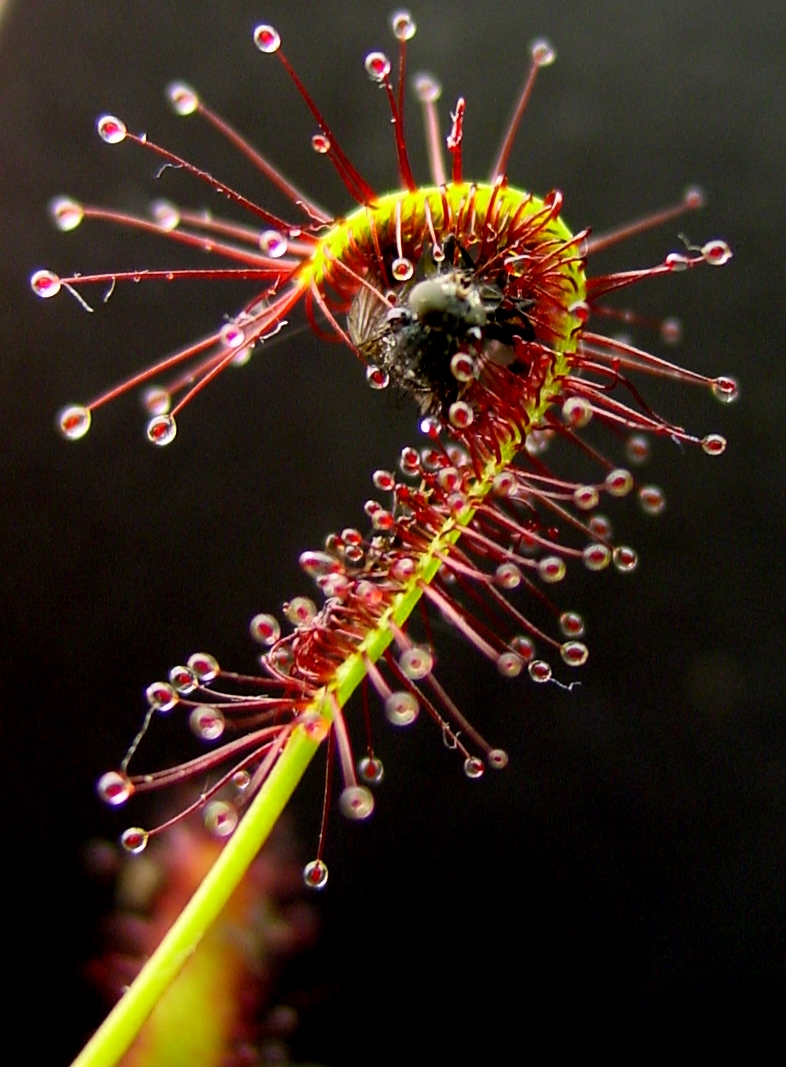 Drosera capensis
-
 Common SundewDrosera rotundifolia
-
 Rosy SundewDrosera spathulata
-
 English SundewDrosera × anglica
-
 Long-Leaved SundewDrosera intermedia
-
 Fork-leaved SundewDrosera binata
-
 Scarlet SundewDrosera glanduligera
-
 Northern Threadleaf SundewDrosera filiformis
Compare
Questions and answers
What is the scientific name of the Tooth Sundew?
The scientific name of the Tooth Sundew is Drosera sessilifolia. Written with its author, the full name is Drosera sessilifolia A.St.-Hil..
Which family does the Tooth Sundew belong to?
Drosera sessilifolia belongs to the family Droseraceae, in the order Caryophyllales and the class Magnoliopsida.
Where is the Tooth Sundew found?
Checklists and occurrence records place Drosera sessilifolia in 7 countries, including Brazil, Venezuela, Guyana, Colombia, Bolivia and French Guiana.
What do sundews eat?
Tooth Sundew has carnivorous leaves.[6]
Sources
Passages the profile rests on
- The plant forms a rosette of small, wedge-shaped to rounded carnivorous leaves. Source passage: “It produces a rosette of small, wedge-shaped to round carnivorous leaves” — English Wikipedia
- Its leaves are generally yellowish but become redder as they age. Source passage: “leaves that are usually yellowish but become redder with age.” — English Wikipedia
- The species has small leaves. Source passage: “small, wedge-shaped to round carnivorous leaves” — English Wikipedia
- Its inflorescences bear pink-lilac flowers. Source passage: “Inflorescences produce pink-lilac flowers.” — English Wikipedia
- The species grows in sandy or gravelly soils in seasonal seepages where a thin layer of water accumulates. Source passage: “grows in sandy or gravelly soils in seasonal seepages where a thin film of water collects.” — English Wikipedia
- The species has carnivorous leaves. Source passage: “small, wedge-shaped to round carnivorous leaves” — English Wikipedia
- Drosera burmanni is closely related to Drosera sessilifolia. Source passage: “It is closely related to D. burmanni” — English Wikipedia
- Drosera burmanni is the only other species in section Thelocalyx. Source passage: “the only other species in section Thelocalyx” — English Wikipedia
- The closely related Drosera burmanni is native to Australia and Southeast Asia. Source passage: “D. burmanni is native to Australia and Southeast Asia.” — English Wikipedia
- The species produces pink-lilac flowers in its inflorescences. Source passage: “Inflorescences produce pink-lilac flowers.” — English Wikipedia
Data
- Catalogue of Life, 2026-10-16 XR cc by
- Global Biodiversity Information Facility CC BY 4.0
- Wikidata CC0
- GeoNames CC BY 4.0
- Wikimedia Commons per image; credit shown with each image
- Within the Catalogue of Life, this name comes from Synonymic Checklists of the Vascular Plants of the World cc by
References
- A.St.-Hil. Hist. Pl. Remarq. Bresil 259., t. 25 (1824). where the name was published
This species in other databases
Page built on 29 November 2026. See how the catalog is made and all sources and licences.
Cite this page
ScientificNames.org. (2026). Drosera sessilifolia (Tooth Sundew). Retrieved November 29, 2026, from https://scientificnames.org/species/drosera-sessilifolia
“Drosera sessilifolia (Tooth Sundew).” ScientificNames.org, 2026, scientificnames.org/species/drosera-sessilifolia. Accessed 29 Nov. 2026.
ScientificNames.org. “Drosera sessilifolia (Tooth Sundew).” Accessed November 29, 2026. https://scientificnames.org/species/drosera-sessilifolia.
@misc{scientificnames_drosera_sessilifolia_tooth_sundew,
  author = {{ScientificNames.org}},
  title = {Drosera sessilifolia (Tooth Sundew)},
  year = {2026},
  url = {https://scientificnames.org/species/drosera-sessilifolia},
  note = {Accessed 2026-11-29}
}