Species · Flowering plants
Drosera silvicola
Drosera silvicola has no English name on record in the checklists used here. It is a species of flowering plant in the family Droseraceae (sundew family), order Caryophyllales.
- Scientific name
- Drosera silvicola Lowrie & Carlquist
- Genus
- Drosera
- Family
- Droseraceae (Sundew Family)
- Order
- Caryophyllales
- Class
- Magnoliopsida
- Red List category
- LC Least Concern
- Recorded in
- 1 country
- Name status
- accepted in the Catalogue of Life

Overview
Drosera silvicola is native to Western Australia and occurs in open areas of Jarrah forest with very little leaf litter. Its leaves have sticky tentacles that capture and digest tiny insects, and its flowers have pink, glossy petals with a dark red centre.
Written 27 November 2026 from the sources listed below. Each statement was checked against the passage it cites; statements that could not be supported were removed.
Appearance
The flowers have pink, glossy petals and a dark red centre. The leaves are covered with sticky tentacles.[1][2]
Habitat
The species occurs in open areas of Jarrah forest with very little leaf litter. It has been found on ridges and slopes situated at relatively high elevations.[3][4]
Before the 2025 discovery, two confirmed populations were known at other sites approximately 70 km from Paruna. One occurred on a mining tenement and another on an active mine site.[5][6]
Diet
Drosera silvicola captures and digests tiny insects using its leaves, which are covered with sticky tentacles.[2][7]
Conservation
The Western Australian Department of Biodiversity, Conservation and Attractions lists the species as Priority 1. It is classified as extremely rare and potentially threatened, requiring an urgent full conservation assessment.[8][9]
Classification of Drosera silvicola
| Kingdom | Plantae |
|---|---|
| Subkingdom | Pteridobiotina |
| Phylum | Tracheophyta |
| Class | Magnoliopsida |
| Order | Caryophyllales |
| Family | Droseraceae (Sundew Family) |
| Genus | Drosera (Sundew) |
| Species | Drosera silvicola Lowrie & Carlquist |
Where Drosera silvicola is found
Checklists and occurrence records place Drosera silvicola in 1 country across Oceania. GBIF holds 33 georeferenced records of it.
Countries
Regions and cities with the most records
Range as the checklists state it
Australia (Western Australia)
A number beside a place is its count of GBIF occurrence records. A place without a number comes from a checklist alone. Records show where a species has been observed or collected, which can include escapes and vagrants.
Synonyms
One other scientific name has been used for this species and is now treated as a synonym of Drosera silvicola.
- Drosera barbigera subsp. silvicola (Lowrie & Carlquist) Schlauer
Related species
-
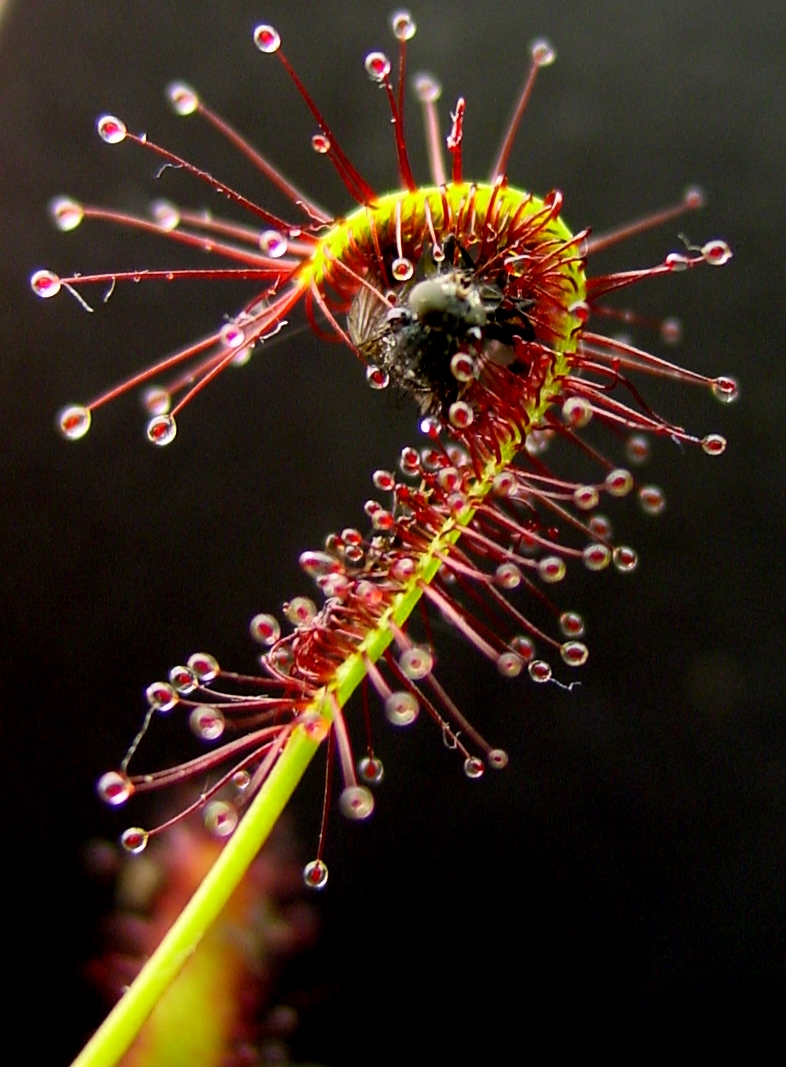 Drosera capensis
-
 Common SundewDrosera rotundifolia
-
 Rosy SundewDrosera spathulata
-
 English SundewDrosera × anglica
-
 Long-Leaved SundewDrosera intermedia
-
 Fork-leaved SundewDrosera binata
-
 Scarlet SundewDrosera glanduligera
-
 Northern Threadleaf SundewDrosera filiformis
Compare
Questions and answers
What do sundew plants eat?
Drosera silvicola captures and digests tiny insects using its leaves.[7]
Sources
Passages the profile rests on
- The flowers have pink, glossy petals and a dark red centre. Source passage: “pink, glossy petals and a dark red centre.” — English Wikipedia
- The leaves are covered with sticky tentacles. Source passage: “its leaves which are covered with sticky tentacles.” — English Wikipedia
- The species occurs in open areas of Jarrah forest with very little leaf litter. Source passage: “It was in the Jarrah forest, but it was an open area with very little leaf litter” — English Wikipedia
- The species has been found on ridges and slopes situated at relatively high elevations. Source passage: “The area had ridges and slopes that sat high up” — English Wikipedia
- Before the 2025 discovery, two confirmed populations were known at other sites approximately 70 km from Paruna. Source passage: “there were only two confirmed populations of the species at other sites, 70 km (43 mi) from the Paruna site” — English Wikipedia
- One previously confirmed population occurred on a mining tenement and another on an active mine site. Source passage: “one on a mining tenement and the other on an active mine site.” — English Wikipedia
- The species captures and digests tiny insects using its leaves. Source passage: “It captures and digests tiny insects using its leaves” — English Wikipedia
- The Western Australian Department of Biodiversity, Conservation and Attractions lists the species as Priority 1. Source passage: “The species is listed by the Department of Biodiversity, Conservation and Attractions (DBCA) of Western Australia as a Priority 1 species” — English Wikipedia
- The species is classified as extremely rare and potentially threatened, requiring an urgent full conservation assessment. Source passage: “extremely rare and potentially threatened, urgently requiring a full conservation assessment” — English Wikipedia
- Drosera silvicola is native to Western Australia. Source passage: “Drosera silvicola is a species of pygmy sundew from Western Australia.” — English Wikipedia
Data
- Catalogue of Life, 2026-10-16 XR cc by
- Global Biodiversity Information Facility CC BY 4.0
- Wikidata CC0
- GeoNames CC BY 4.0
- Wikimedia Commons per image; credit shown with each image
- Within the Catalogue of Life, this name comes from Synonymic Checklists of the Vascular Plants of the World cc by
References
- Lowrie, & Carlquist. (1992). Phytologia 73(2): 105 (1992). where the name was published
This species in other databases
Page built on 28 November 2026. See how the catalog is made and all sources and licences.
Cite this page
ScientificNames.org. (2026). Drosera silvicola. Retrieved November 28, 2026, from https://scientificnames.org/species/drosera-silvicola
“Drosera silvicola.” ScientificNames.org, 2026, scientificnames.org/species/drosera-silvicola. Accessed 28 Nov. 2026.
ScientificNames.org. “Drosera silvicola.” Accessed November 28, 2026. https://scientificnames.org/species/drosera-silvicola.
@misc{scientificnames_drosera_silvicola,
  author = {{ScientificNames.org}},
  title = {Drosera silvicola},
  year = {2026},
  url = {https://scientificnames.org/species/drosera-silvicola},
  note = {Accessed 2026-11-28}
}