Species · Flowering plants
Whittaker's Sundew Drosera whittakeri
The scientific name of the Whittaker's Sundew is Drosera whittakeri. It is a species of flowering plant in the family Droseraceae (sundew family), order Caryophyllales.
- Scientific name
- Drosera whittakeri Planch.
- Common name
- Whittaker's Sundew
- Genus
- Drosera
- Family
- Droseraceae (Sundew Family)
- Order
- Caryophyllales
- Class
- Magnoliopsida
- Red List category
- LC Least Concern
- Recorded in
- 1 country
- Name status
- accepted in the Catalogue of Life

Overview
The species is native to South Australia and Victoria. It has broadly spathulate leaves arranged in a rosette and produces white flowers.
Written 27 November 2026 from the sources listed below. Each statement was checked against the passage it cites; statements that could not be supported were removed.
Appearance
Whittaker's sundew has broadly spathulate leaves arranged in a rosette. Its leaves can be green, orange-yellow or red.[1][2]
Individual plants measure 4 to 8 cm in diameter. The leaves measure 10 to 15 mm in length and 9 to 13 mm in width.[3][4]
The plant produces white flowers.[5]
Habitat
Whittaker's sundew is native to South Australia and Victoria.[6]
Reproduction and life cycle
A plant can produce up to 20 flowers in total. Multiple flowers can be open simultaneously on one plant.[7][8]
The main flowering period extends from May to November in the species' native range. Flowers may appear throughout the year.[9][10]
Classification of the Whittaker's Sundew
| Kingdom | Plantae |
|---|---|
| Subkingdom | Pteridobiotina |
| Phylum | Tracheophyta |
| Class | Magnoliopsida |
| Order | Caryophyllales |
| Family | Droseraceae (Sundew Family) |
| Genus | Drosera (Sundew) |
| Species | Drosera whittakeri Planch. |
Where the Whittaker's Sundew is found
Checklists and occurrence records place Drosera whittakeri in 1 country across Oceania. GBIF holds 5,119 georeferenced records of it.
Countries
Regions and cities with the most records
- South Australia, Australia 4,937
- Adelaide, Australia 1,657
- Adelaide Hills, Australia 1,601
- Mount Barker, Australia 935
- Gawler, Australia 264
- Victoria, Australia 69
- Balwyn North, Australia 8
- Mount Gambier, Australia 5
- New South Wales, Australia 3
- Northern Territory, Australia 3
Range as the checklists state it
Australia (SE-South Australia, Victoria)
A number beside a place is its count of GBIF occurrence records. A place without a number comes from a checklist alone. Records show where a species has been observed or collected, which can include escapes and vagrants.
Common names
English
- Whittaker's Sundew
Names in 1 other language
- Chinese
- 怀特毛毡苔, 懷特毛氈苔
Synonyms
7 other scientific names have been used for this species and are now treated as synonyms of Drosera whittakeri.
- Drosera praefolia Tepper
- Drosera whittakeri subsp. praefolia (Tepper) Lowrie
- Drosera whittakeri subsp. whittakeri
- Drosera whittakeri var. praefolia (Tepper) J.M.Black
- Drosera whittakeri var. whittakeri
- Sondera whittakeri (Planch.) Chrtek & Slavíková
- Drosera rosulata Behr ambiguous synonym
Related species
-
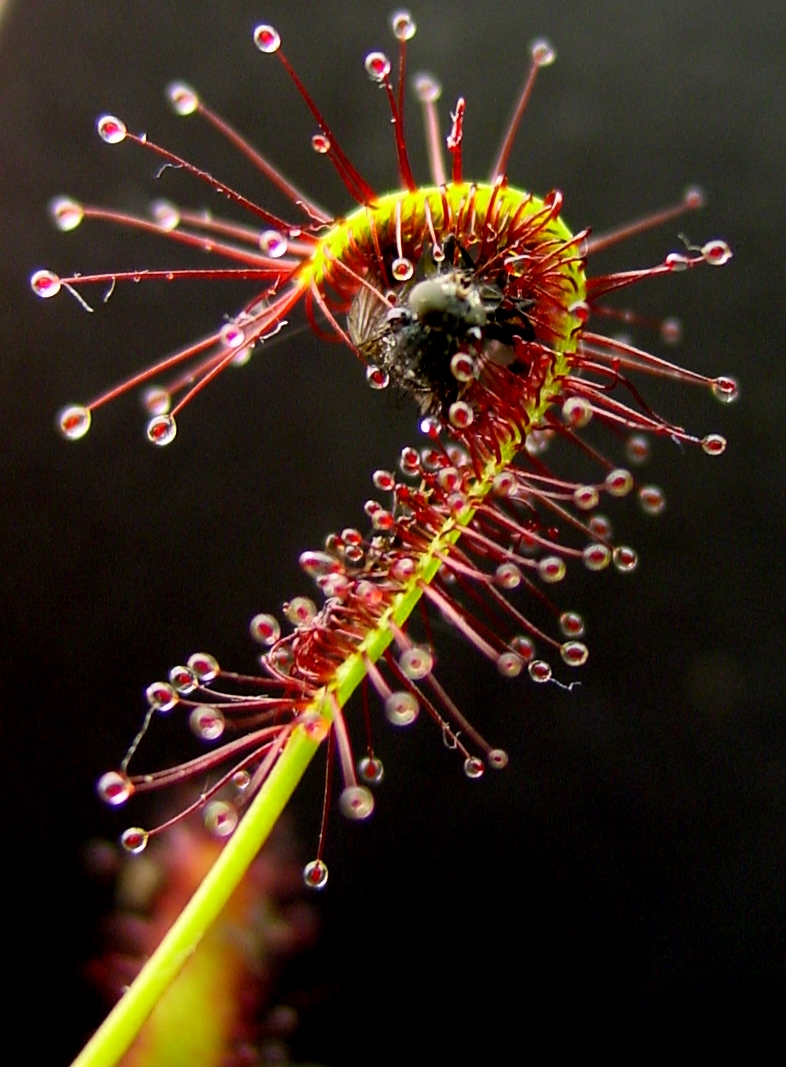 Drosera capensis
-
 Common SundewDrosera rotundifolia
-
 Rosy SundewDrosera spathulata
-
 English SundewDrosera × anglica
-
 Long-Leaved SundewDrosera intermedia
-
 Fork-leaved SundewDrosera binata
-
 Scarlet SundewDrosera glanduligera
-
 Northern Threadleaf SundewDrosera filiformis
Compare
Questions and answers
What is the scientific name of the Whittaker's Sundew?
The scientific name of the Whittaker's Sundew is Drosera whittakeri. Written with its author, the full name is Drosera whittakeri Planch..
Which family does the Whittaker's Sundew belong to?
Drosera whittakeri belongs to the family Droseraceae, in the order Caryophyllales and the class Magnoliopsida.
Where is the Whittaker's Sundew found?
Checklists and occurrence records place Drosera whittakeri in 1 country: Australia.
What is the conservation status of the Whittaker's Sundew?
The IUCN Red List category recorded for Drosera whittakeri is Least Concern (LC).
Why is Drosera called sundew?
The genus name Drosera derives from the Greek word 'droseros', meaning dewy. The name refers to the glistening hairs on the glandular leaf surfaces.[11][12]
Where do sundews grow naturally?
Whittaker's sundew is native to South Australia and Victoria.[6]
Sources
Passages the profile rests on
- The plant has broadly spathulate leaves arranged in a rosette. Source passage: “with broadly spathulate leaves arranged in a rosette.” — English Wikipedia
- Its leaves can be green, orange-yellow or red. Source passage: “These may be green, orange-yellow or red in colour” — English Wikipedia
- Individual plants measure 4 to 8 cm in diameter. Source passage: “Plants are 4 to 8 cm in diameter” — English Wikipedia
- The leaves measure 10 to 15 mm in length and 9 to 13 mm in width. Source passage: “are 10 to 15 mm long and 9 to 13 mm wide.” — English Wikipedia
- The plant produces white flowers. Source passage: “Up to 20 white flowers are produced overall” — English Wikipedia
- The species is native to South Australia and Victoria. Source passage: “is a sundew that is native to South Australia and Victoria.” — English Wikipedia
- A plant can produce up to 20 flowers in total. Source passage: “Up to 20 white flowers are produced overall” — English Wikipedia
- Multiple flowers can be open simultaneously on one plant. Source passage: “with multiple flowers open at any one time.” — English Wikipedia
- The main flowering period extends from May to November in the species' native range. Source passage: “The main flowering period is May to November in its native range” — English Wikipedia
- Flowers may appear throughout the year. Source passage: “but flowers may appear throughout the year.” — English Wikipedia
- The genus name Drosera derives from the Greek word 'droseros', meaning dewy. Source passage: “Drosera from the Greek 'droseros' meaning dewy,” — spapps.environment.sa.gov.au
- The genus name refers to the glistening hairs on the glandular leaf surfaces. Source passage: “alluding to the glistening hairs of the glandular leaf laminae.” — spapps.environment.sa.gov.au
Data
- Catalogue of Life, 2026-10-16 XR cc by
- Global Biodiversity Information Facility CC BY 4.0
- Wikidata CC0
- GeoNames CC BY 4.0
- Wikimedia Commons per image; credit shown with each image
- Within the Catalogue of Life, this name comes from Synonymic Checklists of the Vascular Plants of the World cc by
References
- Planch. (1848). Ann. Sci. Nat., Bot., Sér. 3, 9: 302 (1848). where the name was published
This species in other databases
- Catalogue of Life 37QXP
- Wikidata Q143177
- iNaturalist 148381
- World Flora Online wfo-0000946236
- GRIN 495755
Page built on 27 November 2026. See how the catalog is made and all sources and licences.
Cite this page
ScientificNames.org. (2026). Drosera whittakeri (Whittaker's Sundew). Retrieved November 27, 2026, from https://scientificnames.org/species/drosera-whittakeri
“Drosera whittakeri (Whittaker's Sundew).” ScientificNames.org, 2026, scientificnames.org/species/drosera-whittakeri. Accessed 27 Nov. 2026.
ScientificNames.org. “Drosera whittakeri (Whittaker's Sundew).” Accessed November 27, 2026. https://scientificnames.org/species/drosera-whittakeri.
@misc{scientificnames_drosera_whittakeri_whittakers_sundew,
  author = {{ScientificNames.org}},
  title = {Drosera whittakeri (Whittaker's Sundew)},
  year = {2026},
  url = {https://scientificnames.org/species/drosera-whittakeri},
  note = {Accessed 2026-11-27}
}