Species · Mammals
Capixaba Nectar-feeding Bat Dryadonycteris capixaba
The scientific name of the Capixaba Nectar-feeding Bat is Dryadonycteris capixaba. It is a species of mammal in the family Phyllostomidae (new world leaf-nosed bats), order Chiroptera. The name dates from 2012.
- Scientific name
- Dryadonycteris capixaba Nogueira, Lima, Peracchi & Simmons, 2012
- Common name
- Capixaba Nectar-feeding Bat
- Genus
- Dryadonycteris
- Family
- Phyllostomidae (New World Leaf-nosed Bats)
- Order
- Chiroptera
- Class
- Mammalia
- Red List category
- DD Data Deficient
- Recorded in
- 1 country
- Name status
- accepted in the Catalogue of Life
Overview
The Capixaba Nectar-feeding Bat is a bat from Dryades. It is currently known only from Brazil. It has a triangular nose-leaf.
Written 27 November 2026 from the sources listed below. Each statement was checked against the passage it cites; statements that could not be supported were removed.
Appearance
The Capixaba Nectar-feeding Bat resembles bats in the genera Lichonycteris and Choeroniscus. It has a triangular nose-leaf and 30 teeth.[1][2][3]
Its forearm length ranges from 29 to 32 mm. Its tail measures approximately 6.5 mm in length.[4][5]
Habitat
The species has been documented at elevations of 60 m and 750 m above sea level.[6][7]
Similar species
The species resembles bats in the genera Lichonycteris and Choeroniscus.[1]
Classification of the Capixaba Nectar-feeding Bat
| Kingdom | Animalia |
|---|---|
| Phylum | Chordata |
| Subphylum | Vertebrata |
| Infraphylum | Gnathostomata |
| Parvphylum | Osteichthyes |
| Megaclass | Tetrapoda |
| Class | Mammalia (Mammal) |
| Subclass | Theria |
| Infraclass | Eutheria |
| Order | Chiroptera (Bat) |
| Suborder | Yangochiroptera |
| Superfamily | Noctilionoidea |
| Family | Phyllostomidae (New World Leaf-nosed Bats) |
| Subfamily | Glossophaginae |
| Tribe | Choeronycterini (Tailless Bats) |
| Subtribe | Choeronycterina (Long-tailed Bats) |
| Genus | Dryadonycteris (Capixaba Nectar-feeding Bat) |
| Species | Dryadonycteris capixaba Nogueira, Lima, Peracchi & Simmons, 2012 |
Where the Capixaba Nectar-feeding Bat is found
Checklists and occurrence records place Dryadonycteris capixaba in 1 country across South America. GBIF holds 6 georeferenced records of it.
Countries
Regions and cities with the most records
Range as the checklists state it
South America
A number beside a place is its count of GBIF occurrence records. A place without a number comes from a checklist alone. Records show where a species has been observed or collected, which can include escapes and vagrants.
Common names
English
- Capixaba Nectar-feeding Bat
- Espirito Santo Atlantic Forest Bat
Names in 2 other languages
- German
- Capixaba-Dryades-Fledermaus
- Polish
- Driadek leśny
Related species
-
 Common Vampire BatDesmodus rotundus
-
 Honduran White BatEctophylla alba
-
 Spectral BatVampyrum spectrum
-
 Hairy-legged Vampire BatDiphylla ecaudata
-
 Big-eared Woolly BatChrotopterus auritus
-
 Seba's Short-tailed BatCarollia perspicillata
-
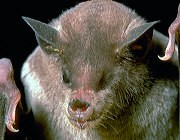 Lesser Long-nosed BatLeptonycteris yerbabuenae
-
 Wrinkle-faced BatCenturio senex
Compare
Questions and answers
What is the scientific name of the Capixaba Nectar-feeding Bat?
The scientific name of the Capixaba Nectar-feeding Bat is Dryadonycteris capixaba. Written with its author, the full name is Dryadonycteris capixaba Nogueira, Lima, Peracchi & Simmons, 2012.
Which family does the Capixaba Nectar-feeding Bat belong to?
Dryadonycteris capixaba belongs to the family Phyllostomidae, in the order Chiroptera and the class Mammalia.
Where is the Capixaba Nectar-feeding Bat found?
Checklists and occurrence records place Dryadonycteris capixaba in 1 country: Brazil.
What is the conservation status of the Capixaba Nectar-feeding Bat?
The IUCN Red List category recorded for Dryadonycteris capixaba is Data Deficient (DD).
What other names does the Capixaba Nectar-feeding Bat have?
Dryadonycteris capixaba is also known in English as Espirito Santo Atlantic Forest Bat.
Sources
Passages the profile rests on
- The species resembles bats in the genera Lichonycteris and Choeroniscus. Source passage: “It is similar in appearance to Lichonycteris and Choeroniscus species.” — English Wikipedia
- The species has a triangular nose-leaf. Source passage: “It has a triangular nose-leaf.” — English Wikipedia
- The species has 30 teeth. Source passage: “for a total of 30 teeth.” — English Wikipedia
- Its forearm length ranges from 29 to 32 mm. Source passage: “with a forearm length of 29–32 mm (1.1–1.3 in).” — English Wikipedia
- Its tail measures approximately 6.5 mm in length. Source passage: “Its tail is short at about 6.5 mm (0.26 in).” — English Wikipedia
- The species has been documented at elevations of 60 m above sea level. Source passage: “It has been documented at elevations of 60 m (200 ft)” — English Wikipedia
- The species has been documented at elevations of 750 m above sea level. Source passage: “and 750 m (2,460 ft) above sea level.” — English Wikipedia
Data
- Catalogue of Life, 2026-10-16 XR cc by
- Global Biodiversity Information Facility CC BY 4.0
- Wikidata CC0
- GeoNames CC BY 4.0
- Within the Catalogue of Life, this name comes from The Integrated Taxonomic Information System cc0
References
- Nogueira, Marcelo R., Isaac P. Lima, Adriano L. Peracchi, and Nancy B. Simmons. (2012). New genus and species of nectar-feeding bat from the Atlantic forest of southeastern Brazil (Chiroptera: Phyllostomidae: Glossophaginae). American Museum Novitates, No. 3747. Link where the name was published
- Wilson, D. E., and R. A. Mittermeier, eds. (2019). Handbook of the Mammals of the World. Vol. 9: Bats.
This species in other databases
Page built on 27 November 2026. See how the catalog is made and all sources and licences.
Cite this page
ScientificNames.org. (2026). Dryadonycteris capixaba (Capixaba Nectar-feeding Bat). Retrieved November 27, 2026, from https://scientificnames.org/species/dryadonycteris-capixaba
“Dryadonycteris capixaba (Capixaba Nectar-feeding Bat).” ScientificNames.org, 2026, scientificnames.org/species/dryadonycteris-capixaba. Accessed 27 Nov. 2026.
ScientificNames.org. “Dryadonycteris capixaba (Capixaba Nectar-feeding Bat).” Accessed November 27, 2026. https://scientificnames.org/species/dryadonycteris-capixaba.
@misc{scientificnames_dryadonycteris_capixaba_capixaba_nectar_feeding_bat,
  author = {{ScientificNames.org}},
  title = {Dryadonycteris capixaba (Capixaba Nectar-feeding Bat)},
  year = {2026},
  url = {https://scientificnames.org/species/dryadonycteris-capixaba},
  note = {Accessed 2026-11-27}
}