Species · Mammals
Asian Garden Dormouse Eliomys melanurus
The scientific name of the Asian Garden Dormouse is Eliomys melanurus. It is a species of mammal in the family Gliridae (dormouse), order Rodentia. The name dates from 1840.
- Scientific name
- Eliomys melanurus (Wagner, 1840)
- Common name
- Asian Garden Dormouse
- Genus
- Eliomys
- Family
- Gliridae (Dormouse)
- Order
- Rodentia
- Class
- Mammalia
- Red List category
- LC Least Concern
- Recorded in
- 5 countries
- Name status
- accepted in the Catalogue of Life

Overview
Eliomys melanurus occurs in Egypt, Iraq, Israel, Jordan, Lebanon, Libya, Saudi Arabia, Syria and Turkey. It is distinguished by large oval ears, dark markings across its eyes and a tail that is black over most of its length.
Written 26 November 2026 from the sources listed below. Each statement was checked against the passage it cites; statements that could not be supported were removed.
Habitat
The Asian Garden Dormouse inhabits temperate forests, dry shrubland in subtropical or tropical regions, Mediterranean-type shrubby vegetation, rocky areas and gardens. Its habitats also include coastal dunes, sandy plateaus, arid steppes, subtropical dry woodland, mountainsides, escarpments and limestone cliffs.[1][2]
The species occurs from near sea level to approximately 2,850 metres above sea level. Individuals are occasionally found inside houses and have also been recorded in a Bedouin tent.[3][4]
Appearance
The species has soft dorsal fur that may be woolly and ranges from yellowish-grey to yellowish-brown or reddish-brown. Its underparts and hind feet are white or cream, sometimes with a grey tinge, and are distinctly separated in colour from its dorsal fur.[5][6]
The cheeks are cream-coloured, and a dark diagonal marking crosses each large eye. The ears are large and oval, with several often inconspicuous pale patches behind them.[7][8]
The tail is black over most of its length, although its tip sometimes has a small amount of white. The head-and-body length ranges from 111 to 144 millimetres, and the tail measures between 100 and 136 millimetres.[9][10][11]
Diet
The Asian Garden Dormouse feeds mainly on insects, snails, centipedes and geckos. Its omnivorous diet also includes plant matter and other invertebrates and small vertebrates.[12][13][14]
Behaviour
Its basal metabolic rate is relatively low. Wild-caught individuals are reported to be very aggressive.[15][16]
Skeletal remains of the species have been identified in regurgitated pellets of barn owls and long-eared owls.[17]
Reproduction and life cycle
Reproduction takes place in spring. The gestation period lasts approximately 22 days, and recorded litters contain approximately three young.[18][19][20]
Conservation
The Asian Garden Dormouse is classified as Least Concern by the International Union for Conservation of Nature. It is described as common and having a wide geographical range, with no particular threats identified.[21][22][23]
Similar species
Western populations formerly included within the broad concept of Eliomys melanurus were reassigned to Eliomys quercinus. The North African population formerly classified as Eliomys quercinus is recognised as a separate species, Eliomys munbyanus.[24][25]
Eliomys munbyanus and Eliomys melanurus have non-overlapping geographical distributions.[26]
Classification of the Asian Garden Dormouse
| Kingdom | Animalia |
|---|---|
| Phylum | Chordata |
| Subphylum | Vertebrata |
| Infraphylum | Gnathostomata |
| Parvphylum | Osteichthyes |
| Megaclass | Tetrapoda |
| Class | Mammalia (Mammal) |
| Subclass | Theria |
| Infraclass | Eutheria |
| Order | Rodentia (Rodent) |
| Suborder | Sciuromorpha (Squirrels) |
| Family | Gliridae (Dormouse) |
| Subfamily | Leithiinae (Palearctic Dormice) |
| Genus | Eliomys (Garden Dormice) |
| Species | Eliomys melanurus (Wagner, 1840) |
Where the Asian Garden Dormouse is found
Checklists and occurrence records place Eliomys melanurus in 5 countries across Africa. GBIF holds 160 georeferenced records of it.
Countries
Regions and cities with the most records
- Southern District, Israel 54
- Beersheba, Israel 15
- Laqiyya, Israel 15
- Ofaqim, Israel 15
- Rahat, Israel 15
- Segev Shalom, Israel 15
- Tel Sheva‘, Israel 15
- As Sallūm, Egypt 14
1 more country has a few records outside this range
These countries hold a few records of Eliomys melanurus but lie outside the range the checklists give for it. Such records are often zoo or garden specimens, museum material or vagrants, so the species is not counted as occurring there.
Range as the checklists state it
Europe & Northern Asia (excluding China)
Africa
A number beside a place is its count of GBIF occurrence records. A place without a number comes from a checklist alone. Records show where a species has been observed or collected, which can include escapes and vagrants.
Common names
English
- Asian Garden Dormouse
- Black-tailed Garden Dormouse
- Large-eared Garden Dormouse
- Large-eared Garden Dormouse (see Comments)
- South-West Asian Garden Dormouse
Names in 14 other languages
- Arabic
- زغبة الحدائق الأسيوية, زغبة الحدائق طويلة الأذن
- Chinese
- 黑園睡鼠
- Czech
- plch černoocasý
- Dutch
- Woestijnslaapmuis
- Finnish
- aasiantammihiiri
- French
- Lérot à queue noire
- German
- Löffelbilch, Orientschläfer, Wüstenschläfer
- Hebrew
- נמנמן סלעים מצוי
- Italian
- Quercino dalla coda nera
- Japanese
- オオミミメガネヤマネ
- Polish
- żołędnica azjatycka
- Russian
- Чернохвостая соня
- Spanish
- Lirón Careto Arábigo
- Turkish
- Asya Bahçe Yediuyuru
Synonyms
2 other scientific names have been used for this species and are now treated as synonyms of Eliomys melanurus.
- Eliomys cyrenaicus Festa, 1922
- Myoxus melanurus Wagner, 1840
Related species
-
 Garden DormouseEliomys quercinus
- Maghreb Garden DormouseEliomys munbyanus
-
 European Edible DormouseGlis glis
-
 Hazel DormouseMuscardinus avellanarius
-
 Forest DormouseDryomys nitedula
-
 Japanese DormouseGlirulus japonicus
- Roach's Mouse-tailed DormouseMyomimus roachi
-
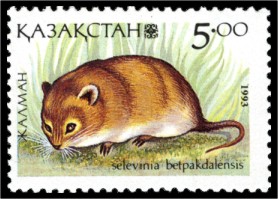 Desert DormouseSelevinia betpakdalaensis
Compare
Questions and answers
What is the scientific name of the Asian Garden Dormouse?
The scientific name of the Asian Garden Dormouse is Eliomys melanurus. Written with its author, the full name is Eliomys melanurus (Wagner, 1840).
Which family does the Asian Garden Dormouse belong to?
Eliomys melanurus belongs to the family Gliridae, in the order Rodentia and the class Mammalia.
Where is the Asian Garden Dormouse found?
Checklists and occurrence records place Eliomys melanurus in 5 countries: Israel, Egypt, Morocco, Syria and Saudi Arabia.
What is the conservation status of the Asian Garden Dormouse?
The IUCN Red List category recorded for Eliomys melanurus is Least Concern (LC).
What other names does the Asian Garden Dormouse have?
Eliomys melanurus is also known in English as Black-tailed Garden Dormouse, Large-eared Garden Dormouse, Large-eared Garden Dormouse (see Comments) and South-West Asian Garden Dormouse.
Sources
Passages the profile rests on
- The species inhabits temperate forests, dry shrubland in subtropical or tropical regions, Mediterranean-type shrubby vegetation, rocky areas and gardens. Source passage: “Its natural habitats are temperate forests, subtropical or tropical dry shrubland, Mediterranean-type shrubby vegetation, rocky areas and gardens.” — English Wikipedia
- Its habitats include coastal dunes, sandy plateaus, arid steppes, subtropical dry woodland, mountainsides, escarpments and limestone cliffs. Source passage: “Suitable habitat includes coastal dunes, sandy plateaus, arid steppes, shrubland, subtropical dry woodland, mountainsides, escarpments, rocky areas and limestone cliffs.” — English Wikipedia
- The species occurs from near sea level to approximately 2,850 metres above sea level. Source passage: “It occurs from near sea level up to about 2,850 m (9,350 ft)” — English Wikipedia
- Individuals are occasionally found inside houses and have also been recorded in a Bedouin tent. Source passage: “Sometimes individuals are found in gardens, occasionally in houses and one was once found in a Bedouin tent.” — English Wikipedia
- The species has soft dorsal fur that may be woolly and ranges from yellowish-grey to yellowish-brown or reddish-brown. Source passage: “The dorsal fur is soft, and sometimes woolly, yellowish-grey, yellowish-brown or reddish-brown.” — English Wikipedia
- Its underparts and hind feet are white or cream, sometimes with a grey tinge, and are distinctly separated in colour from its dorsal fur. Source passage: “The underparts and hind feet are white or cream, sometimes tinged with grey, and clearly delineated from the dorsal pelage.” — English Wikipedia
- The cheeks are cream-coloured, and a dark diagonal marking crosses each large eye. Source passage: “The cheeks are cream, and a dark diagonal streak passes through the large eyes.” — English Wikipedia
- The ears are large and oval, with several often inconspicuous pale patches behind them. Source passage: “The ears are large and oval, and behind them are several, often inconspicuous, pale patches.” — English Wikipedia
- The tail is black over most of its length, although its tip sometimes has a small amount of white. Source passage: “the rest of the tail is black, sometimes with a little white at the tip.” — English Wikipedia
- The head-and-body length ranges from 111 to 144 millimetres. Source passage: “head-and-body length of 111 to 144 mm (4.4 to 5.7 in)” — English Wikipedia
- The tail measures between 100 and 136 millimetres in length. Source passage: “a tail of 100 to 136 mm (3.9 to 5.4 in).” — English Wikipedia
- The species feeds mainly on insects, snails, centipedes and geckos. Source passage: “Diet consists mainly of insects, snails, centipedes and geckos” — English Wikipedia
- Its omnivorous diet also includes plant matter. Source passage: “but as an omnivore, it will also eat plant matter.” — English Wikipedia
- The species consumes insects, other invertebrates and small vertebrates. Source passage: “It feeds on insects and other invertebrates, as well as small vertebrates.” — English Wikipedia
- Its basal metabolic rate is relatively low. Source passage: “the basal metabolic rate is relatively low” — English Wikipedia
- Wild-caught individuals are reported to be very aggressive. Source passage: “animals caught from the wild are said to be very aggressive.” — English Wikipedia
- Skeletal remains of the species have been identified in regurgitated pellets of barn owls and long-eared owls. Source passage: “The skeletal remains of this dormouse have been found in the regurgitated pellets of barn owls and long-eared owls.” — English Wikipedia
- Reproduction takes place in spring. Source passage: “Reproduction occurs in spring” — English Wikipedia
- The gestation period lasts approximately 22 days. Source passage: “the gestation period is 22 days” — English Wikipedia
- Recorded litters contain approximately three young. Source passage: “litters of about three young have been recorded.” — English Wikipedia
- The Asian garden dormouse is classified as Least Concern by the International Union for Conservation of Nature. Source passage: “the International Union for Conservation of Nature has rated its conservation status as being of "least concern".” — English Wikipedia
- No particular threats to the species have been identified. Source passage: “No particular threats have been identified” — English Wikipedia
- The species is described as common and having a wide geographical range. Source passage: “The Asian garden dormouse has a wide range and is a common species.” — English Wikipedia
- Western populations formerly included within the broad concept of Eliomys melanurus were reassigned to Eliomys quercinus. Source passage: “western populations in Morocco, Algeria and Tunisia being assigned to E quercinus” — English Wikipedia
- The North African population formerly classified as Eliomys quercinus is recognised as a separate species, Eliomys munbyanus. Source passage: “the North African population of E. quercinus has been recognised as a separate species, Eliomys munbyanus, the Maghreb garden dormouse.” — English Wikipedia
- Eliomys munbyanus and Eliomys melanurus have non-overlapping geographical distributions. Source passage: “Eliomys munbyanus is allopatric with Eliomys melanurus .” — animaldiversity.org
Data
- Catalogue of Life, 2026-10-16 XR cc by
- Global Biodiversity Information Facility CC BY 4.0
- Wikidata CC0
- GeoNames CC BY 4.0
- Wikimedia Commons per image; credit shown with each image
- Within the Catalogue of Life, this name comes from The Integrated Taxonomic Information System cc0
References
- Gelehrte. Anz. I. K. Bayer. Akad. Wiss., München vol.8 37 p.299 where the name was published
- Ellerman, J. R., and T. C. S. Morrison-Scott. (1966). Checklist of Palaearctic and Indian Mammals 1758 to 1946, 2nd Edition.
- Wilson, Don E., and DeeAnn M. Reeder, eds. (1993). Mammal Species of the World: A Taxonomic and Geographic Reference, 2nd Ed., 3rd Printing.
- Wilson, Don E., and F. Russell Cole. (2000). Common Names of Mammals of the World.
- Wilson, Don E., and DeeAnn M. Reeder, eds. (2005). Family Gliridae. Mammal Species of the World: A Taxonomic and Geographic Reference, 3rd Ed., Vol. 2.
- Holden-Musser, M. E., R. Juskaitis, and G. M. Musser / Wilson, Lacher Jr., and Mittermeier, eds. (2016). Gliridae (Dormice). Handbook of the Mammals of the World. Vol. 6: Lagomorphs and Rodents I.
- Burgin, Connor J., Don E. Wilson, Russell A. Mittermeier, Anthony B. Rylands, et al. (2020). Illustrated Checklist of the Mammals of the World. Vol. 1. Monotremata to Rodentia.
This species in other databases
Page built on 28 November 2026. See how the catalog is made and all sources and licences.
Cite this page
ScientificNames.org. (2026). Eliomys melanurus (Asian Garden Dormouse). Retrieved November 28, 2026, from https://scientificnames.org/species/eliomys-melanurus
“Eliomys melanurus (Asian Garden Dormouse).” ScientificNames.org, 2026, scientificnames.org/species/eliomys-melanurus. Accessed 28 Nov. 2026.
ScientificNames.org. “Eliomys melanurus (Asian Garden Dormouse).” Accessed November 28, 2026. https://scientificnames.org/species/eliomys-melanurus.
@misc{scientificnames_eliomys_melanurus_asian_garden_dormouse,
  author = {{ScientificNames.org}},
  title = {Eliomys melanurus (Asian Garden Dormouse)},
  year = {2026},
  url = {https://scientificnames.org/species/eliomys-melanurus},
  note = {Accessed 2026-11-28}
}