Species · Mammals
Maghreb Garden Dormouse Eliomys munbyanus
The scientific name of the Maghreb Garden Dormouse is Eliomys munbyanus. It is a species of mammal in the family Gliridae (dormouse), order Rodentia. The name dates from 1856.
- Scientific name
- Eliomys munbyanus (Pomel, 1856)
- Common name
- Maghreb Garden Dormouse
- Genus
- Eliomys
- Family
- Gliridae (Dormouse)
- Order
- Rodentia
- Class
- Mammalia
- Red List category
- LC Least Concern
- Recorded in
- 4 countries
- Name status
- accepted in the Catalogue of Life
Overview
Eliomys munbyanus inhabits humid forests, pine forests, mountain cedar forests, coastal dunes and semi-deserts. It has a dark mask around its large eyes and a long tail with a white tip.
Written 26 November 2026 from the sources listed below. Each statement was checked against the passage it cites; statements that could not be supported were removed.
Appearance
The Maghreb Garden Dormouse has moderately long, soft fur that can sometimes have a woolly texture. Its upper body is yellowish or reddish-brown with grey tinges, while its underparts are white with grey tinges and separated from the upper body by a distinct colour boundary.[1][2][3]
Its large eyes are surrounded by a dark mask. Its cheeks are whitish or cream-coloured, with a similarly coloured streak extending to the shoulders, and its ears are medium-sized, oval and brown.[4][5][6]
Its average head-and-body length is 117 millimetres and its average tail length is 108 millimetres. Its reported average body mass ranges from 15 to 180 grams.[7][8][9]
Its hind hairs measure approximately 10–11 millimetres and its guard hairs approximately 16 millimetres. Tail hairs measure approximately 3–4 millimetres at the base and can reach 19 millimetres at the tip.[10][11][12]
Habitat
The Maghreb Garden Dormouse inhabits humid forests, pine forests, mountain cedar forests, coastal dunes and semi-deserts. It appears to prefer rocky habitats and is mostly arboreal.[13][14][15]
It has been recorded living in house roofs, alcoves and attics. It builds nests in tree holes, rock crevices, caves and shrubs.[16][17]
Its nests are constructed using grasses, palm material, goat hair, sheep wool, flowers and stems.[18]
Behaviour
The Maghreb Garden Dormouse is nocturnal and primarily forages at night. It uses vocalizations to communicate with other individuals.[19][20][21]
It may hibernate for periods lasting up to six months. It may also remain active without hibernating when environmental conditions permit or enter winter torpor instead of hibernating.[22][23][24]
Although mainly solitary, individuals generally live in small family groups.[25]
Reproduction and life cycle
The Maghreb Garden Dormouse is polygynous. Its breeding season usually occurs in spring and sometimes in autumn.[26][27]
Its gestation period lasts approximately 22–24 days. Females usually produce litters of four to six offspring, although they may produce only two or three offspring in captivity.[28][29][30]
Newborn individuals are hairless, blind and helpless. Young remain in the nest for approximately seven weeks before weaning.[31][32]
Individuals reach sexual maturity after their first hibernation.[33]
Conservation
The Maghreb Garden Dormouse is classified as Least Concern on the IUCN Red List. Overall populations are reported to be stable.[34][35]
Uses
The Maghreb Garden Dormouse may contribute to seed dispersal through its consumption of seeds. It may also help control insect populations through predation.[36][37]
Similar species
The Maghreb Garden Dormouse is allopatric with Eliomys melanurus.[38]
Classification of the Maghreb Garden Dormouse
| Kingdom | Animalia |
|---|---|
| Phylum | Chordata |
| Subphylum | Vertebrata |
| Infraphylum | Gnathostomata |
| Parvphylum | Osteichthyes |
| Megaclass | Tetrapoda |
| Class | Mammalia (Mammal) |
| Subclass | Theria |
| Infraclass | Eutheria |
| Order | Rodentia (Rodent) |
| Suborder | Sciuromorpha (Squirrels) |
| Family | Gliridae (Dormouse) |
| Subfamily | Leithiinae (Palearctic Dormice) |
| Genus | Eliomys (Garden Dormice) |
| Species | Eliomys munbyanus (Pomel, 1856) |
Where the Maghreb Garden Dormouse is found
Checklists and occurrence records place Eliomys munbyanus in 4 countries across Africa. GBIF holds 105 georeferenced records of it.
Countries
Regions and cities with the most records
- Tan-Tan, Morocco 7
- Essaouira, Morocco 6
- Chefchaouen, Morocco 5
- Azrou, Morocco 4
- Ifrane, Morocco 4
- Al Hoceïma, Morocco 3
- Beni Enzar, Morocco 3
- Bni Bouayach, Morocco 3
- Fnidek, Morocco 3
- Imzouren, Morocco 3
- Oriental, Morocco 3
- Tirhanimîne, Morocco 3
- Tiznit, Morocco 3
1 more country has a few records outside this range
These countries hold a few records of Eliomys munbyanus but lie outside the range the checklists give for it. Such records are often zoo or garden specimens, museum material or vagrants, so the species is not counted as occurring there.
Range as the checklists state it
Africa
A number beside a place is its count of GBIF occurrence records. A place without a number comes from a checklist alone. Records show where a species has been observed or collected, which can include escapes and vagrants.
Common names
English
- Maghreb Garden Dormouse
Names in 9 other languages
- Arabic
- زغبة الحديقة المغربية
- Chinese
- 馬格里布園睡鼠
- French
- Lérot du Maghreb
- German
- Nordafrikanischer Löffelbilch, Tunesischer Gartenschläfer
- Italian
- Quercino del Maghreb
- Japanese
- マグリブメガネヤマネ
- Polish
- żołędnica afrykańska
- Russian
- Магрибская соня
- Spanish
- Lirón Careto Magrebí
Synonyms
5 other scientific names have been used for this species and are now treated as synonyms of Eliomys munbyanus.
- Bifa lerotina Lataste, 1885
- Eliomys lerotinus occidentalis Thomas, 1903
- Eliomys lerotinus tunetae Thomas, 1903
- Eliomys quercinus denticulatus Ranck, 1968
- Myoxus munbyanus Pomel, 1856
Related species
-
 Garden DormouseEliomys quercinus
-
 Asian Garden DormouseEliomys melanurus
-
 European Edible DormouseGlis glis
-
 Hazel DormouseMuscardinus avellanarius
-
 Forest DormouseDryomys nitedula
-
 Japanese DormouseGlirulus japonicus
- Roach's Mouse-tailed DormouseMyomimus roachi
-
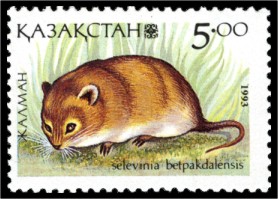 Desert DormouseSelevinia betpakdalaensis
Compare
Questions and answers
What is the scientific name of the Maghreb Garden Dormouse?
The scientific name of the Maghreb Garden Dormouse is Eliomys munbyanus. Written with its author, the full name is Eliomys munbyanus (Pomel, 1856).
Which family does the Maghreb Garden Dormouse belong to?
Eliomys munbyanus belongs to the family Gliridae, in the order Rodentia and the class Mammalia.
Where is the Maghreb Garden Dormouse found?
Checklists and occurrence records place Eliomys munbyanus in 4 countries: Morocco, Algeria, Tunisia and Libya.
What is the conservation status of the Maghreb Garden Dormouse?
The IUCN Red List category recorded for Eliomys munbyanus is Least Concern (LC).
How big is dormice?
The Maghreb Garden Dormouse has an average head-and-body length of 117 millimetres and an average tail length of 108 millimetres. Its reported average body mass ranges from 15 to 180 grams.[7][8][9]
Do dormice live in pairs?
The Maghreb Garden Dormouse is mainly solitary, although individuals generally live in small family groups.[25]
What is the lifespan of a dormouse?
The average lifespan of the Maghreb Garden Dormouse in the wild is approximately five years.[39]
Sources
Passages the profile rests on
- The Maghreb garden dormouse has moderately long, soft fur that can sometimes have a woolly texture. Source passage: “moderately long, soft, sometimes woolly, fur.” — English Wikipedia
- Its upper body is yellowish or reddish-brown with grey tinges. Source passage: “The upper parts are a yellowish or reddish-brown tinged with grey.” — English Wikipedia
- Its underparts are white with grey tinges and are separated from the upper body by a distinct colour boundary. Source passage: “The underparts are white tinged with grey; there is a clear demarcation line between the two colours.” — English Wikipedia
- Its large eyes are surrounded by a dark mask. Source passage: “The large eyes are surrounded by a dark mask.” — English Wikipedia
- Its cheeks are whitish or cream-coloured, with a similarly coloured streak extending to the shoulders. Source passage: “The cheeks are whitish or cream and a streak of the same colour extends to the shoulders.” — English Wikipedia
- Its ears are medium-sized, oval and brown. Source passage: “The ears are medium-sized, oval and brown” — English Wikipedia
- Its average head-and-body length is 117 millimetres. Source passage: “averaging a head and body length of 117 millimeters” — animaldiversity.org
- Its average tail length is 108 millimetres. Source passage: “Their tails are long, averaging 108 mm.” — animaldiversity.org
- Its reported average body mass ranges from 15 to 180 grams. Source passage: “Their average mass is between 15 and 180 grams.” — animaldiversity.org
- Its hind hairs measure approximately 10–11 millimetres in length. Source passage: “Hind hairs are quite long, coming in at around 10-11 mm.” — animaldiversity.org
- Its guard hairs measure approximately 16 millimetres. Source passage: “with guard hairs at 16 mm.” — animaldiversity.org
- Its tail hairs measure approximately 3–4 millimetres at the base and can reach 19 millimetres at the tip. Source passage: “Tail hairs start at around 3-4 mm. at the base and can get as long as 19 mm. at the tip.” — animaldiversity.org
- The species inhabits humid forests, pine forests, mountain cedar forests, coastal dunes and semi-deserts. Source passage: “It occurs in a range of habitats including humid forest, pine forests, mountain cedar forests, coastal dunes and semi-desert” — English Wikipedia
- The species appears to prefer rocky habitats. Source passage: “It seems to prefer rocky habitats.” — English Wikipedia
- The species is mostly arboreal. Source passage: “They are a mostly arboreal species” — animaldiversity.org
- The species has been recorded living in house roofs, alcoves and attics. Source passage: “They also live in roofs of houses, alcoves, and attics.” — animaldiversity.org
- The species builds nests in tree holes, rock crevices, caves and shrubs. Source passage: “These dormice build nests in places such as tree holes, rock crevices, caves, and various shrubs, including cacti.” — animaldiversity.org
- The species uses grasses, palm material, goat hair, sheep wool, flowers and stems to construct its nests. Source passage: “including grasses, palm, goat hair and sheep wool, flowers, and stems.” — animaldiversity.org
- The species is nocturnal. Source passage: “The Maghreb garden dormouse (Eliomys munbyanus) is a nocturnal species of rodent” — English Wikipedia
- The species is primarily a nocturnal forager. Source passage: “They are mostly nocturnal foragers.” — animaldiversity.org
- The species uses vocalizations to communicate with other individuals. Source passage: “They use vocalizations to communicate with each other” — animaldiversity.org
- The species may hibernate for periods lasting up to six months. Source passage: “It may hibernate up to six months long” — animaldiversity.org
- The species may remain active without hibernating when environmental conditions permit. Source passage: “but has been found to not hibernate at all when conditions permit.” — animaldiversity.org
- The species may enter winter torpor instead of hibernating. Source passage: “It is also possible for the species to go into torpor in the winter instead.” — animaldiversity.org
- Although mainly solitary, individuals generally live in small family groups. Source passage: “Although Eliomys munbyanus is mainly a solitary organism, it will usually live in a small family group for the duration of its life.” — animaldiversity.org
- The species is polygynous. Source passage: “Similar to other dormouse species, E. munbyanus is a polygynous species.” — animaldiversity.org
- Its breeding season usually occurs in spring and sometimes in autumn. Source passage: “The breeding season is usually in spring and sometimes autumn.” — animaldiversity.org
- Its gestation period lasts approximately 22–24 days. Source passage: “Eliomys munbyanus has a gestation period of around 22-24 days.” — animaldiversity.org
- Females usually produce litters of four to six offspring. Source passage: “They usually produce 4-6 offspring” — animaldiversity.org
- The species may produce only two or three offspring in captivity. Source passage: “but have been found to only have 2-3 in captivity.” — animaldiversity.org
- Young remain in the nest for approximately seven weeks before weaning. Source passage: “The time to weaning is 7 weeks in the nest” — animaldiversity.org
- Newborn individuals are hairless, blind and helpless. Source passage: “Young are born hairless, blind and helpless” — animaldiversity.org
- Individuals reach sexual maturity after their first hibernation. Source passage: “They are sexually mature after their first hibernation.” — animaldiversity.org
- The species is classified as Least Concern on the IUCN Red List. Source passage: “Eliomys munbyanus is labeled as "least concern" on the IUCN Red List.” — animaldiversity.org
- Overall populations of the species are reported to be stable. Source passage: “Populations are found to be stable overall.” — animaldiversity.org
- The species may contribute to seed dispersal through its consumption of seeds. Source passage: “Eliomys munbyanus may aid in the dispersal of seeds, which makes up a large part of their diet.” — animaldiversity.org
- The species may help control insect populations through predation. Source passage: “The Maghreb garden dormouse preys on poultry eggs and insects, which may also help to control the populations of these species.” — animaldiversity.org
- The species is allopatric with Eliomys melanurus. Source passage: “Eliomys munbyanus is allopatric with Eliomys melanurus .” — animaldiversity.org
- The average lifespan of the species in the wild is approximately five years. Source passage: “The average lifespan of Eliomys munbyanus in the wild is about 5 years.” — animaldiversity.org
Data
- Catalogue of Life, 2026-10-16 XR cc by
- Global Biodiversity Information Facility CC BY 4.0
- Wikidata CC0
- GeoNames CC BY 4.0
- Within the Catalogue of Life, this name comes from The Integrated Taxonomic Information System cc0
References
- C. R. Hebdomadaires des Séances de L Academie des Sciences vol.42 p.653 where the name was published
- Wilson, Don E., and DeeAnn M. Reeder, eds. (2005). Family Gliridae. Mammal Species of the World: A Taxonomic and Geographic Reference, 3rd Ed., Vol. 2.
- Holden-Musser, M. E., R. Juskaitis, and G. M. Musser / Wilson, Lacher Jr., and Mittermeier, eds. (2016). Gliridae (Dormice). Handbook of the Mammals of the World. Vol. 6: Lagomorphs and Rodents I.
- Burgin, Connor J., Don E. Wilson, Russell A. Mittermeier, Anthony B. Rylands, et al. (2020). Illustrated Checklist of the Mammals of the World. Vol. 1. Monotremata to Rodentia.
This species in other databases
Page built on 27 November 2026. See how the catalog is made and all sources and licences.
Cite this page
ScientificNames.org. (2026). Eliomys munbyanus (Maghreb Garden Dormouse). Retrieved November 27, 2026, from https://scientificnames.org/species/eliomys-munbyanus
“Eliomys munbyanus (Maghreb Garden Dormouse).” ScientificNames.org, 2026, scientificnames.org/species/eliomys-munbyanus. Accessed 27 Nov. 2026.
ScientificNames.org. “Eliomys munbyanus (Maghreb Garden Dormouse).” Accessed November 27, 2026. https://scientificnames.org/species/eliomys-munbyanus.
@misc{scientificnames_eliomys_munbyanus_maghreb_garden_dormouse,
  author = {{ScientificNames.org}},
  title = {Eliomys munbyanus (Maghreb Garden Dormouse)},
  year = {2026},
  url = {https://scientificnames.org/species/eliomys-munbyanus},
  note = {Accessed 2026-11-27}
}