Species · Mammals
Garden Dormouse Eliomys quercinus
The scientific name of the Garden Dormouse is Eliomys quercinus. It is a species of mammal in the family Gliridae (dormouse), order Rodentia. The name dates from 1766.
- Scientific name
- Eliomys quercinus (Linnaeus, 1766)
- Common name
- Garden Dormouse
- Genus
- Eliomys
- Family
- Gliridae (Dormouse)
- Order
- Rodentia
- Class
- Mammalia
- Red List category
- VU Vulnerable
- Recorded in
- 18 countries
- Name status
- accepted in the Catalogue of Life

Overview
Eliomys quercinus inhabits forests, fruit-growing regions, steppe deserts, hollow trees, rock crevices, and human dwellings. It has short hair, a tail ending in a white tassel, and a black facial stripe extending from the nose to behind the ear.
Written 26 November 2026 from the sources listed below. Each statement was checked against the passage it cites; statements that could not be supported were removed.
Conservation
The Garden Dormouse was classified as Vulnerable by the IUCN in the Animal Diversity Web account. Deforestation is identified as a threat to the species in parts of Europe and Finland.[1][2]
The Garden Dormouse was named Animal of the Year in 2022 by the Swiss nature conservation organisation Pro Natura.[3]
Uses
Garden dormice were used as food in Britain during the Roman Empire.[4]
Appearance
The Garden Dormouse has short hair and a tail ending in a white tassel. Its facial black stripe extends from the nose to behind the ear.[5][6]
European garden dormice have tails with brown, black, and white coloration. Female garden dormice have eight mammary glands.[7][8]
Habitat
The Garden Dormouse primarily inhabits forests but also occurs in fruit-growing regions. It inhabits steppe deserts, hollow trees, rock crevices, and human dwellings.[9][10]
The species is occasionally found in swamplands despite its predominantly arboreal habits. Garden dormice may shelter in birds' nests, rocks, or trees.[11][12]
Arboreal nests are typically located between 0.8 and 3.0 meters above the ground. Garden dormice may also occupy existing bird or squirrel nests.[13][14]
Diet
Garden dormouse droppings collected in Belgium contained predominantly leaves and flowers in spring, and berries and fruit in summer.[15]
Garden dormice cache food, probably contributing to seed dispersal.[16]
Behaviour
The Garden Dormouse is primarily nocturnal. Individuals sleep in tree nests during the day, sometimes sharing nests with multiple individuals.[17][18]
Garden dormice may hibernate for as long as seven months during winter. Before hibernation, they gain weight to sustain themselves during dormancy.[19][20]
Garden dormice are social animals that share feeding and sleeping sites. Individuals fight in shared areas during the mating season but display little aggression during the rest of the year.[21][22]
The species communicates through whistles, growls, and snores.[23]
Reproduction and life cycle
The mating period described for the Garden Dormouse lasts from April to June. Female garden dormice signal readiness to mate by squeaking loudly.[24][25]
Gestation lasts approximately 23 days, and litters usually contain three to seven young. Newborn garden dormice are blind and naked.[26][27][28]
Young garden dormice open their eyes at approximately 18 days of age and are nursed until they are approximately one month old. They become independent at approximately two months of age.[29][30][31]
In some European regions and Morocco, the breeding season extends from May to October. Female garden dormice enter heat every ten days during the breeding season.[32][33]
Reported litter sizes range from two to eight offspring. Gestation is reported to last between 22 and 28 days.[34][35]
Classification of the Garden Dormouse
| Kingdom | Animalia |
|---|---|
| Phylum | Chordata |
| Subphylum | Vertebrata |
| Infraphylum | Gnathostomata |
| Parvphylum | Osteichthyes |
| Megaclass | Tetrapoda |
| Class | Mammalia (Mammal) |
| Subclass | Theria |
| Infraclass | Eutheria |
| Order | Rodentia (Rodent) |
| Suborder | Sciuromorpha (Squirrels) |
| Family | Gliridae (Dormouse) |
| Subfamily | Leithiinae (Palearctic Dormice) |
| Genus | Eliomys (Garden Dormice) |
| Species | Eliomys quercinus (Linnaeus, 1766) |
Where the Garden Dormouse is found
Checklists and occurrence records place Eliomys quercinus in 18 countries. GBIF holds 30,931 georeferenced records of it.
Countries
- Andorra 178
- Austria 119
- Belgium 1,427
- Croatia 90
- Denmark 4
- Estonia 23
- Finland 12
- France 10,234
- Germany 6,640
- Italy 310
- Liechtenstein 17
- Luxembourg 159
- Poland 11
- Portugal 79
- Russia 70
- Spain 6,903
- Switzerland 4,487
- The Netherlands 168
Regions and cities with the most records
- Rheinland-Pfalz, Germany 4,938
- Bourgogne-Franche-Comté, France 1,755
- Provence-Alpes-Côte d'Azur, France 1,627
- Auvergne-Rhône-Alpes, France 1,484
- Hauts-de-France, France 1,237
- Ginsheim-Gustavsburg, Germany 1,169
- Occitanie, France 1,159
- Hochheim am Main, Germany 1,124
- Mainz, Germany 1,113
- Rüsselsheim am Main, Germany 1,107
- Flörsheim, Germany 1,047
- Ingelheim am Rhein, Germany 989
- Eltville, Germany 933
- Frankenthal, Germany 921
- Alzey, Germany 910
- Groß-Gerau, Germany 875
- Bad Dürkheim, Germany 847
- Hofheim am Taunus, Germany 825
- Hattersheim, Germany 819
- Wiesbaden, Germany 788
- Valais, Switzerland 718
- Worms, Germany 706
- Bad Kreuznach, Germany 705
- Lahnstein, Germany 681
- North Rhine-Westphalia, Germany 615
- Boppard, Germany 610
- Catalonia, Spain 601
- Hesse, Germany 572
- Bingen am Rhein, Germany 561
- Andernach, Germany 558
- Schifferstadt, Germany 543
- Grand Est, France 540
- Riedstadt, Germany 537
- Neuwied, Germany 526
- Hürth, Germany 525
- Köln, Germany 525
4 more countries have a few records outside this range
These countries hold a few records of Eliomys quercinus but lie outside the range the checklists give for it. Such records are often zoo or garden specimens, museum material or vagrants, so the species is not counted as occurring there.
Range as the checklists state it
Europe & Northern Asia (excluding China)
A number beside a place is its count of GBIF occurrence records. A place without a number comes from a checklist alone. Records show where a species has been observed or collected, which can include escapes and vagrants.
Common names
English
- Garden Dormouse
- Asian Garden Dormouse
- European Garden Dormouse
Names in 26 other languages
- Arabic
- زغبة الحديقة الأوربية
- Belarusian
- Садовая соня
- Catalan
- Rata cellarda
- Chinese
- 園睡鼠
- Croatian
- Vrtni puh
- Czech
- plch zahradní
- Danish
- Havesyvsover
- Dutch
- Eikelmuis, Fruitrat, Tuinslaapmuis
- Estonian
- lagrits
- Finnish
- tammihiiri
- French
- Loir des greniers, Loir lérot, Lérot, Lérot commun, Rat-bayard
- German
- Gartenschläfer
- Greek
- Κηπομυωξός
- Italian
- Quercino, Topo quercino
- Japanese
- メガネヤマネ
- Korean
- 뜰겨울잠쥐
- Lithuanian
- Ąžuolinė miegapelė
- Norwegian Bokmål
- Hagesyvsover
- Polish
- Żołędnica europejska
- Portuguese
- Leirão
- Slovak
- Plch záhradný
- Spanish
- Lirón Careto
- Swedish
- trädgårdssovare
- Turkish
- Bahçe Yediuyuru, Meşe Faresi
- Ukrainian
- Соня садова
- fry
- Ikelmûs
Synonyms
27 other scientific names have been used for this species and are now treated as synonyms of Eliomys quercinus.
- Eliomys cincticauda Miller, 1901
- Eliomys gotthardus
- Eliomys gymnesicus Thomas, 1903
- Eliomys hamiltoni Cabrera, 1907
- Eliomys hortualis Cabrera, 1904
- Eliomys jurassicus
- Eliomys nitela
- Eliomys nitela lusitanica Reuvens, 1890
- Eliomys ophiusae Thomas, 1925
- Eliomys pallidus Barrett-Hamilton, 1899
- Eliomys quercinus dichrurus (Rafinesque, 1814)
- Eliomys quercinus gotthardus Burg, 1920
- Eliomys quercinus gymnesicus Thomas, 1903
- Eliomys quercinus jurrasicus Burg, 1920
- Eliomys quercinus liparensis Kahmann, 1960
- Eliomys quercinus lusitanicus Reuvens, 1890
- Eliomys quercinus ophiusae Thomas, 1925
- Eliomys quercinus quercinus (Linnaeus, 1766)
- Eliomys quercinus räticus Burg, 1920
- Eliomys quercinus sardus Barrett-Hamilton, 1901
- Eliomys quercinus superans Ognev & Stroganov, 1936
- Eliomys quercinus valverdei Palacios, 1974
- Eliomys sardus Barrett-Hamilton, 1901
- Eliomys superans
- Mus quercinus Linnaeus, 1766
- Myoxus nitela Schreber, 1782
- Myoxus nitela amori Graells, 1897
Subspecies and varieties
- Eliomys quercinus helleri subspecies
Related species
-
 Asian Garden DormouseEliomys melanurus
- Maghreb Garden DormouseEliomys munbyanus
-
 European Edible DormouseGlis glis
-
 Hazel DormouseMuscardinus avellanarius
-
 Forest DormouseDryomys nitedula
-
 Japanese DormouseGlirulus japonicus
- Roach's Mouse-tailed DormouseMyomimus roachi
-
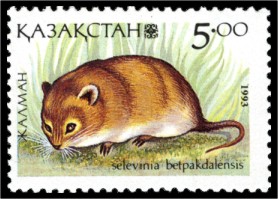 Desert DormouseSelevinia betpakdalaensis
Compare
Questions and answers
What is the scientific name of the Garden Dormouse?
The scientific name of the Garden Dormouse is Eliomys quercinus. Written with its author, the full name is Eliomys quercinus (Linnaeus, 1766).
Which family does the Garden Dormouse belong to?
Eliomys quercinus belongs to the family Gliridae, in the order Rodentia and the class Mammalia.
Where is the Garden Dormouse found?
Checklists and occurrence records place Eliomys quercinus in 18 countries, including France, Spain, Germany, Switzerland, Belgium and Italy.
What is the conservation status of the Garden Dormouse?
The IUCN Red List category recorded for Eliomys quercinus is Vulnerable (VU).
What other names does the Garden Dormouse have?
Eliomys quercinus is also known in English as Asian Garden Dormouse and European Garden Dormouse.
Sources
Passages the profile rests on
- The species was classified as Vulnerable by the IUCN in the Animal Diversity Web account. Source passage: “Garden dormice have an IUCN status of 'Vulnerable'.” — animaldiversity.org
- Deforestation is identified as a threat to garden dormice in parts of Europe and Finland. Source passage: “E. quercinus is endangered in parts of Europe and Finland due to deforestation in these areas.” — animaldiversity.org
- The garden dormouse was named Animal of the Year in 2022 by the Swiss nature conservation organisation Pro Natura. Source passage: “Pro Natura has named the garden dormouse "Animal of the Year" in 2022.” — English Wikipedia
- Garden dormice were used as food in Britain during the Roman Empire. Source passage: “Eliomys quercinus were used for food in Britain during the Roman Empire” — animaldiversity.org
- The species has short hair and a tail ending in a white tassel. Source passage: “Its hair is short, and its tail has a white tassel at the end.” — English Wikipedia
- The facial black stripe extends from the nose to behind the ear. Source passage: “The black stripe goes from the nose to behind the ear.” — animaldiversity.org
- European garden dormice have tails with brown, black, and white coloration. Source passage: “The tails of European dormice have brown, black and white coloration on them.” — animaldiversity.org
- Female garden dormice have eight mammary glands. Source passage: “There are eight mammae on female E. quercinus .” — animaldiversity.org
- The species primarily inhabits forests but also occurs in fruit-growing regions. Source passage: “the garden dormouse's main habitat is the forest, though it can also be found in fruit-growing regions.” — English Wikipedia
- The species inhabits steppe deserts, hollow trees, rock crevices, and human dwellings. Source passage: “Eliomys quercinus lives in steepe deserts, hollow trees, rock crevices, and human dwellings.” — animaldiversity.org
- The species is occasionally found in swamplands despite its predominantly arboreal habits. Source passage: “Although they are highly arboreal, they are occasionally found in swamplands.” — animaldiversity.org
- Garden dormice may shelter in birds' nests, rocks, or trees. Source passage: “They may live in shelters made from birds' nests, rock, or trees.” — animaldiversity.org
- Arboreal nests are typically located between 0.8 and 3.0 meters above the ground. Source passage: “If arboreal, the compact nest will be 0.8-3.0 meters above the ground.” — animaldiversity.org
- Garden dormice may occupy existing bird or squirrel nests. Source passage: “Garden dormice may take over bird or squirrel nests.” — animaldiversity.org
- Garden dormouse droppings collected in Belgium contained leaves and flowers predominantly in spring, and berries and fruit in summer. Source passage: “Garden dormouse scat collected in Belgium contained foremost leaves and flowers in spring, berries and fruit in summer” — English Wikipedia
- Garden dormice cache food, probably contributing to seed dispersal. Source passage: “Because E. quercinus caches food, it probably plays some role in dispersing seeds.” — animaldiversity.org
- The species is primarily nocturnal. Source passage: “The garden dormouse is primarily nocturnal” — English Wikipedia
- Garden dormice sleep in tree nests during the day, sometimes sharing nests with multiple individuals. Source passage: “sleeping in nests in trees during the day, with sometimes multiple individuals living in one nest.” — English Wikipedia
- Garden dormice may hibernate for as long as seven months during winter. Source passage: “They may hibernate for up to seven months in the winter.” — animaldiversity.org
- Before hibernation, garden dormice gain weight to sustain themselves during dormancy. Source passage: “Before hibernation, dormice put on weight to last the duration of the long hibernation.” — animaldiversity.org
- Garden dormice are social animals that share feeding and sleeping sites. Source passage: “Eliomys quercinus is social, with common feeding and sleeping sites.” — animaldiversity.org
- Individuals fight in shared areas during the mating season but display little aggression during the rest of the year. Source passage: “When mating season comes, they fight in the common areas, but during the rest of the year show little aggression, even between groups.” — animaldiversity.org
- The species communicates through whistles, growls, and snores. Source passage: “Eliomys quercinus communicate using vocalizations, including whistles, growls, or snores.” — animaldiversity.org
- The mating period described for the species lasts from April to June. Source passage: “The mating period lasts from April to June.” — English Wikipedia
- Female garden dormice signal readiness to mate by squeaking loudly. Source passage: “the female indicates her readiness to mate by squeaking loudly.” — English Wikipedia
- Gestation lasts approximately 23 days. Source passage: “after a gestation period of 23 days.” — English Wikipedia
- Litters usually contain three to seven young. Source passage: “The young are usually born in litters of three to seven” — English Wikipedia
- Newborn garden dormice are blind and naked. Source passage: “Blind and naked at birth” — English Wikipedia
- Young garden dormice open their eyes at approximately 18 days of age. Source passage: “they open their eyes after about 18 days” — English Wikipedia
- Young garden dormice are nursed until they are approximately one month old. Source passage: “and are nursed until they are one month old.” — English Wikipedia
- Young garden dormice become independent at approximately two months of age. Source passage: “They become independent at two months of age” — English Wikipedia
- In some European regions and Morocco, the breeding season extends from May to October. Source passage: “has a breeding season from May to October in areas of Europe and Morocco.” — animaldiversity.org
- Female garden dormice enter heat every ten days during the breeding season. Source passage: “Females enter heat every 10 days during the breeding season.” — animaldiversity.org
- Reported litter sizes range from two to eight offspring. Source passage: “A litter consists of two to eight offspring” — animaldiversity.org
- Gestation is reported to last between 22 and 28 days. Source passage: “which are born after a gestation period of 22 to 28 days.” — animaldiversity.org
- The species consumes arthropods, including insects and millipedes, as well as snails, slugs, fruit, and seeds. Source passage: “typically arthropods such as insects and millipedes, as well as gastropods like snails and slugs—and plant matter, usually fruit and seeds.” — English Wikipedia
- Garden dormice consume small mammals, insects, snails, and baby birds. Source passage: “Garden dormice are more carnivorous than any other dormice species, including other small mammals, insects, snails and baby birds.” — animaldiversity.org
- The species also eats hazelnuts, chestnuts, acorns, pine seeds, bark, and eggs. Source passage: “Other foods include fruit, hazel nuts, chestnuts, acorns, pine seeds, bark, and eggs.” — animaldiversity.org
Data
- Catalogue of Life, 2026-10-16 XR cc by
- Global Biodiversity Information Facility CC BY 4.0
- Wikidata CC0
- GeoNames CC BY 4.0
- Wikimedia Commons per image; credit shown with each image
- Within the Catalogue of Life, this name comes from The Integrated Taxonomic Information System cc0
References
- Syst. Nat., 12th ed. vol.1 p.84 where the name was published
- Wilson, Don E., and DeeAnn M. Reeder, eds. (1993). Mammal Species of the World: A Taxonomic and Geographic Reference, 2nd Ed., 3rd Printing.
- Wilson, Don E., and F. Russell Cole. (2000). Common Names of Mammals of the World.
- Wilson, Don E., and DeeAnn M. Reeder, eds. (2005). Family Gliridae. Mammal Species of the World: A Taxonomic and Geographic Reference, 3rd Ed., Vol. 2.
- Holden-Musser, M. E., R. Juskaitis, and G. M. Musser / Wilson, Lacher Jr., and Mittermeier, eds. (2016). Gliridae (Dormice). Handbook of the Mammals of the World. Vol. 6: Lagomorphs and Rodents I.
- Burgin, Connor J., Don E. Wilson, Russell A. Mittermeier, Anthony B. Rylands, et al. (2020). Illustrated Checklist of the Mammals of the World. Vol. 1. Monotremata to Rodentia.
This species in other databases
Page built on 28 November 2026. See how the catalog is made and all sources and licences.
Cite this page
ScientificNames.org. (2026). Eliomys quercinus (Garden Dormouse). Retrieved November 28, 2026, from https://scientificnames.org/species/eliomys-quercinus
“Eliomys quercinus (Garden Dormouse).” ScientificNames.org, 2026, scientificnames.org/species/eliomys-quercinus. Accessed 28 Nov. 2026.
ScientificNames.org. “Eliomys quercinus (Garden Dormouse).” Accessed November 28, 2026. https://scientificnames.org/species/eliomys-quercinus.
@misc{scientificnames_eliomys_quercinus_garden_dormouse,
  author = {{ScientificNames.org}},
  title = {Eliomys quercinus (Garden Dormouse)},
  year = {2026},
  url = {https://scientificnames.org/species/eliomys-quercinus},
  note = {Accessed 2026-11-28}
}