Species · Birds
Painted Finch Emblema pictum
The scientific name of the Painted Finch is Emblema pictum. It is a species of bird in the family Estrildidae (munias), order Passeriformes. The name dates from 1842.
- Scientific name
- Emblema pictum Gould, 1842
- Common name
- Painted Finch
- Genus
- Emblema
- Family
- Estrildidae (Munias)
- Order
- Passeriformes
- Class
- Aves
- Red List category
- LC Least Concern
- Recorded in
- 1 country
- Name status
- accepted in the Catalogue of Life

Overview
Emblema pictum inhabits arid and semi-arid zones, particularly rocky areas with spinifex grass ground cover.
Written 26 November 2026 from the sources listed below. Each statement was checked against the passage it cites; statements that could not be supported were removed.
Appearance
The tail, upper body and upper wings are reddish-brown. The rump and uppertail coverts are mostly red and conspicuous during flight.[1][2]
Males have a long, slender and pointed bill, cream or off-white irises, and legs ranging in colour from dark brown to pinkish.[3][4][5]
Juveniles resemble females but have duller and browner underparts. They lack red facial colouring and have a black bill that becomes paler and almost pinkish on the lower part, as well as grey-brown eyes.[6][7][8]
The Painted Finch measures 10–12 cm in length and weighs approximately 11.5 g.[9][10]
Habitat
The Painted Finch inhabits arid and semi-arid zones. It occurs in rocky areas with spinifex grass ground cover.[11][12]
Diet
Grass seeds, particularly those of spinifex species, form the main diet. The Painted Finch sometimes consumes fruit and grass blades.[13][14]
The species forages on the ground among rocks and grass tussocks for fallen seeds. Captive individuals have been observed catching flying termites and gleaning aphids from vegetation.[15][16]
Behaviour
Painted Finches usually occur in pairs and small flocks. Groups of up to 100 individuals have been observed gathering around water sources, and large flocks may include other finch species and honeyeaters.[17][18][19]
Females give a rattling call in response to danger near the nest.[20]
Reproduction and life cycle
Painted Finches may breed at almost any time of year when conditions are suitable. Eggs have been recorded in every month except November and December, while nestlings have been recorded between March and October.[21][22][23]
Courtship usually takes place on the ground and involves both sexes picking up and dropping twigs or other objects. Painted Finches are monogamous and nest in simple pairs.[24][25]
Nesting sites are usually concealed clumps of spinifex grass. Pairs sometimes nest in natural cavities near the top of grass clumps or on the ground at their base.[26][27]
Painted Finches construct loose, bottle-shaped or domed nests with wide entrances. Females lay clutches of three to five oval white eggs.[28][29]
Young begin developing courtship behaviour at approximately 10 weeks old.[30]
Conservation
The Painted Finch is classified as Least Concern on the IUCN Red List. It is also listed as Least Concern in Queensland under the Nature Conservation Act of 1992.[31][32]
Uses
The Painted Finch is commonly kept in captivity and backyard aviaries.[33]
Classification of the Painted Finch
| Kingdom | Animalia |
|---|---|
| Phylum | Chordata |
| Subphylum | Vertebrata |
| Infraphylum | Gnathostomata |
| Parvphylum | Osteichthyes |
| Megaclass | Tetrapoda |
| Class | Aves (Bird) |
| Order | Passeriformes (Passerine) |
| Family | Estrildidae (Munias) |
| Genus | Emblema |
| Species | Emblema pictum Gould, 1842 |
Where the Painted Finch is found
Checklists and occurrence records place Emblema pictum in 1 country. GBIF holds 11,756 georeferenced records of it.
Countries
Regions and cities with the most records
- Western Australia, Australia 6,370
- Northern Territory, Australia 2,956
- Queensland, Australia 1,936
- Mount Isa, Australia 872
- Alice Springs, Australia 410
- Karratha, Australia 170
- South Australia, Australia 148
- New South Wales, Australia 73
- Port Hedland, Australia 26
- Victoria, Australia 7
- Darwin, Australia 6
- Palmerston, Australia 6
- Broken Hill, Australia 4
- Gold Coast, Australia 4
- Launceston, Australia 4
- Tasmania, Australia 4
1 more country has a few records outside this range
These countries hold a few records of Emblema pictum but lie outside the range the checklists give for it. Such records are often zoo or garden specimens, museum material or vagrants, so the species is not counted as occurring there.
A number beside a place is its count of GBIF occurrence records. A place without a number comes from a checklist alone. Records show where a species has been observed or collected, which can include escapes and vagrants.
Common names
English
- Painted Finch
- Painted Firetail
Names in 27 other languages
- Arabic
- عصفور مطلي, ناري الذيل المطلي
- Catalan
- diamant pintat
- Chinese
- 彩火尾雀
- Croatian
- biserastoboka amadina
- Czech
- astrild rudokrký
- Danish
- Malet Astrild
- Dutch
- Geschilderde Astrild, Geschilderde astrilde
- Esperanto
- pentrita estrildo
- Estonian
- helmes-amadiin
- Finnish
- helmituliperä
- French
- Diamant peint
- German
- Gemalte Amadine, Gemalter Astrild, Maleramadine, Malerastrild
- Hungarian
- festett asztrild
- Italian
- Diamante pittato, Diamante variopinto
- Japanese
- コマチスズメ
- Lithuanian
- spalvingoji astrilda
- Norwegian
- mosaikkastrild
- Polish
- krasnogonek czerwonolicy, kraśniczek czerwonolicy
- Portuguese
- diamante-pintado
- Russian
- Расписная амадина, Расписной астрильд
- Serbian
- Pikta amadina
- Slovak
- diamantovka maľovaná, zebrička maľovaná
- Spanish
- Diamante pintado
- Swedish
- målad astrild
- Turkish
- Boyalı Belikınalı, Boyalı ateşkuyruk
- Ukrainian
- вогнегуз червонощокий
- Welsh
- pinc fflamgwt lliwgar
Synonyms
4 other scientific names have been used for this species and are now treated as synonyms of Emblema pictum.
- Emblema picta clelandi Mathews, GM, 1914
- Emblema picta coongani Mathews, GM, 1912
- Emblema picta ethelae Mathews, GM, 1914
- Emblema picta territorii Mathews, GM, 1912
Related species
-
 Scaly-breasted MuniaLonchura punctulata
-
 Red AvadavatAmandava amandava
-
 Common WaxbillEstrilda astrild
-
 Indian SilverbillEuodice malabarica
-
 Red-browed FinchNeochmia temporalis
-
 White-rumped MuniaLonchura striata
-
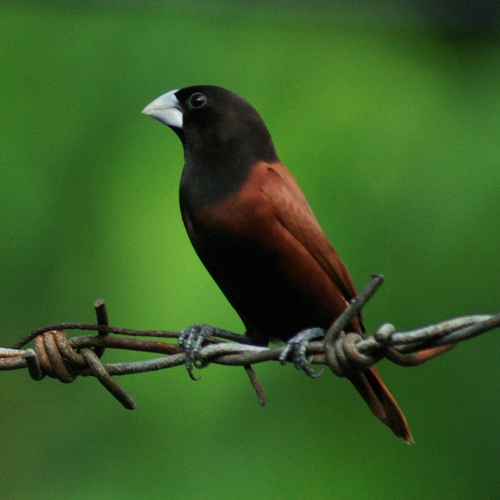 Chestnut MuniaLonchura atricapilla
-
 Double-barred FinchTaeniopygia bichenovii
Compare
Questions and answers
What is the scientific name of the Painted Finch?
The scientific name of the Painted Finch is Emblema pictum. Written with its author, the full name is Emblema pictum Gould, 1842.
Which family does the Painted Finch belong to?
Emblema pictum belongs to the family Estrildidae, in the order Passeriformes and the class Aves.
Where is the Painted Finch found?
Checklists and occurrence records place Emblema pictum in 1 country: Australia.
What is the conservation status of the Painted Finch?
The IUCN Red List category recorded for Emblema pictum is Least Concern (LC).
What other names does the Painted Finch have?
Emblema pictum is also known in English as Painted Firetail.
Sources
Passages the profile rests on
- The tail, upper body and upper wings are reddish-brown. Source passage: “The tail and upper body and upper wing are a reddish-brown colour.” — English Wikipedia
- The rump and uppertail coverts are mostly red and conspicuous during flight. Source passage: “The rump and uppertail coverts are also mostly red and highly conspicuous when the birds is in flight.” — English Wikipedia
- Males have a long, slender and pointed bill. Source passage: “Painted finches have a long, slender and pointed bill” — English Wikipedia
- Male irises are cream or off-white. Source passage: “The Iris of males is a cream or off-white colour” — English Wikipedia
- Male leg colour ranges from dark brown to pinkish. Source passage: “the legs of males vary between a dark brown to pinkish colour.” — English Wikipedia
- Juveniles resemble females but have duller and browner underparts. Source passage: “Juvenile painted finches are similar in appearance to females but their underparts are duller and browner.” — English Wikipedia
- Juveniles lack red facial colouring and have a black bill that becomes paler and almost pinkish on the lower part. Source passage: “Juveniles lack the red colouration on their face and their bill is black which becomes paler and almost pinkish on the lower part.” — English Wikipedia
- Juveniles have grey-brown eyes. Source passage: “Juvenile's eyes are a grey-brown.” — English Wikipedia
- The painted finch measures 10–12 cm in length. Source passage: “10–12 cm (3.9–4.7 in) in length” — English Wikipedia
- The painted finch weighs approximately 11.5 g. Source passage: “weighs around 11.5 g (0.41 oz).” — English Wikipedia
- The painted finch inhabits arid and semi-arid zones. Source passage: “The painted finch is found in arid and semi-arid zones” — English Wikipedia
- The species occurs in rocky areas with spinifex grass ground cover. Source passage: “in rocky areas with a ground cover of spinifex grass.” — English Wikipedia
- Grass seeds, particularly those of spinifex species, form the main diet. Source passage: “The painted finch feeds on grass seeds mostly from spinifex (Triodia) species” — English Wikipedia
- The painted finch sometimes consumes fruit and grass blades. Source passage: “and sometimes may consume fruit and blades of grass.” — English Wikipedia
- The species forages on the ground among rocks and grass tussocks for fallen seeds. Source passage: “Individuals forage on the ground, hopping and bouncing among rocks and tussocks of grass in order to glean for fallen seeds.” — English Wikipedia
- Captive painted finches have been observed catching flying termites and gleaning aphids from vegetation. Source passage: “Captive birds have seen to sally-strike flying termites and glean aphids from vegetation” — English Wikipedia
- Painted finches usually occur in pairs and small flocks. Source passage: “Painted finches usually occur in pairs and small flocks” — English Wikipedia
- Groups of up to 100 individuals have been observed gathering around water sources. Source passage: “larger flocks of up to 100 individuals have been seen when congregating around water sources.” — English Wikipedia
- Large flocks may include other finch species and honeyeaters. Source passage: “These large flocks may contain other species of finches and honeyeaters.” — English Wikipedia
- Females give a rattling call in response to danger near the nest. Source passage: “females make a rattling call in response to danger near the nest.” — English Wikipedia
- Painted finches may breed at almost any time of year when conditions are suitable. Source passage: “If conditions are suitable painted finches breed at almost any time of year” — English Wikipedia
- Eggs have been recorded in every month except November and December. Source passage: “eggs being recorded in all months except November and December” — English Wikipedia
- Nestlings have been recorded between March and October. Source passage: “nestlings being recorded between March and October.” — English Wikipedia
- Courtship usually takes place on the ground and involves both sexes picking up and dropping twigs or other objects. Source passage: “Courtship usually occurs on the ground and involves both sexes picking up twigs or other items and dropping them.” — English Wikipedia
- Painted finches are monogamous and nest in simple pairs. Source passage: “Painted finches are monogamous and nest in simple pairs.” — English Wikipedia
- Nesting sites are usually concealed clumps of spinifex grass. Source passage: “Nesting sites are usually well concealed clumps of spinifex grass” — English Wikipedia
- Pairs sometimes nest in natural cavities near the top of grass clumps or on the ground at their base. Source passage: “pairs have been seen to nest in natural cavities near the top of a clump or on the ground at the base.” — English Wikipedia
- Painted finches construct loose, bottle-shaped or domed nests with wide entrances. Source passage: “Individuals build loose, bottle shaped or domed nests with a wide entrance” — English Wikipedia
- Females lay clutches of three to five oval white eggs. Source passage: “Females will lay a clutch size of 3 to 5 oval white eggs.” — English Wikipedia
- Young begin developing courtship behaviour at approximately 10 weeks old. Source passage: “they begin to develop courtship behaviour at 10 weeks old.” — English Wikipedia
- The painted finch is classified as Least Concern on the IUCN Red List. Source passage: “On the IUCN Red list the painted finch is listed as being of "Least Concern"” — English Wikipedia
- The species is also listed as Least Concern in Queensland under the Nature Conservation Act of 1992. Source passage: “and this is also its listing in Queensland under the Nature Conservation Act of 1992.” — English Wikipedia
- The painted finch is commonly kept in captivity and backyard aviaries. Source passage: “The painted finch is a popular bird to be kept in captivity and in backyard aviaries.” — English Wikipedia
Data
- Catalogue of Life, 2026-10-16 XR cc by
- Global Biodiversity Information Facility CC BY 4.0
- Wikidata CC0
- GeoNames CC BY 4.0
- Wikimedia Commons per image; credit shown with each image
- Within the Catalogue of Life, this name comes from The Integrated Taxonomic Information System cc0
References
- Gill, Frank, & and Minturn Wright. (2006). Birds of the World: Recommended English Names.
This species in other databases
Page built on 29 November 2026. See how the catalog is made and all sources and licences.
Cite this page
ScientificNames.org. (2026). Emblema pictum (Painted Finch). Retrieved November 29, 2026, from https://scientificnames.org/species/emblema-pictum
“Emblema pictum (Painted Finch).” ScientificNames.org, 2026, scientificnames.org/species/emblema-pictum. Accessed 29 Nov. 2026.
ScientificNames.org. “Emblema pictum (Painted Finch).” Accessed November 29, 2026. https://scientificnames.org/species/emblema-pictum.
@misc{scientificnames_emblema_pictum_painted_finch,
  author = {{ScientificNames.org}},
  title = {Emblema pictum (Painted Finch)},
  year = {2026},
  url = {https://scientificnames.org/species/emblema-pictum},
  note = {Accessed 2026-11-29}
}