Species · Reptiles
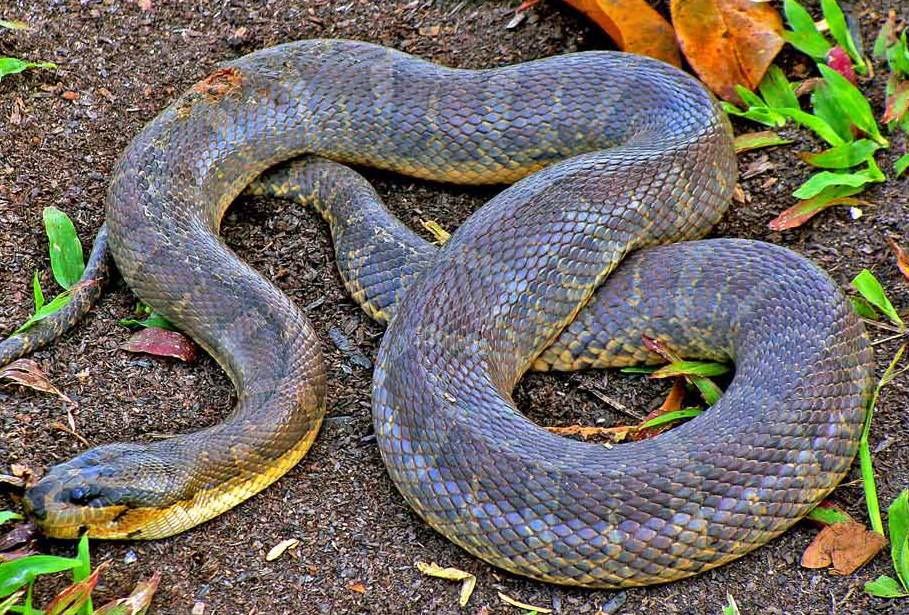
Rainbow Water Snake Enhydris enhydris
The scientific name of the Rainbow Water Snake is Enhydris enhydris. It is a species of reptile in the family Homalopsidae (mud snakes), order Squamata. The name dates from 1799.
- Scientific name
- Enhydris enhydris (Schneider, 1799)
- Common name
- Rainbow Water Snake
- Genus
- Enhydris
- Family
- Homalopsidae (Mud Snakes)
- Order
- Squamata
- Class
- Reptilia
- Red List category
- LC Least Concern
- Environment
- freshwater, terrestrial
- Recorded in
- 13 countries
- Name status
- accepted in the Catalogue of Life

Overview
Enhydris enhydris inhabits lowland freshwater streams, ponds, rivers, marshes, paddy fields, and brackish water bodies, and is occasionally found in terrestrial habitats. It has two pale stripes extending from the tail to the head, where they join.
Written 26 November 2026 from the sources listed below. Each statement was checked against the passage it cites; statements that could not be supported were removed.
Appearance
The Rainbow Water Snake has two pale stripes that extend from the tail to the head, where they join.[1]
Habitat
The species inhabits lowland freshwater streams, ponds, and rivers. It also occurs in marshes and paddy fields.[2][3]
It also inhabits brackish water bodies and is occasionally found in terrestrial habitats.[4][5]
The species occurs in Cambodia and Peninsular Malaysia. A road-killed specimen was reported from Singapore, where the species was possibly introduced with ornamental plants.[6][7][8]
Diet
The Rainbow Water Snake mainly feeds on fish. Its diet also includes tadpoles, frogs, and lizards.[9][10][11][12]
Behaviour
The species is active during the day. It is rear-fanged and mildly venomous.[13][14]
Reproduction and life cycle
Mating has been observed during October and November. Gravid females collected in March contained between four and 18 young.[15][16]
One documented event recorded the birth of 23 young on July 11, 2012.[17]
Conservation
The species is reported to be common in Southeast Asia and some parts of South Asia. Continued human-caused impacts may threaten its populations.[18][19]
Classification of the Rainbow Water Snake
| Kingdom | Animalia |
|---|---|
| Phylum | Chordata |
| Subphylum | Vertebrata |
| Infraphylum | Gnathostomata |
| Parvphylum | Osteichthyes |
| Megaclass | Tetrapoda |
| Class | Reptilia (Reptile) |
| Order | Squamata (Snakes) |
| Suborder | Serpentes (Snakes) |
| Infraorder | Alethinophidia |
| Family | Homalopsidae (Mud Snakes) |
| Genus | Enhydris (Asian Mud Snakes) |
| Species | Enhydris enhydris (Schneider, 1799) |
Where the Rainbow Water Snake is found
Checklists and occurrence records place Enhydris enhydris in 13 countries. GBIF holds 1,610 georeferenced records of it.
Countries
- Bangladesh 52
- Cambodia 54
- China 7
- India 116
- Indonesia 265
- Laos 4
- Malaysia 30
- Myanmar 125
- Nepal 3
- Pakistan 9
- Singapore 6
- Thailand 839
- Vietnam 100
Regions and cities with the most records
- Sawangan, Indonesia 61
- Cibinong, Indonesia 60
- Parung, Indonesia 59
- Citeureup, Indonesia 58
- Depok, Indonesia 52
- Ciampea, Indonesia 50
- Yangon, Myanmar 49
- Bogor, Indonesia 46
- Botataung, Myanmar 45
- Mingala Tangnyunt, Myanmar 45
- Myenigon, Myanmar 45
- Sangyoung, Myanmar 45
- Yangon, Myanmar 45
- Set Ka Lay, Myanmar 42
- Setsan, Myanmar 42
- Kanbe, Myanmar 40
- Ba Dinh, Vietnam 39
- Bạch Mai, Vietnam 39
- Bắc Từ Liêm, Vietnam 39
- Cầu Diễn, Vietnam 39
- Cầu Giấy, Vietnam 39
- Cổ Lóa, Vietnam 39
- Cửa Nam, Vietnam 39
- Dương Nội, Vietnam 39
- Dại Mỗ, Vietnam 39
- Dịch Vọng, Vietnam 39
- Ecopark, Vietnam 39
- Gia Lâm, Vietnam 39
- Giảng Võ, Vietnam 39
- Hai Bà Trưng, Vietnam 39
- Hanoi, Vietnam 39
- Hlaingthaya, Myanmar 39
- Hoang Cau, Vietnam 39
- Hoàn Kiếm, Vietnam 39
- Hoàng Liệt, Vietnam 39
- Hà Đông, Vietnam 39
1 more country has a few records outside this range
These countries hold a few records of Enhydris enhydris but lie outside the range the checklists give for it. Such records are often zoo or garden specimens, museum material or vagrants, so the species is not counted as occurring there.
Range as the checklists state it
SE China
A number beside a place is its count of GBIF occurrence records. A place without a number comes from a checklist alone. Records show where a species has been observed or collected, which can include escapes and vagrants.
Common names
English
- Rainbow Water Snake
- Rainbow Mud Snake
- Smooth Water Snake
- Striped Water Snake
Names in 7 other languages
- Chinese
- 彩虹水蛇
- Danish
- Stribet Muddersnog
- German
- Gestreifte Wassertrugnatter
- Indonesian
- Ular Air Pelangi
- Polish
- Mieliznówka tęczowa
- Spanish
- Serpiente de lodo arcoíris
- Thai
- งูสายรุ้ง
Synonyms
11 other scientific names have been used for this species and are now treated as synonyms of Enhydris enhydris.
- Coluber aer (H. Boie, 1826)
- Coluber pythonissa Daudin, 1803
- Enhydris caerulea Latreille ex Sonnini & Latreille, 1801
- Homalopsis aer Boie, 1827
- Homalopsis enhydris (Schneider, 1799)
- Hydrus atrocaeruleus Shaw, 1802
- Hydrus enhydris Schneider, 1799
- Hypsirhina aer (H. Boie, 1826)
- Hypsirhina bilineata Gray, 1842
- Hypsirhina enhydris (Schneider, 1799)
- Hypsirhina furcata Gray, 1842
Related species
- Sind River SnakeEnhydris chanardi
-
 Mekong Mud SnakeEnhydris subtaeniata
- Tay Ninh Water SnakeEnhydris innominata
- Bangkok Mud SnakeEnhydris jagorii
- Longhead Water SnakeEnhydris longicauda
-
 Tentacled SnakeErpeton tentaculatum
-
 South Asian BockadamCerberus rynchops
-
 Puff-faced Water SnakeHomalopsis buccata
Compare
Questions and answers
What is the scientific name of the Rainbow Water Snake?
The scientific name of the Rainbow Water Snake is Enhydris enhydris. Written with its author, the full name is Enhydris enhydris (Schneider, 1799).
Which family does the Rainbow Water Snake belong to?
Enhydris enhydris belongs to the family Homalopsidae, in the order Squamata and the class Reptilia.
Where is the Rainbow Water Snake found?
Checklists and occurrence records place Enhydris enhydris in 13 countries, including Thailand, Indonesia, Myanmar, India, Vietnam and Cambodia.
What is the conservation status of the Rainbow Water Snake?
The IUCN Red List category recorded for Enhydris enhydris is Least Concern (LC).
What other names does the Rainbow Water Snake have?
Enhydris enhydris is also known in English as Rainbow Mud Snake, Smooth Water Snake and Striped Water Snake.
Is the rainbow snake rare?
The Rainbow Water Snake is reported to be common in Southeast Asia and some parts of South Asia. Continued human-caused impacts may threaten its populations.[18][19]
What is the diet of a water snake?
The Rainbow Water Snake mainly feeds on fish. It also eats tadpoles, frogs, and lizards.[9][10][11][12]
What do rainbow snakes eat?
The Rainbow Water Snake mainly feeds on fish, but also eats tadpoles, frogs, and lizards.[9][10][11][12]
Sources
Passages the profile rests on
- The species has two pale stripes extending from the tail to the head, where they join. Source passage: “It can be distinguished from other snakes by its two pale stripes that run from tail to head region where they confluence” — pmc.ncbi.nlm.nih.gov
- The species inhabits lowland freshwater streams, ponds, and rivers. Source passage: “It inhabits lowland freshwater (streams, ponds, river, etc.)” — pmc.ncbi.nlm.nih.gov
- The species occurs in marshes and paddy fields. Source passage: “marshes, and paddy fields” — pmc.ncbi.nlm.nih.gov
- The species also inhabits brackish water bodies. Source passage: “and brackish water bodies” — pmc.ncbi.nlm.nih.gov
- The species is occasionally found in terrestrial habitats. Source passage: “It is also found occasionally in terrestrial habitats” — pmc.ncbi.nlm.nih.gov
- The species occurs in Cambodia. Source passage: “It distributes widely in Cambodia” — pmc.ncbi.nlm.nih.gov
- The species occurs in Peninsular Malaysia. Source passage: “Peninsular Malaysia [2]” — pmc.ncbi.nlm.nih.gov
- A road-killed specimen was reported from Singapore, where the species was possibly introduced with ornamental plants. Source passage: “Lim and D'Rozario [21] reported a road-killed specimen from Singapore where it was possibly imported with ornamental plants.” — pmc.ncbi.nlm.nih.gov
- The species mainly feeds on fish. Source passage: “where they mainly feed on fishes” — pmc.ncbi.nlm.nih.gov
- The species also feeds on tadpoles. Source passage: “However, it also feeds on tadpoles, frogs, and lizards” — pmc.ncbi.nlm.nih.gov
- The species also feeds on frogs. Source passage: “However, it also feeds on tadpoles, frogs, and lizards” — pmc.ncbi.nlm.nih.gov
- The species also feeds on lizards. Source passage: “However, it also feeds on tadpoles, frogs, and lizards” — pmc.ncbi.nlm.nih.gov
- The species is active during the day. Source passage: “The Rainbow Water Snake (Enhydris) is a diurnal, rear-fanged, and mildly venomous snake” — pmc.ncbi.nlm.nih.gov
- The species is rear-fanged and mildly venomous. Source passage: “The Rainbow Water Snake (Enhydris) is a diurnal, rear-fanged, and mildly venomous snake” — pmc.ncbi.nlm.nih.gov
- Mating has been observed during October and November. Source passage: “Whitaker and Captain [12] observed their mating in October–November” — pmc.ncbi.nlm.nih.gov
- Gravid females collected in March contained between four and 18 young. Source passage: “noted the gravid females collected in March bearing 4–18 young.” — pmc.ncbi.nlm.nih.gov
- The species gave birth to 23 young in one documented event on July 11, 2012. Source passage: “The gravid female gave birth to 23 litters on July 11, 2012.” — pmc.ncbi.nlm.nih.gov
- Continued human-caused impacts may threaten populations of this species. Source passage: “The continued anthropogenic impact can threaten its populations.” — pmc.ncbi.nlm.nih.gov
- The species is reported to be common in Southeast Asia and some parts of South Asia. Source passage: “Although E. enhydris is reported to be common in Southeast Asia and some parts of South Asia” — pmc.ncbi.nlm.nih.gov
Data
- Catalogue of Life, 2026-10-16 XR cc by
- Global Biodiversity Information Facility CC BY 4.0
- Wikidata CC0
- GeoNames CC BY 4.0
- Wikimedia Commons per image; credit shown with each image
- Within the Catalogue of Life, this name comes from The Reptile Database cc by
References
- Russell, P. (1796). An account of Indian serpents collected on the coast of Coromandel, containing descriptions and drawings of each species, together with experiments and remarks on their several poisons. George Nicol, London, 90 Pp.
- Schneider, J. G. (1799). Historiae Amphibiorum narturalis et literariae. Fasciculus primus, continens Ranas. Calamitas, Bufones, Salamandras et Hydros. Frommanni, Jena, 266 S.
- Eydoux, F. & P. Gervais. (1837). Voyage de la Favourite. Reptiles. Dragon spiloptère, Draco spilopterus. Magasin Zool. Guérin, Paris, III: 1 - 10.
- Duméril, A. M. C., Bibron, G. & DUMÉRIL, A. H. A.,. (1854). Erpétologie générale ou histoire naturelle complète des reptiles. Tome septième. Deuxième partie, comprenant l’histoire des serpents venimeux. Paris, Librairie Encyclopédique de Roret: I-Xii + 781-1536.
- Boulenger, George A. (1890). The Fauna of British India, Including Ceylon and Burma. Reptilia and Batrachia. Taylor & Francis, London, Xviii, 541 Pp.
- Boulenger, G. A. (1896). Catalogue of the snakes in the British Museum, Vol. 3. London (Taylor & Francis), Xiv + 727 Pp.
- D’Abreu, E.A. (1913). Effect of a Bite from Schneider’s Water Snake (Hypsirhina enhydris). J. Bombay Nat. Hist. Soc. 22: 203.
- Smith, M. A. (1914). On the breeding habits of Hypsirhina enhydris and Herpeton tentaculatum (the Tentacle Snake). J. Nat. Hist. Soc. Siam 1: 126-7.
- Chabanaud, & P. (1923). Description d’un Chamaeleon nouveau d’Indochine et d’un exemplaire monstrueux d’ Enhydris hardwicki Gray. Bull. Mus. Nat. Hist. Nat., Paris 29: 209-210.
- Mell, R. (1931). List of Chinese snakes. Lingnan Sci. Jour., Canton, 8 [1929]: 199-219.
- Smedley, N. (1932). Notes on the herpetological collections in the Selangor Museum. Bull. Raffles Mus. No 7: 9-17.
- Kopstein, F. (1938). Ein Beitrag zur Eierkunde und zur Fortpflanzung der Malaiischen Reptilien. Bull. Raffles Mus. No 14: 81-167.
- Smith, M. A. (1943). The Fauna of British India, Ceylon and Burma, Including the Whole of the Indo-Chinese Sub-Region. Reptilia and Amphibia. 3 (Serpentes). Taylor and Francis, London. 583 Pp.
- Constable, JOHN D. (1949). Reptiles from the Indian Peninsula in the Museum of Comparative Zoology. Bull. Mus. Comp. Zool. Harvard 103: 59-160.
- Deuve, J. (1961). Liste annotee des Serpents du Laos. Bull. Soc. Sci. Nat. Laos 1:5-32.
- Taylor, E. H. (1965). The serpents of Thailand and adjacent waters. Univ. Kansas Sci. Bull. 45 (9): 609-1096.
- Saint Girons, & Hubert. (1972). Notes sur l’Ecologie des Serpents du Cambodge. Zoologische Mededelingen 47: 65-87.
- Dowling, H.G., & Jenner, J.V. (1988). Snakes of Burma: checklist of reported species and bibliography. Smithsonian Herp. Inf. Serv. (76): 19 Pp.
- David, P., & Vogel, G. (1996). The snakes of Sumatra. An annotated checklist and key with natural history notes. Bücher Kreth, Frankfurt/M.
- Manthey, U., & Grossmann, W. (1997). Amphibien & Reptilien Südostasiens. Natur Und Tier Verlag (Münster), 512 Pp. (ISBN 3-931587-12-6).
- Murphy, J.C.; Chan-ard, T.; Karns, D.R., Sandrick, K.M. & Voris, H.K. (1998). The watersnakes of Lake Songkhila. Tigerpaper (Bangkok) 25: 1-4.
- Cox, Merel J.; Van Dijk, Peter Paul; Jarujin Nabhitabhata & Thirakhupt,Kumthorn. (1998). A Photographic Guide to Snakes and Other Reptiles of Peninsular Malaysia, Singapore and Thailand. Ralph Curtis Publishing, 144 Pp.
- de Silva, A. (1998). Snakes of Sri Lanka: a checklist and an annotated bibliography. Dept. Wildlife Conservation/ GEF /UNDP/ FAO, Colombo.
- Stuart, B.L.; Smith, J.; Davey, K.; Din, P. & Platt, S.G. (2000). Homalopsine watersnakes. The harvest and trade from Tonle Sap, Cambodia. Traffic Bull. 18 (3): 115-124.
- Pauwels, O.S.G.; David, P.; Chimsunchart, C. & Thirakhupt, K. (2003). Reptiles of Phetchaburi Province, Western Thailand: a list of species, with natural history notes, and a discussion on the biogeography at the Isthmus of Kra. Natural History Journal of Chulalongkorn University 3 (1): 23-53.
This species in other databases
- Catalogue of Life 39TXB
- Wikidata Q2384131
- iNaturalist 26770
- WoRMS urn:lsid:marinespecies.org:taxname:1541632
- ITIS 700412
Page built on 26 November 2026. See how the catalog is made and all sources and licences.
Cite this page
ScientificNames.org. (2026). Enhydris enhydris (Rainbow Water Snake). Retrieved November 26, 2026, from https://scientificnames.org/species/enhydris-enhydris
“Enhydris enhydris (Rainbow Water Snake).” ScientificNames.org, 2026, scientificnames.org/species/enhydris-enhydris. Accessed 26 Nov. 2026.
ScientificNames.org. “Enhydris enhydris (Rainbow Water Snake).” Accessed November 26, 2026. https://scientificnames.org/species/enhydris-enhydris.
@misc{scientificnames_enhydris_enhydris_rainbow_water_snake,
  author = {{ScientificNames.org}},
  title = {Enhydris enhydris (Rainbow Water Snake)},
  year = {2026},
  url = {https://scientificnames.org/species/enhydris-enhydris},
  note = {Accessed 2026-11-26}
}