Species · Reptiles
Asian Bockadam Cerberus rynchops
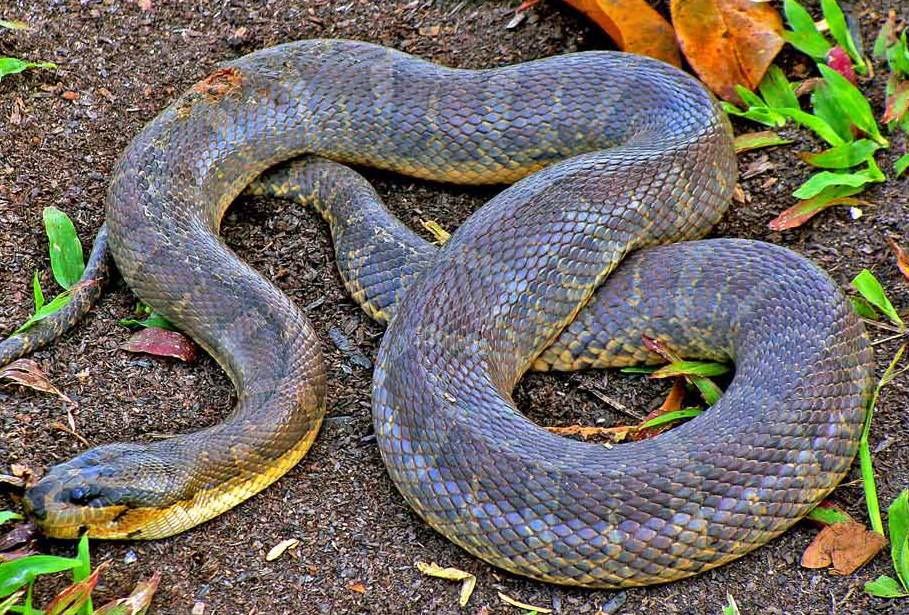
The scientific name of the Asian Bockadam is Cerberus rynchops. It is a species of reptile in the family Homalopsidae (mud snakes), order Squamata. The name dates from 1799.
- Scientific name
- Cerberus rynchops (Schneider, 1799)
- Common name
- Asian Bockadam
- Genus
- Cerberus
- Family
- Homalopsidae (Mud Snakes)
- Order
- Squamata
- Class
- Reptilia
- Red List category
- LC Least Concern
- Environment
- marine
- Recorded in
- 12 countries
- Name status
- accepted in the Catalogue of Life

Overview
Cerberus rynchops, also known as the New Guinea bockadam, South Asian bockadam, bockadam snake, or dog-faced water snake, is a mildly venomous species of a snake in the family Homalopsidae. It is native to coastal waters of South and Southeast Asia. The species was re-delimited in 2012, allocating populations east and south of the west coast of Thailand to other species.
Classification of the Asian Bockadam
| Kingdom | Animalia |
|---|---|
| Phylum | Chordata |
| Subphylum | Vertebrata |
| Infraphylum | Gnathostomata |
| Parvphylum | Osteichthyes |
| Megaclass | Tetrapoda |
| Class | Reptilia (Reptile) |
| Order | Squamata (Snakes) |
| Suborder | Serpentes (Snakes) |
| Infraorder | Alethinophidia |
| Family | Homalopsidae (Mud Snakes) |
| Genus | Cerberus (Dog-faced Water Snakes) |
| Species | Cerberus rynchops (Schneider, 1799) |
Where the Asian Bockadam is found
Checklists and occurrence records place Cerberus rynchops in 12 countries across Asia and Oceania. GBIF holds 1,380 georeferenced records of it.
Countries
- Bangladesh 31
- India 224
- Indonesia 204
- Malaysia 172
- Myanmar 219
- Palau 41
- Papua New Guinea 4
- Philippines 284
- Singapore 34
- Sri Lanka 30
- Thailand 133
- Timor Leste 4
Regions and cities with the most records
- Ayeyarwady, Myanmar 72
- Yangon, Myanmar 50
- Hlaingthaya, Myanmar 49
- Insein, Myanmar 49
- Mingala Tangnyunt, Myanmar 49
- Sangyoung, Myanmar 49
- Set Ka Lay, Myanmar 49
- Yangon, Myanmar 49
- Mingaladon, Myanmar 36
- Andaman and Nicobar, India 28
- Rakhine, Myanmar 22
- Khulna Division, Bangladesh 21
- Kanbe, Myanmar 18
- Tanintharyi Region, Myanmar 17
- Maharashtra, India 16
- Borivli, India 14
- Gwa, Myanmar 14
- Mumbai, India 14
- Port Blair, India 14
- Thāne, India 14
- West Bengal, India 14
- Antipolo, Philippines 13
- Bagong Barrio, Philippines 13
- Bagong Silangan, Philippines 13
- Cainta, Philippines 13
- Caloocan, Philippines 13
- Cavite City, Philippines 13
- Commonwealth, Philippines 13
- Dumaguete, Philippines 13
- Makati City, Philippines 13
- Malabon, Philippines 13
- Mandaluyong, Philippines 13
- Mandaluyong City, Philippines 13
- Manila, Philippines 13
- Marikina City, Philippines 13
- Meycauayan, Philippines 13
Range as the checklists state it
coastal areas of India (Gujarat, Maharashtra, Kerala, Tamil Nadu, Telangana, Assam, Andaman islands, Nicobar islands etc.), Bangladesh, Myanmar, Thailand, NW Malaysia, Timor-Leste
A number beside a place is its count of GBIF occurrence records. A place without a number comes from a checklist alone. Records show where a species has been observed or collected, which can include escapes and vagrants.
Common names
English
- Asian Bockadam
- Bockadam Snake
- Dog-faced Water Snake
- New Guinea Bockadam
- South Asian Bockadam
- Western Dog-faced Bockadam
Names in 13 other languages
- Bengali
- Gangmete
- Czech
- vodnářka rýžovištní
- Danish
- Vestlig Hundehovedsnog
- German
- Hundskopf-Wassertrugnatter
- Hindi
- Pani-ka-samp
- Hungarian
- kutyafejű vízisikló
- Japanese
- キールウミワタリ
- Marathi
- श्वानमुखी सर्प
- Sinhala
- කුණුදිය කළුවා
- Spanish
- Serpiente Acuática de Nueva Guinea
- Tagalog
- Caalabucab
- Tamil
- உவர்நீர் நாய்த் தலையன், நாய்த் தலையன்
- Thai
- งูปากกว้างน้ำเค็มอันดามัน
Synonyms
13 other scientific names have been used for this species and are now treated as synonyms of Cerberus rynchops.
- Boa moluroides Schneider, 1801
- Cerberus cerberus (Daudin, 1803)
- Cerberus cinereus (Shaw, 1802)
- Cerberus grantii Cantor, 1836
- Cerberus rynchops rynchops (Schneider, 1799)
- Coluber cerberus Daudin, 1803
- Enhydris rynchops (Schneider, 1799)
- Homalopsis cerberus (Daudin, 1803)
- Homalopsis rynchops (Schneider, 1799)
- Hurria rynchops Taylor, 1922
- Hydrus cinereus Shaw, 1802
- Hydrus rynchops Schneider, 1799
- Python rynchops (Schneider, 1799)
Related species
- Lake Buhi BockadamCerberus microlepis
- Southeast Asian BockadamCerberus schneiderii
- Australian BockadamCerberus australis
- Palau BockadamCerberus dunsoni
-
 Tentacled SnakeErpeton tentaculatum
-
 Masked Water SnakeHomalopsis buccata
-
 Boie’s Mud SnakeHypsiscopus plumbeus
-
 Rainbow Water SnakeEnhydris enhydris
Compare
Questions and answers
What is the scientific name of the Asian Bockadam?
The scientific name of the Asian Bockadam is Cerberus rynchops. Written with its author, the full name is Cerberus rynchops (Schneider, 1799).
Which family does the Asian Bockadam belong to?
Cerberus rynchops belongs to the family Homalopsidae, in the order Squamata and the class Reptilia.
Where is the Asian Bockadam found?
Checklists and occurrence records place Cerberus rynchops in 12 countries, including Philippines, India, Myanmar, Indonesia, Malaysia and Thailand.
What is the conservation status of the Asian Bockadam?
The IUCN Red List category recorded for Cerberus rynchops is Least Concern (LC).
What other names does the Asian Bockadam have?
Cerberus rynchops is also known in English as Bockadam Snake, Dog-faced Water Snake, New Guinea Bockadam, South Asian Bockadam and Western Dog-faced Bockadam.
Sources
Data
- Catalogue of Life, 2026-10-16 XR cc by
- Global Biodiversity Information Facility CC BY 4.0
- Wikidata CC0
- English Wikipedia CC BY-SA 4.0
- GeoNames CC BY 4.0
- Wikimedia Commons per image; credit shown with each image
- Within the Catalogue of Life, this name comes from The Reptile Database cc by
References
- Russell, P. (1796). An account of Indian serpents collected on the coast of Coromandel, containing descriptions and drawings of each species, together with experiments and remarks on their several poisons. George Nicol, London, 90 Pp.
- Schneider, J. G. (1799). Historiae Amphibiorum narturalis et literariae. Fasciculus primus, continens Ranas. Calamitas, Bufones, Salamandras et Hydros. Frommanni, Jena, 266 S.
- Schneider, & JOHANN GOTTLOB. (1801). Historiae Amphibiorum naturalis et literariae. Fasciculus secundus continens Crocodilos, Scincos, Chamaesauras, Boas. Pseudoboas, Elapes, Angues. Amphisbaenas et Caecilias. Frommanni, Jena. 374 Pp.
- Shaw, G. (1802). General Zoology, or Systematic Natural History. Vol.3, part 2. G. Kearsley, Thomas Davison, London: 313-615.
- Daudin, F. M. (1802). Histoire Naturelle, Générale et Particulière des Reptiles, Vol. 4. F. Dufart, Paris, 397 Pp.
- Daudin, F. M. (1803). Histoire Naturelle, Générale et Particulière des Reptiles. vol. 7. Paris: Dufart, 436 Pp. [Publication Date Fide Harper 1940].
- Merrem, B. (1820). Versuch eines Systems der Amphibien I (Tentamen Systematis Amphibiorum). J. C. Kriegeri, Marburg, 191 Pp.
- Cuvier, G. J. L. N. F. D. (1829). Le Regne Animal Distribué, d’apres son Organisation, pur servir de base à l’Histoire naturelle des Animaux et d’introduction à l’Anatomie Comparé. Nouvelle Edition [second edition]. Vol. 2. Les Reptiles. Déterville, Paris, I-Xvi, 1-406.
- Schlegel, H. (1837). Essai sur la physionomie des serpens. Partie Descriptive. La Haye (J. Kips, J. HZ. Et W. P. Van Stockum), 606 S. + Xvi.
- Duméril, A. M. C., Bibron, G. & DUMÉRIL, A. H. A.,. (1854). Erpétologie générale ou histoire naturelle complète des reptiles. Tome septième. Deuxième partie, comprenant l’histoire des serpents venimeux. Paris, Librairie Encyclopédique de Roret: I-Xii + 781-1536.
- Günther, A. (1864). The Reptiles of British India. London (Taylor & Francis), Xxvii + 452 Pp.
- Stoliczka, F. (1870). Observations on some Indian and Malayan Amphibia and Reptilia. J. Asiat. Soc. Bengal 39: 134-228.
- Anderson, J. (1871). On some Indian reptiles. Proc. Zool. Soc. London 1871: 149-211.
- Boulenger, George A. (1890). The Fauna of British India, Including Ceylon and Burma. Reptilia and Batrachia. Taylor & Francis, London, Xviii, 541 Pp.
- Boulenger, G. A. (1894). On the herpetological fauna of Palawan and Balabac. Ann. Mag. Nat. Hist. (6) 14: 81-90.
- Boulenger, G. A. (1896). Catalogue of the snakes in the British Museum, Vol. 3. London (Taylor & Francis), Xiv + 727 Pp.
- Boulenger, G. A. (1897). List of the reptiles and batrachians collected by Mr. Alfred Everett in Lombok, Flores, Sumba and Saru, with descriptions of new species. Ann. Mag. Nat. Hist. (6) 19: 503-509.
- Wall, F. (1905). Notes on Snakes collected in Cannanore from 5th November 1903 to 5th August 1904. J. Bombay Nat. Hist. Soc. 16: 292.
- Stejneger, LEONHARD H. (1907). Herpetology of Japan and adjacent territory. Bull. US Natl. Mus. 58: Xx, 1-577.
- Oshima, MASAMITSU. (1910). An annotated list of Formosan snakes, with descriptions of four new species and one new subspecies. Annot. Zool. Japon., Tokyo, 7 (3): 185-207.
- Stejneger, L. (1910). The batrachians and reptiles of Formosa. Proc. US Natl. Mus. 38: 91-114.
- Wall, & FRANK. (1921). Ophidia Taprobanica or the Snakes of Ceylon. Colombo Mus. (H. R. Cottle, Govt. Printer), Colombo. Xxii, 581 Pages.
- Mertens, R. (1930). Die Amphibien und Reptilien der Inseln Bali, Lombok, Sumbawa und Flores. Senck. Naturf. Gesell., Frankfurt Am Main, Abhandl. 42(3): 117-344.
- Smith, M. A. (1943). The Fauna of British India, Ceylon and Burma, Including the Whole of the Indo-Chinese Sub-Region. Reptilia and Amphibia. 3 (Serpentes). Taylor and Francis, London. 583 Pp.
- Bergman, R. A. M. (1955). L’anatomie de Cerberus rhynchops. Arch. Neerl. Zool. 11:113-126.
This species in other databases
- Catalogue of Life SQWD
- Wikidata Q2442553
- iNaturalist 27357
- WoRMS urn:lsid:marinespecies.org:taxname:344028
- ITIS 174208
Page built on 25 November 2026. See how the catalog is made and all sources and licences.
Cite this page
ScientificNames.org. (2026). Cerberus rynchops (Asian Bockadam). Retrieved November 25, 2026, from https://scientificnames.org/species/cerberus-rynchops
“Cerberus rynchops (Asian Bockadam).” ScientificNames.org, 2026, scientificnames.org/species/cerberus-rynchops. Accessed 25 Nov. 2026.
ScientificNames.org. “Cerberus rynchops (Asian Bockadam).” Accessed November 25, 2026. https://scientificnames.org/species/cerberus-rynchops.
@misc{scientificnames_cerberus_rynchops_asian_bockadam,
  author = {{ScientificNames.org}},
  title = {Cerberus rynchops (Asian Bockadam)},
  year = {2026},
  url = {https://scientificnames.org/species/cerberus-rynchops},
  note = {Accessed 2026-11-25}
}