Species · Reptiles
Puff-faced Water Snake Homalopsis buccata
The scientific name of the Puff-faced Water Snake is Homalopsis buccata. It is a species of reptile in the family Homalopsidae (mud snakes), order Squamata. The name dates from 1758.
- Scientific name
- Homalopsis buccata (Linnaeus, 1758)
- Common name
- Puff-faced Water Snake
- Genus
- Homalopsis
- Family
- Homalopsidae (Mud Snakes)
- Order
- Squamata
- Class
- Reptilia
- Red List category
- LC Least Concern
- Recorded in
- 8 countries
- Name status
- accepted in the Catalogue of Life
Overview
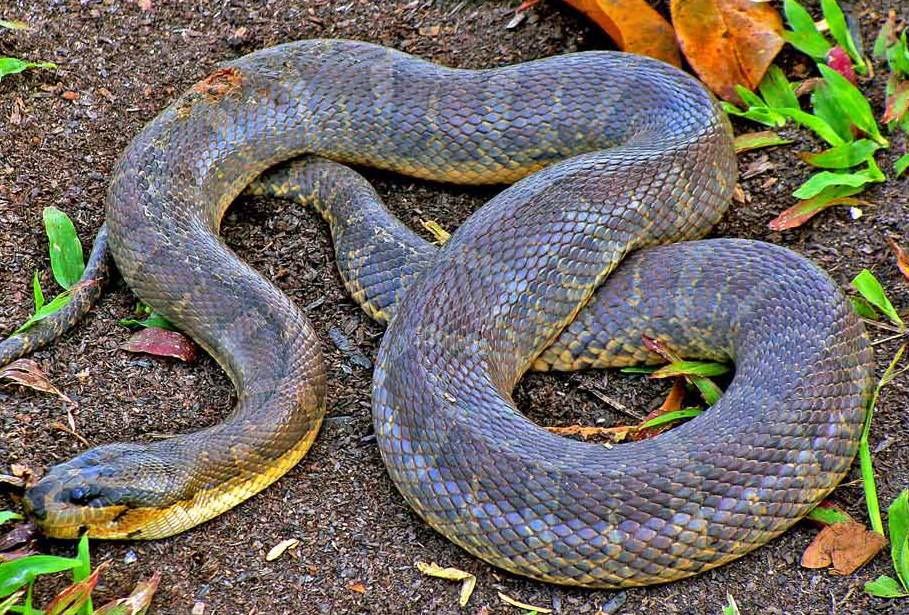
Homalopsis buccata occurs in tropical areas of South and Southeast Asia. It has a banded body pattern and uses mild venom delivered through a grooved rear fang to subdue prey.
Written 26 November 2026 from the sources listed below. Each statement was checked against the passage it cites; statements that could not be supported were removed.
Appearance
The Puff-faced Water Snake has a banded body pattern. It has 33–40 dorsal scale rows at mid-body, usually decreasing to fewer than 30 rows toward the rear.[1][2]
It has one postocular scale and one postsubocular scale. It has 12 upper labial scales, with a recorded range of 11–14, and fewer than 166 ventral scales.[3][4][5]
The species usually reaches approximately 1 meter in length.[6]
Habitat
The Puff-faced Water Snake occurs in tropical areas of South and Southeast Asia.[7]
Diet
Recorded prey include tilapia, guppies, catfish, Asian swamp eels, other small fish, frogs, and freshwater crustaceans.[8]
In captivity, the species readily consumes minnows, goldfish, cichlid fish, tilapia, mollies, and tadpoles.[9]
Behaviour
The Puff-faced Water Snake uses mild venom delivered through a grooved rear fang to subdue prey rather than relying on constriction.[10]
Reproduction and life cycle
The species is ovoviviparous and gives birth to live young rather than laying eggs. Females produce between 2 and 20 live young per birth.[11][12]
The average number of young per breeding is 9.26.[13]
The species has been reported to breed throughout the year, with breeding activity peaking between October and March.[14][15]
Classification of the Puff-faced Water Snake
| Kingdom | Animalia |
|---|---|
| Phylum | Chordata |
| Subphylum | Vertebrata |
| Infraphylum | Gnathostomata |
| Parvphylum | Osteichthyes |
| Megaclass | Tetrapoda |
| Class | Reptilia (Reptile) |
| Order | Squamata (Snakes) |
| Suborder | Serpentes (Snakes) |
| Infraorder | Alethinophidia |
| Family | Homalopsidae (Mud Snakes) |
| Genus | Homalopsis |
| Species | Homalopsis buccata (Linnaeus, 1758) |
Where the Puff-faced Water Snake is found
Checklists and occurrence records place Homalopsis buccata in 8 countries across Asia. GBIF holds 1,185 georeferenced records of it.
Countries
Regions and cities with the most records
- Yangon, Myanmar 104
- Botataung, Myanmar 102
- Kanbe, Myanmar 102
- Mingala Tangnyunt, Myanmar 102
- Myenigon, Myanmar 102
- Nyaung, Myanmar 102
- Sangyoung, Myanmar 102
- Set Ka Lay, Myanmar 102
- Setsan, Myanmar 102
- Twante, Myanmar 102
- Yangon, Myanmar 102
- Hlaingthaya, Myanmar 100
- Insein, Myanmar 100
- Oke Kan, Myanmar 100
- Pawgan, Myanmar 100
- Shan Chaung, Myanmar 100
- Shwe Lin Ban, Myanmar 100
- Cibinong, Indonesia 85
- Citeureup, Indonesia 77
- Parung, Indonesia 72
- Sawangan, Indonesia 69
- Ciampea, Indonesia 65
- Depok, Indonesia 63
- Bogor, Indonesia 62
- Caringin, Indonesia 47
- Riau, Indonesia 42
- Pamulang, Indonesia 40
- Cileungsir, Indonesia 38
- Jakarta, Indonesia 35
- South Tangerang, Indonesia 31
- Serpong, Indonesia 24
- Jambi, Indonesia 22
- Bekasi, Indonesia 20
- Majenang, Indonesia 20
- Ciputat, Indonesia 19
- Jambi City, Indonesia 19
Range as the checklists state it
Cambodia; Thailand; Vietnam;
A number beside a place is its count of GBIF occurrence records. A place without a number comes from a checklist alone. Records show where a species has been observed or collected, which can include escapes and vagrants.
Common names
English
- Puff-faced Water Snake
- Banded Swamp Snake
- Dog-face Water Snake
- Linne's Water Snake
- Linne’s Water Snake
- Masked Water Snake
- Puff-face Water Snake
Names in 11 other languages
- Chinese
- 寬紋水蛇
- Czech
- vodnářka pruhovaná
- Danish
- Malayisk Maskevandsnog
- German
- Boa-Wassertrugnatter
- Indonesian
- Ular Air Belang, Ular Buhu, Ular air, kadut belang
- Italian
- Serpente acquatico mascherato
- Japanese
- ヒロクチミズヘビ
- Russian
- Удавовидный уж
- Spanish
- Serpiente Acuática Enmascarada
- Thai
- งูหัวกะโหลก
- Ukrainian
- Вуж удавоподібний
Synonyms
8 other scientific names have been used for this species and are now treated as synonyms of Homalopsis buccata.
- Coluber buccatus Linnaeus, 1758
- Coluber horridus Daudin, 1803
- Coluber monilis Linnaeus, 1758
- Coluber subalbidus Gmelin, 1789
- Homalopsis horridus (Daudin, 1803)
- Homalopsis monilis (Linnaeus, 1758)
- Vipera buccata (Linnaeus, 1758)
- Vipera buccata Daudin, 1803
Related species
-
 Deuve's Water SnakeHomalopsis nigroventralis
-
 Jack’s Water SnakeHomalopsis mereljcoxi
- Hardwick’s Water SnakeHomalopsis hardwickii
-
 Martaban Water SnakeHomalopsis semizonata
-
 Tentacled SnakeErpeton tentaculatum
-
 South Asian BockadamCerberus rynchops
-
 Boie’s Mud SnakeHypsiscopus plumbeus
-
 Rainbow Water SnakeEnhydris enhydris
Compare
Questions and answers
What is the scientific name of the Puff-faced Water Snake?
The scientific name of the Puff-faced Water Snake is Homalopsis buccata. Written with its author, the full name is Homalopsis buccata (Linnaeus, 1758).
Which family does the Puff-faced Water Snake belong to?
Homalopsis buccata belongs to the family Homalopsidae, in the order Squamata and the class Reptilia.
Where is the Puff-faced Water Snake found?
Checklists and occurrence records place Homalopsis buccata in 8 countries, including Indonesia, Thailand, Myanmar, Malaysia, Singapore and Cambodia.
What is the conservation status of the Puff-faced Water Snake?
The IUCN Red List category recorded for Homalopsis buccata is Least Concern (LC).
What other names does the Puff-faced Water Snake have?
Homalopsis buccata is also known in English as Banded Swamp Snake, Dog-face Water Snake, Linne's Water Snake, Linne’s Water Snake, Masked Water Snake and Puff-face Water Snake.
Is a banded watersnake venomous?
The Puff-faced Water Snake uses mild venom delivered through a grooved rear fang to subdue prey rather than relying on constriction.[10]
What is the diet of a water snake?
The Puff-faced Water Snake's recorded prey include tilapia, guppies, catfish, Asian swamp eels, other small fish, frogs, and freshwater crustaceans.[8]
What is the habitat of a water snake?
The Puff-faced Water Snake occurs in tropical areas of South and Southeast Asia.[7]
Sources
Passages the profile rests on
- The species has a banded body pattern. Source passage: “Homalopsis buccata has a banded pattern” — English Wikipedia
- The species has 33–40 dorsal scale rows at mid-body, usually decreasing to fewer than 30 rows toward the rear. Source passage: “33–40 dorsal scale rows at mid-body, usually reduced to fewer than 30 posteriorly” — English Wikipedia
- The species has one postocular scale and one postsubocular scale. Source passage: “one postocular plus a postsubocular” — English Wikipedia
- The species has 12 upper labial scales, with a recorded range of 11–14. Source passage: “12 (11–14) upper labials” — English Wikipedia
- The species has fewer than 166 ventral scales. Source passage: “ventral count fewer than 166.” — English Wikipedia
- The species usually reaches approximately 1 meter in length. Source passage: “usually reaches 1 meter (3 feet) in length.” — English Wikipedia
- The species occurs in tropical areas of South and Southeast Asia. Source passage: “found in tropical areas of South and Southeast Asia.” — inaturalist.org
- The species' recorded prey include tilapia, guppies, catfish, Asian swamp eels, other small fish, frogs, and freshwater crustaceans. Source passage: “tilapia, guppy, catfish, Asian swamp eel, various other small fish, a variety of frogs, freshwater crustaceans.” — English Wikipedia
- In captivity, the species readily consumes minnows, goldfish, cichlid fish, tilapia, mollies, and tadpoles. Source passage: “In captivity, the species feeds readily on minnows, goldfish, various cichlid fish, tilapia, Mollies (Poecilia), and tadpoles.” — English Wikipedia
- The species uses mild venom delivered through a grooved rear fang to subdue prey rather than relying on constriction. Source passage: “instead of constriction they use a mild venom from a grooved rear fang to subdue prey.” — English Wikipedia
- The species is ovoviviparous and gives birth to live young rather than laying eggs. Source passage: “H. buccata are ovoviviparous, meaning they do not lay eggs but rather give birth to live young.” — English Wikipedia
- Females produce between 2 and 20 live young per birth. Source passage: “Females give birth to 2-20 live young” — English Wikipedia
- The average number of young per breeding is 9.26. Source passage: “with an average of 9.26 young per breeding.” — English Wikipedia
- The species has been reported to breed throughout the year. Source passage: “Studies have shown this species breeds year round” — English Wikipedia
- Breeding activity has a reported peak between October and March. Source passage: “with a peak season of October–March” — English Wikipedia
Data
- Catalogue of Life, 2026-10-16 XR cc by
- Global Biodiversity Information Facility CC BY 4.0
- Wikidata CC0
- GeoNames CC BY 4.0
- Wikimedia Commons per image; credit shown with each image
- Within the Catalogue of Life, this name comes from The Reptile Database cc by
References
- Linné, C. [= Linnaeus, C.]. (1758). Systema naturæ per regna tria naturæ, secundum classes, ordines, genera, species, cum characteribus, differentiis, synonymis, locis. Tomus I. Editio decima, reformata. Laurentii Salvii, Holmiæ. 10th Edition: 824 Pp.
- Kuhl, H. and Hasselt, J.C. van. (1822). Uittreksel uit de brieven van Heeren Kuhl en van Hasselt aan de Heeren C. J. Temminck, Th. Van Swinderen en W. de Haan. Algemeene Konsten Letter Bode Voor Het Jaar 1822, 1, 99-104.
- Duméril, A. M. C., Bibron, G. & DUMÉRIL, A. H. A.,. (1854). Erpétologie générale ou histoire naturelle complète des reptiles. Tome septième. Deuxième partie, comprenant l’histoire des serpents venimeux. Paris, Librairie Encyclopédique de Roret: I-Xii + 781-1536.
- Boulenger, George A. (1890). The Fauna of British India, Including Ceylon and Burma. Reptilia and Batrachia. Taylor & Francis, London, Xviii, 541 Pp.
- Boulenger, G. A. (1896). Catalogue of the snakes in the British Museum, Vol. 3. London (Taylor & Francis), Xiv + 727 Pp.
- Wall, F. (1905). Double-headed Snakes. J. Bombay Nat. Hist. Soc. 16: 386-388.
- Smith, M. A. (1917). A Two-headed Snake. J. Nat. Hist. Soc. Siam 2: 255.
- de Rooij, & DE, N. (1917). The Reptiles of the Indo-Australian Archipelago. Il. Ophidia. Leiden (E. J. Brill), Xiv + 334 S.
- Kopstein, F. (1938). Ein Beitrag zur Eierkunde und zur Fortpflanzung der Malaiischen Reptilien. Bull. Raffles Mus. No 14: 81-167.
- Smith, M. A. (1943). The Fauna of British India, Ceylon and Burma, Including the Whole of the Indo-Chinese Sub-Region. Reptilia and Amphibia. 3 (Serpentes). Taylor and Francis, London. 583 Pp.
- Bergman, R. A. M. (1951). The anatomy of Homalopsis buccata. Proc. Kon. Ned. Akad. Wet. Amsterdam, C 54:511-524.
- Deuve, J. (1961). Liste annotee des Serpents du Laos. Bull. Soc. Sci. Nat. Laos 1:5-32.
- Taylor, E. H. (1965). The serpents of Thailand and adjacent waters. Univ. Kansas Sci. Bull. 45 (9): 609-1096.
- Berry, P.Y. & G.S. Lim. (1967). The Breeding Pattern of the Puff-Faced Water Snake, Homalopsis buccata Boulenger. Copeia 1967 (2): 307-313.
- Deuve, J. (1970). Serpents du Laos. Office de La Recherche Scientifique et Technique Outre-Mer, Paris, Mem. No. 39 251 Pp.
- Saint Girons, & Hubert. (1972). Notes sur l’Ecologie des Serpents du Cambodge. Zoologische Mededelingen 47: 65-87.
- Dowling, H.G., & Jenner, J.V. (1988). Snakes of Burma: checklist of reported species and bibliography. Smithsonian Herp. Inf. Serv. (76): 19 Pp.
- Zug, G. R., & Mitchell, J. C. (1995). Amphibians and Reptiles of the Royal Chitwan National Park, Nepal. Asiatic Herpetological Research 6: 172-180.
- David, P., & Vogel, G. (1996). The snakes of Sumatra. An annotated checklist and key with natural history notes. Bücher Kreth, Frankfurt/M.
- Teo, R. C. H., & Rajathurai, S. (1997). Mammals, reptiles and amphibians in the Nature Reserves of Singapore - diversity, abundance and distribution. Proc. Nature Reserves Survey Seminar. Gardens’ Bulletin Singapore 49: 353-425.
- Manthey, U., & Grossmann, W. (1997). Amphibien & Reptilien Südostasiens. Natur Und Tier Verlag (Münster), 512 Pp. (ISBN 3-931587-12-6).
- Cox, Merel J.; Van Dijk, Peter Paul; Jarujin Nabhitabhata & Thirakhupt,Kumthorn. (1998). A Photographic Guide to Snakes and Other Reptiles of Peninsular Malaysia, Singapore and Thailand. Ralph Curtis Publishing, 144 Pp.
- Chan-ard,T.; Grossmann,W.; Gumprecht,A. & Schulz,K. D. (1999). Amphibians and reptiles of peninsular Malaysia and Thailand - an illustrated checklist [bilingual English and German]. Bushmaster Publications, Würselen, Gemany, 240 Pp. [Book Review in Russ. J Herp. 7: 87].
- Pauwels,O.S.G. et al. (2000). Herpetological investigations in Phang-Nga Province, southern Peninsular Thailand, with a list of reptile species and notes on their biology. Dumerilia 4 (2): 123-154.
- Stuart, B.L.; Smith, J.; Davey, K.; Din, P. & Platt, S.G. (2000). Homalopsine watersnakes. The harvest and trade from Tonle Sap, Cambodia. Traffic Bull. 18 (3): 115-124.
This species in other databases
Page built on 27 November 2026. See how the catalog is made and all sources and licences.
Cite this page
ScientificNames.org. (2026). Homalopsis buccata (Puff-faced Water Snake). Retrieved November 27, 2026, from https://scientificnames.org/species/homalopsis-buccata
“Homalopsis buccata (Puff-faced Water Snake).” ScientificNames.org, 2026, scientificnames.org/species/homalopsis-buccata. Accessed 27 Nov. 2026.
ScientificNames.org. “Homalopsis buccata (Puff-faced Water Snake).” Accessed November 27, 2026. https://scientificnames.org/species/homalopsis-buccata.
@misc{scientificnames_homalopsis_buccata_puff_faced_water_snake,
  author = {{ScientificNames.org}},
  title = {Homalopsis buccata (Puff-faced Water Snake)},
  year = {2026},
  url = {https://scientificnames.org/species/homalopsis-buccata},
  note = {Accessed 2026-11-27}
}