Species · Reptiles
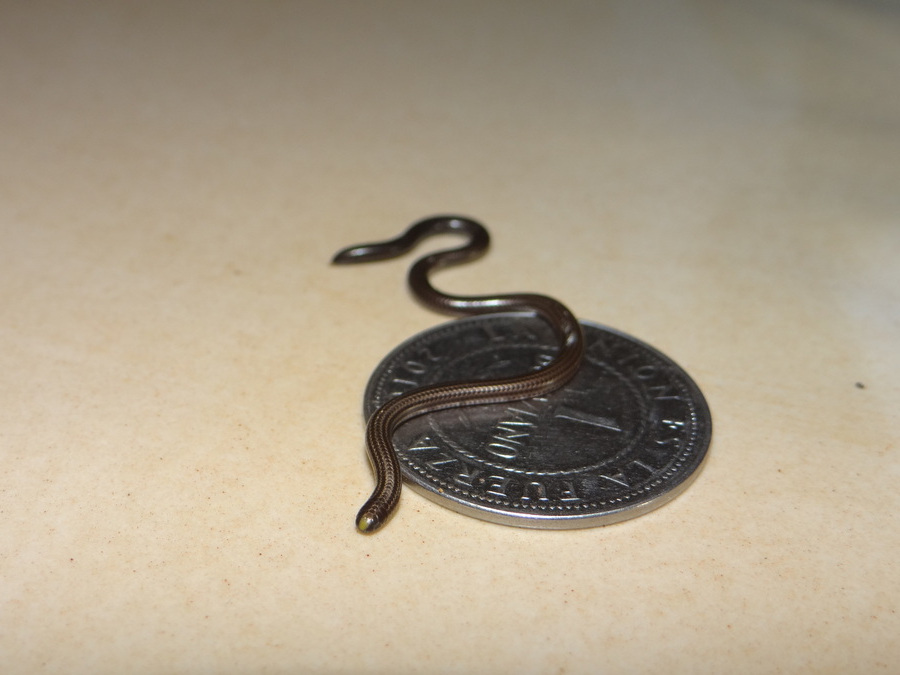
Rio Grande Do Sul Blind Snake Epictia munoai
The scientific name of the Rio Grande Do Sul Blind Snake is Epictia munoai. It is a species of reptile in the family Leptotyphlopidae (thread snakes), order Squamata. The name dates from 1961.
- Scientific name
- Epictia munoai (Orejas-Miranda, 1961)
- Common name
- Rio Grande Do Sul Blind Snake
- Genus
- Epictia
- Family
- Leptotyphlopidae (Thread Snakes)
- Order
- Squamata
- Class
- Reptilia
- Red List category
- LC Least Concern
- Recorded in
- 3 countries
- Name status
- accepted in the Catalogue of Life

Overview
Epictia munoai occurs in northern Argentina, extreme southern Brazil, and Uruguay. It is oviparous.
Written 27 November 2026 from the sources listed below. Each statement was checked against the passage it cites; statements that could not be supported were removed.
Habitat
The Rio Grande Do Sul Blind Snake inhabits forests and grasslands.[1]
Reproduction and life cycle
The Rio Grande Do Sul Blind Snake is oviparous.[2]
Classification of the Rio Grande Do Sul Blind Snake
| Kingdom | Animalia |
|---|---|
| Phylum | Chordata |
| Subphylum | Vertebrata |
| Infraphylum | Gnathostomata |
| Parvphylum | Osteichthyes |
| Megaclass | Tetrapoda |
| Class | Reptilia (Reptile) |
| Order | Squamata (Snakes) |
| Suborder | Serpentes (Snakes) |
| Infraorder | Scolecophidia |
| Family | Leptotyphlopidae (Thread Snakes) |
| Subfamily | Epictinae |
| Genus | Epictia (Neotropical Thread Snakes) |
| Species | Epictia munoai (Orejas-Miranda, 1961) |
Where the Rio Grande Do Sul Blind Snake is found
Checklists and occurrence records place Epictia munoai in 3 countries across South America. GBIF holds 258 georeferenced records of it.
Countries
Regions and cities with the most records
- Rio Grande do Sul, Brazil 95
- Buenos Aires, Argentina 33
- Berisso, Argentina 17
- Ensenada, Argentina 17
- La Plata, Argentina 17
- Tacuarembó Department, Uruguay 14
- Lavalleja, Uruguay 12
- Santos Lugares, Argentina 12
- Avellaneda, Argentina 11
- Dom Feliciano, Brazil 11
- Valentín Alsina, Argentina 11
- Buenos Aires, Argentina 10
- Haedo, Argentina 10
- Lanús, Argentina 10
- Monte Chingolo, Argentina 10
- Remedios de Escalada de San Martín, Argentina 10
- San Justo, Argentina 10
- Sarandí, Argentina 10
- Villa Sarmiento, Argentina 10
- Banfield, Argentina 9
- El Palomar, Argentina 9
- San Isidro, Argentina 9
- Artigas, Uruguay 8
- Hurlingham, Argentina 8
- Lomas de Zamora, Argentina 8
- Rivera, Uruguay 8
- Sant'Ana do Livramento, Brazil 8
- Alvorada, Brazil 7
- Canoas, Brazil 7
- Delta del Tigre, Uruguay 7
- Guaíba, Brazil 7
- Isidro Casanova, Argentina 7
- La Paz, Uruguay 7
- Las Piedras, Uruguay 7
- Montevideo, Uruguay 7
- Montevideo Department, Uruguay 7
Range as the checklists state it
N Argentina (Corrientes, Misiones), Uruguay, Brazil (Rio Grande do Sul)
A number beside a place is its count of GBIF occurrence records. A place without a number comes from a checklist alone. Records show where a species has been observed or collected, which can include escapes and vagrants.
Common names
English
- Rio Grande Do Sul Blind Snake
Names in 3 other languages
- Danish
- Rio Grande do Sul-trådslange
- Portuguese
- Cobra-Cega-Amarela, Cobra-Cega-Minhoca-Comum, Cobra-Cega-Sulina
- Spanish
- culebra ciega oriental
Synonyms
One other scientific name has been used for this species and is now treated as a synonym of Epictia munoai.
- Leptotyphlops munoai Orejas-Miranda, 1961
Related species
-
 Black Blind SnakeEpictia goudotii
-
 Guyana Blind SnakeEpictia tenella
- Tucuman ThreadsnakeEpictia albipuncta
- Wagler's Blind SnakeEpictia albifrons
-
 Klauber's Blind SnakeEpictia subcrotilla
- Northern Blind SnakeEpictia teaguei
- Slinder ThreadsnakeEpictia phenops
-
 Epictia borapeliotes
Compare
Questions and answers
What is the scientific name of the Rio Grande Do Sul Blind Snake?
The scientific name of the Rio Grande Do Sul Blind Snake is Epictia munoai. Written with its author, the full name is Epictia munoai (Orejas-Miranda, 1961).
Which family does the Rio Grande Do Sul Blind Snake belong to?
Epictia munoai belongs to the family Leptotyphlopidae, in the order Squamata and the class Reptilia.
Where is the Rio Grande Do Sul Blind Snake found?
Checklists and occurrence records place Epictia munoai in 3 countries: Brazil, Uruguay and Argentina.
What is the conservation status of the Rio Grande Do Sul Blind Snake?
The IUCN Red List category recorded for Epictia munoai is Least Concern (LC).
Sources
Passages the profile rests on
- The species inhabits forests and grasslands. Source passage: “The preferred natural habitats of Epictia munoai are forest and grassland.” — English Wikipedia
- The species is oviparous. Source passage: “Epictia munoai is oviparous.” — English Wikipedia
Data
- Catalogue of Life, 2026-10-16 XR cc by
- Global Biodiversity Information Facility CC BY 4.0
- Wikidata CC0
- GeoNames CC BY 4.0
- Wikimedia Commons per image; credit shown with each image
- Within the Catalogue of Life, this name comes from The Reptile Database cc by
References
- Orejas-Miranda B. R. 1961. Una nueva especie de ofidio de la familia Leptotyphlopidae. Acta Biologica Venezuelica, Caracas 3: 83 - 97. where the name was published
- Orejas-Miranda, Braulio R. (1961). Una nueva especie de ofidio de la familia Leptotyphlopidae. Act. Biol. Venezuelica, Caracas, 3: 83-97.
- Orejas-Miranda, Braulio R. (1962). Description del Hemipenis de Leptotyphlops munoai Orejas-Miranda, 1961. Comunicaciones Zoologicas Del Museo de Historia Natural de Montevideo 7 (97): 1-5.
- Giraudo, A. R. (1999). New records of snakes from Argentina. Herpetological Review 30 (3): 179-181.
- McDiarmid, R.W.; Campbell, J.A. & Touré,T.A. (1999). Snake species of the world. Vol. 1. [type catalogue]. Herpetologists’ League, 511 Pp.
- Carreira Vidal, & Santiago. (2002). Alimentación de los ofidios de Uruguay. Asoc. Herp. Esp., Monograf. Herp. 6, 127 Pp.
- Adalsteinsson, S.A.; Branch, W.R.; Trapé, S.; Vitt, L.J. & Hedges, S.B. (2009). Molecular phylogeny, classification, and biogeography of snakes of the Family Leptotyphlopidae (Reptilia, Squamata). Zootaxa 2244: 1-50.
- Arredondo, & Juan Camilo and Hussam Zaher. (2010). A New Species of Epictia (Serpentes: Leptotyphlopidae) from Central Brazil. South American J. Herp. 5 (3): 189–198.
- Prigioni, C.; C. Borteiro; F. Kolenc. (2011). Amphibia and Reptilia, Quebrada de los Cuervos, Departamento de Treinta y Tres, Uruguay. Check List 7 (6): 763-767.
- Beolens, B., & Michael Watkins, a. M. G. (2011). The Eponym Dictionary of Reptiles. Johns Hopkins University Press, Baltimore, USA.
- Souza Filho, G.A.; L.Verrastro. (2012). Reptiles of the Parque Estadual de Itapuã, state of Rio Grande do Sul, southern Brazil. Check List 8(5):847-851.
- Carreira, S.; Brazeiro, A.; Camargo, A.; da Rosa, I.; Canavero, A. & Maneyro, M. (2012). DIVERSITY OF REPTILES OF URUGUAY: KNOWLEDGE AND INFORMATION GAPS. Bol. Soc. Zool. Uruguay (2a Época) 21 (1-2): 9-29.
- FRANCISCO, BÁRBARA CRISTINA S.; ROBERTA R. PINTO & DANIEL S. FERNANDES. (2012). Taxonomy of Epictia munoai (Orejas-Miranda, 1961) (Squamata: Serpentes: Leptotyphlopidae). Zootaxa 3512: 42–52.
- Lema, T. d. & Dotto, C. P. (2012). Epictia munoai (Uruguayan blindsnake) aggregation. Herpetological Review 43: 344.
- Hedges, S. B., Marion, A. B., Lipp, K. M., Marin, J., & Vidal, N. (2014). A taxonomic framework for typhlopid snakes from the Caribbean and other regions (Reptilia, Squamata). Caribbean Herpetology 49: 1–61.
- Wallach, Van; Kenneth L. Williams, Jeff Boundy. (2014). Snakes of the World: A Catalogue of Living and Extinct Species. [type catalogue]. Taylor and Francis, CRC Press, 1237 Pp.
- Outeiral, Arlete B.; Rafael L. Balestrin, Lize H. Cappellari, Thales de Lema, Vanda Lúcia Ferreira. (2018). Snake assemblage from Serra do Sudeste, Pampa Biome in Southern Brazil. Herpetology Notes 11: 733-745.
- Machín, Victoria; Emilia Rossini, Carlos Prigioni, Francisco Kolenc, Alejandro Crampet, Claudio Borteiro, José Manuel Verdes. (2018). Hypopigmentation in wild snakes from Uruguay. Herpetology Notes 11: 1051-1053.
- Nogueira, Cristiano C.; Antonio J.S. Argôlo, Vanesa Arzamendia, Josué A. Azevedo, Fausto E. Barbo, Renato S. Bérnils, Bruna E. Bolochio, Marcio Borges-Martins, Marcela Brasil-Godinho, Henrique Braz, Marcus A. Buononato, Diego F. Cisneros-Heredia, Guarino R. Colli, Henrique C. Costa, Francisco L. Franco, Alejandro Giraudo, Rodrigo C. Gonzalez, Thaís Guedes, Marinus S. Hoogmoed, Otavio A.V. Marques, Giovanna G. Montingelli, Paulo Passos, Ana L.C. Prudente, Gilson A. Rivas, Paola M. Sanchez, Filipe C. Serrano, Nelson J. Silva Jr., Christine Strüssmann, João Paulo S. Vieira-Alencar, Hussam Zaher, Ricardo J. Sawaya, Marcio Martins. (2019). Atlas of Brazilian snakes: verified point-locality maps to mitigate the Wallacean shortfall in a megadiverse snake fauna. South American J. Herp. 14 (Special Issue 1):1-274.
- Gonzalez R. C. et al. (2020). Lista dos Nomes Populares dos Répteis no Brasil – Primeira Versão. Herpetologia Brasileira 9 (2): 121 – 214.
- Vera, David G, Diego O Di Pietro, Clara Trofino Falasco, Germán Tettamanti, Luciana Iriarte, Micaela Harkes, Federico P Kacoliris, and Igor Berkunsky. (2022). Identifying Key Conservation Sites for the Reptiles of the Tandilia Mountains in Pampas Highlands. Journal for Nature Conservation, 126321.
- Mario-Da-Rosa, C., Brum, A. J. C., Loebens, L., Santos, T. G., & Cechin, S. Z. (2025). Natural history of the small snake Epictia munoai (Scolecophidia; Leptotyphlopidae): Reproductive cycle, sexual maturity and activity pattern. Acta Zoologica, 107, 54–66.
- Mario-Da-Rosa, C., Brum, A. J. C., Loebens, L., Santos, T. G., & Cechin, S. Z. (2025). Natural history of the small snake Epictia munoai (Scolecophidia; Leptotyphlopidae): Reproductive cycle, sexual maturity and activity pattern. Acta Zoologica, 00, 1–13.
- PASSOS, P., RODRIGUES, R., PINNA, P. H., WOITOVICZ-CARDOSO, M. A. N. O. E. L. A., FERNANDES, R., & CARAMASCHI, U. (2025). Filling gaps between museum and society: An illustrated catalog of the primary type specimens of Squamata housed in the Museu Nacional, Rio de Janeiro, Brazil. Zootaxa 5698(1): 1-91.
- Arzamendia, V., Bellini, G. P., Ulibarrie, A. A., & Giraudo, A. R. (2026). Fighting biodiversity loss in the Anthropocene: the INALI snake collection as a key resource for natural history in the Global South. Biological Journal of the Linnean Society, 147(1), Blaf132.
This species in other databases
Page built on 28 November 2026. See how the catalog is made and all sources and licences.
Cite this page
ScientificNames.org. (2026). Epictia munoai (Rio Grande Do Sul Blind Snake). Retrieved November 28, 2026, from https://scientificnames.org/species/epictia-munoai
“Epictia munoai (Rio Grande Do Sul Blind Snake).” ScientificNames.org, 2026, scientificnames.org/species/epictia-munoai. Accessed 28 Nov. 2026.
ScientificNames.org. “Epictia munoai (Rio Grande Do Sul Blind Snake).” Accessed November 28, 2026. https://scientificnames.org/species/epictia-munoai.
@misc{scientificnames_epictia_munoai_rio_grande_do_sul_blind_snake,
  author = {{ScientificNames.org}},
  title = {Epictia munoai (Rio Grande Do Sul Blind Snake)},
  year = {2026},
  url = {https://scientificnames.org/species/epictia-munoai},
  note = {Accessed 2026-11-28}
}