Species · Reptiles
Guyana Blind Snake Epictia tenella
The scientific name of the Guyana Blind Snake is Epictia tenella. It is a species of reptile in the family Leptotyphlopidae (thread snakes), order Squamata. The name dates from 1939.
- Scientific name
- Epictia tenella (Klauber, 1939)
- Common name
- Guyana Blind Snake
- Genus
- Epictia
- Family
- Leptotyphlopidae (Thread Snakes)
- Order
- Squamata
- Class
- Reptilia
- Recorded in
- 7 countries
- Name status
- accepted in the Catalogue of Life
Overview
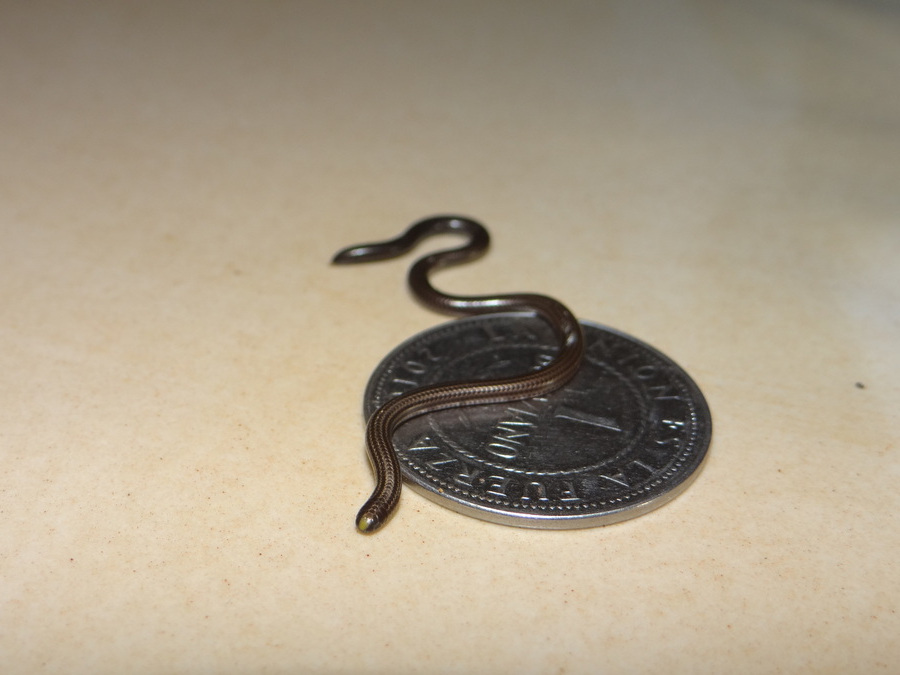
Epictia tenella occurs on Trinidad in the Caribbean and in South America, ranging from Guyana south to Brazil and northwestern Peru. It has a medium brown dorsal surface, a paler ventral surface, a yellow tail, and a dark head with a white to yellow spot on the upper half of the rostral scale.
Written 27 November 2026 from the sources listed below. Each statement was checked against the passage it cites; statements that could not be supported were removed.
Appearance
The dorsal surface is medium brown, while the ventral surface is paler and the tail is yellow.[1]
The head is dark, with a white to yellow spot covering the upper half of the rostral scale. The species can reach a snout-to-vent length of 170 mm.[2][3]
Habitat
The Guyana blind snake inhabits damp soil and rotting vegetation, where it burrows. It may also inhabit ant and termite colonies.[4][5]
Diet
The Guyana blind snake feeds on ants, termites, millipedes, and eggs.[6]
Classification of the Guyana Blind Snake
| Kingdom | Animalia |
|---|---|
| Phylum | Chordata |
| Subphylum | Vertebrata |
| Infraphylum | Gnathostomata |
| Parvphylum | Osteichthyes |
| Megaclass | Tetrapoda |
| Class | Reptilia (Reptile) |
| Order | Squamata (Snakes) |
| Suborder | Serpentes (Snakes) |
| Infraorder | Scolecophidia |
| Family | Leptotyphlopidae (Thread Snakes) |
| Subfamily | Epictinae |
| Genus | Epictia (Neotropical Thread Snakes) |
| Species | Epictia tenella (Klauber, 1939) |
Where the Guyana Blind Snake is found
Checklists and occurrence records place Epictia tenella in 7 countries. GBIF holds 320 georeferenced records of it.
Countries
Regions and cities with the most records
- Paradise, Trinidad and Tobago 45
- Tunapuna, Trinidad and Tobago 44
- Arima, Trinidad and Tobago 42
- Tunapuna/Piarco, Trinidad and Tobago 37
- Laventille, Trinidad and Tobago 20
- Port of Spain, Trinidad and Tobago 20
- Diego Martin, Trinidad and Tobago 19
- Sangre Grande, Trinidad and Tobago 17
- Amazonas, Brazil 15
- Pará, Brazil 12
- Chaguanas, Trinidad and Tobago 11
- Terra Santa, Brazil 9
- Sipaliwini District, Suriname 8
- Roraima, Brazil 7
- Essequibo Islands-West Demerara, Guyana 6
- Manaus, Brazil 6
- Rondônia, Brazil 6
- Brokopondo District, Suriname 5
- Oiapoque, Brazil 5
- Amapá, Brazil 3
- Beni Department, Bolivia 3
- Mato Grosso, Brazil 3
Range as the checklists state it
Lesser Antilles (maybe introduced, known only from one record in Antigua),
A number beside a place is its count of GBIF occurrence records. A place without a number comes from a checklist alone. Records show where a species has been observed or collected, which can include escapes and vagrants.
Common names
English
- Guyana Blind Snake
- Guyana Threadsnake
- Wagler's Blind Snake
Names in 3 other languages
- Danish
- Guyana-trådslange
- French
- Leptotyphlops menu (Le), Serpent aveugle menu
- Portuguese
- Cobra-Cega-da-Guiana
Synonyms
One other scientific name has been used for this species and is now treated as a synonym of Epictia tenella.
- Leptotyphlops tenella Klauber, 1939
Related species
-
 Black Blind SnakeEpictia goudotii
- Tucuman ThreadsnakeEpictia albipuncta
-
 Rio Grande Do Sul Blind SnakeEpictia munoai
- Wagler's Blind SnakeEpictia albifrons
-
 Klauber's Blind SnakeEpictia subcrotilla
- Northern Blind SnakeEpictia teaguei
- Slinder ThreadsnakeEpictia phenops
-
 Epictia borapeliotes
Compare
Questions and answers
What is the scientific name of the Guyana Blind Snake?
The scientific name of the Guyana Blind Snake is Epictia tenella. Written with its author, the full name is Epictia tenella (Klauber, 1939).
Which family does the Guyana Blind Snake belong to?
Epictia tenella belongs to the family Leptotyphlopidae, in the order Squamata and the class Reptilia.
Where is the Guyana Blind Snake found?
Checklists and occurrence records place Epictia tenella in 7 countries, including Brazil, Trinidad and Tobago, Guyana, Suriname, French Guiana and Bolivia.
What other names does the Guyana Blind Snake have?
Epictia tenella is also known in English as Guyana Threadsnake and Wagler's Blind Snake.
Where does the blind snake live?
The Guyana blind snake occurs on Trinidad in the Caribbean and in South America, ranging from Guyana south to Brazil and northwestern Peru.[7]
Sources
Passages the profile rests on
- The dorsal surface is medium brown, while the ventral surface is paler and the tail is yellow. Source passage: “It has a medium brown dorsal surface, with a paler ventral surface and a yellow tail.” — English Wikipedia
- The head is dark, with a white to yellow spot covering the upper half of the rostral scale. Source passage: “Its head is dark except for a white to yellow spot covering the upper half of its rostral scale.” — English Wikipedia
- The species can reach a snout-to-vent length of 170 mm. Source passage: “It can reach a length of 170 mm (6-11/16 in) snout-to-vent.” — English Wikipedia
- The species inhabits damp soil and rotting vegetation, where it burrows. Source passage: “It burrows in damp soil and rotting vegetation” — English Wikipedia
- The species may also inhabit ant and termite colonies. Source passage: “and possibly in ant and termite colonies.” — English Wikipedia
- The species feeds on ants, termites, millipedes, and eggs. Source passage: “It feeds on ants, termites, millipedes, and eggs.” — English Wikipedia
- Epictia tenella occurs on Trinidad in the Caribbean and in South America, ranging from Guyana south to Brazil and northwestern Peru. Source passage: “found on Trinidad in the Caribbean, and in South America, where it ranges from Guyana south to Brazil and northwestern Peru.” — English Wikipedia
Data
- Catalogue of Life, 2026-10-16 XR cc by
- Global Biodiversity Information Facility CC BY 4.0
- Wikidata CC0
- GeoNames CC BY 4.0
- Wikimedia Commons per image; credit shown with each image
- Within the Catalogue of Life, this name comes from The Reptile Database cc by
References
- Wagler, J. (1824). Serpentum Brasiliensium species novae, ou histoire naturelle des espèces nouvelles de serpens. In: Jean de Spix, Animalia nova sive species novae. [NAtrix bahiensis: 27,. Monaco, Typis Franc. Seraph. Hübschmanni, Vii + 75 Pp.
- Duméril, A. M. C. and G. Bibron. (1844). Erpetologie Générale ou Histoire Naturelle Complete des Reptiles. Vol.6. Libr. Encyclopédique Roret, Paris, 609 Pp.
- Garman, S. (1887). On West Indian reptiles in the Museum of Comparative Zoology at Cambridge, Mass. Proc. Amer. Philos. Soc. 24: 278-286.
- Boulenger, G. A. (1893). Catalogue of the snakes in the British Museum (Nat. Hist.) I. London (Taylor & Francis), 448 Pp.
- Boulenger, G. A. (1894). List of reptiles and batachians collected by Dr. T. Bohls near Asuncion, Paraguay. Ann. Mag. Nat. Hist. (6) 13: 342-348.
- Koslowsky, J. (1895). Batracios y reptiles de Rioja y Catamarca. Rev. Mus. La Plata 6: 359-370.
- Boulenger, G. A. (1896). Catalogue of the snakes in the British Museum, Vol. 3. London (Taylor & Francis), Xiv + 727 Pp.
- Barbour, T., and L. J. Cole. (1906). Vertebrata from Yucatan. Reptilia, Amphibia and Pisces. Bull. Mus. Comp. Zool. Harvard 50: 146-159.
- Amaral, & do, A. (1929). Contribuicao ao conhecimento dos ophidios do Brasil. IV. Lista remissiva dos ophidios do Brasil. Mem. Inst. Butantan, Sao Paulo, 4: 71-125.
- Schmidt, K. P, & ANDREWS, E. W. (1936). Notes on snakes from Yucatán. Field Mus. Nat Hist. Zool. Ser. 20: 167-187.
- Klauber, L. M. (1939). Three new worm snakes of the genus Leptotyphlops. Trans. San Diego Soc. Nat. Hist. 9: 59-65.
- Beebe, & William. (1946). Field notes on the snakes of Kartabo, British Guiana, and Caripito, Venezuela. Zoologica 31: 11-52.
- Roze, J. A. (1952). Contribución al conocimiento de los ofidios de las familias Typhlopidae y Leptotyphlopidae en Venezuela. Mem. Soc. Cien. Nat. La Salle, Caracas, 12 (32): 143-158.
- Smith, H. M., & List, J. C. (1958). The type of the blind snake Stenostoma albifrons. Herpetologica 14: 271.
- Valdivieso, D. & J.R. Tamsitt. (1963). A Check List and Key to the Amphibian and Reptiles of Providencia and San Andres. Carib. J. Sci. 3 (2/3): 77-79.
- Orejas-Miranda, B. R., & ZUG, G. R. (1974). A new tricolor Leptotyphlops (Reptilia: Serpentes) from Peru. Proc. Biol. Soc. Washington, 87 (16): 167 - 174.
- Schmidt, O. (1977). Sobre o uso da largura da cabeca em substituicao a espessura corporal como um criterio sistematico nos scolecohidia (serpentes). Pap. Avulsos Zool. 31 (10): 169-172.
- Gasc, & Rodrigues. (1980). Liste preliminaire des Serpents de la Guyane francaise. Bull. Mus. Nat. Hist. Nat. Paris 2 (4): 559-598.
- Miranda, M. E., & Tio Vallejo, M. (1985). El género Leptotyphlops en Argentina (Reptilia: Ophidia). 1: Grupos septemstriatus, dulcis y albifrons. Phisis 43 (105): 71-72.
- Pérez-Santos, C., & Moreno, A. G. (1988). Ofidios de Colombia. Museo Reegionale Di Scienze Naturali, Torino, Monographie VI, 517 Pp.
- Lancini, A. R., & Kornacker, P. M. (1989). Die Schlangen von Venezuela. Armitano Editores C.A., Caracas, 1-381.
- Schwartz, A., & Henderson, R. W. (1991). Amphibians and Reptiles of the West Indies. University of Florida Press, Gainesville, 720 Pp.
- Perez-Santos, C., & Moreno, A.G. (1991). Serpientes de Ecuador. Mus. Regionale Di Sci. Natur., Torino, Monogr. 11, 538 Pp.
- Carrillo de Espinoza, Nelly, Icochea, & Javier. (1995). Lista taxonomica preliminar de los reptiles vivientes del Peru. Publicaciones Del Museo de Historia Natural “Javier Prado”, Universidad Nacional Mayor de San Marcos, Serie A, Zoología (49): 1–27.
- Starace, & Fausto. (1998). Guide des Serpents et Amphisbènes de Guyane. IBIS Rouge Editions, Guadeloupe, Guyane, 450 Pp.
This species in other databases
Page built on 29 November 2026. See how the catalog is made and all sources and licences.
Cite this page
ScientificNames.org. (2026). Epictia tenella (Guyana Blind Snake). Retrieved November 29, 2026, from https://scientificnames.org/species/epictia-tenella
“Epictia tenella (Guyana Blind Snake).” ScientificNames.org, 2026, scientificnames.org/species/epictia-tenella. Accessed 29 Nov. 2026.
ScientificNames.org. “Epictia tenella (Guyana Blind Snake).” Accessed November 29, 2026. https://scientificnames.org/species/epictia-tenella.
@misc{scientificnames_epictia_tenella_guyana_blind_snake,
  author = {{ScientificNames.org}},
  title = {Epictia tenella (Guyana Blind Snake)},
  year = {2026},
  url = {https://scientificnames.org/species/epictia-tenella},
  note = {Accessed 2026-11-29}
}