Species · Flowering plants
Tall Annual Willowherb Epilobium brachycarpum
The scientific name of the Tall Annual Willowherb is Epilobium brachycarpum. It is a species of flowering plant in the family Onagraceae (evening-primrose family), order Myrtales.
- Scientific name
- Epilobium brachycarpum C.Presl
- Common name
- Tall Annual Willowherb
- Genus
- Epilobium
- Family
- Onagraceae (Evening-primrose Family)
- Order
- Myrtales
- Class
- Magnoliopsida
- Recorded in
- 12 countries
- Name status
- accepted in the Catalogue of Life
Overview
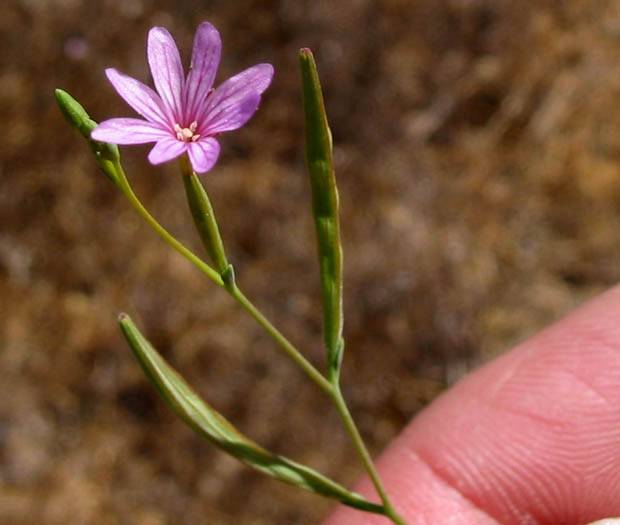
Epilobium brachycarpum has four deeply notched flowers petals that are usually light purple or pink with darker veins.
Written 26 November 2026 from the sources listed below. Each statement was checked against the passage it cites; statements that could not be supported were removed.
Habitat
The tall annual willowherb occurs in varied open and woodland habitats. It grows in dry soils, grasslands, open woodlands and roadside habitats.[1][2]
It inhabits dry, open sites in unmanaged, disturbed, landscaped and agricultural areas. It also occurs in fields, orchards, vineyards and forestry sites.[3][4]
Appearance
The plant grows erect and usually has one main stem that branches in its upper portion. Its growth form is highly variable, and it develops a large taproot.[5][6][7]
Plants range from 8 inches to 6 feet in height, although they can occasionally reach 2 metres. The mature stem is weakly woody and peels at the base.[8][9][10]
The lower stems are smooth and have a peeling outer layer, while the upper stems bear some rigid hairs. The upward-growing branches are almost hairless except at their tips, which often have glandular hairs.[11][12][13]
The leaves are narrowly football-shaped, mostly 1–5 centimetres long, nearly hairless and often folded upward. They have no stalks or very short stalks, with smooth margins or a few small teeth.[14][15]
The leaf surfaces are glandular above and have fine, short hairs below. The upper leaves often have clusters of smaller leaves in their axils.[16][17]
The flowering racemes terminate in numerous branches bearing flowers with four deeply notched petals. The calyx tube is narrow and funnel-shaped, and the flowering heads are nearly hairless with very few leaves.[18][19][20]
The sepals measure between 1/16 and 5/16 inch long, and the petals measure between 1/8 and 1/2 inch long.[21][22]
The fruits are slender, straight, cylindrical capsules with four chambers. They measure 1.5–3.5 centimetres long and are hairless or bear glandular hairs.[23][24][25]
The seeds are flattened and egg-shaped, with a prominent tuft of long, soft hairs at their tips. They measure between 1/16 and 1/8 inch long.[26][27][28]
Behaviour
The leaves initially grow opposite one another and can sometimes develop a reddish tinge.[29]
Reproduction and life cycle
The flowers have four notched petals ranging from white to violet-pink. They grow on long, slender stalks attached along the flowering stem, and the stalks generally bear some glandular hairs.[30][31][32]
The species flowers from May through September.[33]
The capsules split open and peel backward to expose the seeds.[34]
Classification of the Tall Annual Willowherb
| Kingdom | Plantae |
|---|---|
| Subkingdom | Pteridobiotina |
| Phylum | Tracheophyta |
| Class | Magnoliopsida |
| Order | Myrtales |
| Family | Onagraceae (Evening-primrose Family) |
| Subfamily | Onagroideae |
| Tribe | Epilobieae |
| Genus | Epilobium (Fireweed) |
| Species | Epilobium brachycarpum C.Presl |
Where the Tall Annual Willowherb is found
Checklists and occurrence records place Epilobium brachycarpum in 12 countries across Europe, North America, Oceania and South America. GBIF holds 14,874 georeferenced records of it.
Countries where it is native or its origin is not stated
Countries where it has been introduced
Regions and cities with the most records
- California, United States 3,491
- Oregon, United States 714
- Washington, United States 667
- Idaho, United States 545
- Bavaria, Germany 436
- Los Altos, United States 377
- Auvergne-Rhône-Alpes, France 368
- Palo Alto, United States 363
- East Palo Alto, United States 352
- Menlo Park, United States 345
- Mountain View, United States 344
- Colorado, United States 324
- Redwood City, United States 307
- Millbrae, United States 303
- Burlingame, United States 297
- Pays de la Loire, France 296
- Hesse, Germany 292
- San Mateo, United States 290
- San Carlos, United States 283
- Belmont, United States 282
- Foster City, United States 271
- Oakland, United States 270
- Utah, United States 264
- Alameda, United States 256
- Cupertino, United States 252
- Grimbergen, Belgium 243
- Vilvoorde, Belgium 242
- Meise, Belgium 241
- Hauts-de-France, France 238
- Sunnyvale, United States 238
- Zemst, Belgium 238
- San Francisco, United States 235
- Campbell, United States 233
- British Columbia, Canada 232
- Nevada, United States 232
- Albany, United States 230
6 more countries have a few records outside this range
These countries hold a few records of Epilobium brachycarpum but lie outside the range the checklists give for it. Such records are often zoo or garden specimens, museum material or vagrants, so the species is not counted as occurring there.
Range as the checklists state it
Germany [I]; Switzerland [I]; Austria [I]; Spain [I]; France [I]; Australia [I] (Queensland [I]); Canada (Alberta, British Columbia, Manitoba, Ontario, Quebec, Saskatchewan); USA (Arizona, California, Colorado, Idaho, Kentucky, Minnesota, Montana, North Dakota, New Mexico, Nevada, Oregon, South Dakota, Utah, Washington State, Wisconsin, Wyoming); Mexico [I]; Argentina [I]; Chile [I] (Biobío [I])
A number beside a place is its count of GBIF occurrence records. A place without a number comes from a checklist alone. Records show where a species has been observed or collected, which can include escapes and vagrants.
Common names
English
- Tall Annual Willowherb
- Annual Willowherb
- Autumn Willowherb
- Panicle Willowherb
- Panicled Willowherb
Names in 6 other languages
- Chinese
- 散穗柳葉菜
- Czech
- vrbovka krátkoplodá
- Dutch
- Wijde basterdwederik
- French
- épilobe d'automne
- German
- Kurzfrüchtiges Weidenröschen
- Swedish
- grusdunört
Synonyms
30 other scientific names have been used for this species and are now treated as synonyms of Epilobium brachycarpum.
- Epilobium adenocladum (Hausskn.) Rydb.
- Epilobium altissimum Suksd.
- Epilobium apricum Suksd.
- Epilobium fasciculatum Suksd.
- Epilobium hammondii Howell
- Epilobium jucundum A.Gray
- Epilobium jucundum var. jucundum
- Epilobium jucundum var. viridifolium Suksd.
- Epilobium laevicaule Rydb.
- Epilobium paniculatum Nutt. ex Torr. & A.Gray
- Epilobium paniculatum f. adenocaulon Hausskn.
- Epilobium paniculatum f. adenocladum Hausskn.
- Epilobium paniculatum f. altissimum (Suksd.) Munz
- Epilobium paniculatum f. bracteatum Hausskn.
- Epilobium paniculatum f. fasciculatum Munz
- Epilobium paniculatum f. laevicaule (Rydb.) H.St.John
- Epilobium paniculatum f. subulatum Hausskn.
- Epilobium paniculatum f. tracyi (Rydb.) H.St.John
- Epilobium paniculatum f. tubulosum Hausskn.
- Epilobium paniculatum var. hammondii (Howell) M.Peck
- Epilobium paniculatum var. jucundum (A.Gray) Trel.
- Epilobium paniculatum var. laevicaule (Rydb.) Munz
- Epilobium paniculatum var. paniculatum
- Epilobium paniculatum var. subulatum (Hausskn.) Fernald
- Epilobium paniculatum var. tracyi (Rydb.) Munz
- Epilobium subulatum (Hausskn.) Rydb.
- Epilobium tracyi Rydb.
- Epilobium mexicanum Hausskn. ambiguous synonym
- Epilobium mexicanum Schltdl. ambiguous synonym
- Epilobium micranthum Nutt. ex Hausskn. ambiguous synonym
Related species
-
 Hoary WillowherbEpilobium parviflorum
-
 California FuchsiaEpilobium canum
-
 Fringed WillowherbEpilobium ciliatum
-
 Great WillowherbEpilobium hirsutum
-
 Southern Willow-HerbEpilobium tetragonum
-
 Pale WillowherbEpilobium roseum
-
 White WillowherbEpilobium lactiflorum
-
 Cinnamon Willow-herbEpilobium coloratum
Compare
Questions and answers
What is the scientific name of the Tall Annual Willowherb?
The scientific name of the Tall Annual Willowherb is Epilobium brachycarpum. Written with its author, the full name is Epilobium brachycarpum C.Presl.
Which family does the Tall Annual Willowherb belong to?
Epilobium brachycarpum belongs to the family Onagraceae, in the order Myrtales and the class Magnoliopsida.
Where is the Tall Annual Willowherb found?
Checklists and occurrence records place Epilobium brachycarpum in 12 countries, including United States, Belgium and Canada.
What other names does the Tall Annual Willowherb have?
Epilobium brachycarpum is also known in English as Annual Willowherb, Autumn Willowherb, Panicle Willowherb and Panicled Willowherb.
Sources
Passages the profile rests on
- The species occurs in varied open and woodland habitats. Source passage: “It is a resident of varied open and woodland habitats.” — English Wikipedia
- The species grows in dry soils and open woodland, grassland and roadside habitats. Source passage: “Dry soils and open areas in woodlands, grasslands, and roadsides.” — yavapaiplants.extension.arizona.edu
- The species inhabits dry, open sites in diverse plant communities, including unmanaged, disturbed, landscaped and agricultural areas. Source passage: “It inhabits dry, open sites in many plant communities, unmanaged, disturbed areas, landscaped areas, and agricultural sites.” — ipm.ucanr.edu
- The species occurs in fields, orchards, vineyards, forestry sites and roadsides. Source passage: “Tall annual willowherb–fields, agronomic crop fields, orchards, vineyards, forestry sites, and roadsides.” — ipm.ucanr.edu
- The plant has a highly variable, erect and many-branched growth form. Source passage: “Highly variable, erect, many-branched plants” — yavapaiplants.extension.arizona.edu
- The plant develops a large taproot. Source passage: “have a large tap root” — yavapaiplants.extension.arizona.edu
- The plant grows erect and usually has one main stem that branches in its upper portion. Source passage: “Tall annual willowherb grows erect and usually has one main stem that branches in the upper portion” — ipm.ucanr.edu
- The plant can occasionally reach 2 metres in height. Source passage: “occasionally reaching 2 metres (6 ft 7 in) in height.” — English Wikipedia
- Plants range from 8 inches to 6 feet in height. Source passage: “Plant 8 inches to 6 feet tall;” — yavapaiplants.extension.arizona.edu
- The mature plant has a weakly woody stem that peels at the base. Source passage: “is weakly woody, and peels at the base when mature.” — ipm.ucanr.edu
- The lower stems are smooth and have a peeling outer layer. Source passage: “Lower stems are smooth with a peeling outer layer.” — yavapaiplants.extension.arizona.edu
- The upper stems bear some rigid hairs. Source passage: “There are some rigid hairs on the upper stems.” — yavapaiplants.extension.arizona.edu
- The branches grow upward or nearly straight and are almost hairless except for their tips, which often have glandular hairs. Source passage: “Branches grow ascending (sloping upward) to almost straight and are nearly hairless, except for the tips, which often have some glandular hairs.” — ipm.ucanr.edu
- The leaves are narrowly football-shaped, mostly 1–5 centimetres long, nearly hairless and often folded upward. Source passage: “Leaves are narrowly football shaped, mostly 2/5 to 2 inches (1–5 cm) long, nearly hairless, often fold upward” — ipm.ucanr.edu
- The leaves have no stalks or very short stalks and smooth margins or a few small teeth. Source passage: “have no stalks or very short stalks, and have edges that are smooth or have a few small teeth.” — ipm.ucanr.edu
- The leaves have glandular surfaces above and fine, short hairs below. Source passage: “leaves glandular above, fine short hairs below;” — yavapaiplants.extension.arizona.edu
- The upper leaves often have clusters of smaller leaves in their axils. Source passage: “Often the upper leaves have clusters of smaller leaves where their stalks meet the stem (axils).” — ipm.ucanr.edu
- The flowering racemes terminate in numerous branches bearing flowers with four deeply notched petals. Source passage: “Racemes terminate in numerous branches of flowers which have 4 deeply notched petals.” — yavapaiplants.extension.arizona.edu
- The calyx tube is narrow and funnel-shaped. Source passage: “The calyx tube is narrow and funnel shaped.” — yavapaiplants.extension.arizona.edu
- The flowering heads are nearly hairless and have very few leaves. Source passage: “Flower heads are nearly hairless and have very few leaves.” — ipm.ucanr.edu
- The sepals measure between 1/16 and 5/16 inch long. Source passage: “sepals 1/16 to 5/16 inch,” — yavapaiplants.extension.arizona.edu
- The petals measure between 1/8 and 1/2 inch long. Source passage: “petals 1/8 to 1/2 inch;” — yavapaiplants.extension.arizona.edu
- The fruits are slender, straight, cylindrical capsules with four chambers. Source passage: “Fruits consist of slender, straight, cylindrical capsules with four chambers.” — ipm.ucanr.edu
- The capsules measure 1.5–3.5 centimetres long. Source passage: “Tall annual willowherb: Capsules are 3/5 to 1-2/5 inches (1.5–3.5 cm) long” — ipm.ucanr.edu
- The capsules are hairless or bear glandular hairs and have long stalks. Source passage: “hairless or have glandular hairs, and have long stalks.” — ipm.ucanr.edu
- The seeds measure between 1/16 and 1/8 inch long. Source passage: “seeds 1/16 to 1/8 inch;” — yavapaiplants.extension.arizona.edu
- The seeds have a prominent tuft of long, soft hairs at their tips. Source passage: “Seeds are tipped with a prominent tuft of long soft hairs” — yavapaiplants.extension.arizona.edu
- The seeds are flattened, egg-shaped and terminate in a tuft of long, soft hairs. Source passage: “Seeds are egg shaped, flattened, and end in a tuft of long, soft hairs.” — ipm.ucanr.edu
- The leaves initially grow opposite one another and can sometimes develop a reddish tinge. Source passage: “In both fringed willowherb and tall annual willowherb, leaves are initially opposite to one another and sometimes are tinged red.” — ipm.ucanr.edu
- The flowers have four notched petals ranging from white to violet-pink. Source passage: “Flowers have four, white to violet-pink notched petals” — ipm.ucanr.edu
- The flowers are produced on long, slender stalks attached along the flowering stem. Source passage: “which are produced at the end of long, slender stalks that attach along the flowering stem” — ipm.ucanr.edu
- The flower stalks generally bear some glandular hairs. Source passage: “Flower stalks generally have some glandular hairs.” — ipm.ucanr.edu
- The species flowers from May through September. Source passage: “Tall annual willowherb flowers bloom from May through September.” — ipm.ucanr.edu
- The capsules split open and peel backward to expose the seeds. Source passage: “Capsules eventually split open and peel back, exposing the seeds.” — ipm.ucanr.edu
Data
- Catalogue of Life, 2026-10-16 XR cc by
- Global Biodiversity Information Facility CC BY 4.0
- Wikidata CC0
- GeoNames CC BY 4.0
- Wikimedia Commons per image; credit shown with each image
- Within the Catalogue of Life, this name comes from Synonymic Checklists of the Vascular Plants of the World cc by
References
- Presl, C. (1831). Reliq. Haenk. [C. Presl] 2: 30 (1831). where the name was published
This species in other databases
- Catalogue of Life 6FSW6
- Wikidata Q5382992
- iNaturalist 52971
- World Flora Online wfo-0000668840
- GRIN 316949
Page built on 29 November 2026. See how the catalog is made and all sources and licences.
Cite this page
ScientificNames.org. (2026). Epilobium brachycarpum (Tall Annual Willowherb). Retrieved November 29, 2026, from https://scientificnames.org/species/epilobium-brachycarpum
“Epilobium brachycarpum (Tall Annual Willowherb).” ScientificNames.org, 2026, scientificnames.org/species/epilobium-brachycarpum. Accessed 29 Nov. 2026.
ScientificNames.org. “Epilobium brachycarpum (Tall Annual Willowherb).” Accessed November 29, 2026. https://scientificnames.org/species/epilobium-brachycarpum.
@misc{scientificnames_epilobium_brachycarpum_tall_annual_willowherb,
  author = {{ScientificNames.org}},
  title = {Epilobium brachycarpum (Tall Annual Willowherb)},
  year = {2026},
  url = {https://scientificnames.org/species/epilobium-brachycarpum},
  note = {Accessed 2026-11-29}
}