Species · Flowering plants
California Fuchsia Epilobium canum
The scientific name of the California Fuchsia is Epilobium canum. It is a species of flowering plant in the family Onagraceae (evening-primrose family), order Myrtales.
- Scientific name
- Epilobium canum (Greene) P.H.Raven
- Common name
- California Fuchsia
- Genus
- Epilobium
- Family
- Onagraceae (Evening-primrose Family)
- Order
- Myrtales
- Class
- Magnoliopsida
- Recorded in
- 3 countries
- Name status
- accepted in the Catalogue of Life

Overview
California fuchsia is a subshrub that can grow up to 60 centimetres tall. The species is native to dry slopes and chaparral habitats in western North America, with particular prominence in California. It produces bright scarlet, predominantly reddish tubular or funnel-shaped flowers that bloom profusely in late summer and autumn.
Written 26 November 2026 from the sources listed below. Each statement was checked against the passage it cites; statements that could not be supported were removed.
Appearance
California fuchsia has small leaves that may be opposite or alternate, lance-shaped or ovate, and green to nearly white in colour. Its flowers are tubular or funnel-shaped, predominantly reddish, and grow in terminal racemes.[1][2]
The plant produces bright scarlet flowers that bloom profusely in late summer and autumn.[3]
The species can grow up to 60 centimetres tall.[4]
Habitat
California fuchsia is native to dry slopes and chaparral habitats. Its native distribution extends across western North America, with particular prominence in California.[5][6]
The species has been observed on a north-facing hillside slope near Aliso Hall on the California Islands campus and at the base of a large rock on a hillside behind Malibu Hall.[7][8]
It has also been observed growing in landscaped areas near natural habitats and cultivated in a native plant garden in Camarillo, California.[9][10]
Behaviour
California fuchsia commonly spreads through rhizomes and may develop a matting or mounding growth form. Considerable variation in appearance and growth habit occurs among native populations.[11][12]
The flowers attract hummingbirds.[13]
Reproduction and life cycle
California fuchsia produces terminal racemes of tubular or funnel-shaped flowers.[14]
Uses
California fuchsia is suitable for cultivation in native plant gardens. It is preferably grown in well-drained soil with full sun exposure and protection from wind.[15][16]
The species requires little watering when cultivated.[17]
Similar species
The flowers of California fuchsia resemble those of plants in the genus Fuchsia.[18]
Classification of the California Fuchsia
| Kingdom | Plantae |
|---|---|
| Subkingdom | Pteridobiotina |
| Phylum | Tracheophyta |
| Class | Magnoliopsida |
| Order | Myrtales |
| Family | Onagraceae (Evening-primrose Family) |
| Subfamily | Onagroideae |
| Tribe | Epilobieae |
| Genus | Epilobium (Fireweed) |
| Species | Epilobium canum (Greene) P.H.Raven |
Where the California Fuchsia is found
Checklists and occurrence records place Epilobium canum in 3 countries across North America. GBIF holds 20,891 georeferenced records of it.
Countries
Regions and cities with the most records
- California, United States 16,331
- Lafayette, United States 925
- Altadena, United States 899
- Moraga, United States 890
- La Cañada Flintridge, United States 887
- Glendale, United States 878
- Burbank, United States 874
- La Crescenta-Montrose, United States 847
- Pasadena, United States 845
- Walnut Creek, United States 823
- South Pasadena, United States 812
- Campbell, United States 788
- Pleasant Hill, United States 783
- Cupertino, United States 746
- Alhambra, United States 745
- Saratoga, United States 735
- Sunnyvale, United States 731
- Danville, United States 728
- Los Gatos, United States 726
- Arcadia, United States 724
- San Gabriel, United States 715
- Los Altos, United States 693
- Mountain View, United States 691
- Santa Clara, United States 674
- Monrovia, United States 664
- Temple City, United States 653
- Oakland, United States 652
- San Jose, United States 648
- Monterey Park, United States 644
- Palo Alto, United States 641
- Alameda, United States 640
- San Ramon, United States 635
- Orinda, United States 616
- Agoura, United States 615
- Los Angeles, United States 613
- Albany, United States 604
5 more countries have a few records outside this range
These countries hold a few records of Epilobium canum but lie outside the range the checklists give for it. Such records are often zoo or garden specimens, museum material or vagrants, so the species is not counted as occurring there.
A number beside a place is its count of GBIF occurrence records. A place without a number comes from a checklist alone. Records show where a species has been observed or collected, which can include escapes and vagrants.
Common names
English
- California Fuchsia
- California-fuchsia
- Hummingbird Trumpet
- Hummingbird-trumpet
- Zauschneria
Names in 8 other languages
- Chinese
- 加州吊鐘
- Dutch
- Californische fuchsia
- French
- Fuchsia de Californie
- Hebrew
- ערברבה מאפירה
- Japanese
- カリフォルニアフクシア
- Russian
- Кипрей седой
- Slovak
- vŕbovka sivá
- Swedish
- kolibritrumpet
Synonyms
2 other scientific names have been used for this species and are now treated as synonyms of Epilobium canum.
- Zauschneria californica subsp. californica
- Zauschneria californica var. californica
Subspecies and varieties
- Epilobium canum subsp. canum (Wild Fuchsia) subspecies
- Epilobium canum subsp. garrettii (Garrett's California Fuchsia) subspecies
- Epilobium canum subsp. latifolium (Hummingbird-flower) subspecies
Related species
-
 Hoary WillowherbEpilobium parviflorum
-
 Fringed WillowherbEpilobium ciliatum
-
 Great WillowherbEpilobium hirsutum
-
 Southern Willow-HerbEpilobium tetragonum
-
 Pale WillowherbEpilobium roseum
-
 White WillowherbEpilobium lactiflorum
-
 Cinnamon Willow-herbEpilobium coloratum
-
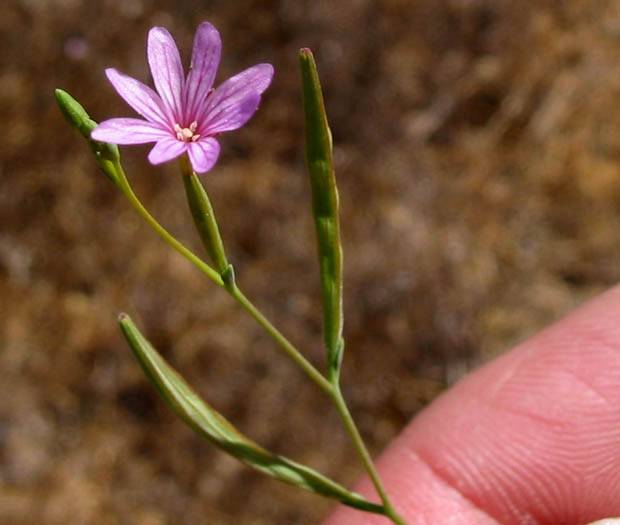 Tall Annual WillowherbEpilobium brachycarpum
Compare
Questions and answers
What is the scientific name of the California Fuchsia?
The scientific name of the California Fuchsia is Epilobium canum. Written with its author, the full name is Epilobium canum (Greene) P.H.Raven.
Which family does the California Fuchsia belong to?
Epilobium canum belongs to the family Onagraceae, in the order Myrtales and the class Magnoliopsida.
Where is the California Fuchsia found?
Checklists and occurrence records place Epilobium canum in 3 countries: United States, Mexico and Canada.
What other names does the California Fuchsia have?
Epilobium canum is also known in English as California-fuchsia, Hummingbird Trumpet, Hummingbird-trumpet and Zauschneria.
Does California fuchsia spread?
Yes. California fuchsia commonly spreads through rhizomes and may develop a matting or mounding growth form.[11]
Does California fuchsia attract hummingbirds?
Yes. Its flowers attract hummingbirds.[13]
How tall can a California fuchsia plant get?
California fuchsia can grow up to 60 centimetres tall.[4]
Does California fuchsia need full sun?
Yes. Full sun exposure is preferred when cultivating California fuchsia.[16]
Sources
Passages the profile rests on
- Its leaves are small and may be opposite or alternate, lance-shaped or ovate, with green to nearly white coloration. Source passage: “The small leaves may be opposite or alternate, lance-shaped or ovate, with short to nonexistent stalks, and range in color from green to nearly white.” — English Wikipedia
- Its flowers are tubular or funnel-shaped, grow in terminal racemes, and are predominantly reddish. Source passage: “The racemes of tubular or funnel-shaped flowers are terminal, and colors are mostly reddish, ranging from fuchsia to pink to red-orange.” — English Wikipedia
- The plant produces bright scarlet flowers that bloom profusely in late summer and autumn. Source passage: “notable for the profusion of bright scarlet flowers in late summer and autumn.” — English Wikipedia
- The plant is a subshrub that can grow up to 60 centimetres tall. Source passage: “It is a subshrub growing to 60 centimetres (24 in) tall.” — English Wikipedia
- The species is native to dry slopes and chaparral habitats. Source passage: “It is native to dry slopes and in chaparral of western North America, especially California.” — English Wikipedia
- The species is native to western North America, with particular prominence in California. Source passage: “It is native to dry slopes and in chaparral of western North America, especially California.” — English Wikipedia
- The species has been observed growing on a north-facing hillside slope near Aliso Hall on the California Islands campus. Source passage: “A large patch of this species was observed in flower on 10 September 2013 on the north facing slope of the hill to the south of Aliso Hall, CI” — csuci.edu
- The species has been observed growing at the base of a large rock on a hillside behind Malibu Hall. Source passage: “Epilobium canum at base of large rock on hillside behind (to the south) of Malibu Hall, CI.” — csuci.edu
- The species has been observed growing in landscaped areas near natural habitats. Source passage: “Occasionally observed growing as a volunteer in landscaped areas near natural habitats.” — csuci.edu
- The species has been cultivated in a native plant garden in Camarillo, California. Source passage: “Epilobium canum flowers in native plant garden in Camarillo, CA (27 July 2013).” — csuci.edu
- The plant commonly spreads through rhizomes and may develop a matting or mounding growth form. Source passage: “Overall shape may be matting or mounding, the plants commonly spreading via rhizomes.” — English Wikipedia
- Considerable variation in appearance and growth habit occurs among native populations of the species. Source passage: “Native populations of these plants exhibit considerable variation in appearance and habit.” — English Wikipedia
- The flowers attract hummingbirds. Source passage: “The bright red flowers attract hummingbirds.” — csuci.edu
- The species produces terminal racemes of tubular or funnel-shaped flowers. Source passage: “The racemes of tubular or funnel-shaped flowers are terminal” — English Wikipedia
- The species is suitable for cultivation in native plant gardens. Source passage: “This species easily adapts to use in a native plant garden.” — csuci.edu
- The species is preferably cultivated in well-drained soil with full sun exposure and protection from wind. Source passage: “they prefer to be cultivated in well-drained soil exposed to full sun but protected from the wind” — English Wikipedia
- The species requires little watering when cultivated. Source passage: “and need little watering.” — English Wikipedia
- The flowers resemble those of plants in the genus Fuchsia. Source passage: “California-fuchsia (from the resemblance of the flowers to those of fuchsias)” — English Wikipedia
Data
- Catalogue of Life, 2026-10-16 XR cc by
- Global Biodiversity Information Facility CC BY 4.0
- Wikidata CC0
- GeoNames CC BY 4.0
- Wikimedia Commons per image; credit shown with each image
- Within the Catalogue of Life, this name comes from Synonymic Checklists of the Vascular Plants of the World cc by
References
- (Greene) P.H.Raven. where the name was published
This species in other databases
- Catalogue of Life 6G4VS
- Wikidata Q5382993
- iNaturalist 53051
- World Flora Online wfo-0000668881
- GRIN 456306
Page built on 27 November 2026. See how the catalog is made and all sources and licences.
Cite this page
ScientificNames.org. (2026). Epilobium canum (California Fuchsia). Retrieved November 27, 2026, from https://scientificnames.org/species/epilobium-canum
“Epilobium canum (California Fuchsia).” ScientificNames.org, 2026, scientificnames.org/species/epilobium-canum. Accessed 27 Nov. 2026.
ScientificNames.org. “Epilobium canum (California Fuchsia).” Accessed November 27, 2026. https://scientificnames.org/species/epilobium-canum.
@misc{scientificnames_epilobium_canum_california_fuchsia,
  author = {{ScientificNames.org}},
  title = {Epilobium canum (California Fuchsia)},
  year = {2026},
  url = {https://scientificnames.org/species/epilobium-canum},
  note = {Accessed 2026-11-27}
}