Species · Flowering plants
Fringed Willowherb Epilobium ciliatum
The scientific name of the Fringed Willowherb is Epilobium ciliatum. It is a species of flowering plant in the family Onagraceae (evening-primrose family), order Myrtales.
- Scientific name
- Epilobium ciliatum Raf.
- Common name
- Fringed Willowherb
- Genus
- Epilobium
- Family
- Onagraceae (Evening-primrose Family)
- Order
- Myrtales
- Class
- Magnoliopsida
- Red List category
- LC Least Concern
- Recorded in
- 49 countries
- Name status
- accepted in the Catalogue of Life

Overview
Epilobium ciliatum usually grows in wetlands, disturbed areas and along roadsides, at elevations below 1,400 metres. It is distinguished by bristly, glandular hairs on its foliage, stems and inflorescences, and flowers ranging from white to light purple or pink.
Written 26 November 2026 from the sources listed below. Each statement was checked against the passage it cites; statements that could not be supported were removed.
Appearance
Fringed willowherb grows as a clumping perennial herb and commonly reaches more than 1.5 metres tall. Its lance-shaped, thickly veined leaves have basal leaves reaching up to 15 centimetres long.[1][2][3]
The foliage, stems and inflorescences are covered with bristly hairs and glands. The documented subspecies has a branched inflorescence.[4][5]
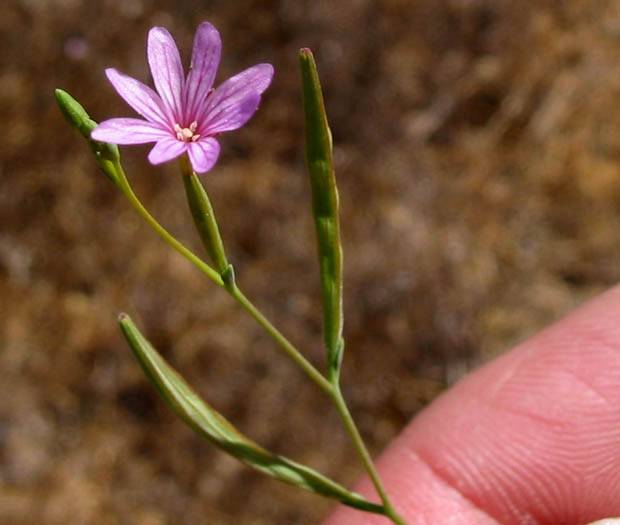
The flowers have four sepals and four deeply notched petals, ranging from white to light purple or pink with dark veining. Each flower has eight stamens and a club-shaped stigma.[6][7][8]
The fruit is a narrow, hairy capsule divided into four chambers. It can reach 10 centimetres in length and may be borne on a long stalk.[9][10][11]
Habitat
Fringed willowherb usually grows in wetlands and also occurs in disturbed areas and along roadsides. Recorded habitats include stream-sides, ditches and ponds, as well as gardens, recently cleared areas and wasteland.[12][13][14][15]
The species occurs at elevations below 1,400 metres.[16]
Similar species
In Europe, fringed willowherb competes with Epilobium roseum and is often found growing alongside it. Epilobium roseum prefers a similar habitat.[17][18][19]
Three subspecies of Epilobium ciliatum are currently recognized, although the species may represent a cryptic species complex and the recognized subspecies may each represent separate species. Epilobium saximontanum is sometimes treated as an additional subspecies.[20][21][22][23]
Behaviour
The species spread rapidly after arriving in northern Europe. Its seeds can be dispersed over long distances by wind.[24][25]
Classification of the Fringed Willowherb
| Kingdom | Plantae |
|---|---|
| Subkingdom | Pteridobiotina |
| Phylum | Tracheophyta |
| Class | Magnoliopsida |
| Order | Myrtales |
| Family | Onagraceae (Evening-primrose Family) |
| Subfamily | Onagroideae |
| Tribe | Epilobieae |
| Genus | Epilobium (Fireweed) |
| Species | Epilobium ciliatum Raf. |
Where the Fringed Willowherb is found
Checklists and occurrence records place Epilobium ciliatum in 49 countries across Asia, Europe, North America, Oceania and South America. GBIF holds 296,297 georeferenced records of it.
Countries where it is native or its origin is not stated
- Aland Islands 492
- Argentina 239
- Bolivia 3
- Brazil 3
- Canada 6,116
- Chile 287
- China 30
- Colombia 5
- Denmark 19,333
- Falkland Islands 33
- Greenland 6
- Guatemala 24
- Japan 305
- Mexico 888
- North Korea 14
- Russia 3,792
- Saint Pierre and Miquelon 10
- South Korea 9
- Taiwan 7
- The Netherlands 11,279
- Venezuela 4
Countries where it has been introduced
- Australia 809
- Austria 2,378
- Belarus 28
- Belgium 14,953
- Croatia 1
- Czechia 2,896
- Estonia 1,394
- Finland 21,267
- France 10,653
- Germany 21,035
- Greece 4
- Guernsey
- Hungary 6
- Ireland 285
- Italy 15
- Jersey
- Latvia 79
- Liechtenstein
- Lithuania 15
- Luxembourg 829
- New Zealand 1,191
- Norway 9,052
- Poland 1,733
- Slovakia 298
- Sweden 31,367
- Switzerland 901
- United Kingdom 108,294
- United States 23,935
Regions and cities with the most records
- England, United Kingdom 83,239
- Scotland, United Kingdom 15,544
- Bavaria, Germany 8,832
- Central Jutland, Denmark 7,481
- Västra Götaland, Sweden 5,569
- South Denmark, Denmark 5,456
- Wales, United Kingdom 5,456
- California, United States 5,034
- Skåne, Sweden 3,602
- Södermanland, Sweden 3,237
- Halesowen, United Kingdom 3,080
- Stourbridge, United Kingdom 3,040
- Bartley Green, United Kingdom 2,978
- Brierley Hill, United Kingdom 2,971
- Bromsgrove, United Kingdom 2,966
- Droitwich, United Kingdom 2,927
- Myyrmäki, Finland 2,908
- Kidderminster, United Kingdom 2,887
- Dudley, United Kingdom 2,866
- Kingswinford, United Kingdom 2,800
- Stourport-on-Severn, United Kingdom 2,772
- Helsinki, Finland 2,746
- Tipton, United Kingdom 2,741
- Smethwick, United Kingdom 2,700
- Hauts-de-France, France 2,607
- West Bromwich, United Kingdom 2,606
- Birmingham, United Kingdom 2,576
- Wednesbury, United Kingdom 2,534
- Brasschaat, Belgium 2,511
- Östergötland, Sweden 2,500
- Ekeren, Belgium 2,492
- Stockholm, Sweden 2,479
- Berchem, Belgium 2,476
- Merksem, Belgium 2,461
- Deurne, Belgium 2,455
- Antwerp, Belgium 2,452
7 more countries have a few records outside this range
These countries hold a few records of Epilobium ciliatum but lie outside the range the checklists give for it. Such records are often zoo or garden specimens, museum material or vagrants, so the species is not counted as occurring there.
A number beside a place is its count of GBIF occurrence records. A place without a number comes from a checklist alone. Records show where a species has been observed or collected, which can include escapes and vagrants.
Common names
English
- Fringed Willowherb
- American Willowherb
- Glandular Willowherb
- Northern Willowherb
- Purple-leaved Willowherb
- Willowherb
Names in 23 other languages
- Chinese
- 东北柳叶菜, 北美柳葉菜, 東北柳葉菜, 流蘇柳葉菜
- Czech
- vrbovka žláznatá
- Danish
- Hvid dueurt, Kirtel-dueurt
- Dutch
- Beklierde basterdwederik
- Estonian
- hele pajulill, mets-pajulill, punakas pajulill
- Faroese
- kertildúnurt
- Finnish
- amerikanhorsma, rusoamerikanhorsma, vaalea-amerikanhorsma
- French
- epilobe cilié, épilobe cilié
- German
- Drüsiges Weidenröschen
- Hungarian
- jövevény füzike, mirigyes füzike
- Icelandic
- Vætudúnurt
- Irish
- Saileachán sráide
- Italian
- Garofanino cigliato
- Lithuanian
- Liaukuotastiebė ožkarožė
- Norwegian Bokmål
- amerikamjølke
- Polish
- Wierzbownica gruczołowata
- Russian
- Кипрей железистостебельный, Кипрей реснитчатый
- Slovak
- vŕbovka brvitá
- Slovenian
- vejicati vrbovec
- Swedish
- Amerikansk dunört, Stadsdunört, Vitblommig dunört, vit dunört
- Ukrainian
- Зніт війчастий
- Welsh
- Helyglys America, Helyglys Americanaidd
- nav
- Bikétłʼóól Názbąs
Synonyms
One other scientific name has been used for this species and is now treated as a synonym of Epilobium ciliatum.
- Epilboium adenocaulon
Subspecies and varieties
- Epilobium ciliatum subsp. ciliatum (Fringed Willowherb) subspecies
- Epilobium ciliatum subsp. glandulosum (Glandular Willowherb) subspecies
- Epilobium ciliatum subsp. watsonii (Pacific Willowherb) subspecies
Related species
-
 Hoary WillowherbEpilobium parviflorum
-
 California FuchsiaEpilobium canum
-
 Great WillowherbEpilobium hirsutum
-
 Southern Willow-HerbEpilobium tetragonum
-
 Pale WillowherbEpilobium roseum
-
 White WillowherbEpilobium lactiflorum
-
 Cinnamon Willow-herbEpilobium coloratum
-
 Tall Annual WillowherbEpilobium brachycarpum
Compare
Questions and answers
What is the scientific name of the Fringed Willowherb?
The scientific name of the Fringed Willowherb is Epilobium ciliatum. Written with its author, the full name is Epilobium ciliatum Raf..
Which family does the Fringed Willowherb belong to?
Epilobium ciliatum belongs to the family Onagraceae, in the order Myrtales and the class Magnoliopsida.
Where is the Fringed Willowherb found?
Checklists and occurrence records place Epilobium ciliatum in 49 countries, including Denmark, The Netherlands, Canada, Russia, Mexico and Aland Islands.
What is the conservation status of the Fringed Willowherb?
The IUCN Red List category recorded for Epilobium ciliatum is Least Concern (LC).
What other names does the Fringed Willowherb have?
Epilobium ciliatum is also known in English as American Willowherb, Glandular Willowherb, Northern Willowherb, Purple-leaved Willowherb and Willowherb.
Sources
Passages the profile rests on
- The species grows as a clumping perennial herb. Source passage: “Epilobium ciliatum is a clumping perennial” — English Wikipedia
- The plant commonly grows to more than 1.5 metres tall. Source passage: “often exceeding 1.5 metres (5 ft) in height.” — English Wikipedia
- Its leaves are lance-shaped and thickly veined, with basal leaves reaching up to 15 centimetres long. Source passage: “It has thickly veined lance-shaped leaves which may be up to 15 centimeters long toward the base of the plant.” — English Wikipedia
- The foliage, stems and inflorescences are covered with bristly hairs and glands. Source passage: “The foliage, stem, and inflorescence are covered in bristly hairs and glands.” — English Wikipedia
- The inflorescence of the documented subspecies has a branched structure. Source passage: “inflorescence branched;” — fieldguide.mt.gov
- The flowers have four sepals and four deeply notched petals. Source passage: “There are four sepals. The regular, trumpet-shaped flowers have four petals which are so deeply notched they look like four pairs.” — English Wikipedia
- The flowers range from white to light purple or pink and have dark veining. Source passage: “They are white to light purple or pink with dark veining.” — English Wikipedia
- Each flower has eight stamens and a club-shaped stigma. Source passage: “There are eight stamens and a club-shaped stigma.” — English Wikipedia
- The fruit is a narrow, hairy capsule divided into four chambers. Source passage: “The fruit is a narrow, hairy, four-chambered capsule up to 10 centimeters in length” — English Wikipedia
- The fruit capsule can reach 10 centimetres in length. Source passage: “up to 10 centimeters in length” — English Wikipedia
- The fruit capsule may be borne on a long stalk. Source passage: “which may be held on a long stalk.” — English Wikipedia
- The species usually grows in wetlands. Source passage: “This perennial herbaceous plant usually occurs in wetlands” — English Wikipedia
- The species also grows in disturbed areas and along roadsides. Source passage: “including disturbed areas and roadsides” — English Wikipedia
- Its recorded habitats include stream-sides, ditches and ponds. Source passage: “stream-sides, ditches, ponds” — English Wikipedia
- The species also occurs in gardens, recently cleared areas and wasteland. Source passage: “gardens, roadsides, recently cleared areas and wasteland.” — English Wikipedia
- The species occurs at elevations below 1,400 metres. Source passage: “at elevations below 1,400 metres (4,600 ft).” — English Wikipedia
- The species competes with Epilobium roseum in Europe. Source passage: “In Europe, Epilobium ciliatum competes with” — English Wikipedia
- Epilobium ciliatum is often found growing alongside Epilobium roseum in Europe. Source passage: “and is often found together with Epilobium roseum” — English Wikipedia
- Epilobium roseum prefers a habitat similar to that of this species. Source passage: “which prefers a similar habitat.” — English Wikipedia
- Three subspecies of Epilobium ciliatum are currently recognized. Source passage: “Three subspecies are currently recognized:” — English Wikipedia
- Epilobium ciliatum may represent a cryptic species complex. Source passage: “Epilobium ciliatum may be a cryptic species complex.” — English Wikipedia
- Epilobium saximontanum is sometimes treated as an additional subspecies of Epilobium ciliatum. Source passage: “The Rocky Mountain Willowherb (Epilobium saximontanum) is sometimes included as yet another subspecies.” — English Wikipedia
- The recognized subspecies may each represent separate species. Source passage: “The three currently recognized subspecies may each constitute a distinct species.” — English Wikipedia
- The seeds can be dispersed over long distances by wind. Source passage: “can float for long distances with the wind.” — English Wikipedia
- The species spread rapidly after arriving in northern Europe. Source passage: “and spread rapidly, reaching Finland in about 1920.” — English Wikipedia
- The species has been introduced across much of Eurasia and Australia. Source passage: “It is an introduced species in much of Eurasia and Australia.” — English Wikipedia
Data
- Catalogue of Life, 2026-10-16 XR cc by
- Global Biodiversity Information Facility CC BY 4.0
- Wikidata CC0
- GeoNames CC BY 4.0
- Wikimedia Commons per image; credit shown with each image
- Within the Catalogue of Life, this name comes from Synonymic Checklists of the Vascular Plants of the World cc by
References
- Raf. where the name was published
This species in other databases
- Catalogue of Life 6G4VY
- Wikidata Q164151
- iNaturalist 53050
- World Flora Online wfo-0000668926
- GRIN 450339
Page built on 27 November 2026. See how the catalog is made and all sources and licences.
Cite this page
ScientificNames.org. (2026). Epilobium ciliatum (Fringed Willowherb). Retrieved November 27, 2026, from https://scientificnames.org/species/epilobium-ciliatum
“Epilobium ciliatum (Fringed Willowherb).” ScientificNames.org, 2026, scientificnames.org/species/epilobium-ciliatum. Accessed 27 Nov. 2026.
ScientificNames.org. “Epilobium ciliatum (Fringed Willowherb).” Accessed November 27, 2026. https://scientificnames.org/species/epilobium-ciliatum.
@misc{scientificnames_epilobium_ciliatum_fringed_willowherb,
  author = {{ScientificNames.org}},
  title = {Epilobium ciliatum (Fringed Willowherb)},
  year = {2026},
  url = {https://scientificnames.org/species/epilobium-ciliatum},
  note = {Accessed 2026-11-27}
}