Species · Fishes
White Grouper Epinephelus aeneus
The scientific name of the White Grouper is Epinephelus aeneus. It is a species of fish in the family Epinephelidae (groupers), order Perciformes. The name dates from 1817.
- Scientific name
- Epinephelus aeneus (Geoffroy Saint-Hilaire, 1817)
- Common name
- White Grouper
- Genus
- Epinephelus
- Family
- Epinephelidae (Groupers)
- Order
- Perciformes
- Class
- Teleostei
- Red List category
- NT Near Threatened
- Environment
- brackish, marine
- Recorded in
- 33 countries
- Name status
- accepted in the Catalogue of Life

Overview
Epinephelus aeneus occurs in the subtropical eastern Atlantic Ocean and southern Mediterranean Sea. It has greenish bronze coloration, brownish-purple fins with pale margins and 3 or 4 pale lines across its gill cover.
Written 26 November 2026 from the sources listed below. Each statement was checked against the passage it cites; statements that could not be supported were removed.
Appearance
The head is longer than the body is deep. Standard length is 3 to 3.6 times body depth, and the dorsal profile is convex between the eyes. The preopercle has 3 to 6 large spines at its angle, with the lowest spine pointing downwards.[1][2][3][4]
The dorsal fin has 10–11 spines and 14–16 soft rays, while the anal fin has 3 spines and 7–9 soft rays. The caudal fin is rounded. The body is covered with small scales embedded in thick skin and has more than 90 scales along the lateral line.[5][6][7][8][9]
The overall coloration is greenish bronze, with brownish-purple fins that have white or pale margins. There are 3 or 4 pale blue or white lines across the gill cover, which may be faint in larger adults.[10][11][12]
Juveniles have faint dark body spots forming five indistinct dark vertical bars. They also have indistinct dark spots on their fins.[13][14]
The maximum recorded total length is 120 cm, although individuals are more commonly around 60 cm long. The maximum published weight is 25 kg.[15][16][17]
Habitat
The species occurs on rocky, muddy and sandy substrates. Juveniles inhabit coastal lagoons and estuaries, while adults occur at depths of 20–200 m.[18][19][20]
Its eastern Atlantic distribution extends from southern Portugal and southern Spain southwards along western Africa to Angola, including islands in the Gulf of Guinea. It also occurs in the southern and eastern Mediterranean.[21][22][23]
Recent records indicate that its Mediterranean range may be expanding northwards. Recent northern Mediterranean records include Corsica and Monaco.[24][25]
Diet
White Grouper is carnivorous. Off West Africa, fishes account for 58% of its reported diet and cephalopods account for 10%.[26][27][28]
Behaviour
The species undergoes seasonal migration off the coasts of Senegal and Mauritania. This migration is associated with coastal upwelling.[29][30]
Reproduction and life cycle
White Grouper is a protogynous hermaphrodite. Females reach sexual maturity at a total length of 50–60 cm and an age of 5–7 years. Sex change to males occurs at an age of 10–13 years.[31][32][33][34]
The species spawns off Tunisia during June and July. In Iskenderun Bay, Turkey, spawning begins in early June and continues until late August.[35][36]
Conservation
Overfishing is the major threat to the species. It is targeted by poachers using spear guns and lights at night, including in protected areas.[37][38]
Uses
White Grouper is an important target species for fisheries throughout its range. Fishermen catch it using hook-and-line fishing and trawls. Artisanal fishers are the main landers of the species in Senegalese waters.[39][40][41]
A local commercial fishery in Senegal supplies an export market, mainly in Europe. The species is marketed fresh or preserved by smoking.[42][43]
The species has been bred in aquaculture at the Israeli National Center for Mariculture.[44]
Classification of the White Grouper
| Kingdom | Animalia |
|---|---|
| Phylum | Chordata |
| Subphylum | Vertebrata |
| Infraphylum | Gnathostomata |
| Parvphylum | Osteichthyes |
| Gigaclass | Actinopterygii |
| Superclass | Actinopteri |
| Class | Teleostei (Teleost) |
| Order | Perciformes |
| Suborder | Percoidei |
| Family | Epinephelidae (Groupers) |
| Genus | Epinephelus (Groupers) |
| Species | Epinephelus aeneus (Geoffroy Saint-Hilaire, 1817) |
Where the White Grouper is found
Checklists and occurrence records place Epinephelus aeneus in 33 countries. GBIF holds 2,613 georeferenced records of it.
Countries
- Albania 32
- Angola 34
- Benin 34
- Cameroon 75
- Cyprus 8
- Democratic Republic of the Congo 31
- Egypt 28
- Equatorial Guinea 21
- France 15
- Gabon 92
- Gambia 5
- Ghana 95
- Greece 50
- Guinea 35
- Guinea-Bissau 35
- Israel 150
- Italy 88
- Ivory Coast 249
- Lebanon 60
- Liberia 70
- Malta 15
- Mauritania 129
- Montenegro 4
- Nigeria 134
- Portugal 5
- Republic of the Congo 14
- Senegal 199
- Sierra Leone 45
- Spain 753
- Togo 19
- Tunisia 10
- Turkey 73
- Western Sahara 6
Regions and cities with the most records
- Fatick, Senegal 168
- Arenys de Mar, Spain 112
- Blanes, Spain 112
- Calella, Spain 112
- Lloret de Mar, Spain 112
- Malgrat de Mar, Spain 112
- Pineda de Mar, Spain 112
- Tordera, Spain 112
- Castelldefels, Spain 102
- Cornellà de Llobregat, Spain 102
- El Prat de Llobregat, Spain 102
- Esplugues de Llobregat, Spain 102
- Gavà, Spain 102
- L'Hospitalet de Llobregat, Spain 102
- Premià de Mar, Spain 102
- Sant Boi de Llobregat, Spain 102
- Sant Feliu de Llobregat, Spain 102
- Sant Joan Despí, Spain 102
- Sant Just Desvern, Spain 102
- Viladecans, Spain 102
- Vilassar de Mar, Spain 102
- Abidjan, Ivory Coast 86
- Marcory, Ivory Coast 86
- Koumassi, Ivory Coast 85
- Abobo, Ivory Coast 75
- Acre, Israel 62
- Haifa, Israel 61
- Qiryat Yam, Israel 60
- Calafell, Spain 57
- El Vendrell, Spain 57
- Qiryat Motsqin, Israel 57
- Torredembarra, Spain 57
- Vilanova i la Geltrú, Spain 57
- Tirat Karmel, Israel 55
- Qiryat Bialik, Israel 53
- Nesher, Israel 52
1 more country has a few records outside this range
These countries hold a few records of Epinephelus aeneus but lie outside the range the checklists give for it. Such records are often zoo or garden specimens, museum material or vagrants, so the species is not counted as occurring there.
A number beside a place is its count of GBIF occurrence records. A place without a number comes from a checklist alone. Records show where a species has been observed or collected, which can include escapes and vagrants.
Common names
English
- White Grouper
Names in 21 other languages
- Albanian
- kermi vijabardhë, kerni vijabardhë
- Catalan
- anfós blanc
- Chinese
- 青銅石斑魚
- Croatian
- Kirnja bjelica
- Czech
- kanic lagunový
- Danish
- Hvid havaborre
- Dutch
- witte grouper, witte zaagbaars
- Finnish
- valkomeriahven
- French
- mérou blanc
- German
- weißer Zackenbarsch
- Greek
- Επινέφελος ο αινειός, Σφυρίδα
- Hebrew
- דקר המכמורת
- Italian
- cernia bianca
- Lithuanian
- baltadryžis gruperis:
- Polish
- granik szary
- Portuguese
- Garoupa Verde, garoupa-branca, murianga
- Russian
- Белополосый мероу, белый морской окунь
- Spanish
- cherna de ley, cherne de ley
- Turkish
- Beyaz Lahos, Kaya Hanisi, lahoz
- Ukrainian
- Групер, Групер білосмугий, Мероу білосмугий
- wol
- Thiof
Synonyms
8 other scientific names have been used for this species and are now treated as synonyms of Epinephelus aeneus.
- Cerna aenea (Geoffroy Saint-Hilaire, 1817)
- Chenia aenea (Geoffroy Saint-Hilaire, 1817)
- Cherna aenea (Geoffroy Saint-Hilaire, 1817)
- Epinephelus aenus (Geoffroy Saint-Hilaire, 1817)
- Epinephelus oeneus (Geoffroy St. Hilaire, 1817)
- Perca robusta Couch, 1832
- Serranus aeneus Geoffroy Saint-Hilaire, 1817
- Serranus aeneus Ben-Tuvia, 1953
Related species
-
 Atlantic Goliath GrouperEpinephelus itajara
-
 Giant GrouperEpinephelus lanceolatus
-
 Dusky GrouperEpinephelus marginatus
-
 Nassau GrouperEpinephelus striatus
-
 Red GrouperEpinephelus morio
-
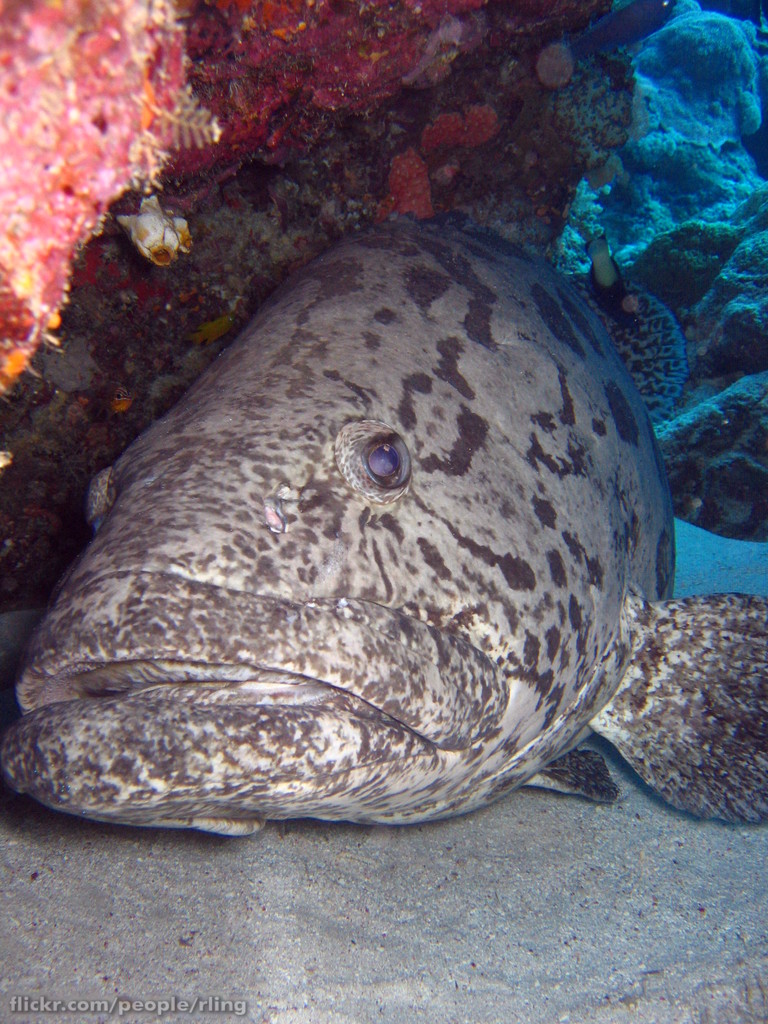 Potato GrouperEpinephelus tukula
-
 Pacific Goliath GrouperEpinephelus quinquefasciatus
-
 Orange-spotted GrouperEpinephelus coioides
Compare
Questions and answers
What is the scientific name of the White Grouper?
The scientific name of the White Grouper is Epinephelus aeneus. Written with its author, the full name is Epinephelus aeneus (Geoffroy Saint-Hilaire, 1817).
Which family does the White Grouper belong to?
Epinephelus aeneus belongs to the family Epinephelidae, in the order Perciformes and the class Teleostei.
Where is the White Grouper found?
Checklists and occurrence records place Epinephelus aeneus in 33 countries, including Spain, Ivory Coast, Senegal, Israel, Nigeria and Mauritania.
What is the conservation status of the White Grouper?
The IUCN Red List category recorded for Epinephelus aeneus is Near Threatened (NT).
Sources
Passages the profile rests on
- The species has a head longer than its body is deep. Source passage: “The white grouper has a head which is longer than its body is deep” — English Wikipedia
- Its standard length is 3 to 3.6 times its body depth. Source passage: “the standard length being 3 to 3.6 times the depth of the body.” — English Wikipedia
- Its dorsal profile is convex between the eyes. Source passage: “The dorsal profile is convex between the eyes.” — English Wikipedia
- Its preopercle has 3 to 6 large spines at its angle, with the lowest spine pointing downwards. Source passage: “The preopercle is angular and has with 3 to 6 large spines at its angle, the lowest being directed downwards.” — English Wikipedia
- Its dorsal fin has 10–11 spines and 14–16 soft rays. Source passage: “The dorsal fin contains 10-11 spines and 14-16 soft rays” — English Wikipedia
- Its anal fin has 3 spines and 7–9 soft rays. Source passage: “the anal fin has 3 spines and 7-9 soft rays.” — English Wikipedia
- Its caudal fin is rounded. Source passage: “The caudal fin is rounded” — English Wikipedia
- Its body is covered with small scales embedded in thick skin. Source passage: “the body is covered in small scales which are set within thick skin.” — English Wikipedia
- It has more than 90 scales along its lateral line. Source passage: “There are over 90 scales in the lateral line.” — English Wikipedia
- Its overall coloration is greenish bronze, with brownish-purple fins that have white or pale margins. Source passage: “The overall colour is greenish bronze with darker fins which are brownish purple and have white or pale margins.” — English Wikipedia
- It has 3 or 4 pale blue or white lines across its gill cover. Source passage: “There are 3 or 4 pale blue or white lines across the gill cover” — English Wikipedia
- The pale lines on the gill cover may be faint in larger adults. Source passage: “these can be quite faint in larger adults.” — English Wikipedia
- Juveniles have faint dark body spots forming five indistinct dark vertical bars. Source passage: “The juveniles have faint dark spots on their body which create 5 indistinct dark vertical bars.” — English Wikipedia
- Juveniles also have indistinct dark spots on their fins. Source passage: “The juveniles also have indistinct dark spots on the fins.” — English Wikipedia
- The maximum recorded total length is 120 cm. Source passage: “The maximum total length this species has been recorded at is 120 centimetres (47 in)” — English Wikipedia
- Individuals are more commonly around 60 cm long. Source passage: “although they are more common at around 60 centimetres (24 in)” — English Wikipedia
- The maximum published weight is 25 kg. Source passage: “the maximum published weight is 25 kilograms (55 lb).” — English Wikipedia
- The species occurs on rocky, muddy and sandy substrates. Source passage: “The white grouper occurs on substrates of rock or mud and sand” — English Wikipedia
- Juveniles inhabit coastal lagoons and estuaries. Source passage: “while the juveniles are found in coastal lagoons and estuaries” — English Wikipedia
- Adults occur at depths of 20–200 m. Source passage: “adults are found at depths between 20 and 200 metres (66 and 656 ft).” — English Wikipedia
- Its eastern Atlantic distribution extends from southern Portugal and southern Spain southwards along western Africa to Angola. Source passage: “from southern Portugal and southern Spain south along the western coast of Africa as far south as Angola” — English Wikipedia
- Its recorded eastern Atlantic distribution includes islands in the Gulf of Guinea. Source passage: “including the islands in the Gulf of Guinea.” — English Wikipedia
- The species occurs in the southern and eastern Mediterranean. Source passage: “It is found in the southern and eastern Mediterranean” — English Wikipedia
- Recent records indicate that its Mediterranean range may be expanding northwards. Source passage: “but appears to be expanding its range northwards” — English Wikipedia
- Recent northern Mediterranean records include Corsica and Monaco. Source passage: “there have been records from Corsica and Monaco” — English Wikipedia
- The species is carnivorous. Source passage: “This is a carnivorous species” — English Wikipedia
- Fishes account for 58% of its reported diet off West Africa. Source passage: “58% of their diet is made up of fishes” — English Wikipedia
- Cephalopods account for 10% of its reported diet off West Africa. Source passage: “and 10% of cephalopods.” — English Wikipedia
- The species undergoes seasonal migration off the coasts of Senegal and Mauritania. Source passage: “There is a seasonal migration of this species off the coasts of Senegal and Mauritania” — English Wikipedia
- Its seasonal migration off Senegal and Mauritania is associated with coastal upwelling. Source passage: “which is linked to an upwelling off the coasts of those nations.” — English Wikipedia
- The species is a protogynous hermaphrodite. Source passage: “They are protogynous hermaphrodites” — English Wikipedia
- Females reach sexual maturity at a total length of 50–60 cm. Source passage: “the females reaching sexual maturity on attainment of a total length of 50 to 60 centimetres (20 to 24 in)” — English Wikipedia
- Females reach sexual maturity at an age of 5–7 years. Source passage: “and at an age of 5–7 years” — English Wikipedia
- Sex change to males occurs at an age of 10–13 years. Source passage: “the sex change to males occurs when they are 10 to 13 years old.” — English Wikipedia
- The species spawns off Tunisia during June and July. Source passage: “Off Tunisia this species spawns during June and July” — English Wikipedia
- Spawning in Iskenderun Bay, Turkey, begins in early June and continues until late August. Source passage: “in Iskenderun Bay in Turkey, spawning starts in early June and continues up to late August.” — English Wikipedia
- Overfishing is identified as the major threat to the species. Source passage: “Overfishing is the major threat to the white grouper.” — English Wikipedia
- The species is targeted by poachers using spear guns and lights at night, including in protected areas. Source passage: “Even where protected it has been targeted by poachers using spear guns and lights at night.” — English Wikipedia
- The white grouper is an important target species for fisheries throughout its range. Source passage: “The white grouper is a very important quarry species for fisheries throughout its range” — English Wikipedia
- Fishermen catch the species using hook-and-line fishing and trawls. Source passage: “fishermen use hook-and-line and trawls to catch it.” — English Wikipedia
- Artisanal fishers are the main landers of the species in Senegalese waters. Source passage: “In Senegalese waters, artisanal fishers are the main landers of this species” — English Wikipedia
- A local commercial fishery in Senegal supplies an export market, mainly in Europe. Source passage: “there is a local commercial fishery which is set up for the export market, mainly to Europe.” — English Wikipedia
- The species is marketed fresh or preserved by smoking. Source passage: “It is marketed fresh or preserved by smoking.” — English Wikipedia
- The species has been bred in aquaculture at the Israeli National Center for Mariculture. Source passage: “It has been bred in aquaculture at the Israeli National Center for Mariculture.” — English Wikipedia
Data
- Catalogue of Life, 2026-10-16 XR cc by
- Global Biodiversity Information Facility CC BY 4.0
- Wikidata CC0
- GeoNames CC BY 4.0
- Wikimedia Commons per image; credit shown with each image
- Within the Catalogue of Life, this name comes from World Register of Marine Species cc by
References
- GEOFFROY SAINT-HILAIRE, E.: 1817. Poissons de la Mer Rouge et de la Mediterranee. In, Description de l' Egypte au Recueil des observations et des Recherches qui ont ete faites en Egypte pendant l'expedition de l'armee francaise. Paris, Planches Histoire Naturelle, 1, Poissons, pls. 18 - 27. where the name was published
This species in other databases
- Catalogue of Life 6G5LX
- Wikidata Q550195
- iNaturalist 68118
- WoRMS urn:lsid:marinespecies.org:taxname:127032
- ITIS 551036
Page built on 28 November 2026. See how the catalog is made and all sources and licences.
Cite this page
ScientificNames.org. (2026). Epinephelus aeneus (White Grouper). Retrieved November 28, 2026, from https://scientificnames.org/species/epinephelus-aeneus
“Epinephelus aeneus (White Grouper).” ScientificNames.org, 2026, scientificnames.org/species/epinephelus-aeneus. Accessed 28 Nov. 2026.
ScientificNames.org. “Epinephelus aeneus (White Grouper).” Accessed November 28, 2026. https://scientificnames.org/species/epinephelus-aeneus.
@misc{scientificnames_epinephelus_aeneus_white_grouper,
  author = {{ScientificNames.org}},
  title = {Epinephelus aeneus (White Grouper)},
  year = {2026},
  url = {https://scientificnames.org/species/epinephelus-aeneus},
  note = {Accessed 2026-11-28}
}