Species · Fishes
Longtooth Grouper Epinephelus bruneus
The scientific name of the Longtooth Grouper is Epinephelus bruneus. It is a species of fish in the family Epinephelidae (groupers), order Perciformes. The name dates from 1793.
- Scientific name
- Epinephelus bruneus Bloch, 1793
- Common name
- Longtooth Grouper
- Genus
- Epinephelus
- Family
- Epinephelidae (Groupers)
- Order
- Perciformes
- Class
- Teleostei
- Red List category
- VU Vulnerable
- Environment
- marine
- Recorded in
- 2 countries
- Name status
- accepted in the Catalogue of Life

Overview
Epinephelus bruneus occurs in the Western Pacific Ocean, with a recorded range including southern Japan, Taiwan, southern Korea, Hainan and Hong Kong in southern China. It has an elongated body, and adults have small grey spots arranged in short longitudinal lines that produce a mottled pattern.
Written 26 November 2026 from the sources listed below. Each statement was checked against the passage it cites; statements that could not be supported were removed.
Appearance
The longtooth grouper has an elongated body, with a standard length 3.0 to 3.6 times its body depth. The dorsal profile of the head between the eyes is convex, and the angle of the preopercle has notably enlarged serrations.[1][2][3]
The upper edge of the gill cover is convex and bears a small spine. The dorsal fin has 11 spines and 13–15 soft rays, while the anal fin has three spines and eight soft rays; the lateral line contains 64–72 scales.[4][5][6][7]
Larger adults are dark greyish brown and may have faint blotches on their backs. Adults have small grey spots arranged into short longitudinal lines, producing a mottled pattern, and the lower margin of the anal fin and lower corner of the caudal fin have white edges.[8][9][10]
Juveniles are pale yellowish brown and have six irregular diagonal dark bars containing irregular pale spots. The first bar extends from the nape to the eye, while the last is located on the caudal peduncle.[11][12]
Juveniles have three dark brown bands radiating from the lower part of the eye. Some juveniles have greenish yellow membranes between the rearmost dorsal-fin spines.[13][14]
Habitat
The longtooth grouper occurs over rocky reefs and muddy substrates. It is also found over coral reefs and artificial reefs.[15][16]
Adults inhabit depths of 20 to 200 metres, while juveniles inhabit shallow water at depths of less than five metres.[17][18]
Uses
The longtooth grouper is considered an excellent food fish. It is caught using hand lines, longlines and trawls.[19][20]
Classification of the Longtooth Grouper
| Kingdom | Animalia |
|---|---|
| Phylum | Chordata |
| Subphylum | Vertebrata |
| Infraphylum | Gnathostomata |
| Parvphylum | Osteichthyes |
| Gigaclass | Actinopterygii |
| Superclass | Actinopteri |
| Class | Teleostei (Teleost) |
| Order | Perciformes |
| Suborder | Percoidei |
| Family | Epinephelidae (Groupers) |
| Genus | Epinephelus (Groupers) |
| Species | Epinephelus bruneus Bloch, 1793 |
Where the Longtooth Grouper is found
Checklists and occurrence records place Epinephelus bruneus in 2 countries. GBIF holds 29,100 georeferenced records of it.
Countries
6 more countries have a few records outside this range
These countries hold a few records of Epinephelus bruneus but lie outside the range the checklists give for it. Such records are often zoo or garden specimens, museum material or vagrants, so the species is not counted as occurring there.
A number beside a place is its count of GBIF occurrence records. A place without a number comes from a checklist alone. Records show where a species has been observed or collected, which can include escapes and vagrants.
Common names
English
- Longtooth Grouper
- Kelp Grouper
- Tawny Grouper
- Mudgrouper
Names in 9 other languages
- Chinese
- Cao Ban, Hè Shí Ban, 土溝龍, 土鱠, 油斑, 石斑, 褐帶石斑魚, 褐石斑魚
- Czech
- kanic japonský
- French
- Mérou longues dents
- Japanese
- Kue, クエ
- Korean
- Cha-ba-ri, 자바리
- Mandarin Chinese
- 過魚
- Portuguese
- Garoupa-castanha
- Vietnamese
- Cá Song Nâu
- sgd
- Lapu-lapu
Synonyms
4 other scientific names have been used for this species and are now treated as synonyms of Epinephelus bruneus.
- Cephalopholis moara (Temminck & Schlegel, 1842)
- Epinephelus brunneus Bloch, 1793
- Epinephelus moara (Temminck & Schlegel, 1842)
- Serranus moara Temminck & Schlegel, 1842
Related species
-
 Atlantic Goliath GrouperEpinephelus itajara
-
 Giant GrouperEpinephelus lanceolatus
-
 Dusky GrouperEpinephelus marginatus
-
 Nassau GrouperEpinephelus striatus
-
 Red GrouperEpinephelus morio
-
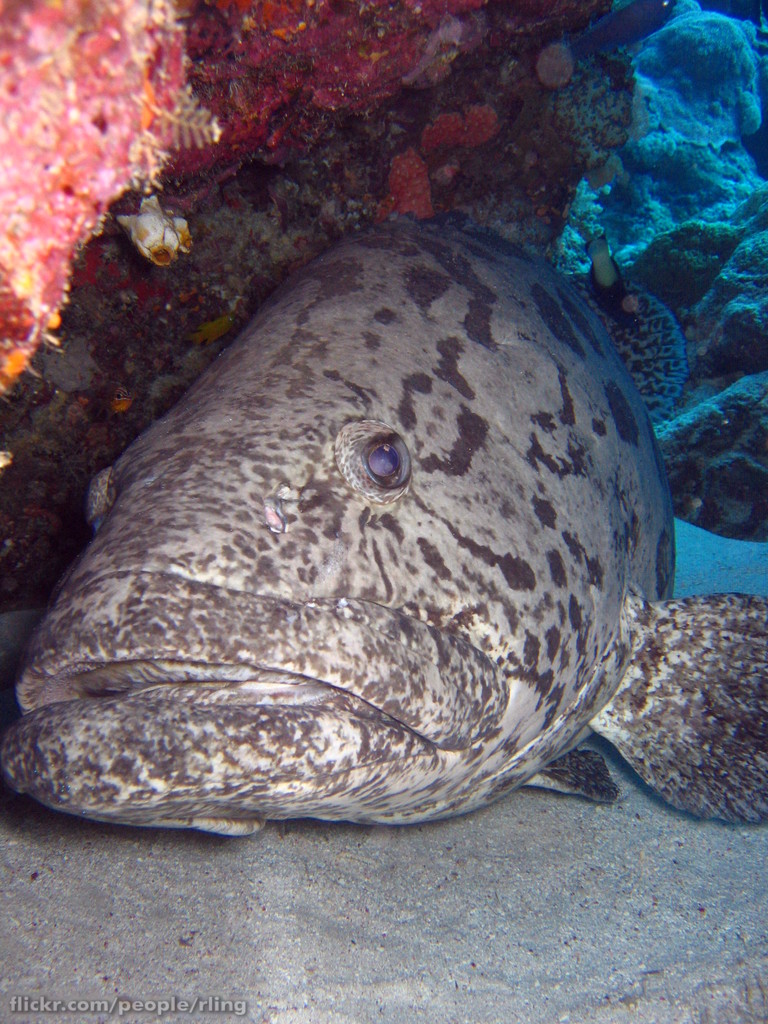 Potato GrouperEpinephelus tukula
-
 Pacific Goliath GrouperEpinephelus quinquefasciatus
-
 Orange-spotted GrouperEpinephelus coioides
Compare
Questions and answers
What is the scientific name of the Longtooth Grouper?
The scientific name of the Longtooth Grouper is Epinephelus bruneus. Written with its author, the full name is Epinephelus bruneus Bloch, 1793.
Which family does the Longtooth Grouper belong to?
Epinephelus bruneus belongs to the family Epinephelidae, in the order Perciformes and the class Teleostei.
Where is the Longtooth Grouper found?
Checklists and occurrence records place Epinephelus bruneus in 2 countries: Australia and New Caledonia.
What is the conservation status of the Longtooth Grouper?
The IUCN Red List category recorded for Epinephelus bruneus is Vulnerable (VU).
What other names does the Longtooth Grouper have?
Epinephelus bruneus is also known in English as Kelp Grouper, Tawny Grouper and Mudgrouper.
Sources
Passages the profile rests on
- The species has an elongated body with a standard length 3.0 to 3.6 times its body depth. Source passage: “Epinephelus bruneus has an elongate body which has a standard length which is 3.0 to 3.6 times its depth.” — English Wikipedia
- The dorsal profile of the head between the eyes is convex. Source passage: “The dorsal profile of the head between the eyes is convex.” — English Wikipedia
- The angle of the preopercle has notably enlarged serrations. Source passage: “The preopercle has an angle where the serrations are notably enlarged.” — English Wikipedia
- The upper edge of the gill cover is convex and bears a small spine. Source passage: “There is a small spine on the upper edge of the gill cover and this upper edge is convex.” — English Wikipedia
- The dorsal fin has 11 spines and 13–15 soft rays. Source passage: “The dorsal fin contains 11 spines and 13-15 soft rays” — English Wikipedia
- The anal fin has three spines and eight soft rays. Source passage: “the anal fin has 3 spines and 8 soft rays.” — English Wikipedia
- The lateral line contains 64–72 scales. Source passage: “It has 64-72 scales in its lateral line.” — English Wikipedia
- Larger adults are dark greyish brown and may have faint blotches on their backs. Source passage: “The larger adults are dark greyish brown in colour, and may be marked with faint blotches on their nbacks” — English Wikipedia
- Adults have small grey spots arranged into short longitudinal lines, producing a mottled pattern. Source passage: “They also have a covering of small grey spots on their bodies which form short longitudinal lines and creating a mottled pattern.” — English Wikipedia
- The lower margin of the anal fin and the lower corner of the caudal fin have white edges. Source passage: “The lower margin of the anal fin and the lower corner of caudal fin have white edges.” — English Wikipedia
- Juveniles are pale yellowish brown and have six irregular diagonal dark bars containing irregular pale spots. Source passage: “The juveniles are pale yellowish brown in colour, with 6 irregular, diagonal dark bars within which there are irregular pale spots.” — English Wikipedia
- The first dark bar in juveniles extends from the nape to the eye, while the last is located on the caudal peduncle. Source passage: “The first of these bars extends from nape to eye and the last is on the caudal peduncle.” — English Wikipedia
- Juveniles have three dark brown bands radiating from the lower part of the eye. Source passage: “There are 3 dark brown bands which radiate from lower part of eye” — English Wikipedia
- Some juveniles have greenish yellow membranes between the rearmost dorsal-fin spines. Source passage: “some juveniles have greenish yellow membranes between the rearmost spines of the dorsal fin.” — English Wikipedia
- The species occurs over rocky reefs and muddy substrates. Source passage: “Epinephelus bruneus is found over rocky reefs and over areas of muddy substrates.” — English Wikipedia
- The species is also found over coral reefs and artificial reefs. Source passage: “They are also found over coral and artificial reefs” — English Wikipedia
- Adults inhabit depths of 20 to 200 metres. Source passage: “Adults are found at depths of 20 to 200 metres (66 to 656 ft).” — English Wikipedia
- Juveniles inhabit shallow water at depths of less than five metres. Source passage: “Juveniles are found in shallower water, less than 5 metres (16 ft).” — English Wikipedia
- The species is considered an excellent food fish. Source passage: “Epinephelus bruneus is considered an excellent fish for eating” — English Wikipedia
- The species is caught using hand lines, longlines and trawls. Source passage: “and is caught using hand lines, longlines and trawls.” — English Wikipedia
Data
- Catalogue of Life, 2026-10-16 XR cc by
- Global Biodiversity Information Facility CC BY 4.0
- Wikidata CC0
- GeoNames CC BY 4.0
- Wikimedia Commons per image; credit shown with each image
- Within the Catalogue of Life, this name comes from World Register of Marine Species cc by
References
- Bloch, M. E. (1793). Naturgeschichte der ausländischen Fische. Berlin., v. 7: i–xiv + 1–144, Pls. 325–360. [Also a French edition, Ichthyologie, ou Histoire naturelle, générale et particulière des poissons, v. 10, published 1797.]. where the name was published
This species in other databases
- Catalogue of Life 6G5LH
- Wikidata Q707049
- iNaturalist 100082
- WoRMS urn:lsid:marinespecies.org:taxname:273840
- ITIS 551044
Page built on 29 November 2026. See how the catalog is made and all sources and licences.
Cite this page
ScientificNames.org. (2026). Epinephelus bruneus (Longtooth Grouper). Retrieved November 29, 2026, from https://scientificnames.org/species/epinephelus-bruneus
“Epinephelus bruneus (Longtooth Grouper).” ScientificNames.org, 2026, scientificnames.org/species/epinephelus-bruneus. Accessed 29 Nov. 2026.
ScientificNames.org. “Epinephelus bruneus (Longtooth Grouper).” Accessed November 29, 2026. https://scientificnames.org/species/epinephelus-bruneus.
@misc{scientificnames_epinephelus_bruneus_longtooth_grouper,
  author = {{ScientificNames.org}},
  title = {Epinephelus bruneus (Longtooth Grouper)},
  year = {2026},
  url = {https://scientificnames.org/species/epinephelus-bruneus},
  note = {Accessed 2026-11-29}
}