Species · Fishes
Brown-marbled Grouper Epinephelus fuscoguttatus
The scientific name of the Brown-marbled Grouper is Epinephelus fuscoguttatus. It is a species of fish in the family Epinephelidae (groupers), order Perciformes. The name dates from 1775.
- Scientific name
- Epinephelus fuscoguttatus (Forsskål, 1775)
- Common name
- Brown-marbled Grouper
- Genus
- Epinephelus
- Family
- Epinephelidae (Groupers)
- Order
- Perciformes
- Class
- Teleostei
- Red List category
- VU Vulnerable
- Environment
- marine
- Recorded in
- 36 countries
- Name status
- accepted in the Catalogue of Life

Overview
Epinephelus fuscoguttatus inhabits clear, productive waters near coral reefs and rocky reefs, including lagoons and external reef slopes, from the surface to depths of 60 metres. It is distinguished by its pale yellowish-brown coloration, numerous dark brown spots and a small black saddle on the upper caudal peduncle.
Written 26 November 2026 from the sources listed below. Each statement was checked against the passage it cites; statements that could not be supported were removed.
Appearance
The Brown-marbled Grouper has a stocky, robust body that is laterally compressed and a head with a sharp profile. Its background coloration is pale yellowish-brown with irregular dark brown or grey blotches, and its body is covered with numerous small, dark brown spots.[1][2][3]
All fins are large and rounded. The mouth is large and upward-positioned, with numerous small teeth and anterior canines.[4][5]
A small black saddle on the upper caudal peduncle distinguishes the species. It also has a notch above the eyes when viewed from the side.[6][7]
Habitat
The Brown-marbled Grouper inhabits clear, productive waters near coral reefs and rocky reefs. Its habitats include lagoons and external reef slopes.[8][9]
The species occurs from the surface to depths of 60 metres.[10]
Diet
The Brown-marbled Grouper is carnivorous and feeds mainly on fishes, crustaceans and cephalopods.[11]
Behaviour
The Brown-marbled Grouper is solitary, sedentary and benthic. It defends a clearly defined territory.[12][13][14]
It hunts by ambushing its prey and is nocturnal. Its activity reaches its maximum around sunrise and sunset.[15][14][16]
Reproduction and life cycle
The Brown-marbled Grouper is a protogynous hermaphrodite, with females capable of changing into males during their lifetime.[17]
During mating periods, the species forms spawning aggregations at particular times and locations.[18]
Conservation
The Brown-marbled Grouper has been classified as Vulnerable on the IUCN Red List since 2004. Its biological characteristics make it particularly vulnerable to overfishing.[19][20]
Its long lifespan and low population density on natural reefs contribute to slow population regeneration. The species is expected to live for at least 40 years.[21][22]
Fishing highly fertile female breeders can reduce their contribution to maintaining the proportion of young fish in the population.[23]
Uses
The Brown-marbled Grouper has substantial commercial value in the live food fish trade because of its size and hardiness.[24]
Similar species
Epinephelus polyphekadion is a close relative with which the Brown-marbled Grouper can be confused. Differences between the two species are more apparent in adult specimens.[25][26]
Classification of the Brown-marbled Grouper
| Kingdom | Animalia |
|---|---|
| Phylum | Chordata |
| Subphylum | Vertebrata |
| Infraphylum | Gnathostomata |
| Parvphylum | Osteichthyes |
| Gigaclass | Actinopterygii |
| Superclass | Actinopteri |
| Class | Teleostei (Teleost) |
| Order | Perciformes |
| Suborder | Percoidei |
| Family | Epinephelidae (Groupers) |
| Genus | Epinephelus (Groupers) |
| Species | Epinephelus fuscoguttatus (Forsskål, 1775) |
Where the Brown-marbled Grouper is found
Checklists and occurrence records place Epinephelus fuscoguttatus in 36 countries. GBIF holds 1,422 georeferenced records of it.
Countries
- Australia 422
- Bangladesh 4
- China 54
- Cocos Islands 12
- Egypt 23
- Fiji 13
- French Polynesia 13
- Hong Kong 3
- India 30
- Indonesia 163
- Japan 38
- Kenya 19
- Kiribati 12
- Madagascar 13
- Malaysia 34
- Maldives 33
- Marshall Islands 25
- Mayotte 19
- Micronesia 23
- Mozambique 30
- New Caledonia 116
- Palau 45
- Papua New Guinea 10
- Philippines 97
- Reunion 4
- Saudi Arabia 12
- Seychelles 19
- Solomon Islands 19
- South Africa 4
- Sudan 6
- Taiwan 19
- Tanzania 26
- Thailand 39
- Tuvalu 8
- Vietnam 12
- Wallis and Futuna 3
Regions and cities with the most records
- Nouméa, New Caledonia 64
- Western Australia, Australia 64
- Mont-Dore, New Caledonia 58
- Dumbéa, New Caledonia 39
- Kaouéni, Mayotte 19
- Mamoudzou, Mayotte 19
- Queensland, Australia 19
- Koungou, Mayotte 18
- Bali, Indonesia 17
- Dzaoudzi, Mayotte 17
- Labattoir, Mayotte 16
- Inhambane, Mozambique 15
- Maxixe, Mozambique 14
- Zanzibar, Tanzania 12
- Male, Maldives 11
- Batubulan, Indonesia 9
- Hell-Ville, Madagascar 9
- West Island, Cocos Islands 9
- Andaman and Nicobar, India 8
- Benoa, Indonesia 8
- Dalung, Indonesia 8
- Denpasar, Indonesia 8
- Hurghada, Egypt 8
- Kuta, Indonesia 8
- Port Blair, India 8
- Tuban, Indonesia 8
- Taiwan, Taiwan 7
- Chaozhou, Taiwan 6
- Donggang, Taiwan 6
- Dumaguete, Philippines 6
- Fengshan, Taiwan 6
- Kaohsiung, Taiwan 6
- Labuan Bajo, Indonesia 6
- Ngerulmud, Palau 6
- Puerto Princesa, Philippines 6
- Botolan, Philippines 5
1 more country has a few records outside this range
These countries hold a few records of Epinephelus fuscoguttatus but lie outside the range the checklists give for it. Such records are often zoo or garden specimens, museum material or vagrants, so the species is not counted as occurring there.
A number beside a place is its count of GBIF occurrence records. A place without a number comes from a checklist alone. Records show where a species has been observed or collected, which can include escapes and vagrants.
Common names
English
- Brown-marbled Grouper
- Black Rock-cod
- Brownmarbled Grouper
- Carpet Cod
- Carpet-cod
- Flower Cod
- Flower Grouper
- Flower-cod
- Flowery Cod
- Flowery Rockcod
- Tiger Grouper
- Black Rockcod
Names in 25 other languages
- Arabic
- Hamour
- Cebuano
- Kugtong, Pugapo
- Chinese
- 棕点石斑鱼, 棕點石斑魚, 棕點石斑魚˙, 老虎斑
- Czech
- kanic hnědoskvrnný
- Danish
- Marmoreret koralbars
- French
- Mérou marron, loche marbrée
- German
- Stierkopf-Zackenbarsch
- Japanese
- アカマダラハタ
- Malay
- Kerapu hitam, Kertang
- Mandarin Chinese
- 過魚
- Portuguese
- Garoupa-marmoreada-do-Indo-Pacífico
- Russian
- Буропятнистый групер
- Spanish
- Mero Florido, Mero Manchado
- Tagalog
- Garopa, Kulapo
- Thai
- ปลาเก๋าเสือ
- agn
- Bulang
- bik
- Inid, Kigting
- cbk
- Mantis
- div
- ކަސް ފާނަ
- ilo
- Kurapu
- pau
- Temekai
- pon
- Ripw-ripw
- sgd
- Lapu-lapu
- som
- Caalo
- war
- Tingag
Synonyms
11 other scientific names have been used for this species and are now treated as synonyms of Epinephelus fuscoguttatus.
- Ephinephelus fuscoguttatus (Forsskål, 1775)
- Epinephelus fuscogutatus (Forsskål, 1775)
- Epinephelus fuscuguttatus (Forsskål, 1775)
- Epinephelus lutra (Valenciennes, 1832)
- Perca summana fuscoguttata Forsskål, 1775
- Perca summana var. fuscoguttata Forsskål, 1775
- Perca summana var. koschar Walbaum, 1792
- Serranus fuscoguttatus (Forsskål, 1775)
- Serranus horridus Valenciennes, 1828
- Serranus lutra Valenciennes, 1832
- Serranus taeniocheirus Valenciennes, 1830
Related species
-
 Atlantic Goliath GrouperEpinephelus itajara
-
 Giant GrouperEpinephelus lanceolatus
-
 Dusky GrouperEpinephelus marginatus
-
 Nassau GrouperEpinephelus striatus
-
 Red GrouperEpinephelus morio
-
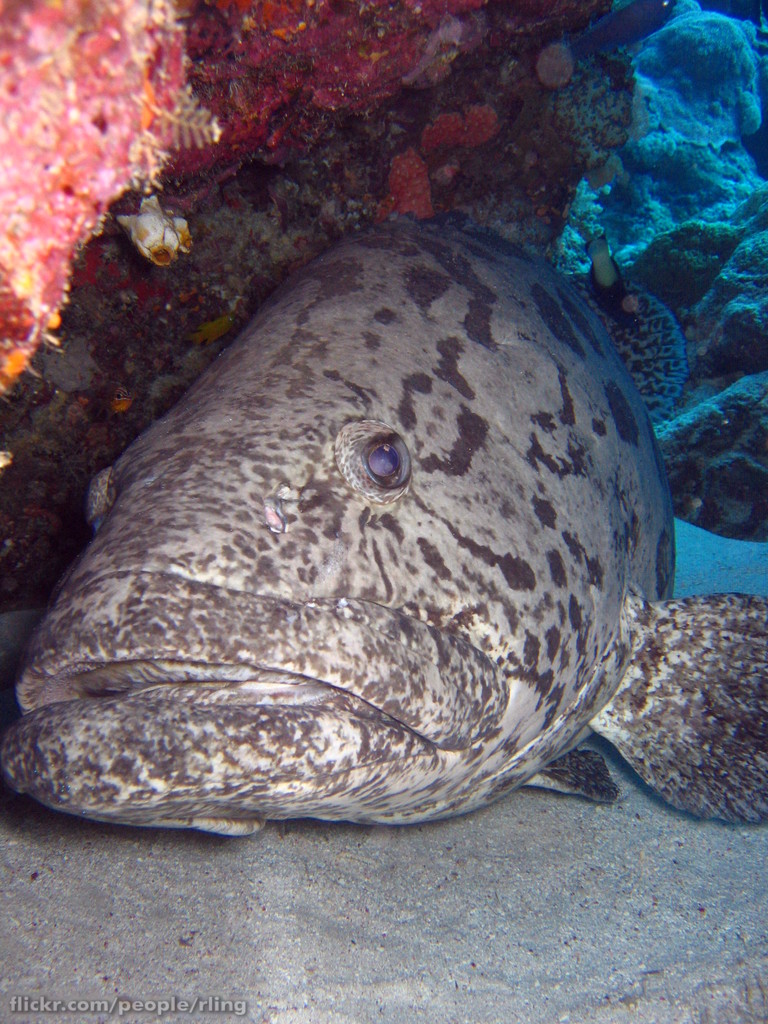 Potato GrouperEpinephelus tukula
-
 Pacific Goliath GrouperEpinephelus quinquefasciatus
-
 Orange-spotted GrouperEpinephelus coioides
Compare
Questions and answers
What is the scientific name of the Brown-marbled Grouper?
The scientific name of the Brown-marbled Grouper is Epinephelus fuscoguttatus. Written with its author, the full name is Epinephelus fuscoguttatus (Forsskål, 1775).
Which family does the Brown-marbled Grouper belong to?
Epinephelus fuscoguttatus belongs to the family Epinephelidae, in the order Perciformes and the class Teleostei.
Where is the Brown-marbled Grouper found?
Checklists and occurrence records place Epinephelus fuscoguttatus in 36 countries, including Australia, Indonesia, New Caledonia, Philippines, China and Palau.
What is the conservation status of the Brown-marbled Grouper?
The IUCN Red List category recorded for Epinephelus fuscoguttatus is Vulnerable (VU).
What other names does the Brown-marbled Grouper have?
Epinephelus fuscoguttatus is also known in English as Black Rock-cod, Brownmarbled Grouper, Carpet Cod, Carpet-cod, Flower Cod and Flower Grouper.
What is the diet of a grouper?
The Brown-marbled Grouper is carnivorous and feeds mainly on fishes, crustaceans and cephalopods.[11]
What is the habitat of a grouper?
The Brown-marbled Grouper inhabits clear, productive waters near coral reefs and rocky reefs, including lagoons and external reef slopes. It occurs from the surface to depths of 60 metres.[8][9][10]
Is a grouper a carnivore?
The Brown-marbled Grouper is carnivorous and feeds mainly on fishes, crustaceans and cephalopods.[11]
Sources
Passages the profile rests on
- The species has a stocky, robust body that is laterally compressed and a head with a sharp profile. Source passage: “Its body has a stocky and robust aspect, is compressed laterally, and has a sharp profile for the head.” — English Wikipedia
- Its background coloration is pale yellowish-brown with irregular dark brown or grey blotches. Source passage: “The background coloration is pale yellowish-brown with many dark brown or grey blotches that are irregular in size and shape.” — English Wikipedia
- The body is covered with numerous small, dark brown spots. Source passage: “The body is also covered with many small, dark brown spots.” — English Wikipedia
- All fins are large and rounded. Source passage: “All the fins are large and round.” — English Wikipedia
- The species has a large, upward-positioned mouth with numerous small teeth and anterior canines. Source passage: “The mouth is big and has a superior position with many small teeth and canines in front.” — English Wikipedia
- A small black saddle on the upper caudal peduncle is a distinguishing characteristic of this species. Source passage: “a small black saddle on the top of the caudal peduncle” — English Wikipedia
- The species has a notch above the eyes when viewed from the side. Source passage: “when observed on the side a notch above the eyes” — English Wikipedia
- The species inhabits clear, productive waters near coral reefs and rocky reefs. Source passage: “lives in rich clear waters close to coral or rocky reefs” — English Wikipedia
- Its habitats include lagoons and external reef slopes. Source passage: “coral or rocky reefs, lagoons, and external slopes” — English Wikipedia
- The species occurs from the surface to depths of 60 metres. Source passage: “from the surface until 60 metres (200 ft) depth.” — English Wikipedia
- The species is carnivorous and feeds mainly on fishes, crustaceans and cephalopods. Source passage: “The brown-marbled grouper is carnivorous and its diet consists mainly in fishes, crustaceans and cephalopods.” — English Wikipedia
- The species is solitary and sedentary. Source passage: “This grouper is solitary and sedentary;” — English Wikipedia
- The species defends a clearly defined territory. Source passage: “it defends a well-defined territory” — English Wikipedia
- The species is benthic and nocturnal. Source passage: “benthic, and is nocturnal” — English Wikipedia
- The species hunts by ambushing its prey. Source passage: “It is an ambush predator.” — English Wikipedia
- Its activity reaches its maximum around sunrise and sunset. Source passage: “with activity maximal at sunrise and/or at sunset.” — English Wikipedia
- The species is a protogynous hermaphrodite, with females capable of changing into males during their lifetime. Source passage: “It is a protogynous hermaphrodite, which means the female can evolve into a male during its life.” — English Wikipedia
- The species forms spawning aggregations at particular times and locations during mating periods. Source passage: “Especially during mating periods at specific times and places, the brown-marbled grouper forms spawning aggregations” — English Wikipedia
- The species has been classified as Vulnerable on the IUCN Red List since 2004. Source passage: “The brown-marbled grouper has been listed as "Vulnerable" on the IUCN Red List of Threatened Species since 2004.” — English Wikipedia
- The species is particularly vulnerable to overfishing because of its biological characteristics. Source passage: “its biological characteristics make this species particularly vulnerable to over-fishing.” — English Wikipedia
- The species is expected to live for at least 40 years. Source passage: “It has a quite long life span for a fish and is expected to live until at least 40 years old.” — English Wikipedia
- Its long lifespan and low population density on natural reefs contribute to slow population regeneration. Source passage: “The long life span of this grouper and its low population density in reefs in the wild result in a weak and slow population regeneration capacity.” — English Wikipedia
- Fishing highly fertile female breeders can reduce their contribution to maintaining the proportion of young fish in the population. Source passage: “over-fishing female breeders that are highly fertile and would not be able to actively contribute to maintaining the proportion of young in the population.” — English Wikipedia
- The species has substantial commercial value in the live food fish trade because of its size and hardiness. Source passage: “Because of its size and hardiness, this species has a high commercial interest in the live food fish trade.” — English Wikipedia
- Epinephelus polyphekadion is a close relative with which the brown-marbled grouper can be confused. Source passage: “The brown-marbled grouper can be easily confused with its close relative Epinephelus polyphekadion.” — English Wikipedia
- Differences between the brown-marbled grouper and Epinephelus polyphekadion are more apparent in adult specimens. Source passage: “The differences are more obvious in adult specimens.” — English Wikipedia
Data
- Catalogue of Life, 2026-10-16 XR cc by
- Global Biodiversity Information Facility CC BY 4.0
- Wikidata CC0
- GeoNames CC BY 4.0
- Wikimedia Commons per image; credit shown with each image
- Within the Catalogue of Life, this name comes from World Register of Marine Species cc by
This species in other databases
- Catalogue of Life 6G5NL
- Wikidata Q1239958
- iNaturalist 56559
- WoRMS urn:lsid:marinespecies.org:taxname:218218
- ITIS 167711
Page built on 29 November 2026. See how the catalog is made and all sources and licences.
Cite this page
ScientificNames.org. (2026). Epinephelus fuscoguttatus (Brown-marbled Grouper). Retrieved November 29, 2026, from https://scientificnames.org/species/epinephelus-fuscoguttatus
“Epinephelus fuscoguttatus (Brown-marbled Grouper).” ScientificNames.org, 2026, scientificnames.org/species/epinephelus-fuscoguttatus. Accessed 29 Nov. 2026.
ScientificNames.org. “Epinephelus fuscoguttatus (Brown-marbled Grouper).” Accessed November 29, 2026. https://scientificnames.org/species/epinephelus-fuscoguttatus.
@misc{scientificnames_epinephelus_fuscoguttatus_brown_marbled_grouper,
  author = {{ScientificNames.org}},
  title = {Epinephelus fuscoguttatus (Brown-marbled Grouper)},
  year = {2026},
  url = {https://scientificnames.org/species/epinephelus-fuscoguttatus},
  note = {Accessed 2026-11-29}
}