Species · Fishes
Highfin Grouper Epinephelus maculatus
The scientific name of the Highfin Grouper is Epinephelus maculatus. It is a species of fish in the family Epinephelidae (groupers), order Perciformes. The name dates from 1790.
- Scientific name
- Epinephelus maculatus (Bloch, 1790)
- Common name
- Highfin Grouper
- Genus
- Epinephelus
- Family
- Epinephelidae (Groupers)
- Order
- Perciformes
- Class
- Teleostei
- Red List category
- LC Least Concern
- Environment
- marine
- Recorded in
- 26 countries
- Name status
- accepted in the Catalogue of Life

Overview
Epinephelus maculatus occurs in the eastern Indian Ocean and western Pacific Ocean, from the Cocos (Keeling) Islands eastward to Micronesia and Samoa, south to Australia and north to Japan's Ryukyu and Ogasawara Islands. Adults measuring 25–45 centimetres long have regularly spaced brown spots forming hexagonal patterns on the head and body.
Written 26 November 2026 from the sources listed below. Each statement was checked against the passage it cites; statements that could not be supported were removed.
Appearance
The body has a standard length 2.8 to 3.1 times its depth. The dorsal profile of the head is convex, while the area between the eyes is flat or slightly convex.[1][2]
The preopercle has a notch above its angle, where enlarged serrations are present. The dorsal fin has 11 spines and 15–17 soft rays, and is tallest in its anterior spiny section.[3][4][5]
The anal fin has 3 spines and 8 soft rays. The caudal fin is convex or rounded.[6][7]
Juveniles initially have black coloration with white blotches and develop spots as they grow. Adults measuring 25–45 centimetres long have regularly spaced brown spots forming hexagonal patterns on the head and body.[8][9]
The maximum published total length is 60.5 centimetres.[10]
Habitat
The highfin grouper inhabits coastal and offshore coral and rocky reefs at depths of 2–100 metres. It frequently occurs over open sand near the bases of reefs.[11][12]
Juveniles have been recorded in shallow coral rubble.[13]
Diet
Its main prey consists of small fish, crabs and octopuses.[14]
Behaviour
The species is generally solitary outside spawning aggregations. Individuals have been observed moving between reefs over distances of at least 5–10 kilometres.[15][16]
Compared with other groupers, the highfin grouper has a fast growth rate and high population turnover rate.[17]
Reproduction and life cycle
Females reach maturity at approximately 2.8 years of age, while males reach maturity at approximately 4 years of age.[18][19]
Uses
The species is mainly harvested by subsistence and artisanal fisheries. It is not generally considered as valuable as other grouper species.[20][21]
The highfin grouper is traded in Hong Kong's live food market. In Indonesia, it is caught using hook and line, spears and traps.[22][23]
Similar species
The highfin grouper belongs to a group of related Epinephelus species known as reticulated coral groupers. Other members include Epinephelus bilobatus, E. faveatus, E. hexagonatus, E. macrospilos, E. melanostigma, E. merra, E. quoyanus and E. spilotoceps.[24][25]
Members of this related species group have frequently been confused with one another, resulting in museum specimen misidentifications.[26]
Classification of the Highfin Grouper
| Kingdom | Animalia |
|---|---|
| Phylum | Chordata |
| Subphylum | Vertebrata |
| Infraphylum | Gnathostomata |
| Parvphylum | Osteichthyes |
| Gigaclass | Actinopterygii |
| Superclass | Actinopteri |
| Class | Teleostei (Teleost) |
| Order | Perciformes |
| Suborder | Percoidei |
| Family | Epinephelidae (Groupers) |
| Genus | Epinephelus (Groupers) |
| Species | Epinephelus maculatus (Bloch, 1790) |
Where the Highfin Grouper is found
Checklists and occurrence records place Epinephelus maculatus in 26 countries. GBIF holds 1,535 georeferenced records of it.
Countries
- American Samoa 5
- Australia 685
- China 26
- Cocos Islands 3
- Fiji 73
- French Polynesia 21
- Guam 3
- Hong Kong 5
- India 4
- Indonesia 90
- Japan 177
- Kiribati 13
- Marshall Islands 46
- Micronesia 4
- New Caledonia 180
- Northern Mariana Islands 23
- Palau 6
- Papua New Guinea 13
- Philippines 34
- Solomon Islands 29
- Taiwan 15
- Timor Leste 7
- Tonga 41
- Tuvalu 16
- Vanuatu 13
- Wallis and Futuna 3
Regions and cities with the most records
- Nouméa, New Caledonia 48
- Queensland, Australia 33
- Mont-Dore, New Caledonia 25
- Dumbéa, New Caledonia 20
- New South Wales, Australia 20
- Amlapura, Indonesia 12
- Amlapura city, Indonesia 12
- Bedugul, Indonesia 12
- Bitung, Indonesia 12
- Gold Coast, Australia 10
- Ambon, Indonesia 9
- Northern Islands, Northern Mariana Islands 8
- Bali, Indonesia 7
- Keelung, Taiwan 7
- Labuan Bajo, Indonesia 7
- Batubulan, Indonesia 5
- Benoa, Indonesia 5
- Dalung, Indonesia 5
- Denpasar, Indonesia 5
- Gushikawa, Japan 5
- Ishikawa, Japan 5
- Katsuren-haebaru, Japan 5
- Kuta, Indonesia 5
- Manado, Indonesia 5
- Port-Vila, Vanuatu 5
- Tuban, Indonesia 5
- Uruma, Japan 5
- Dili, Timor Leste 4
- Okinawa, Japan 4
- Temotu Province, Solomon Islands 4
- Vavau, Tonga 4
- Amami, Japan 3
- Bauan, Philippines 3
- Hagåtña, Guam 3
- Hengchun, Taiwan 3
- Mangilao Village, Guam 3
3 more countries have a few records outside this range
These countries hold a few records of Epinephelus maculatus but lie outside the range the checklists give for it. Such records are often zoo or garden specimens, museum material or vagrants, so the species is not counted as occurring there.
A number beside a place is its count of GBIF occurrence records. A place without a number comes from a checklist alone. Records show where a species has been observed or collected, which can include escapes and vagrants.
Common names
English
- Highfin Grouper
- Blackfin Cod
- Bloch's Rockcod
- Brown-spotted Rock-cod
- Marbled Rock-cod
- Marbled Rockcod
- Marnbled Rock Cod
- Rock Cod
- Spotted Rockcod
- Spotty Cod
- Trout Cod
Names in 21 other languages
- Cebuano
- Pugapo
- Chinese
- Cheung-gig-paan, 石斑, 花点石斑鱼, 花鱠, 花點石斑魚, 過魚, 鱠仔
- Finnish
- purjemeriahven
- French
- Grisette, Loche De Sable, Loche Grisette, Loche Uitoe, Merou Haute Voile, Mérou haute voile
- German
- Hochflossen-Zackenbarsch
- Japanese
- Shirobuchihata, シロブチハタ
- Kannada
- Kolaji
- Malayalam
- Kolamin, Pulli Kalawa, കലവ മീന്, കൊലമീന്
- Marathi
- Gobra, Hekaru, गोबरा, हीकरू
- Portuguese
- Garoupa-de-Cocos-Keeling
- Spanish
- Mero Aleta Alta
- Tagalog
- Lapu Lapu
- Tamil
- Kalava
- Telugu
- Bontoo
- Vietnamese
- Ca Song Mac
- agn
- Bulang
- bik
- Baraka
- ilo
- Kurapu
- mah
- Lejibjib
- sam
- Gatala-puleuli
- war
- Bantulon, Lapu-lapu, Tingag
Synonyms
8 other scientific names have been used for this species and are now treated as synonyms of Epinephelus maculatus.
- Epinephelus maculates (Bloch, 1790)
- Epinephelus medurensis (Günther, 1873)
- Holocentrus albo-fuscus Lacepède, 1802
- Holocentrus albofuscus Lacepède, 1802
- Holocentrus maculatus Bloch, 1790
- Plectropoma kulas Thiollière, 1857
- Serranus medurensis Günther, 1873
- Serranus sebae Bleeker, 1854
Related species
-
 Atlantic Goliath GrouperEpinephelus itajara
-
 Giant GrouperEpinephelus lanceolatus
-
 Dusky GrouperEpinephelus marginatus
-
 Nassau GrouperEpinephelus striatus
-
 Red GrouperEpinephelus morio
-
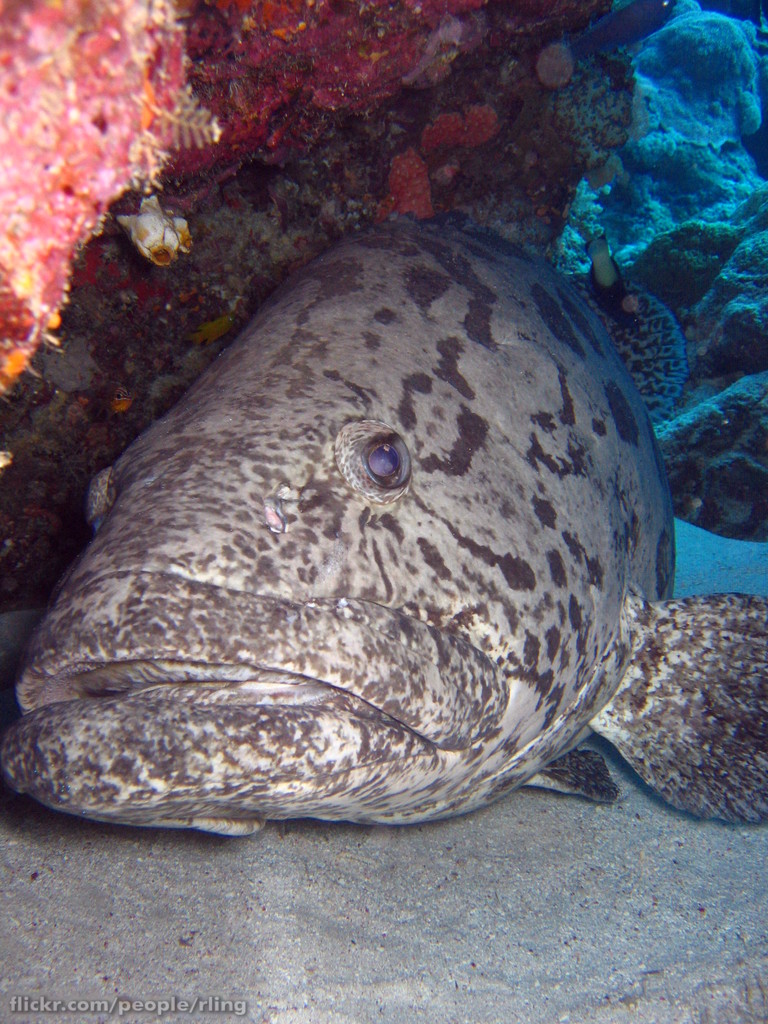 Potato GrouperEpinephelus tukula
-
 Pacific Goliath GrouperEpinephelus quinquefasciatus
-
 Orange-spotted GrouperEpinephelus coioides
Compare
Questions and answers
What is the scientific name of the Highfin Grouper?
The scientific name of the Highfin Grouper is Epinephelus maculatus. Written with its author, the full name is Epinephelus maculatus (Bloch, 1790).
Which family does the Highfin Grouper belong to?
Epinephelus maculatus belongs to the family Epinephelidae, in the order Perciformes and the class Teleostei.
Where is the Highfin Grouper found?
Checklists and occurrence records place Epinephelus maculatus in 26 countries, including Australia, New Caledonia, Japan, Indonesia, Fiji and Marshall Islands.
What is the conservation status of the Highfin Grouper?
The IUCN Red List category recorded for Epinephelus maculatus is Least Concern (LC).
What other names does the Highfin Grouper have?
Epinephelus maculatus is also known in English as Blackfin Cod, Bloch's Rockcod, Brown-spotted Rock-cod, Marbled Rock-cod, Marbled Rockcod and Marnbled Rock Cod.
What do grouper fish eat?
The highfin grouper's main prey consists of small fish, crabs and octopuses.[14]
What is the habitat of a grouper?
The highfin grouper inhabits coastal and offshore coral and rocky reefs at depths of 2–100 metres. It frequently occurs over open sand near the bases of reefs.[11][12]
What grouper can you not eat?
The flesh of the highfin grouper may be toxic in some regions because of ciguatoxins.[27]
Sources
Passages the profile rests on
- The body has a standard length 2.8 to 3.1 times its depth. Source passage: “Epinephelus maculatus has a body with a standard length which is 2.8 to 3.1 times its depth.” — English Wikipedia
- The dorsal profile of the head is convex, while the area between the eyes is flat or slightly convex. Source passage: “The dorsal profile of the head is convex and the area between the eyes is either flat or marginally convex.” — English Wikipedia
- The preopercle has a notch above its angle, where enlarged serrations are present. Source passage: “The preopercle has a notch above the angle where there are enlarged serrations.” — English Wikipedia
- The dorsal fin has 11 spines and 15–17 soft rays. Source passage: “The dorsal fin contains 11 spines and 15-17 soft rays” — English Wikipedia
- The dorsal fin is tallest in its anterior spiny section. Source passage: “The dorsal fin is highest in its anterior spiny part” — English Wikipedia
- The anal fin has 3 spines and 8 soft rays. Source passage: “the anal fin has 3 spines and 8 soft rays.” — English Wikipedia
- The caudal fin is convex or rounded. Source passage: “The caudal fin is convex or rounded.” — English Wikipedia
- The head and body have regularly spaced brown spots that form hexagonal patterns in adults measuring 25–45 centimetres long. Source passage: “The head and body are covered with regularly spaced brown spots which group into hexagonal shapes on adults of lengths between 25 and 45 centimetres” — English Wikipedia
- Juveniles initially have black coloration with white blotches and develop spots as they grow. Source passage: “The juveniles are initially black with blotched with white and as they grow they develops their spots.” — English Wikipedia
- The maximum published total length is 60.5 centimetres. Source passage: “This species has a maximum published total length of 60.5 centimetres (23.8 in).” — English Wikipedia
- The species inhabits coastal and offshore coral and rocky reefs at depths of 2–100 metres. Source passage: “Epinephelus maculatus is found on coastal and offshore coral and rocky reefs at depths from 2 to 100 metres (6.6 to 328.1 ft)” — English Wikipedia
- It frequently occurs over open sand near the bases of reefs. Source passage: “frequently occurring over open sand near the base of these reefs.” — English Wikipedia
- Juveniles have been recorded in shallow coral rubble. Source passage: “The juveniles have been recorded from shallow coral rubble.” — English Wikipedia
- Its main prey consists of small fish, crabs and octopuses. Source passage: “It is a predatory species which preys mainly on small fish, crabs and octopuses.” — English Wikipedia
- Individuals have been observed moving between reefs over distances of at least 5–10 kilometres. Source passage: “They have been observed moving between reefs and undertaking journeys of at least 5 to 10 kilometres (3.1 to 6.2 miles).” — English Wikipedia
- The species is generally solitary outside spawning aggregations. Source passage: “They may for spawning aggregations, otherwise solitary.” — English Wikipedia
- Compared with other groupers, the species has a fast growth rate and high population turnover rate. Source passage: “Compared with other groupers this is a species which has a fast growth rate and a high population turnover rate.” — English Wikipedia
- Females reach maturity at approximately 2.8 years of age. Source passage: “females mature at 2,8 years old” — English Wikipedia
- Males reach maturity at approximately 4 years of age. Source passage: “while males are mature at 4 years old.” — English Wikipedia
- The species is mainly harvested by subsistence and artisanal fisheries. Source passage: “Epinephelus maculatus is mainly taken by subsistence and artisanal fisheries” — English Wikipedia
- It is not generally considered as valuable as other grouper species. Source passage: “is not normally regarded as being as valuable as other species of grouper.” — English Wikipedia
- The species is traded in Hong Kong's live food market. Source passage: “It does appear in the Hong Kong live food market.” — English Wikipedia
- In Indonesia, it is caught using hook and line, spears and traps. Source passage: “In Indonesia it is caught using hook and line, spears and traps.” — English Wikipedia
- The species belongs to a group of related Epinephelus species known as reticulated coral groupers. Source passage: “This species is one of a group of related members of the genus Epinephelus known as "reticulated coral groupers"” — English Wikipedia
- Other members of its reticulated coral grouper group include Epinephelus bilobatus, E. faveatus, E. hexagonatus, E. macrospilos, E. melanostigma, E. merra, E. quoyanus and E. spilotoceps. Source passage: “along with E. bilobatus, E. faveatus, E. hexagonatus, E. macrospilos, E. melanostigma, E. merra, E. quoyanus and E. spilotoceps.” — English Wikipedia
- Members of this related species group have frequently been confused with one another, resulting in museum specimen misidentifications. Source passage: “These species have frequently been mistaken for each other and as a result many specimens in museums have been misidentified.” — English Wikipedia
- The flesh may be toxic in some regions because of ciguatoxins. Source passage: “In some regions the flesh may be toxic due to the presence ciguatoxins.” — English Wikipedia
Data
- Catalogue of Life, 2026-10-16 XR cc by
- Global Biodiversity Information Facility CC BY 4.0
- Wikidata CC0
- GeoNames CC BY 4.0
- Wikimedia Commons per image; credit shown with each image
- Within the Catalogue of Life, this name comes from World Register of Marine Species cc by
This species in other databases
- Catalogue of Life 6G5QJ
- Wikidata Q2199367
- iNaturalist 100116
- WoRMS urn:lsid:marinespecies.org:taxname:273860
- ITIS 167720
Page built on 29 November 2026. See how the catalog is made and all sources and licences.
Cite this page
ScientificNames.org. (2026). Epinephelus maculatus (Highfin Grouper). Retrieved November 29, 2026, from https://scientificnames.org/species/epinephelus-maculatus
“Epinephelus maculatus (Highfin Grouper).” ScientificNames.org, 2026, scientificnames.org/species/epinephelus-maculatus. Accessed 29 Nov. 2026.
ScientificNames.org. “Epinephelus maculatus (Highfin Grouper).” Accessed November 29, 2026. https://scientificnames.org/species/epinephelus-maculatus.
@misc{scientificnames_epinephelus_maculatus_highfin_grouper,
  author = {{ScientificNames.org}},
  title = {Epinephelus maculatus (Highfin Grouper)},
  year = {2026},
  url = {https://scientificnames.org/species/epinephelus-maculatus},
  note = {Accessed 2026-11-29}
}