Species · Fishes
Malabar Grouper Epinephelus malabaricus
The scientific name of the Malabar Grouper is Epinephelus malabaricus. It is a species of fish in the family Epinephelidae (groupers), order Perciformes. The name dates from 1801.
- Scientific name
- Epinephelus malabaricus (Bloch & Schneider, 1801)
- Common name
- Malabar Grouper
- Genus
- Epinephelus
- Family
- Epinephelidae (Groupers)
- Order
- Perciformes
- Class
- Teleostei
- Red List category
- LC Least Concern
- Environment
- brackish, marine
- Recorded in
- 31 countries
- Name status
- accepted in the Catalogue of Life

Overview
Epinephelus malabaricus has a light grey to light brownish body with dark brown spots, brown diagonal stripes, and a rounded tail fin.
Written 26 November 2026 from the sources listed below. Each statement was checked against the passage it cites; statements that could not be supported were removed.
Appearance
The body background colour ranges from light grey to light brownish. Randomly distributed dark brown spots increase in number as the fish ages, and the body displays varying numbers of brown diagonal stripes.[1][2][3]
Young individuals have broad, broken, darker vertical bands across their bodies and numerous brown spots. As the fish reaches maturity, its body becomes a uniform darker colour.[4][5][6]
The species has a rounded tail fin.[7]
Habitat
The Malabar Grouper inhabits lagoons, mangroves, coral reefs, rocky reefs, and areas with sandy or muddy bottoms. It occurs at depths ranging from 2 to 150 metres.[8][9]
Juveniles prefer lagoon environments or brackish-water areas.[10]
The species occurs across tropical Indo-West Pacific waters, extending from the eastern coast of Africa to the Tonga Islands and including the Red Sea. It was first recorded in the eastern Mediterranean Sea in 1969, where it remains extremely rare.[11][12]
Diet
The Malabar Grouper feeds on fish, crustaceans, and occasionally cephalopods.[13]
Behaviour
The species is described as a voracious predator.[14]
Uses
The species is harvested for human food, sport fishing, and commercial purposes. Some individuals are raised through aquaculture.[15][16][17]
Conservation
The species has an estimated median population doubling time of 4.5 to 14 years and a reported moderate vulnerability score of 40 out of 100.[18][19]
Classification of the Malabar Grouper
| Kingdom | Animalia |
|---|---|
| Phylum | Chordata |
| Subphylum | Vertebrata |
| Infraphylum | Gnathostomata |
| Parvphylum | Osteichthyes |
| Gigaclass | Actinopterygii |
| Superclass | Actinopteri |
| Class | Teleostei (Teleost) |
| Order | Perciformes |
| Suborder | Percoidei |
| Family | Epinephelidae (Groupers) |
| Genus | Epinephelus (Groupers) |
| Species | Epinephelus malabaricus (Bloch & Schneider, 1801) |
Where the Malabar Grouper is found
Checklists and occurrence records place Epinephelus malabaricus in 31 countries. GBIF holds 1,643 georeferenced records of it.
Countries
- Australia 470
- China 8
- Egypt 19
- Eritrea 5
- Fiji 19
- Hong Kong 3
- India 54
- Indonesia 62
- Israel 4
- Japan 96
- Kenya 19
- Madagascar 17
- Malaysia 16
- Mayotte 5
- Mozambique 518
- Myanmar 3
- New Caledonia 73
- Oman 5
- Palau 6
- Philippines 40
- Reunion 3
- Seychelles 4
- Singapore 14
- Solomon Islands 4
- South Africa 39
- Sri Lanka 15
- Taiwan 72
- Tanzania 13
- Thailand 9
- Tonga 9
- Vietnam 19
Regions and cities with the most records
- Inhambane, Mozambique 128
- Vilankulo, Mozambique 127
- Maxixe, Mozambique 117
- Queensland, Australia 68
- Western Australia, Australia 29
- New South Wales, Australia 21
- Magong, Taiwan 15
- Nouméa, New Caledonia 14
- Taiwan, Taiwan 14
- Townsville, Australia 14
- Mont-Dore, New Caledonia 12
- Andaman and Nicobar, India 9
- Darwin, Australia 9
- Durban, South Africa 9
- KwaZulu-Natal, South Africa 9
- Ntuzuma, South Africa 9
- Pinetown, South Africa 9
- Port Blair, India 9
- Northern Territory, Australia 8
- Palmerston, Australia 8
- Keelung, Taiwan 7
- Labuan Bajo, Indonesia 7
- Nha Trang, Vietnam 7
- Ciputat, Indonesia 6
- Dumbéa, New Caledonia 6
- Eastern Cape, South Africa 6
- Jakarta, Indonesia 6
- Kagoshima, Japan 6
- Núi Thành, Vietnam 6
- Pebane, Mozambique 6
- South Tangerang, Indonesia 6
- Utan, Indonesia 6
- Caloundra, Australia 5
- Chaozhou, Taiwan 5
- Donggang, Taiwan 5
- Kochi, India 5
A number beside a place is its count of GBIF occurrence records. A place without a number comes from a checklist alone. Records show where a species has been observed or collected, which can include escapes and vagrants.
Common names
English
- Malabar Grouper
- Blackspot Cod
- Blackspotted Rockcod
- Estuary Cod
- Estuary Rock-cod
- Malabar Cod
- Malabar Rock-cod
- Malabar Rockcod
- Morgan's Cod
Names in 27 other languages
- Arabic
- Hamour, هامور مليبار
- Cebuano
- Pugapo
- Chinese
- 來貓, 厲麻, 瑪拉巴石斑魚, 石斑, 虎麻, 過魚, 馬拉巴
- Czech
- kanic malabarský
- Danish
- Malabar-havaborre
- Dutch
- Malabar Tandbaars
- Finnish
- usvameriahven
- French
- Grand gueule, Mère loche, Mérou Malabare, Mérou de Malabar, Mérou malabar
- German
- Malabar-Zackenbarsch
- Gujarati
- Wekhali, Wekhru
- Hebrew
- דקר דו-ימי, דקר מלברי
- Indonesian
- Kerapu lumpur
- Japanese
- ヤイトハタ
- Malay
- Kerapu hitam, Kertang
- Marathi
- Gobra, Hekaru, Hekru, गोबरा, हीकरू
- Polish
- granik malabarski
- Portuguese
- Garoupa-do-Malabar
- Spanish
- Mero Malabárico, Mero de Malabar
- Tamil
- Kalava
- Telugu
- Bontoo
- Thai
- ปลากะรังน้ำกร่อย
- agn
- Bulang
- bik
- Inid
- cbk
- Mantis
- ilo
- Kurapu
- sgd
- Lapu-lapu
- war
- Tingag
Synonyms
14 other scientific names have been used for this species and are now treated as synonyms of Epinephelus malabaricus.
- Cephalopholis malabaricus (Bloch & Schneider, 1801)
- Epinephalus malabaricus (Bloch & Schneider, 1801)
- Epinephelus cylindricus Postel, 1965
- Epinephelus malabrica (Bloch & Schneider, 1801)
- Epinephelus salmoides (Lacepède, 1802)
- Epinephelus salmonoides (Valenciennes, 1828)
- Holocentrus malabaricus Bloch & Schneider, 1801
- Holocentrus salmoides Lacepède, 1802
- Serranus crapao Cuvier, 1829
- Serranus estuarius MacLeay, 1883
- Serranus polypodophilus Bleeker, 1849
- Serranus salmonoides Valenciennes, 1828
- Serranus semi-punctatus Valenciennes, 1828
- Serranus semipunctatus Valenciennes, 1828
Related species
-
 Atlantic Goliath GrouperEpinephelus itajara
-
 Giant GrouperEpinephelus lanceolatus
-
 Dusky GrouperEpinephelus marginatus
-
 Nassau GrouperEpinephelus striatus
-
 Red GrouperEpinephelus morio
-
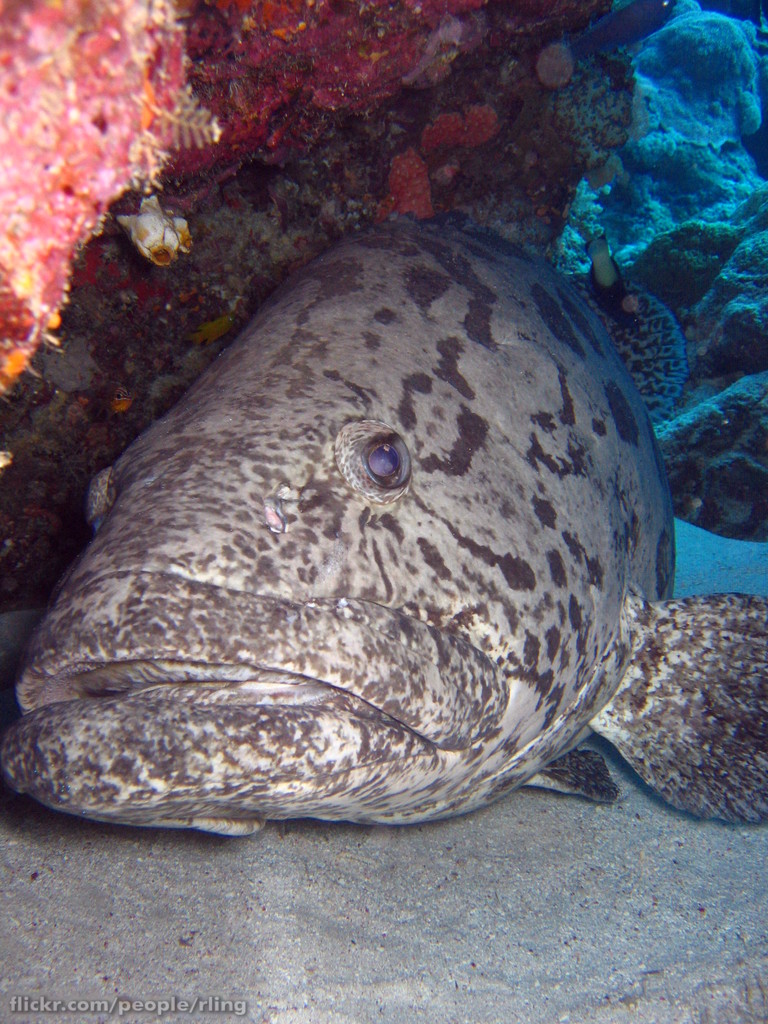 Potato GrouperEpinephelus tukula
-
 Pacific Goliath GrouperEpinephelus quinquefasciatus
-
 Orange-spotted GrouperEpinephelus coioides
Compare
Questions and answers
What is the scientific name of the Malabar Grouper?
The scientific name of the Malabar Grouper is Epinephelus malabaricus. Written with its author, the full name is Epinephelus malabaricus (Bloch & Schneider, 1801).
Which family does the Malabar Grouper belong to?
Epinephelus malabaricus belongs to the family Epinephelidae, in the order Perciformes and the class Teleostei.
Where is the Malabar Grouper found?
Checklists and occurrence records place Epinephelus malabaricus in 31 countries, including Mozambique, Australia, Japan, New Caledonia, Taiwan and Indonesia.
What is the conservation status of the Malabar Grouper?
The IUCN Red List category recorded for Epinephelus malabaricus is Least Concern (LC).
What other names does the Malabar Grouper have?
Epinephelus malabaricus is also known in English as Blackspot Cod, Blackspotted Rockcod, Estuary Cod, Estuary Rock-cod, Malabar Cod and Malabar Rock-cod.
What do grouper fish eat?
The Malabar Grouper feeds on fish, crustaceans, and occasionally cephalopods.[13]
Sources
Passages the profile rests on
- The body background colour ranges from light grey to light brownish. Source passage: “It has a light grey to light brownish background color” — English Wikipedia
- The body bears randomly distributed dark brown spots that increase in number as the fish ages. Source passage: “with a number of dark brown spots randomly scattered, which increase in number with age.” — English Wikipedia
- The body also displays varying numbers of brown diagonal stripes. Source passage: “The body has also a various number of brown diagonal stripes.” — English Wikipedia
- Young individuals have broad, broken, darker vertical bands across their bodies. Source passage: “Younger fish have a number of wide, broken vertical bands of darker shade across their bodies” — English Wikipedia
- The body becomes a uniform darker colour as the fish reaches maturity. Source passage: “but in maturity they seem to become a uniform darker colour.” — English Wikipedia
- Young individuals have numerous brown spots. Source passage: “Young fish have numerous brown spots.” — English Wikipedia
- The species has a rounded tail fin. Source passage: “The tail fin is rounded.” — English Wikipedia
- The species inhabits lagoons, mangroves, coral reefs, rocky reefs, and areas with sandy or muddy bottoms. Source passage: “This grouper lives in various habitats, such as lagoons, mangroves, coral and rocky reefs, sandy and muddy bottom areas” — English Wikipedia
- The species occurs at depths ranging from 2 to 150 metres. Source passage: “between 2 and 150 m deep.” — English Wikipedia
- Juveniles prefer lagoon environments or brackish-water areas. Source passage: “The juveniles prefers lagoon or brackish areas.” — English Wikipedia
- The species occurs across tropical Indo-West Pacific waters, extending from the eastern coast of Africa to the Tonga Islands and including the Red Sea. Source passage: “from the eastern coast of Africa to the Tonga Islands, Red Sea included.” — English Wikipedia
- The species was first recorded in the eastern Mediterranean Sea in 1969, where it remains extremely rare. Source passage: “It was first recorded in the eastern Mediterranean Sea in 1969 where it remains extremely rare.” — English Wikipedia
- The species feeds on fish, crustaceans, and occasionally cephalopods. Source passage: “they feed on fish, crustaceans, and occasionally, cephalopods.” — English Wikipedia
- The species is described as a voracious predator. Source passage: “Malabar grouper are voracious predators” — English Wikipedia
- The species is harvested for human food. Source passage: “Malabar groupers are harvested for food” — English Wikipedia
- The species is harvested for sport fishing and commercial purposes. Source passage: “sport, and commercially” — English Wikipedia
- Some individuals of the species are raised through aquaculture. Source passage: “some are grown in aquaculture.” — English Wikipedia
- The species has an estimated median population doubling time of 4.5 to 14 years. Source passage: “Low, minimum population doubling time 4.5 - 14 years” — fishbase.se
- The species has a reported moderate vulnerability score of 40 out of 100. Source passage: “Moderate vulnerability (40 of 100).” — fishbase.se
Data
- Catalogue of Life, 2026-10-16 XR cc by
- Global Biodiversity Information Facility CC BY 4.0
- Wikidata CC0
- GeoNames CC BY 4.0
- Wikimedia Commons per image; credit shown with each image
- Within the Catalogue of Life, this name comes from World Register of Marine Species cc by
This species in other databases
- Catalogue of Life 6FTQD
- Wikidata Q1824230
- iNaturalist 100118
- WoRMS urn:lsid:marinespecies.org:taxname:218206
- ITIS 551076
Page built on 27 November 2026. See how the catalog is made and all sources and licences.
Cite this page
ScientificNames.org. (2026). Epinephelus malabaricus (Malabar Grouper). Retrieved November 27, 2026, from https://scientificnames.org/species/epinephelus-malabaricus
“Epinephelus malabaricus (Malabar Grouper).” ScientificNames.org, 2026, scientificnames.org/species/epinephelus-malabaricus. Accessed 27 Nov. 2026.
ScientificNames.org. “Epinephelus malabaricus (Malabar Grouper).” Accessed November 27, 2026. https://scientificnames.org/species/epinephelus-malabaricus.
@misc{scientificnames_epinephelus_malabaricus_malabar_grouper,
  author = {{ScientificNames.org}},
  title = {Epinephelus malabaricus (Malabar Grouper)},
  year = {2026},
  url = {https://scientificnames.org/species/epinephelus-malabaricus},
  note = {Accessed 2026-11-27}
}