Species · Flowering plants
Dark Red Helleborine Epipactis atrorubens
The scientific name of the Dark Red Helleborine is Epipactis atrorubens. It is a species of flowering plant in the family Orchidaceae (orchid), order Asparagales.
- Scientific name
- Epipactis atrorubens (Hoffm.) Besser
- Common name
- Dark Red Helleborine
- Genus
- Goodyera
- Family
- Orchidaceae (Orchid)
- Order
- Asparagales
- Class
- Liliopsida
- Recorded in
- 37 countries
- Name status
- provisionally accepted in the Catalogue of Life
Overview
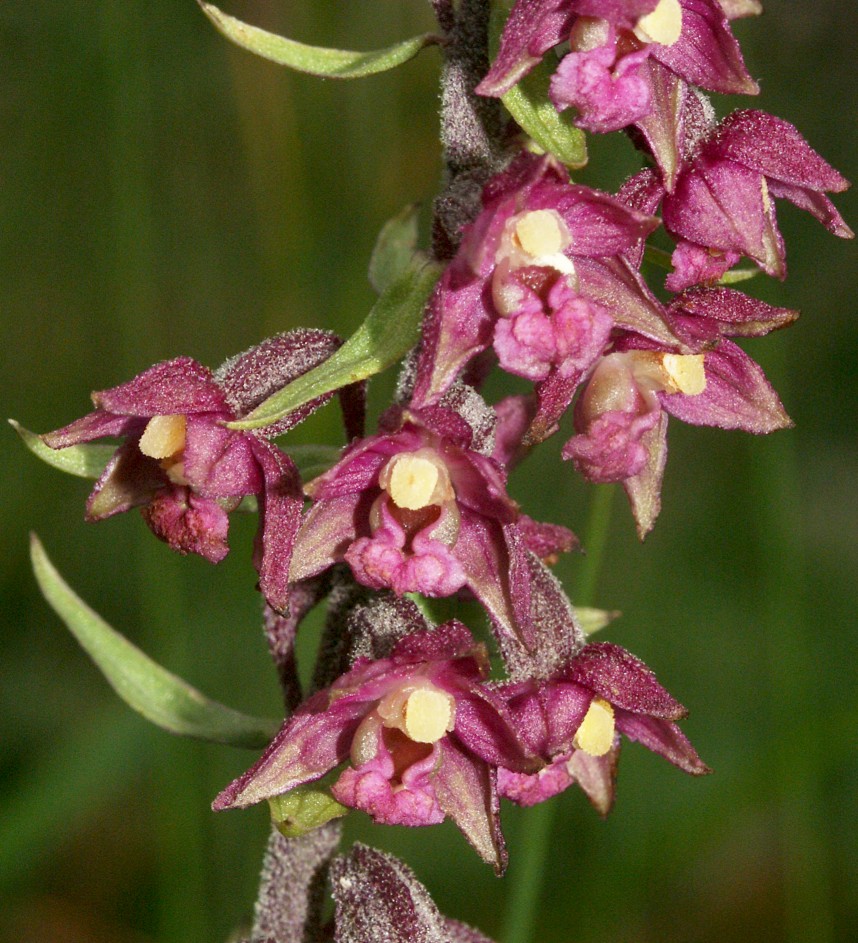
Epipactis atrorubens grows in warm, dry habitats, including dunes, lawns, open forests, loose rock and sandy soils over limestone substrates. It is distinguished by predominantly purple inflorescences, generally reddish-brown flowers and a strong vanilla fragrance.
Written 26 November 2026 from the sources listed below. Each statement was checked against the passage it cites; statements that could not be supported were removed.
Appearance
The plant has a short rootstock that often produces multiple fleshy roots. Its upright inflorescences are predominantly purple and densely hairy at their upper ends.[1][2]
Its flowers are generally reddish-brown, although their coloration can vary. The blossoms produce a strong vanilla fragrance, particularly during warm weather.[3][4]
The flowering stems reach heights of 20–80 cm. The fruit develops as a capsule containing lightweight seeds.[5][6]
Habitat
The species favors warm, dry environments with basic to neutral soil. It grows in nutrient-poor, permeable soils, including loose rock, scree and sandy soils over limestone substrates.[7][8][9]
Its habitats include dunes, lawns and open forests. It also occurs in grass and shrub communities and open birch stands during early to middle stages of ecological succession.[10][11]
The species can establish itself in fallow land, roadside embankments and waste dumps. It occurs at elevations ranging from sea level to 2,400 metres.[12][13]
Behaviour
The dark red helleborine functions as a pioneer plant that colonizes disturbed or previously fallow environments.[14]
Reproduction and life cycle
The species flowers between June and August. Insects, particularly bees, frequently pollinate its flowers.[15][16]
Its lightweight seeds are dispersed by wind. The species is known to form natural hybrids with other species in the Epipactis genus.[17][18]
Conservation
The species is assessed as being of least concern in Europe and the United Kingdom. It has declined in Central Europe over recent decades.[19][20]
Overgrazing and quarrying have been identified as threats to the species in some areas.[21]
Classification of the Dark Red Helleborine
| Kingdom | Plantae |
|---|---|
| Subkingdom | Pteridobiotina |
| Phylum | Tracheophyta |
| Class | Liliopsida |
| Order | Asparagales |
| Family | Orchidaceae (Orchid) |
| Genus | Goodyera (Rattlesnake Orchid) |
| Species | Epipactis atrorubens (Hoffm.) Besser |
This name was added to the Catalogue of Life from a contributing dataset by automated merging and has not yet been reviewed by its editors.
Where the Dark Red Helleborine is found
Checklists and occurrence records place Epipactis atrorubens in 37 countries across Europe. GBIF holds 115,828 georeferenced records of it.
Countries
- Albania 6
- Andorra 22
- Austria 5,343
- Belarus 10
- Belgium 303
- Bosnia and Herzegovina 6
- Bulgaria 9
- Croatia 54
- Czechia 252
- Denmark 142
- Estonia 1,625
- Finland 791
- France 42,355
- Germany 16,544
- Greece 39
- Hungary 50
- Ireland 95
- Italy 1,222
- Latvia 119
- Liechtenstein 154
- Lithuania 41
- Luxembourg 294
- Montenegro 9
- North Macedonia 3
- Norway 8,707
- Poland 899
- Romania 49
- Russia 720
- Serbia 7
- Slovakia 729
- Slovenia 74
- Spain 1,500
- Sweden 8,214
- Switzerland 22,687
- The Netherlands 67
- Ukraine 222
- United Kingdom 2,465
Regions and cities with the most records
- Auvergne-Rhône-Alpes, France 16,167
- Bavaria, Germany 13,508
- Provence-Alpes-Côte d'Azur, France 5,859
- Bourgogne-Franche-Comté, France 4,217
- Upper Austria, Austria 4,174
- Valais, Switzerland 3,467
- Île-de-France, France 3,228
- Bern, Switzerland 3,198
- Gotland, Sweden 2,870
- Hauts-de-France, France 2,818
- Grand Est, France 2,550
- Occitanie, France 2,515
- Vaud, Switzerland 2,185
- Buskerud, Norway 1,984
- Sulzbach-Rosenberg, Germany 1,832
- Chur, Switzerland 1,782
- Sitten, Switzerland 1,696
- Sierre, Switzerland 1,681
- Étampes, France 1,610
- Cluses, France 1,601
- Sallanches, France 1,530
- Nordland, Norway 1,501
- England, United Kingdom 1,448
- Monthey, Switzerland 1,362
- Louviers, France 1,309
- Vernon, France 1,297
- Zurich, Switzerland 1,263
- Bad Kissingen, Germany 1,255
- Lauf an der Pegnitz, Germany 1,205
- Martigny-Ville, Switzerland 1,180
- Oyonnax, France 1,174
- Amberg, Germany 1,148
- Drammen, Norway 1,124
- Östergötland, Sweden 1,100
- Nyon, Switzerland 1,073
- Uster, Switzerland 1,034
3 more countries have a few records outside this range
These countries hold a few records of Epipactis atrorubens but lie outside the range the checklists give for it. Such records are often zoo or garden specimens, museum material or vagrants, so the species is not counted as occurring there.
A number beside a place is its count of GBIF occurrence records. A place without a number comes from a checklist alone. Records show where a species has been observed or collected, which can include escapes and vagrants.
Common names
English
- Dark Red Helleborine
- Dark-Red Helleborine
Names in 9 other languages
- Danish
- Rød hullæbe, Rødblomstret hullæbe
- Dutch
- Bruinrode wespenorchis
- Finnish
- tummaneidonvaippa
- German
- Rotbraune Stendelwurz
- Northern Sami
- čohkkesbeaitagaš
- Norwegian Bokmål
- rødflangre
- Norwegian Nynorsk
- raudflangre
- Swedish
- purpurknipprot
- Welsh
- Caldrist Dugoch, Caldrist Rhudd, Caldrist Rhuddgoch, Y Galdrist Ruddgoch
Synonyms
105 other scientific names have been used for this species and are now treated as synonyms of Epipactis atrorubens.
- Amesia atropurpurea (Raf.) A.Nelson & J.F.Macbr.
- Amesia rubiginosa (Crantz) Mousley
- Epipactis albensis subsp. danubialis (Robatsch & Rydlo) Kreutz
- Epipactis atropurpurea Raf.
- Epipactis atropurpurea f. lutescens (Coss. & Germ.) Hegi
- Epipactis atropurpurea f. pallens Beckh.
- Epipactis atropurpurea f. viridiflora (Sanio) Hegi
- Epipactis atropurpurea subvar. lutescens (Coss. & Germ.) Rouy
- Epipactis atropurpurea subvar. virescens Rouy
- Epipactis atropurpurea var. borbasii Soó
- Epipactis atropurpurea var. leviconica Engenst.
- Epipactis atropurpurea var. longibracteata Bordz.
- Epipactis atropurpurea var. majoriflora Bordz.
- Epipactis atrorubens f. angustifolia Snarskis
- Epipactis atrorubens f. latifolia (Tocl) Soó
- Epipactis atrorubens f. longibracteata (Bordz.) Soó
- Epipactis atrorubens f. majoriflora (Bordz.) Soó
- Epipactis atrorubens f. orbicularis (Zapał.) Soó
- Epipactis atrorubens f. pallens (Beckh.) Hyl.
- Epipactis atrorubens f. sirneensis Neirynck
- Epipactis atrorubens subsp. borbasii Soó
- Epipactis atrorubens subsp. danubialis (Robatsch & Rydlo) Ciocârlan & R.Rösler
- Epipactis atrorubens subsp. spiridonovii (Devillers-Tersch. & Devillers) Kreutz
- Epipactis atrorubens subsp. subclausa (Robatsch) Kreutz
- Epipactis atrorubens subsp. triploidea Gelbr. & G.Hamel
- Epipactis atrorubens subvar. albiflora E.G.Camus
- Epipactis atrorubens subvar. borbasii (Soó) E.G.Camus
- Epipactis atrorubens subvar. lutescens (Coss. & Germ.) E.G.Camus
- Epipactis atrorubens subvar. radnensis (Soó) E.G.Camus
- Epipactis atrorubens subvar. suboppositifolia (G.Froel. ex Soó) E.G.Camus
- Epipactis atrorubens subvar. viridiflora (Sanio) E.G.Camus
- Epipactis atrorubens var. atrata A.Waldner & Webernd.
- Epipactis atrorubens var. bicolor B.Yorke
- Epipactis atrorubens var. borbasii (Soó) Soó & Javorka
- Epipactis atrorubens var. dilatata (Graber) Verm.
- Epipactis atrorubens var. macedonica Kreutz, Tsiftsis & Antonop.
- Epipactis atrorubens var. media (Fr.) Nyman
- Epipactis atrorubens var. radnensis Soó
- Epipactis atrorubens var. stenopetala Walth.Zimm.
- Epipactis atrorubens var. triploidea (Gelbr. & G.Hamel) Kreutz
Showing 40 of 105.
Subspecies and varieties
- Epipactis atrorubens subsp. atrorubens subspecies
Related species
-
 Broad-leaved HelleborineEpipactis helleborine
-
 Downy Rattlesnake PlantainGoodyera pubescens
-
 Western Rattlesnake PlantainGoodyera oblongifolia
-
 Marsh HelleborineEpipactis palustris
-
 Creeping Lady's-tressesGoodyera repens
-
 Giant HelleborineEpipactis gigantea
-
 Violet HelleborineEpipactis purpurata
-
 Dune HelleborineEpipactis dunensis
Compare
Questions and answers
What is the scientific name of the Dark Red Helleborine?
The scientific name of the Dark Red Helleborine is Epipactis atrorubens. Written with its author, the full name is Epipactis atrorubens (Hoffm.) Besser.
Which family does the Dark Red Helleborine belong to?
Epipactis atrorubens belongs to the family Orchidaceae, in the order Asparagales and the class Liliopsida.
Where is the Dark Red Helleborine found?
Checklists and occurrence records place Epipactis atrorubens in 37 countries, including France, Switzerland, Germany, Norway, Sweden and Austria.
What other names does the Dark Red Helleborine have?
Epipactis atrorubens is also known in English as Dark-Red Helleborine.
What are the dark red flowers called?
The reddish-brown flowers described here belong to the dark red helleborine (Epipactis atrorubens). Their coloration can vary.[3]
Sources
Passages the profile rests on
- The plant has a short rootstock that often produces multiple fleshy roots. Source passage: “The plant is hardy and has a short rootstalk, often with multiple, fleshy roots.” — English Wikipedia
- Its inflorescences are predominantly purple, upright, and densely hairy at their upper ends. Source passage: “erect, mostly purple inflorescences with dense hair on the tops” — English Wikipedia
- Its flowers are generally reddish-brown, although their coloration can vary. Source passage: “The flowers sometimes vary in color, but are in general reddish-brown.” — English Wikipedia
- Its blossoms produce a strong vanilla fragrance, particularly during warm weather. Source passage: “The blossoms emit a strong vanilla scent, especially in warm weather.” — English Wikipedia
- Its fruit develops as a capsule containing lightweight seeds. Source passage: “The fruit is a capsule, out of which the light, dustlike seeds are spread by the wind.” — English Wikipedia
- The flowering stems reach heights of 20–80 cm. Source passage: “standing between 20–80 cm (7.9–31.5 in) in height.” — English Wikipedia
- The species favors warm, dry environments with basic to neutral soil. Source passage: “The dark-red helleborine favours warm and dry locations, with soil basic to neutral in pH” — English Wikipedia
- It grows in nutrient-poor, permeable soils. Source passage: “nutrient-poor, and permeable.” — English Wikipedia
- It occurs in loose rock, scree, and sandy soils over limestone substrates. Source passage: “It grows in loose rock, scree, or sandy soils above a limestone substrate” — English Wikipedia
- Its habitats include dunes, lawns, and open forests. Source passage: “including dunes, lawns, or open forest.” — English Wikipedia
- It occurs in grass and shrub communities as well as open birch stands during early to middle stages of ecological succession. Source passage: “in the early to middle stages of ecological succession, among communities of grass and bush and light birch stands.” — English Wikipedia
- The species can establish itself in fallow land, roadside embankments, and waste dumps. Source passage: “which settles in fallow areas, road embankments, and waste dumps” — English Wikipedia
- The species occurs at elevations ranging from sea level to 2,400 metres. Source passage: “The orchid grows at altitudes from sea level to 2,400 m (7,900 ft)” — English Wikipedia
- The species functions as a pioneer plant that colonizes disturbed or previously fallow environments. Source passage: “It is also a pioneer species, which settles in fallow areas, road embankments, and waste dumps” — English Wikipedia
- The species flowers between June and August. Source passage: “It blooms from June to August” — English Wikipedia
- Insects, particularly bees, frequently pollinate its flowers. Source passage: “The flowers of this orchid species are often pollinated by insects, particularly bees.” — English Wikipedia
- Its lightweight seeds are dispersed by wind. Source passage: “The fruit is a capsule, out of which the light, dustlike seeds are spread by the wind.” — English Wikipedia
- The species is known to form natural hybrids with other species in the Epipactis genus. Source passage: “A number of natural hybrids with other Epipactis species are known.” — English Wikipedia
- The species has declined in Central Europe over recent decades. Source passage: “In Central Europe it has been in decline in recent decades.” — English Wikipedia
- The species is assessed as being of least concern in Europe and the United Kingdom. Source passage: “This species is assessed as conservation status "least concern" in Europe and in the United Kingdom” — English Wikipedia
- Overgrazing and quarrying have been identified as threats to the species in some areas. Source passage: “it has been noted to be threatened in some areas by overgrazing and quarrying.” — English Wikipedia
Data
- Catalogue of Life, 2026-10-16 XR cc by
- Global Biodiversity Information Facility CC BY 4.0
- Wikidata CC0
- GeoNames CC BY 4.0
- Wikimedia Commons per image; credit shown with each image
- Within the Catalogue of Life, this name comes from Pinopsida from WFO cc0
References
- Prim. Fl. Galic. 2: 220 (1809) where the name was published
- POWO record for urn:lsid:ipni.org:names:20010355-1 Link
This species in other databases
Page built on 27 November 2026. See how the catalog is made and all sources and licences.
Cite this page
ScientificNames.org. (2026). Epipactis atrorubens (Dark Red Helleborine). Retrieved November 27, 2026, from https://scientificnames.org/species/epipactis-atrorubens
“Epipactis atrorubens (Dark Red Helleborine).” ScientificNames.org, 2026, scientificnames.org/species/epipactis-atrorubens. Accessed 27 Nov. 2026.
ScientificNames.org. “Epipactis atrorubens (Dark Red Helleborine).” Accessed November 27, 2026. https://scientificnames.org/species/epipactis-atrorubens.
@misc{scientificnames_epipactis_atrorubens_dark_red_helleborine,
  author = {{ScientificNames.org}},
  title = {Epipactis atrorubens (Dark Red Helleborine)},
  year = {2026},
  url = {https://scientificnames.org/species/epipactis-atrorubens},
  note = {Accessed 2026-11-27}
}