Species · Flowering plants
Marsh Helleborine Epipactis palustris
The scientific name of the Marsh Helleborine is Epipactis palustris. It is a species of flowering plant in the family Orchidaceae (orchid), order Asparagales.
- Scientific name
- Epipactis palustris (L.) Crantz
- Common name
- Marsh Helleborine
- Genus
- Goodyera
- Family
- Orchidaceae (Orchid)
- Order
- Asparagales
- Class
- Liliopsida
- Red List category
- LC Least Concern
- Recorded in
- 38 countries
- Name status
- provisionally accepted in the Catalogue of Life

Overview
Marsh Helleborine (Epipactis palustris) is a perennial herbaceous flowering plant in the family Orchidaceae, order Asparagales and class Liliopsida. It is native to Europe and Asia and occurs in marshes, dune slacks and bogs. It is distinguished by flowers with deep pink or purplish-red sepals and a white labellum marked with red or yellow spots.
Written 26 November 2026 from the sources listed below. Each statement was checked against the passage it cites; statements that could not be supported were removed.
Appearance
Marsh Helleborine is a perennial herbaceous plant with an upright, cylindrical aerial stem that can reach 60 cm in height. The lower stem is smooth and surrounded by pink scales, while the upper stem is slightly reddish and covered with fine hairs.[1][2][3][4][5]
The plant can produce as many as ten erect leaves with parallel venation. Its leaves can grow up to 12 cm long and 4 cm wide.[6][7]
Its flowers measure approximately 17 mm across and are arranged in a one-sided raceme. The typical form has deep pink or purplish-red sepals, shorter and paler upper petals, and a white labellum at least as long as the sepals, with red or yellow spots in the middle.[8][9][10][11]
Forms lacking most of the typical reddish coloration have been designated Epipactis palustris var. ochroleuca. The fruit is a many-ribbed capsule containing numerous minute seeds.[12][13]
The plant persists through an underground horizontal rhizome that produces new roots and stems each year.[14]
Habitat
Marsh Helleborine occurs in marshes, dune slacks and bogs. It prefers calcareous substrates with basic pH, low nutrient availability and medium moisture.[15][16]
The species is native to Europe and Asia. Its European distribution includes the United Kingdom and Mediterranean countries, while its documented Asian distribution includes Turkey, northern Iraq, the Caucasus, northern Iran, western and eastern Siberia and Central Asia.[17][18][19][20]
The species occurs in the Sarmatic mixed forests ecoregion.[21]
Behaviour
Marsh Helleborine forms symbiotic associations with soil fungi that provide access to additional soil nutrients. It is more specialized in its fungal associations than other Epipactis species.[22][23]
It associates primarily with fungal species belonging to the order Helotiales. Its less frequent fungal partners include Sebacina, Tulasnella, Thelephora and Ceratobasidium, in descending order of frequency.[24][25]
Reproduction and life cycle
Each flower contains both male and female reproductive organs and produces nectar. Wasps, bees and Diptera pollinate the flowers.[26][27][28]
The species produces numerous minute seeds inside its capsule fruit.[13][29]
Classification of the Marsh Helleborine
| Kingdom | Plantae |
|---|---|
| Subkingdom | Pteridobiotina |
| Phylum | Tracheophyta |
| Class | Liliopsida |
| Order | Asparagales |
| Family | Orchidaceae (Orchid) |
| Genus | Goodyera (Rattlesnake Orchid) |
| Species | Epipactis palustris (L.) Crantz |
This name was added to the Catalogue of Life from a contributing dataset by automated merging and has not yet been reviewed by its editors.
Where the Marsh Helleborine is found
Checklists and occurrence records place Epipactis palustris in 38 countries. GBIF holds 131,176 georeferenced records of it.
Countries
- Aland Islands 229
- Albania 4
- Andorra 4
- Austria 3,213
- Belarus 34
- Belgium 12,220
- Bulgaria 5
- Croatia 6
- Czechia 433
- Denmark 2,891
- Estonia 3,993
- Finland 500
- France 35,574
- Germany 18,925
- Greece 7
- Guernsey 3
- Hungary 26
- Ireland 430
- Italy 332
- Jersey 14
- Latvia 109
- Liechtenstein 92
- Lithuania 39
- Luxembourg 86
- Norway 704
- Poland 2,085
- Portugal 11
- Romania 28
- Russia 862
- Serbia 7
- Slovakia 93
- Slovenia 18
- Spain 1,305
- Sweden 17,995
- Switzerland 14,437
- The Netherlands 6,451
- Ukraine 436
- United Kingdom 7,575
Regions and cities with the most records
- Auvergne-Rhône-Alpes, France 16,108
- Bavaria, Germany 14,968
- Uppsala, Sweden 8,940
- Koksijde, Belgium 7,901
- Coudekerque-Branche, France 6,487
- Dunkirk, France 6,486
- Saint-Pol-sur-Mer, France 6,379
- Grande-Synthe, France 5,430
- Hauts-de-France, France 5,226
- England, United Kingdom 5,141
- Stabroek, Belgium 3,815
- Kapellen, Belgium 3,796
- Ekeren, Belgium 3,795
- Merksem, Belgium 3,791
- Deurne, Belgium 3,776
- Brasschaat, Belgium 3,768
- Schoten, Belgium 3,764
- Zurich, Switzerland 3,750
- Antwerp, Belgium 3,727
- Borgerhout, Belgium 3,727
- Berchem, Belgium 3,710
- Hoboken, Belgium 3,710
- Wilrijk, Belgium 3,710
- Zwijndrecht, Belgium 3,710
- Beveren, Belgium 3,709
- Sint-Gillis-Waas, Belgium 3,704
- Mortsel, Belgium 3,685
- Edegem, Belgium 3,683
- Temse, Belgium 3,665
- Sint-Niklaas, Belgium 3,530
- Stekene, Belgium 3,477
- Horgen, Switzerland 3,400
- Uster, Switzerland 3,345
- Bourgogne-Franche-Comté, France 3,308
- Dübendorf, Switzerland 3,118
- Rapperswil, Switzerland 3,069
9 more countries have a few records outside this range
These countries hold a few records of Epipactis palustris but lie outside the range the checklists give for it. Such records are often zoo or garden specimens, museum material or vagrants, so the species is not counted as occurring there.
A number beside a place is its count of GBIF occurrence records. A place without a number comes from a checklist alone. Records show where a species has been observed or collected, which can include escapes and vagrants.
Common names
English
- Marsh Helleborine
Names in 9 other languages
- Danish
- Sump-hullæbe
- Dutch
- Moeraswespenorchis
- Finnish
- suoneidonvaippa
- German
- Sumpf-Stendelwurz
- Italian
- Mughetti pendolini
- Northern Sami
- jeaggebeaitagaš
- Norwegian Bokmål
- myrflangre
- Swedish
- kärrknipprot
- Welsh
- Caldrist y Gors
Synonyms
54 other scientific names have been used for this species and are now treated as synonyms of Epipactis palustris.
- Amesia palustris (L.) A.Nelson & J.F.Macbr.
- Arthrochilium palustre (L.) Beck
- Calliphyllon palustre (L.) Bubani
- Cymbidium palustre (L.) Sw.
- Epipactis palustris f. albiflora (Lüscher) Verm.
- Epipactis palustris f. albiflora (Lüscher) J.D.Arm. & J.M.H.Shaw
- Epipactis palustris f. elongata Höppner
- Epipactis palustris f. ericetorum (Asch. & Graebn.) Soó
- Epipactis palustris f. longibracteata Höppner
- Epipactis palustris f. macrostachya Höppner
- Epipactis palustris f. ochroleuca (Barla) O.Gruss
- Epipactis palustris f. ochroleuca (Barla) Verm.
- Epipactis palustris f. pumila Zapał.
- Epipactis palustris f. purpurea (Sipkes) Verm.
- Epipactis palustris f. purpurea (Sipkes) L.Lewis & Mielcarek
- Epipactis palustris f. rectilinguis Höppner
- Epipactis palustris f. robusta (Zapał.) Höppner
- Epipactis palustris f. silvatica (Asch. & Graebn.) Höppner
- Epipactis palustris f. submersa Glück
- Epipactis palustris f. tricolor (Höppner) L.Lewis & Mielcarek
- Epipactis palustris lusus ochroleuca (Barla) Höppner
- Epipactis palustris lusus tricolor Höppner
- Epipactis palustris lusus violacea Höppner
- Epipactis palustris subsp. salina (Schur) K.Richt.
- Epipactis palustris var. albiflora Lüscher
- Epipactis palustris var. albiflora Höppner
- Epipactis palustris var. elatior Pantu
- Epipactis palustris var. ericetorum Asch. & Graebn.
- Epipactis palustris var. ochroleuca Barla
- Epipactis palustris var. parvifolia Schur
- Epipactis palustris var. purpurea Sipkes
- Epipactis palustris var. robusta Zapał.
- Epipactis palustris var. silvatica Asch. & Graebn.
- Epipactis salina Schur
- Helleborine palustris (L.) Schrank
- Helleborine palustris (L.) Hill
- Helleborine palustris f. ericetorum (Asch. & Graebn.) Soó
- Helleborine palustris f. longibracteata (Höppner) Soó
- Helleborine palustris f. parvifolia (Schur) Soó
- Helleborine palustris f. rectilinguis (Höppner) Soó
Showing 40 of 54.
Related species
-
 Broad-leaved HelleborineEpipactis helleborine
-
 Downy Rattlesnake PlantainGoodyera pubescens
-
 Western Rattlesnake PlantainGoodyera oblongifolia
-
 Creeping Lady's-tressesGoodyera repens
-
 Giant HelleborineEpipactis gigantea
-
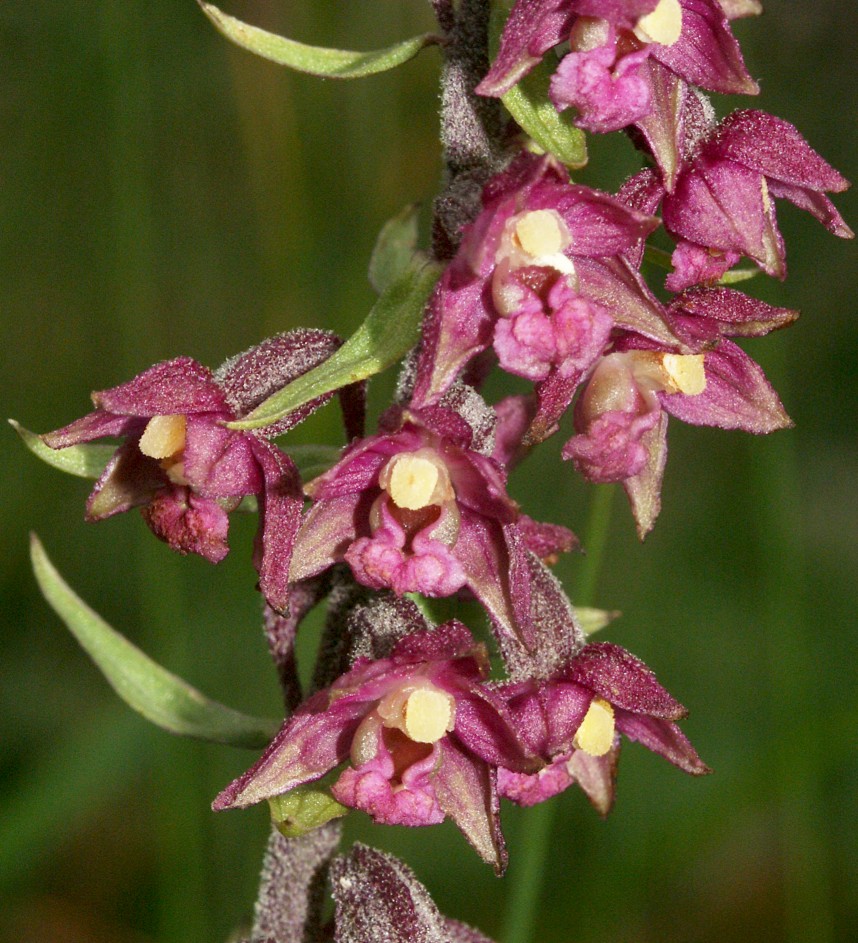 Dark Red HelleborineEpipactis atrorubens
-
 Violet HelleborineEpipactis purpurata
-
 Dune HelleborineEpipactis dunensis
Compare
Questions and answers
What is the scientific name of the Marsh Helleborine?
The scientific name of the Marsh Helleborine is Epipactis palustris. Written with its author, the full name is Epipactis palustris (L.) Crantz.
Which family does the Marsh Helleborine belong to?
Epipactis palustris belongs to the family Orchidaceae, in the order Asparagales and the class Liliopsida.
Where is the Marsh Helleborine found?
Checklists and occurrence records place Epipactis palustris in 38 countries, including France, Germany, Sweden, Switzerland, Belgium and United Kingdom.
What is the conservation status of the Marsh Helleborine?
The IUCN Red List category recorded for Epipactis palustris is Least Concern (LC).
Sources
Passages the profile rests on
- Epipactis palustris is a perennial herbaceous plant. Source passage: “Epipactis palustris is a perennial herbaceous plant.” — English Wikipedia
- Its stem can reach a height of 60 cm. Source passage: “This species has a stem growing to 60 cm high” — English Wikipedia
- The aerial stem is upright and cylindrical in cross-section. Source passage: “The aerial part of the stem is upright and has a cylindrical section.” — English Wikipedia
- The lower aerial stem is smooth and surrounded by pink scales. Source passage: “The base of the aerial stem is glabrous (smooth) and surrounded with pink scales” — English Wikipedia
- The upper stem is covered with fine hairs and is slightly reddish. Source passage: “the upper part of the stem is pubescent and slightly reddened.” — English Wikipedia
- The plant can produce as many as ten erect leaves with parallel venation. Source passage: “with as many as ten erect leaves up to 12 cm long and up to 4 cm wide, with parallel venation.” — English Wikipedia
- Its leaves can grow up to 12 cm long and 4 cm wide. Source passage: “up to 12 cm long and up to 4 cm wide” — English Wikipedia
- Its flowers measure approximately 17 mm across and are arranged in a one-sided raceme. Source passage: “The flowers are 17 mm across arranged in a one-sided raceme.” — English Wikipedia
- The typical form has deep pink or purplish-red sepals. Source passage: “In the typical form, the sepals are coloured deep pink or purplish-red” — English Wikipedia
- Its upper petals are shorter and paler than its sepals. Source passage: “the upper petals shorter and paler.” — English Wikipedia
- Its labellum is at least as long as the sepals and is white with red or yellow spots in the middle. Source passage: “The labellum at least as long as the sepals, white with red or yellow spots in the middle.” — English Wikipedia
- Forms lacking most of the typical reddish coloration have been designated Epipactis palustris var. ochroleuca. Source passage: “Variants without most of the reddish colours of the typical form have been called E. palustris var. ochroleuca.” — English Wikipedia
- Its fruit is a many-ribbed capsule containing numerous minute seeds. Source passage: “The fruit is a many-ribbed capsule, containing a large number of minute seeds.” — English Wikipedia
- The plant persists through an underground horizontal rhizome that produces new roots and stems each year. Source passage: “It persists as an underground horizontal stem called a rhizome, from which new roots and stems grow each year.” — English Wikipedia
- The species also occurs in marshes, dune slacks and bogs. Source passage: “as well as in marshes, dune slacks and bogs.” — English Wikipedia
- It prefers calcareous substrates with basic pH, low nutrient availability and medium moisture. Source passage: “It prefers a calcareous substrate with a basic pH, low nutrient availability and medium wet.” — English Wikipedia
- The species is native to Europe and Asia. Source passage: “Epipactis palustris, the marsh helleborine, is a species of orchid native to Europe and Asia.” — English Wikipedia
- Its European distribution includes the United Kingdom and Mediterranean countries. Source passage: “Europe, including the United Kingdom and Mediterranean countries” — English Wikipedia
- Its documented Asian distribution includes Turkey, northern Iraq, the Caucasus and northern Iran. Source passage: “Turkey, north Iraq, the Caucasus, north Iran” — English Wikipedia
- Its documented distribution extends into western and eastern Siberia and Central Asia. Source passage: “West and East Siberia and Central Asia.” — English Wikipedia
- The species occurs in the Sarmatic mixed forests ecoregion. Source passage: “This species occurs in the Sarmatic mixed forests ecoregion.” — English Wikipedia
- The species forms symbiotic associations with soil fungi that provide access to additional soil nutrients. Source passage: “Orchids rely on a symbiotic relationship with soil fungi, which gives them access to more soil nutrients.” — English Wikipedia
- Epipactis palustris is more specialized in its fungal associations than other Epipactis species. Source passage: “Epipactis palustris is specialised compared to other Epipactis species” — English Wikipedia
- The species associates primarily with fungal species belonging to the order Helotiales. Source passage: “partnering mainly with fungal species in the order Helotiales” — English Wikipedia
- Its less frequent fungal partners include Sebacina, Tulasnella, Thelephora and Ceratobasidium, in descending order of frequency. Source passage: “but also to a much lesser degree with Sebacina, Tulasnella, Thelephora and Ceratobasidium in descending order of frequency.” — English Wikipedia
- Each flower contains both male and female reproductive organs. Source passage: “Each flower contains male and female organs of reproduction.” — English Wikipedia
- Its flowers produce nectar. Source passage: “Flowers produce nectar” — English Wikipedia
- Wasps, bees and Diptera pollinate the flowers. Source passage: “are pollinated by wasps, bees and Diptera.” — English Wikipedia
- The species produces numerous minute seeds inside its capsule fruit. Source passage: “containing a large number of minute seeds.” — English Wikipedia
Data
- Catalogue of Life, 2026-10-16 XR cc by
- Global Biodiversity Information Facility CC BY 4.0
- Wikidata CC0
- GeoNames CC BY 4.0
- Wikimedia Commons per image; credit shown with each image
- Within the Catalogue of Life, this name comes from Pinopsida from WFO cc0
References
- Stirp. Austr. Fasc., ed. 2, 2: 463 (1769) where the name was published
- POWO record for urn:lsid:ipni.org:names:633289-1 Link
This species in other databases
Page built on 27 November 2026. See how the catalog is made and all sources and licences.
Cite this page
ScientificNames.org. (2026). Epipactis palustris (Marsh Helleborine). Retrieved November 27, 2026, from https://scientificnames.org/species/epipactis-palustris
“Epipactis palustris (Marsh Helleborine).” ScientificNames.org, 2026, scientificnames.org/species/epipactis-palustris. Accessed 27 Nov. 2026.
ScientificNames.org. “Epipactis palustris (Marsh Helleborine).” Accessed November 27, 2026. https://scientificnames.org/species/epipactis-palustris.
@misc{scientificnames_epipactis_palustris_marsh_helleborine,
  author = {{ScientificNames.org}},
  title = {Epipactis palustris (Marsh Helleborine)},
  year = {2026},
  url = {https://scientificnames.org/species/epipactis-palustris},
  note = {Accessed 2026-11-27}
}