Species · Ferns and allies
Common Horsetail Equisetum arvense
The scientific name of the Common Horsetail is Equisetum arvense. It is a species of fern or lycophyte in the family Equisetaceae (horsetail family), order Equisetales.
- Scientific name
- Equisetum arvense L.
- Common name
- Common Horsetail
- Genus
- Equisetum
- Family
- Equisetaceae (Horsetail Family)
- Order
- Equisetales
- Class
- Polypodiopsida
- Red List category
- LC Least Concern
- Recorded in
- 85 countries
- Name status
- accepted in the Catalogue of Life

Overview
Common Horsetail (Equisetum arvense L.) is a perennial herbaceous plant in the family Equisetaceae, order Equisetales and class Polypodiopsida. It commonly grows in damp, open woodlands, pastures, cultivated land, roadsides, disturbed areas and stream margins. It has two distinct stem forms: fertile spore-bearing stems and sterile green stems.
Written 24 November 2026 from the sources listed below. Each statement was checked against the passage it cites; statements that could not be supported were removed.
Habitat
Common Horsetail commonly grows in damp, open woodlands, pastures, cultivated land, roadsides, disturbed areas and stream margins. It prefers neutral or slightly basic clay loam soils that are sandy or silty and have a high water table.[1][2]
It thrives in full sun and moist soil but tolerates seasonally dry soil after establishment. It can grow in temperatures ranging from below 5 °C to above 20 °C and occurs in areas receiving annual rainfall between 100 and 2,000 mm.[3][4][5]
Horsetail grows in moist areas throughout the Pacific Northwest.[6]
Diet
Young horsetail shoots are eaten by people. The buds are consumed as a spring vegetable in Japan and Korea.[7][8]
Behaviour
Common Horsetail spreads through underground rhizomes that produce new shoots. The rhizomes branch freely and bear stem tubers, and can penetrate soil to depths of approximately 1.8 metres.[9][10][11]
The species can form dense stands that obstruct waterways and contribute to flooding and silting.[12]
Reproduction and life cycle
Common Horsetail reproduces through spores rather than flowers. Fertile spore-bearing stems begin appearing in April and produce spores in cone-like structures at their tips.[13][14][15]
Both fertile and sterile stem forms arise from the same underground rhizome. Fertile stems die shortly after releasing their spores.[16][17]
Conservation
Common Horsetail was introduced into New Zealand during the 1920s. It is listed on New Zealand's National Pest Plant Accord, which prohibits its sale, spread and cultivation.[18][19]
Uses
Common Horsetail has traditionally been used to polish pewter and wood. The plant has also been used as an abrasive for cleaning and polishing.[20][21]
An aqueous extract of the species is approved for use as a fungicide in the European Union and United Kingdom.[22]
The species has been used in traditional Austrian herbal medicine for skin, musculoskeletal, kidney and urinary tract disorders, rheumatism and gout. Finnish traditional medicine has used dried green summer shoots as a remedy.[23][24]
The species has traditionally been used by Indigenous groups for medicinal and edible purposes.[25]
Similar species
Common Horsetail is sometimes confused with mare's tail, Hippuris vulgaris. Giant horsetail, Equisetum talmatiea, is also identified as similar to field horsetail.[26][27]
Appearance
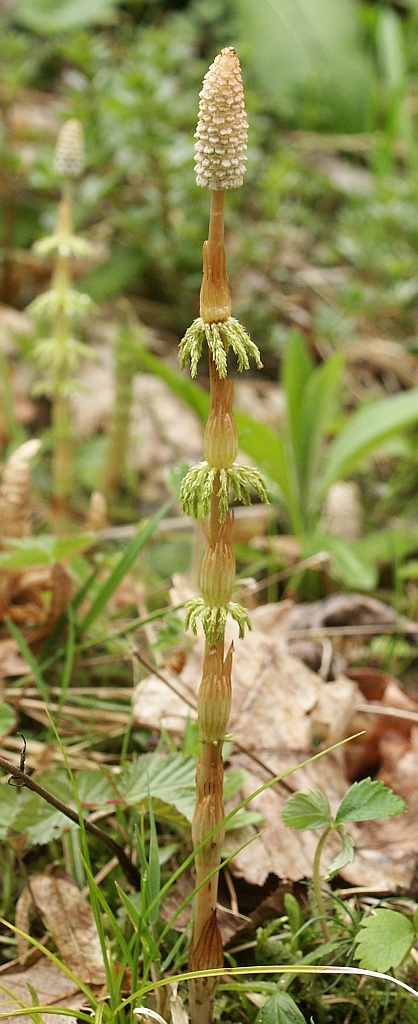
Common Horsetail has two distinct stem forms: fertile spore-bearing stems and sterile green stems. Its jointed stems have thin leaves arranged in whorls at each joint.[28][29]
The sterile stems are green, hollow and bear whorls of delicate branches. They may grow erect or prostrate and have jointed segments with whorls of side shoots.[30][31]
The fertile stems are off-white and succulent, with brown scale leaves and a brown spore cone at the tip. The spore cones measure 10–40 mm long and 4–9 mm wide.[32][33]
Sterile stems measure 10–90 cm in height and 3–5 mm in diameter. Individual segments are approximately 2–5 cm long, and some sterile stems contain as many as 20 segments.[34][35][36]
Fertile stems measure 10–25 cm in height and 3–5 mm in diameter.[37]
Classification of the Common Horsetail
| Kingdom | Plantae |
|---|---|
| Subkingdom | Pteridobiotina |
| Phylum | Tracheophyta |
| Class | Polypodiopsida (Fern) |
| Order | Equisetales |
| Family | Equisetaceae (Horsetail Family) |
| Genus | Equisetum (Horsetail) |
| Species | Equisetum arvense L. |
Where the Common Horsetail is found
Checklists and occurrence records place Equisetum arvense in 85 countries across Africa, Asia, Europe, North America and Oceania. GBIF holds 951,193 georeferenced records of it.
Countries where it is native or its origin is not stated
- Afghanistan 9
- Aland Islands 1,127
- Albania 8
- Algeria
- Andorra 57
- Armenia 69
- Austria 17,264
- Azerbaijan 12
- Belarus 510
- Belgium 34,850
- Bhutan 7
- Bosnia and Herzegovina 17
- Bulgaria 64
- Canada 21,886
- China 1,204
- Croatia 107
- Cyprus
- Czechia 7,107
- Democratic Republic of the Congo 5
- Denmark 51,496
- Dominica 3
- Estonia 3,615
- Faroe Islands 72
- Finland 38,549
- France 142,243
- Georgia 27
- Germany 70,228
- Greece 377
- Greenland 1,623
- Guernsey 7
- Hungary 246
- Iceland 3,831
- India 61
- Indonesia 3
- Iran 16
- Iraq 3
- Ireland 1,063
- Isle of Man 1,883
- Italy 2,422
- Japan 7,472
- Jersey 7
- Kazakhstan 120
- Kosovo
- Kyrgyzstan 26
- Latvia 239
- Liechtenstein 61
- Lithuania 421
- Luxembourg 1,950
- Malta 1
- Mexico 13
- Moldova 10
- Mongolia 113
- Montenegro 13
- Morocco
- Nepal 24
- North Korea 23
- North Macedonia 3
- Norway 20,085
- Pakistan 31
- Poland 23,209
- Portugal 298
- Romania 104
- Russia 23,548
- Saint Pierre and Miquelon 11
- San Marino
- Serbia 29
- Slovakia 6,699
- Slovenia 168
- South Korea 3,709
- Spain 7,361
- Svalbard and Jan Mayen 757
- Sweden 44,658
- Switzerland 27,298
- Tajikistan 39
- The Netherlands 104,499
- Turkey 40
- Turkmenistan 5
- Ukraine 3,323
- United Kingdom 234,578
- United States 37,630
- Uzbekistan 44
- Vietnam 4
Countries where it has been introduced
Regions and cities with the most records
- England, United Kingdom 166,266
- Scotland, United Kingdom 43,578
- Bavaria, Germany 39,455
- Auvergne-Rhône-Alpes, France 28,046
- Hauts-de-France, France 20,641
- Île-de-France, France 17,720
- Gelderland, The Netherlands 17,716
- Grand Est, France 16,550
- Bourgogne-Franche-Comté, France 15,169
- Central Jutland, Denmark 14,514
- Zeeland, The Netherlands 13,481
- Centre-Val de Loire, France 11,632
- Wales, United Kingdom 11,472
- South Denmark, Denmark 11,111
- Upper Austria, Austria 9,207
- Zealand, Denmark 8,914
- Zoetermeer, The Netherlands 8,498
- Västra Götaland, Sweden 8,133
- Delft, The Netherlands 7,812
- Lapland, Finland 7,474
- Spijkenisse, The Netherlands 7,404
- Rotterdam, The Netherlands 7,189
- Overijssel, The Netherlands 7,138
- Rijswijk, The Netherlands 7,138
- Alphen aan den Rijn, The Netherlands 7,047
- Leiden, The Netherlands 7,042
- Vlaardingen, The Netherlands 6,986
- Schiedam, The Netherlands 6,982
- Limburg, The Netherlands 6,965
- Capelle aan den IJssel, The Netherlands 6,954
- Ridderkerk, The Netherlands 6,825
- Nijmegen, The Netherlands 6,799
- The Hague, The Netherlands 6,515
- Capital Region, Denmark 6,373
- Provence-Alpes-Côte d'Azur, France 6,162
- Vlissingen, The Netherlands 6,090
2 more countries have a few records outside this range
These countries hold a few records of Equisetum arvense but lie outside the range the checklists give for it. Such records are often zoo or garden specimens, museum material or vagrants, so the species is not counted as occurring there.
A number beside a place is its count of GBIF occurrence records. A place without a number comes from a checklist alone. Records show where a species has been observed or collected, which can include escapes and vagrants.
Common names
English
- Common Horsetail
- Field Horsetail
Names in 12 other languages
- Danish
- Ager-padderok
- Dutch
- Heermoes
- Finnish
- peltokorte
- French
- prêle des champs, queue de renard
- German
- Acker-Schachtelhalm, Akerschachtelhalm
- Italian
- Equiseto dei Campi
- Japanese
- sugi-na, tsukushi
- Northern Sami
- bealdohoašša, galvagorddat, njoammilsuoidni, savzarássi
- Norwegian Bokmål
- åkersnelle
- Spanish
- cola de caballo
- Swedish
- rävrumpa, åkerfräken
- Welsh
- Brwyn Nadd, Marchrawn yr Ardir, Marchrawnen yr Ardir, Rhawn March yr Ardir, Rhawn y March yr Yd, Rhawn yr Ardir, Rhonell y March
Synonyms
2 other scientific names have been used for this species and are now treated as synonyms of Equisetum arvense.
- Equisetum arvense f. arvense
- Equisetum arvense var. arvense
Subspecies and varieties
- Equisetum arvense subsp. alpestre subspecies
- Equisetum arvense subsp. arvense subspecies
Related species
-
 Rough HorsetailEquisetum hyemale
-
 Great HorsetailEquisetum telmateia
-
 PipesEquisetum fluviatile
-
 Southern Giant HorsetailEquisetum giganteum
-
 Marsh HorsetailEquisetum palustre
-
 Mexican Giant HorsetailEquisetum myriochaetum
-
 Wood HorsetailEquisetum sylvaticum
-
 Boston HorsetailEquisetum ramosissimum
Compare
Questions and answers
What is the scientific name of the Common Horsetail?
The scientific name of the Common Horsetail is Equisetum arvense. Written with its author, the full name is Equisetum arvense L..
Which family does the Common Horsetail belong to?
Equisetum arvense belongs to the family Equisetaceae, in the order Equisetales and the class Polypodiopsida.
Where is the Common Horsetail found?
Checklists and occurrence records place Equisetum arvense in 85 countries, including United Kingdom, France, The Netherlands, Germany, Denmark and Sweden.
What is the conservation status of the Common Horsetail?
The IUCN Red List category recorded for Equisetum arvense is Least Concern (LC).
What other names does the Common Horsetail have?
Equisetum arvense is also known in English as Field Horsetail.
How invasive is horsetail?
Common Horsetail spreads through underground rhizomes that produce new shoots. It can form dense stands that obstruct waterways and contribute to flooding and silting.[10][12]
How to identify field horsetail?
Common Horsetail has two distinct stem forms: fertile, off-white, succulent stems with brown scale leaves and a brown spore cone, and sterile green stems that are hollow and bear whorls of delicate branches. Both forms have jointed stems with thin leaves arranged in whorls at each joint.[28][32][29][31]
Can horsetail be eaten by humans?
Young horsetail shoots are eaten by people. The buds are consumed as a spring vegetable in Japan and Korea.[7][8]
How far does horsetail spread?
Its underground rhizomes can penetrate soil to depths of approximately 1.8 metres. They branch freely and produce new shoots.[9][10][11]
Sources
Passages the profile rests on
- The species commonly grows in damp, open woodlands, pastures, cultivated land, roadsides, disturbed areas and stream margins. Source passage: “It commonly occurs in damp and open woodlands, pastures, arable lands, roadsides, disturbed areas, and near the edge of streams.” — English Wikipedia
- The species prefers neutral or slightly basic clay loam soils that are sandy or silty and have a high water table. Source passage: “It prefers neutral or slightly basic clay loams that are sandy or silty, especially where the water table is high” — English Wikipedia
- The species can grow in temperatures ranging from below 5 °C to above 20 °C. Source passage: “in temperatures less than 5 °C (41 °F) to greater than 20 °C (68 °F)” — English Wikipedia
- The species can occur in areas receiving annual rainfall between 100 and 2,000 mm. Source passage: “in areas that receive annual rainfall as low as 100 mm (3.9 in) and as great as 2,000 mm (79 in).” — English Wikipedia
- The species thrives in full sun and moist soil but tolerates seasonally dry soil after establishment. Source passage: “They thrive with full sun and moist soil. After plants are established they will tolerate seasonally dry soil.” — solvepestproblems.oregonstate.edu
- Horsetail grows in moist areas throughout the Pacific Northwest. Source passage: “Horsetails (Equisetum spp) grow in moist areas throughout the Pacific Northwest.” — solvepestproblems.oregonstate.edu
- Young horsetail shoots are eaten by people. Source passage: “People enjoy eating young horsetail shoots, but should not eat too much.” — solvepestproblems.oregonstate.edu
- The buds are consumed as a spring vegetable in Japan and Korea. Source passage: “The buds are eaten as a vegetable in Japan and Korea in spring.” — English Wikipedia
- The underground rhizomes can penetrate soil to depths of approximately 1.8 metres. Source passage: “which can penetrate the soil up to 6 feet (1.8 m) deep.” — English Wikipedia
- The species spreads through underground rhizomes that produce new shoots. Source passage: “Equisetum arvense is a perennial herbaceous plant that spreads by means of an underground rhizome.” — English Wikipedia
- The underground rhizomes branch freely and bear stem tubers. Source passage: “The slender, felted rhizome freely forks and bears stem tubers.” — English Wikipedia
- The species can form dense stands that obstruct waterways and contribute to flooding and silting. Source passage: “Horsetail grows in dense stands. It can block waterways and contribute to flooding and silting.” — solvepestproblems.oregonstate.edu
- The species reproduces through spores rather than flowers. Source passage: “E. arvense is a nonflowering plant, multiplying through spores.” — English Wikipedia
- Fertile spore-bearing stems begin appearing in April. Source passage: “Fertile spore-bearing stems begin to appear in April.” — English Wikipedia
- The fertile stems produce spores in cone-like structures at their tips. Source passage: “At the top is a cone-like structure that produces spores.” — solvepestproblems.oregonstate.edu
- Fertile stems die shortly after releasing their spores. Source passage: “After shedding its spores, a fertile stem promptly withers and dies.” — English Wikipedia
- Both fertile and sterile stem forms arise from the same underground rhizome. Source passage: “both arising from the same rhizome.” — English Wikipedia
- The species was introduced into New Zealand during the 1920s. Source passage: “It was introduced into New Zealand in the 1920s” — English Wikipedia
- The species is listed on New Zealand's National Pest Plant Accord, which prohibits its sale, spread and cultivation. Source passage: “It is listed on the National Pest Plant Accord, prohibiting its sale, spread and cultivation.” — English Wikipedia
- The species has traditionally been used to polish pewter and wood. Source passage: “It was also once used to polish pewter and wood” — English Wikipedia
- The plant has been used as an abrasive for cleaning and polishing. Source passage: “It is also an abrasive.” — English Wikipedia
- An aqueous extract of the species is approved for use as a fungicide in the European Union and United Kingdom. Source passage: “an aqueous extract of E. arvense has been approved for use as a fungicide in the European Union and the United Kingdom” — English Wikipedia
- The species has been used in traditional Austrian herbal medicine for skin, musculoskeletal, kidney and urinary tract disorders, rheumatism and gout. Source passage: “for treatment of disorders of the skin, locomotor system, kidneys and urinary tract, rheumatism and gout.” — English Wikipedia
- Finnish traditional medicine has used dried green summer shoots as a remedy. Source passage: “Green summer shoots, dried, as a remedy.” — English Wikipedia
- The species has traditionally been used by Indigenous groups for medicinal and edible purposes. Source passage: “Horsetail is harvested by many Indigenous groups for medicinal and edible uses.” — solvepestproblems.oregonstate.edu
- The species is sometimes confused with mare's tail, Hippuris vulgaris. Source passage: “It is sometimes confused with mare's tail, Hippuris vulgaris.” — English Wikipedia
- Giant horsetail, Equisetum talmatiea, is identified as similar to field horsetail. Source passage: “Giant Horsetail (Equisetum talmatiea) is similar to field horsetail.” — solvepestproblems.oregonstate.edu
- The species has two distinct stem forms: fertile spore-bearing stems and sterile green stems. Source passage: “It has two distinct growth forms, a fertile spore-bearing stem and a sterile green stem.” — English Wikipedia
- The plant has jointed stems with thin leaves arranged in whorls at each joint. Source passage: “The jointed stems of horsetails grow distinctive thin leaves in whorls at each joint.” — solvepestproblems.oregonstate.edu
- The sterile stems may grow either erect or prostrate and have jointed segments with whorls of side shoots. Source passage: “The erect or prostrate sterile stems are 10–90 cm (3.9–35.4 in) tall and 3–5 mm (0.12–0.20 in) diameter, with jointed segments around 2–5 cm (0.79–1.97 in) long with whorls of side shoots at the segment joints” — English Wikipedia
- The vegetative stems are green, hollow and bear whorls of delicate branches. Source passage: “Vegetative stems are green, hollow, and grow up to 2 feet tall. They support whorls of delicate branches.” — solvepestproblems.oregonstate.edu
- The fertile stems are off-white and succulent, with brown scale leaves and a brown spore cone at the tip. Source passage: “The off-white fertile stems are of a succulent texture, 10–25 cm (3.9–9.8 in) tall and 3–5 mm (0.12–0.20 in) diameter, with 4–8 whorls of brown scale leaves and an apical brown spore cone.” — English Wikipedia
- The fertile stems have spore cones measuring 10–40 mm long and 4–9 mm wide. Source passage: “The cone is 10–40 mm (0.39–1.57 in) long and 4–9 mm (0.16–0.35 in) broad.” — English Wikipedia
- Sterile stems measure 10–90 cm in height and 3–5 mm in diameter. Source passage: “The erect or prostrate sterile stems are 10–90 cm (3.9–35.4 in) tall and 3–5 mm (0.12–0.20 in) diameter” — English Wikipedia
- Individual sterile stem segments are approximately 2–5 cm long. Source passage: “with jointed segments around 2–5 cm (0.79–1.97 in) long” — English Wikipedia
- Some sterile stems contain as many as 20 segments. Source passage: “Some stems can have as many as 20 segments.” — English Wikipedia
- Fertile stems measure 10–25 cm in height and 3–5 mm in diameter. Source passage: “The off-white fertile stems are of a succulent texture, 10–25 cm (3.9–9.8 in) tall and 3–5 mm (0.12–0.20 in) diameter” — English Wikipedia
- The species is a perennial herbaceous plant. Source passage: “Equisetum arvense is a perennial herbaceous plant” — English Wikipedia
- The species absorbs silicon from the soil. Source passage: “It absorbs silicon from the soil, which is rare among herbs.” — English Wikipedia
- The species has a diploid chromosome number of 216. Source passage: “It has a very high diploid number of 216 (108 pairs of chromosomes).” — English Wikipedia
Data
- Catalogue of Life, 2026-10-16 XR cc by
- Global Biodiversity Information Facility CC BY 4.0
- Wikidata CC0
- GeoNames CC BY 4.0
- Wikimedia Commons per image; credit shown with each image
- Within the Catalogue of Life, this name comes from Checklist of Ferns and Lycophytes of the World cc by
References
- L. where the name was published
This species in other databases
Page built on 24 November 2026. See how the catalog is made and all sources and licences.
Cite this page
ScientificNames.org. (2026). Equisetum arvense (Common Horsetail). Retrieved November 24, 2026, from https://scientificnames.org/species/equisetum-arvense
“Equisetum arvense (Common Horsetail).” ScientificNames.org, 2026, scientificnames.org/species/equisetum-arvense. Accessed 24 Nov. 2026.
ScientificNames.org. “Equisetum arvense (Common Horsetail).” Accessed November 24, 2026. https://scientificnames.org/species/equisetum-arvense.
@misc{scientificnames_equisetum_arvense_common_horsetail,
  author = {{ScientificNames.org}},
  title = {Equisetum arvense (Common Horsetail)},
  year = {2026},
  url = {https://scientificnames.org/species/equisetum-arvense},
  note = {Accessed 2026-11-24}
}