Species · Ferns and allies
Great Horsetail Equisetum telmateia
The scientific name of the Great Horsetail is Equisetum telmateia. It is a species of fern or lycophyte in the family Equisetaceae (horsetail family), order Equisetales.
- Scientific name
- Equisetum telmateia Ehrh.
- Common name
- Great Horsetail
- Genus
- Equisetum
- Family
- Equisetaceae (Horsetail Family)
- Order
- Equisetales
- Class
- Polypodiopsida
- Red List category
- LC Least Concern
- Recorded in
- 60 countries
- Name status
- accepted in the Catalogue of Life

Overview
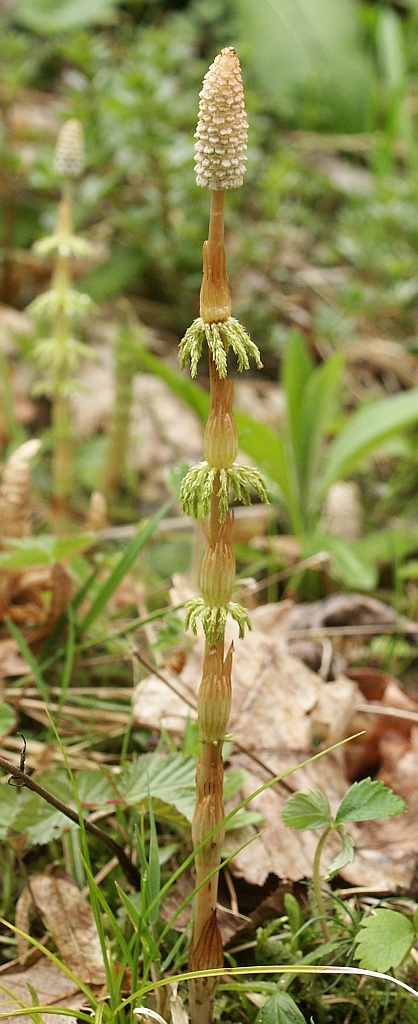
Great Horsetail (Equisetum telmateia Ehrh.) is a herbaceous perennial plant in the family Equisetaceae. It occurs in damp, shady places, including spring fens, seepage lines and open woodlands. It has separate green sterile stems and pale yellowish fertile stems that bear spores.
Written 24 November 2026 from the sources listed below. Each statement was checked against the passage it cites; statements that could not be supported were removed.
Appearance
Great Horsetail has separate green photosynthetic sterile stems and pale yellowish non-photosynthetic fertile stems. The sterile stems typically reach 30–150 cm in height, although they can rarely grow to 240 cm, and have a diameter of approximately 1 cm.[1][2][3]
The sterile stems can produce whorls containing 14–40 branches, which can reach 20 cm in length. The fertile stems grow to approximately 15–45 cm in height and bear a spore-bearing strobilus measuring 4–10 cm in length and 1–2 cm in width.[4][5][6][7]
Habitat
Great Horsetail occurs in damp, shady places, including spring fens and seepage lines. It commonly grows in open woodlands.[8][9][10]
Behaviour
The fertile stems emerge in early spring, before the sterile shoots, and have no side branches. The sterile stems emerge in late spring and die down in late autumn.[11][12][13]
Reproduction and life cycle
Great Horsetail produces pale yellowish fertile stems that bear spores. The spores are dispersed in mid-spring, and the fertile stems die immediately after releasing them.[14][15][16]
The species also spreads through rhizomes, which have been observed penetrating up to 4 metres into wet clay soil. These rhizomes can spread laterally in multiple layers.[17][18][19]
Some plants occasionally produce stems that are both fertile and photosynthetic.[20]
Conservation
In Sweden, Great Horsetail is rare and endangered and is restricted to three locations on the west coast of southern Skåne. These populations extend north to approximately 56°08' N.[21][22]
Similar species
Equisetum braunii was formerly included within a broader treatment of Equisetum telmateia as a subspecies. It is now treated as a separate species.[23][24]
Classification of the Great Horsetail
| Kingdom | Plantae |
|---|---|
| Subkingdom | Pteridobiotina |
| Phylum | Tracheophyta |
| Class | Polypodiopsida (Fern) |
| Order | Equisetales |
| Family | Equisetaceae (Horsetail Family) |
| Genus | Equisetum (Horsetail) |
| Species | Equisetum telmateia Ehrh. |
Where the Great Horsetail is found
Checklists and occurrence records place Equisetum telmateia in 60 countries across Africa, Asia and Europe. GBIF holds 169,150 georeferenced records of it.
Countries
- Albania 27
- Algeria 23
- Armenia 17
- Austria 7,178
- Azerbaijan 44
- Belarus 14
- Belgium 10,640
- Bosnia and Herzegovina 21
- Bulgaria 62
- Canada 4,169
- Croatia 167
- Cyprus 16
- Czechia 336
- Denmark 2,417
- Finland 3
- France 35,329
- Georgia 82
- Germany 13,259
- Gibraltar
- Greece 537
- Guernsey 5
- Hungary 192
- Iran 48
- Iraq 3
- Ireland 453
- Isle of Man 153
- Israel 137
- Italy 4,025
- Kosovo 1
- Latvia 4
- Lebanon 19
- Libya 2
- Liechtenstein 14
- Lithuania 36
- Luxembourg 489
- Malta
- Moldova 12
- Montenegro 37
- Morocco 29
- North Macedonia 5
- Norway 6
- Palestinian Territory 3
- Poland 1,754
- Portugal 2,255
- Romania 197
- Russia 854
- San Marino
- Serbia 48
- Slovakia 689
- Slovenia 246
- Spain 8,001
- Sweden 397
- Switzerland 12,446
- Syria 13
- The Netherlands 8,811
- Tunisia 9
- Turkey 125
- Ukraine 641
- United Kingdom 41,996
- United States 10,654
Regions and cities with the most records
- England, United Kingdom 33,604
- Auvergne-Rhône-Alpes, France 9,055
- Bavaria, Germany 8,661
- Maastricht, The Netherlands 5,897
- Heerlen, The Netherlands 5,101
- California, United States 4,690
- Occitanie, France 4,525
- Limburg, The Netherlands 4,320
- Sittard, The Netherlands 3,993
- British Columbia, Canada 3,925
- Kerkrade, The Netherlands 3,735
- Herzogenrath, Germany 3,584
- Upper Austria, Austria 3,529
- Provence-Alpes-Côte d'Azur, France 3,356
- Jette, Belgium 3,315
- Molenbeek-Saint-Jean, Belgium 3,313
- Brussels, Belgium 3,306
- Saint-Gilles, Belgium 3,283
- Ixelles, Belgium 3,279
- Etterbeek, Belgium 3,228
- Aachen, Germany 3,206
- Anderlecht, Belgium 3,180
- Schaerbeek, Belgium 3,165
- Washington, United States 3,121
- Forest, Belgium 3,116
- Woluwe-Saint-Lambert, Belgium 3,085
- Uccle, Belgium 3,021
- Île-de-France, France 2,759
- Alsdorf, Germany 2,754
- Hauts-de-France, France 2,741
- Wales, United Kingdom 2,687
- Aalst, Belgium 2,560
- Zurich, Switzerland 2,434
- Grand Est, France 2,358
- Genk, Belgium 2,008
- Blackburn, United Kingdom 2,001
Range as the checklists state it
England (England, Wales, Scotland, Isle of Man); Ireland (Ireland, Northern Ireland); Denmark; Sweden; Netherlands; Belgium; Luxembourg; Germany (Brandenburg, Baden-Württemberg, Bayern, Hessen, +Hamburg, Mecklenburg-Vorpommern, Niedersachsen, Nordrhein-Westfalen, Rheinland-Pfalz, Schleswig-Holstein, Saarland, Sachsen, Sachsen-Anhalt, Thüringen); Switzerland; Liechtenstein; Austria; Poland; Czech Republic; Slovakia; Hungary; Portugal; Spain; Gibraltar; Baleares; France; Channel Isl. (Guernsey, Alderney); Corsica; Sardinia; Italy; Sicily; Malta; San Marino; Slovenia; Croatia; Bosnia & Hercegovina; Montenegro; Serbia; Kosovo; North Macedonia; Albania; Romania; Bulgaria; European Turkey; Greece (widespread, incl. Kiklades, Samothraki); Crete (widespread); Latvia; Lithuania; Belarus; European Russia (N-European Russia, C-European Russia, W-European Russia, E-European Russia); Ukraine; Moldova; Crimea; Morocco; Algeria; Tunisia; Libya; Azores (Santa Maria Isl., Sao Miguel Isl., Terceira, Sao Jorge, Faial, Flores Isl.); Madeira (Madeira Isl.); Northern Caucasus; Georgia [Caucasus]; Armenia; Azerbaijan; East Aegaean Isl. (Lesvos, Chios, Ikaria, Samos, Rhodos); Turkey (N-, W- & SW-Anatolia); Iran; Cyprus; Lebanon; Syria; Israel
A number beside a place is its count of GBIF occurrence records. A place without a number comes from a checklist alone. Records show where a species has been observed or collected, which can include escapes and vagrants.
Common names
English
- Great Horsetail
- Giant Horsetail
- Northern Giant Horsetail
Names in 32 other languages
- Basque
- Azeri buztana
- Belarusian
- Хвошч вялікі
- Catalan
- Coa de Cavall Grossa, cua de cavall grossa
- Chinese
- 巨問荊, 歐洲巨馬尾
- Czech
- přeslička největší
- Danish
- Elfenbens-padderok
- Dutch
- Reuzenpaardenstaart
- Estonian
- raitosi
- Finnish
- jättikorte
- French
- Grande Prêle, Prêle élevée, prêle géante
- German
- Riesen-Schachtelhalm
- Greek
- Πολυκόμπι των τελμάτων
- Hebrew
- שבטבט גדול
- Hungarian
- Óriás zsurló
- Irish
- Cuirdín
- Italian
- Equiseto maggiore, coda cavallina, equiseto massimo
- Lithuanian
- Didysis asiūklis
- Macedonian
- Коњско опавче
- Norwegian Bokmål
- kjempesnelle
- Polish
- Skrzyp olbrzymi
- Portuguese
- Cavalinha-gigante, Grande Cavalinha
- Russian
- Хвощ большой, Хвощ майский
- Serbian
- Велики раставић
- Slovak
- praslička obrovská
- Slovenian
- velika preslica
- Spanish
- Cola de caballo, canutillos
- Swedish
- jättefräken
- Turkish
- Bataklık Atkuyruğu, Deredoruk
- Ukrainian
- Хвощ великий
- Welsh
- Marchrawn Mawr, Marchrawn Mwyaf, Marchrawnen Fawr, Marchronell Afonol, Rhawn y March Afonol
- clm
- t̕t̕úc̕
- nok
- xémxem
Synonyms
45 other scientific names have been used for this species and are now treated as synonyms of Equisetum telmateia.
- Allostelites maximum Börner
- Allostelites maximum var. serotinum (A.Braun) Börner
- Equisetum caenosum Clairv.
- Equisetum ebernum Schreb.
- Equisetum eburneum Schreb. ex Roth
- Equisetum eburneum var. serotinum Silliman
- Equisetum macrostachion Poir.
- Equisetum majus Garsault
- Equisetum majus Garsault ex Schinz & Thell.
- Equisetum majus var. serotinum (A.Braun) Vollm.
- Equisetum maximum Duval-Jouve
- Equisetum maximum f. pluviale Werner Christ.
- Equisetum maximum f. serotinum (A.Braun) F.Wirtg.
- Equisetum maximum f. serotinum (A.Braun) Werner Christ.
- Equisetum maximum var. serotinum (A.Br. ex Silliman) Rouy
- Equisetum palustre f. fallax (Milde) M.Broun
- Equisetum palustre var. fallax Milde
- Equisetum telmateia f. breve (Milde) Luerss.
- Equisetum telmateia f. caespitosum (Milde) Luerss.
- Equisetum telmateia f. comosum Milde
- Equisetum telmateia f. dactyloideum Bruhin
- Equisetum telmateia f. gracile (Milde) Luerss.
- Equisetum telmateia f. humile (Milde) Luerss.
- Equisetum telmateia f. macrostachyum Milde
- Equisetum telmateia f. microstachyum Milde
- Equisetum telmateia f. polystachyum Milde
- Equisetum telmateia f. proliferum Milde
- Equisetum telmateia f. ramulosum (Milde) Murr
- Equisetum telmateia f. ramulosum (Milde) Luerss.
- Equisetum telmateia f. serotinum (A.Braun) Luerss.
- Equisetum telmateia f. vaucheri Bruhin
- Equisetum telmateia var. breve Milde
- Equisetum telmateia var. caespitosum Milde
- Equisetum telmateia var. comosum (Milde) Milde
- Equisetum telmateia var. conforme J.J.Schmitz & Regel
- Equisetum telmateia var. gracile Milde
- Equisetum telmateia var. humile Milde
- Equisetum telmateia var. nanum Van Hoek
- Equisetum telmateia var. pleiostachyum Lange
- Equisetum telmateia var. polystachyum J.J.Schmitz & Regel
Showing 40 of 45.
Related species
-
 Common HorsetailEquisetum arvense
-
 Rough HorsetailEquisetum hyemale
-
 PipesEquisetum fluviatile
-
 Southern Giant HorsetailEquisetum giganteum
-
 Marsh HorsetailEquisetum palustre
-
 Mexican Giant HorsetailEquisetum myriochaetum
-
 Wood HorsetailEquisetum sylvaticum
-
 Boston HorsetailEquisetum ramosissimum
Compare
Questions and answers
What is the scientific name of the Great Horsetail?
The scientific name of the Great Horsetail is Equisetum telmateia. Written with its author, the full name is Equisetum telmateia Ehrh..
Which family does the Great Horsetail belong to?
Equisetum telmateia belongs to the family Equisetaceae, in the order Equisetales and the class Polypodiopsida.
Where is the Great Horsetail found?
Checklists and occurrence records place Equisetum telmateia in 60 countries, including United Kingdom, France, Germany, Switzerland, United States and Belgium.
What is the conservation status of the Great Horsetail?
The IUCN Red List category recorded for Equisetum telmateia is Least Concern (LC).
What other names does the Great Horsetail have?
Equisetum telmateia is also known in English as Giant Horsetail and Northern Giant Horsetail.
What is the botanical name for horsetail?
The botanical name of Great Horsetail is Equisetum telmateia Ehrh.[1]
What are two interesting facts about horsetail?
Its rhizomes have been observed penetrating up to 4 metres into wet clay soil. They can also spread laterally in multiple layers.[18][19]
Can you describe the horsetail plant?
Great Horsetail is a herbaceous perennial plant with separate green photosynthetic sterile stems and pale yellowish non-photosynthetic fertile stems that bear spores. Its sterile stems typically reach 30–150 cm in height and can produce whorls containing 14–40 branches.[1][2][4]
Sources
Passages the profile rests on
- Equisetum telmateia is a herbaceous perennial plant with separate green photosynthetic sterile stems and pale yellowish non-photosynthetic fertile stems that bear spores. Source passage: “It is a herbaceous perennial plant, with separate green photosynthetic sterile stems, and pale yellowish non-photosynthetic spore-bearing fertile stems.” — English Wikipedia
- The sterile stems typically reach 30–150 cm in height, although they can rarely grow to 240 cm. Source passage: “30–150 cm (12–59 in) (rarely to 240 cm (94 in)) tall” — English Wikipedia
- The sterile stems have a diameter of approximately 1 cm. Source passage: “and 1 cm (0.39 in) diameter” — English Wikipedia
- The sterile stems can produce whorls containing 14–40 branches. Source passage: “with whorls of 14–40 branches” — English Wikipedia
- The branches of the sterile stems can reach 20 cm in length. Source passage: “these up to 20 cm (7.9 in) long” — English Wikipedia
- The fertile stems grow to approximately 15–45 cm in height. Source passage: “The fertile stems are produced in early spring before the sterile shoots, growing to 15–45 cm (5.9–17.7 in) tall” — English Wikipedia
- The spore-bearing strobilus measures 4–10 cm in length and 1–2 cm in width. Source passage: “an apical spore-bearing strobilus 4–10 cm (1.6–3.9 in) long and 1–2 cm (0.39–0.79 in) broad” — English Wikipedia
- Equisetum telmateia occurs in damp, shady places. Source passage: “It is found in damp shady places” — English Wikipedia
- The species occurs in spring fens and seepage lines. Source passage: “spring fens and seepage lines” — English Wikipedia
- The species commonly grows in open woodlands. Source passage: “usually in open woodlands” — English Wikipedia
- The sterile stems emerge in late spring and die down in late autumn. Source passage: “The sterile stems, produced in late spring and dying down in late autumn” — English Wikipedia
- The fertile stems emerge in early spring before the sterile shoots. Source passage: “The fertile stems are produced in early spring before the sterile shoots” — English Wikipedia
- The fertile stems have no side branches. Source passage: “and no side branches.” — English Wikipedia
- The species produces pale yellowish fertile stems that bear spores. Source passage: “pale yellowish non-photosynthetic spore-bearing fertile stems.” — English Wikipedia
- The spores are dispersed in mid-spring. Source passage: “The spores disperse in mid spring” — English Wikipedia
- The fertile stems die immediately after releasing their spores. Source passage: “with the fertile stems dying immediately after spore release.” — English Wikipedia
- The species also spreads through rhizomes. Source passage: “It also spreads by means of rhizomes” — English Wikipedia
- Its rhizomes have been observed penetrating up to 4 metres into wet clay soil. Source passage: “rhizomes that have been observed to penetrate 4 metres (13 ft) into wet clay soil” — English Wikipedia
- The rhizomes can spread laterally in multiple layers. Source passage: “spreading laterally in multiple layers.” — English Wikipedia
- Some plants occasionally produce stems that are both fertile and photosynthetic. Source passage: “Occasionally plants produce stems that are both fertile and photosynthetic.” — English Wikipedia
- In Sweden, the species is rare and endangered and is restricted to three locations on the west coast of southern Skåne. Source passage: “in Sweden, it is rare and endangered, confined to just three locations” — English Wikipedia
- The Swedish populations extend north to approximately 56°08' N. Source passage: “north to about 56°08' N on the west coast of the southern province of Skåne.” — English Wikipedia
- Equisetum braunii was formerly included within a broader treatment of Equisetum telmateia as a subspecies. Source passage: “It was formerly widely treated in a broader sense including a subspecies (subsp. braunii)” — English Wikipedia
- Equisetum braunii is now treated as a separate species rather than part of Equisetum telmateia. Source passage: “but this is now treated as a separate species, Equisetum braunii.” — English Wikipedia
Data
- Catalogue of Life, 2026-10-16 XR cc by
- Global Biodiversity Information Facility CC BY 4.0
- Wikidata CC0
- GeoNames CC BY 4.0
- Wikimedia Commons per image; credit shown with each image
- Within the Catalogue of Life, this name comes from Checklist of Ferns and Lycophytes of the World cc by
References
- Ehrh. (1783). Hannover. Mag. 21: 2 (1783). where the name was published
This species in other databases
- Catalogue of Life 6FYJP
- Wikidata Q936546
- iNaturalist 57030
- World Flora Online wfo-0001108925
- GRIN 402582
Page built on 24 November 2026. See how the catalog is made and all sources and licences.
Cite this page
ScientificNames.org. (2026). Equisetum telmateia (Great Horsetail). Retrieved November 24, 2026, from https://scientificnames.org/species/equisetum-telmateia
“Equisetum telmateia (Great Horsetail).” ScientificNames.org, 2026, scientificnames.org/species/equisetum-telmateia. Accessed 24 Nov. 2026.
ScientificNames.org. “Equisetum telmateia (Great Horsetail).” Accessed November 24, 2026. https://scientificnames.org/species/equisetum-telmateia.
@misc{scientificnames_equisetum_telmateia_great_horsetail,
  author = {{ScientificNames.org}},
  title = {Equisetum telmateia (Great Horsetail)},
  year = {2026},
  url = {https://scientificnames.org/species/equisetum-telmateia},
  note = {Accessed 2026-11-24}
}