Species · Ferns and allies
Rough Horsetail Equisetum hyemale
The scientific name of the Rough Horsetail is Equisetum hyemale. It is a species of fern or lycophyte in the family Equisetaceae (horsetail family), order Equisetales.
- Scientific name
- Equisetum hyemale L.
- Common name
- Rough Horsetail
- Genus
- Equisetum
- Family
- Equisetaceae (Horsetail Family)
- Order
- Equisetales
- Class
- Polypodiopsida
- Red List category
- LC Least Concern
- Recorded in
- 63 countries
- Name status
- accepted in the Catalogue of Life

Overview
Equisetum hyemale grows in reliably moist habitats, including riverbanks, streamsides, woodland openings, lake shores, ponds, ditches, marshes, and swamps. It is distinguished by upright, hollow, jointed stems with prominent silica-impregnated ridges and narrow black-green leaf sheaths.
Written 24 November 2026 from the sources listed below. Each statement was checked against the passage it cites; statements that could not be supported were removed.
Appearance
Rough horsetail produces a single type of dark-green, leafless, hollow, segmented stem. The upright stems resemble reeds and are usually unbranched.[1][2][3]
The stems have 10–30 prominent silica-impregnated ridges that feel rough. Tiny leaves form narrow black-green sheaths around the stems at the joints.[4][5]
Its stems typically reach 30–100 cm in height and are 3–6 mm thick. In Australia, plants can reach 2 m in height, with stems up to 15 mm thick.[6][7][8]
Habitat
Rough horsetail grows in reliably moist habitats, including riparian areas with heavy clay or sandy soils. It occurs along rivers and streams and tolerates occasional flooding.[9][10]
Other habitats include moist woodland openings, lake shores, pond shores, ditches, marshes, and swamps. It occurs at elevations ranging from sea level to 2,000 m.[11][12]
Behaviour
Rough horsetail forms dense, spreading colonies in conditions ranging from full sun to partial sun. It also forms clonal colonies.[13][14]
Its stems generally remain green through winter in warmer climates but usually die back in cold climates.[15]
Reproduction and life cycle
Rough horsetail reproduces through spores rather than flowers or seeds. In Australia, it usually grows from rhizome or tuber fragments rather than spores.[16][17]
Conservation
Rough horsetail is invasive in moist natural habitats in South Africa and Australia.[18]
Uses
Boiled and dried stems are traditionally used as polishing material in Japan. The species has historically been used for scrubbing and cleaning pots.[19][20]
Its stems are used to shape reeds for clarinets and saxophones.[21]
Rough horsetail is cultivated as an ornamental plant in garden beds, planters, and pots. It is also used as an accent plant in garden ponds, ornamental pools, and other landscape water features.[22][23]
Classification of the Rough Horsetail
| Kingdom | Plantae |
|---|---|
| Subkingdom | Pteridobiotina |
| Phylum | Tracheophyta |
| Class | Polypodiopsida (Fern) |
| Order | Equisetales |
| Family | Equisetaceae (Horsetail Family) |
| Genus | Equisetum (Horsetail) |
| Species | Equisetum hyemale L. |
Where the Rough Horsetail is found
Checklists and occurrence records place Equisetum hyemale in 63 countries across Africa, Asia, Europe, North America and Oceania. GBIF holds 114,670 georeferenced records of it.
Countries where it is native or its origin is not stated
- Aland Islands 94
- Albania 2
- Algeria
- Andorra 23
- Armenia 1
- Austria 2,578
- Belarus 164
- Belgium 1,628
- Bosnia and Herzegovina 8
- Bulgaria 30
- Canada 7,803
- China 536
- Croatia 23
- Czechia 68
- Denmark 1,949
- El Salvador 6
- Estonia 1,718
- Finland 4,363
- France 10,391
- Georgia 8
- Greece 25
- Greenland 10
- Guatemala 28
- Hungary 50
- Iceland 693
- India 5
- Ireland 46
- Italy 369
- Japan 1,032
- Kazakhstan 125
- Kosovo
- Kyrgyzstan 5
- Latvia 140
- Liechtenstein 6
- Lithuania 225
- Luxembourg 244
- Malta
- Mexico 831
- Moldova 6
- Mongolia 6
- Montenegro 6
- North Korea 45
- North Macedonia 1
- Norway 6,099
- Poland 1,239
- Portugal 27
- Romania 77
- Russia 9,848
- Serbia 3
- Slovakia 207
- Slovenia 43
- South Korea 540
- Spain 1,181
- Sweden 12,864
- Switzerland 7,243
- The Netherlands 3,991
- Turkey 9
- Ukraine 564
- United Kingdom 4,089
- United States 22,636
Countries where it has been introduced
Regions and cities with the most records
- Auvergne-Rhône-Alpes, France 4,907
- Bavaria, Germany 3,555
- Ontario, Canada 2,663
- British Columbia, Canada 1,815
- Vaud, Switzerland 1,679
- England, United Kingdom 1,668
- Scotland, United Kingdom 1,585
- California, United States 1,534
- Uppsala, Sweden 1,456
- Västra Götaland, Sweden 1,447
- Grand Est, France 1,321
- Gelderland, The Netherlands 1,293
- Bocholt, Germany 1,122
- Michigan, United States 1,070
- Bourgogne-Franche-Comté, France 1,066
- North Rhine-Westphalia, Germany 1,059
- Quebec, Canada 1,036
- Stockholm, Sweden 1,023
- Baden-Wurttemberg, Germany 1,018
- Upper Austria, Austria 934
- Östergötland, Sweden 929
- Gävleborg, Sweden 887
- Washington, United States 870
- Buskerud, Norway 868
- Bern, Switzerland 826
- Occitanie, France 807
- Kalmar, Sweden 785
- Salzburg, Austria 764
- Vermont, United States 745
- Minnesota, United States 742
- Mecklenburg-Vorpommern, Germany 728
- Zurich, Switzerland 707
- Oregon, United States 694
- Lapland, Finland 687
- Fribourg, Switzerland 676
- Novosibirsk Oblast, Russia 675
4 more countries have a few records outside this range
These countries hold a few records of Equisetum hyemale but lie outside the range the checklists give for it. Such records are often zoo or garden specimens, museum material or vagrants, so the species is not counted as occurring there.
A number beside a place is its count of GBIF occurrence records. A place without a number comes from a checklist alone. Records show where a species has been observed or collected, which can include escapes and vagrants.
Common names
English
- Rough Horsetail
- Common Scouring-Rush
- Dutch Rush
- Indian Legos
- Scouring-Rush
- Shave-Grass
- Snakegrass
- Great Scouring-rush
- Scouring-rush Horsetail
- Tall Scouring-rush
- Tall Scouringrush
- Winter Scouring-rush
Names in 30 other languages
- Chinese
- 木賊
- Croatian
- Zimska preslica
- Czech
- přeslička zimní
- Danish
- Skavgræs, Skavgræs-Padderok
- Dutch
- Schaafstro, Vertakt schaafstro
- Estonian
- raudosi
- Finnish
- kangaskorte
- French
- prêle d'hiver, prêle des tourneurs
- German
- Winter-Schachtelhalm, Überwinternder Schachtelhalm
- Hebrew
- שבטבט חורפי
- Hungarian
- téli zsurló
- Italian
- Equiseto Invernale
- Japanese
- tokusa, トクサ, 砥草
- Korean
- 속새, 속새속
- Latvian
- Ziemzaļā kosa
- Lithuanian
- Šiurkštusis asiūklis
- Northern Sami
- guolbbagorddet
- Norwegian Bokmål
- skavgras, skavgress, skjefte
- Polish
- Skrzyp zimowy
- Russian
- Хвощ Комарова, Хвощ зимующий
- Slovak
- prasličkovka zimná
- Spanish
- Caña carricillo, Cola de caballo
- Swedish
- skavfräken, skavgräs, skäfte
- Turkish
- Ulamotu
- Ukrainian
- Хвощ зимовий
- Welsh
- Marchrawn y Gaeaf, Marchrawnen y Gaeaf
- clm
- sc̕c̕x̣áɬč
- liv
- Kõʼŗ
- nok
- xweqw’él7a
- oji
- Aanikawishkoons (Zhiishiibinashk)
Synonyms
One other scientific name has been used for this species and is now treated as a synonym of Equisetum hyemale.
- Hippochaete hyemalis (L.) Farw.
Subspecies and varieties
- Equisetum hyemale subsp. affine (Scouring-rush) subspecies
- Equisetum hyemale subsp. hyemale (Scouring-rush) subspecies
Related species
-
 Common HorsetailEquisetum arvense
-
 Great HorsetailEquisetum telmateia
-
 PipesEquisetum fluviatile
-
 Southern Giant HorsetailEquisetum giganteum
-
 Marsh HorsetailEquisetum palustre
-
 Mexican Giant HorsetailEquisetum myriochaetum
-
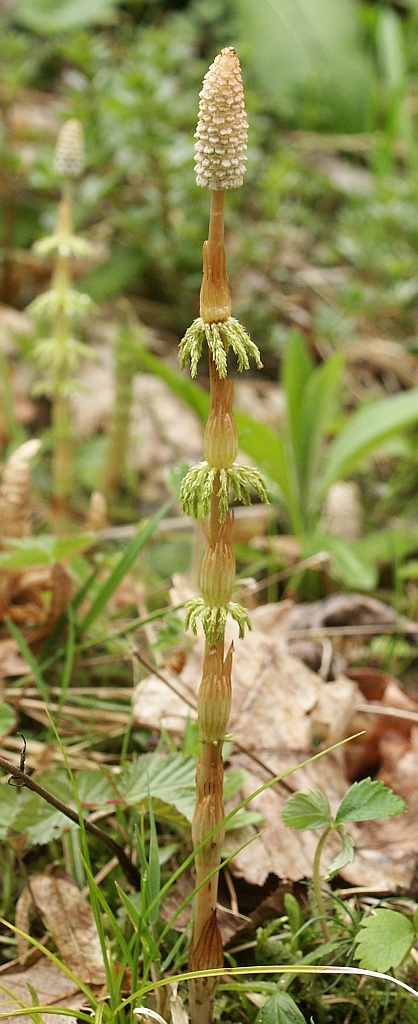 Wood HorsetailEquisetum sylvaticum
-
 Boston HorsetailEquisetum ramosissimum
Compare
Questions and answers
What is the scientific name of the Rough Horsetail?
The scientific name of the Rough Horsetail is Equisetum hyemale. Written with its author, the full name is Equisetum hyemale L..
Which family does the Rough Horsetail belong to?
Equisetum hyemale belongs to the family Equisetaceae, in the order Equisetales and the class Polypodiopsida.
Where is the Rough Horsetail found?
Checklists and occurrence records place Equisetum hyemale in 63 countries, including United States, Sweden, France, Russia, Canada and Switzerland.
What is the conservation status of the Rough Horsetail?
The IUCN Red List category recorded for Equisetum hyemale is Least Concern (LC).
What other names does the Rough Horsetail have?
Equisetum hyemale is also known in English as Common Scouring-Rush, Dutch Rush, Indian Legos, Scouring-Rush, Shave-Grass and Snakegrass.
What is shavegrass good for?
Its stems are used as polishing material, for scrubbing and cleaning pots, and to shape reeds for clarinets and saxophones. The species is also cultivated as an ornamental plant in gardens, pots, and landscape water features.[19][21][22][23][20]
Where does horsetail grass grow?
Rough horsetail grows in reliably moist habitats, including riverbanks, streamsides, moist woodland openings, lake shores, pond shores, ditches, marshes, and swamps. It occurs at elevations from sea level to 2,000 m.[9][10][11][12]
What is Equisetum hyemale used for?
Its boiled and dried stems are traditionally used as polishing material in Japan, and its stems have historically been used for scrubbing and cleaning pots. They are also used to shape reeds for clarinets and saxophones. The species is cultivated as an ornamental plant and used in landscape water features.[19][21][22][23][20]
Sources
Passages the profile rests on
- The plant has upright, jointed stems that resemble reeds and are medium to dark green. Source passage: “Equisetum hyemale has vertical jointed reed-like stalks of medium to dark green.” — English Wikipedia
- Its stems are hollow and usually unbranched. Source passage: “The hollow stems are up to 30–100 centimetres (12–39 in) in height, and are rarely branched.” — English Wikipedia
- The species produces a single type of dark-green, leafless, hollow, segmented stem. Source passage: “Scouring rush (Equisetum hyemale) grows one type of stem rather than two. They are dark green, leafless, hollow, and segmented.” — solvepestproblems.oregonstate.edu
- Its stems have 10–30 prominent silica-impregnated ridges that feel rough. Source passage: “The stems are 3–6 mm thick with 10–30 conspicuous ridges, which are impregnated with silica and rough to the touch” — English Wikipedia
- Its tiny leaves form narrow black-green sheaths around the stems at the joints. Source passage: “The tiny leaves are joined around the stem, forming a narrow black-green band or sheath at each joint.” — English Wikipedia
- Its stems typically reach 30–100 cm in height. Source passage: “The hollow stems are up to 30–100 centimetres (12–39 in) in height” — English Wikipedia
- Its stems are typically 3–6 mm thick. Source passage: “The stems are 3–6 mm thick” — English Wikipedia
- In Australia, plants can reach 2 m in height and have stems up to 15 mm thick. Source passage: “In Australia, Equisetum hyemale can grow up to 2 m (6 ft 7 in) tall with stems up to 15 mm (0.59 in) thick.” — English Wikipedia
- The species grows in reliably moist habitats, including riparian areas with heavy clay or sandy soils. Source passage: “where it forms clonal colonies in mesic (reliably moist) habitats, often in heavy clay or sandy soils in riparian zones” — English Wikipedia
- It occurs along rivers and streams and can tolerate occasional flooding. Source passage: “where it can withstand occasional flooding” — English Wikipedia
- Other habitats include moist woodland openings, lake shores, pond shores, ditches, marshes, and swamps. Source passage: “Other habitats include moist forest and woodland openings, lake and pond shores, ditches, marshes and swamps.” — English Wikipedia
- The species occurs at elevations ranging from sea level to 2,000 m. Source passage: “It grows from between sea level to 2,000 metres (6,600 ft) in elevation.” — English Wikipedia
- The species forms clonal colonies. Source passage: “where it forms clonal colonies in mesic (reliably moist) habitats” — English Wikipedia
- The species forms dense, spreading colonies in conditions ranging from full sun to partial sun. Source passage: “It forms dense spreading colonies in full to partial sun.” — English Wikipedia
- Its stems generally remain green through winter in warmer climates but usually die back in cold climates. Source passage: “The stems remain green during winter in warmer climates, but are generally deciduous in cold climates.” — English Wikipedia
- The species reproduces through spores rather than flowers or seeds. Source passage: “the plant reproduces by spores and does not produce flowers or seeds.” — English Wikipedia
- In Australia, the species usually grows from rhizome or tuber fragments rather than spores. Source passage: “It usually grows from rhizome or tuber fragments instead of spores.” — English Wikipedia
- The species is invasive in moist natural habitats in South Africa and Australia. Source passage: “In South Africa and Australia, the plant is an invasive species of moist natural habitats.” — English Wikipedia
- Boiled and dried stems are traditionally used as polishing material in Japan. Source passage: “Boiled and dried Equisetum hyemale is used as traditional polishing material, similar to a fine grit sandpaper, in Japan.” — English Wikipedia
- The species has historically been used for scrubbing and cleaning pots. Source passage: “Horsetail has been used in the past for scrubbing and cleaning pots.” — solvepestproblems.oregonstate.edu
- Its stems are used to shape reeds for clarinets and saxophones. Source passage: “The stems are used to shape the reeds of reed instruments such as clarinets or saxophones.” — English Wikipedia
- The species is cultivated as an ornamental plant in garden beds, planters, and pots. Source passage: “Equisetum hyemale cultivated as an ornamental plant, for use in contained garden beds and planters, and in pots.” — English Wikipedia
- The species is used as an accent plant in garden ponds, ornamental pools, and other landscape water features. Source passage: “It is also used as an accent plant in garden ponds and ornamental pools, and other landscape water features” — English Wikipedia
Data
- Catalogue of Life, 2026-10-16 XR cc by
- Global Biodiversity Information Facility CC BY 4.0
- Wikidata CC0
- GeoNames CC BY 4.0
- Wikimedia Commons per image; credit shown with each image
- Within the Catalogue of Life, this name comes from Checklist of Ferns and Lycophytes of the World cc by
References
- L. where the name was published
This species in other databases
- Catalogue of Life 6FYGG
- Wikidata Q263881
- iNaturalist 52673
- World Flora Online wfo-0000748047
- GRIN 400387
Page built on 24 November 2026. See how the catalog is made and all sources and licences.
Cite this page
ScientificNames.org. (2026). Equisetum hyemale (Rough Horsetail). Retrieved November 24, 2026, from https://scientificnames.org/species/equisetum-hyemale
“Equisetum hyemale (Rough Horsetail).” ScientificNames.org, 2026, scientificnames.org/species/equisetum-hyemale. Accessed 24 Nov. 2026.
ScientificNames.org. “Equisetum hyemale (Rough Horsetail).” Accessed November 24, 2026. https://scientificnames.org/species/equisetum-hyemale.
@misc{scientificnames_equisetum_hyemale_rough_horsetail,
  author = {{ScientificNames.org}},
  title = {Equisetum hyemale (Rough Horsetail)},
  year = {2026},
  url = {https://scientificnames.org/species/equisetum-hyemale},
  note = {Accessed 2026-11-24}
}