Species · Birds
Ochre-flanked Tapaculo Eugralla paradoxa
The scientific name of the Ochre-flanked Tapaculo is Eugralla paradoxa. It is a species of bird in the family Rhinocryptidae (tapaculo), order Passeriformes. The name dates from 1830.
- Scientific name
- Eugralla paradoxa (Kittlitz, 1830)
- Common name
- Ochre-flanked Tapaculo
- Genus
- Eugralla
- Family
- Rhinocryptidae (Tapaculo)
- Order
- Passeriformes
- Class
- Aves
- Red List category
- LC Least Concern
- Recorded in
- 2 countries
- Name status
- accepted in the Catalogue of Life

Overview
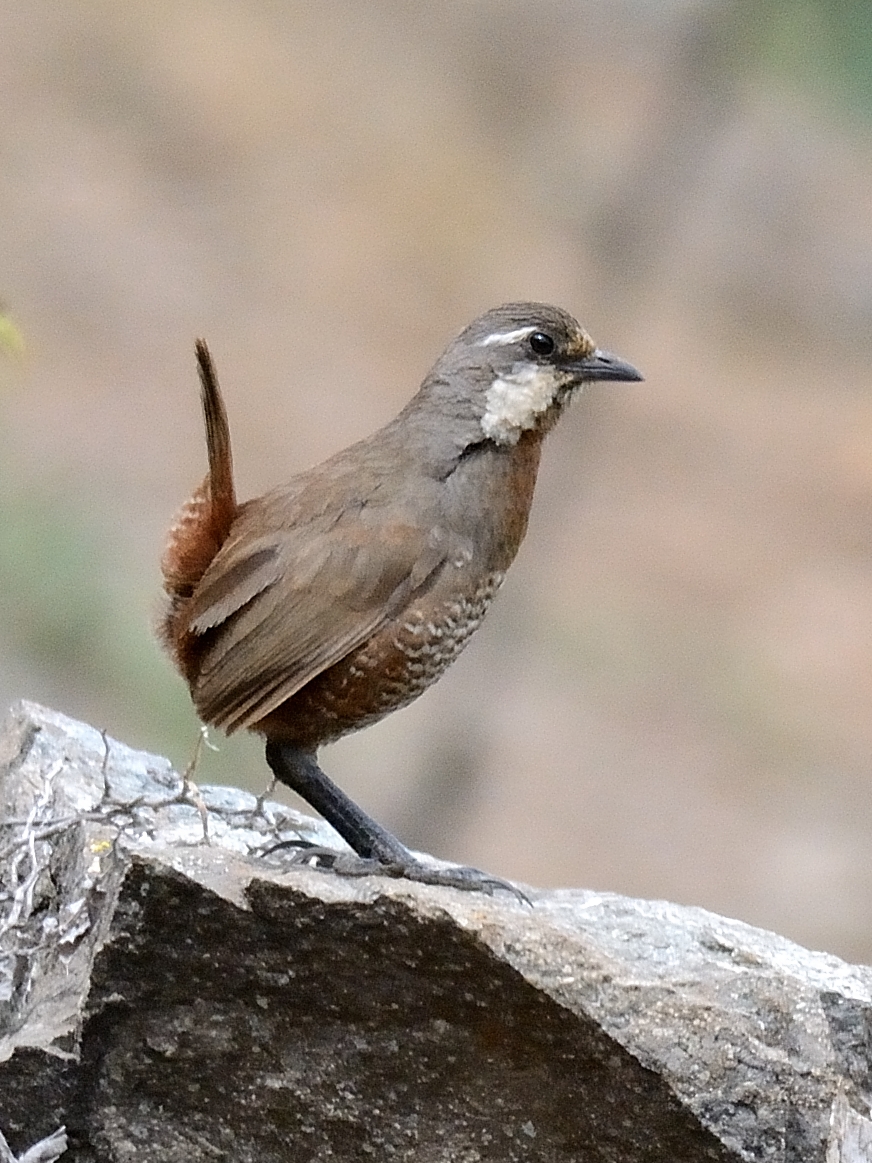
The Ochre-flanked Tapaculo (Eugralla paradoxa) is a bird in the family Rhinocryptidae and order Passeriformes. It occurs in south-central Chile and adjacent western Argentina. It has dark gray upperparts, clay brown underparts, tawny brown flanks, and a distinctive Roman-nose facial profile.
Written 27 November 2026 from the sources listed below. Each statement was checked against the passage it cites; statements that could not be supported were removed.
Appearance
Adults have dark gray upperparts and paler gray underparts extending to the abdomen. The abdomen and vent are clay brown, and the flanks are tawny brown.[1][2][3][4]
Juveniles have cinnamon to rufous barring over dusky gray plumage. The species has a distinctive Roman-nose facial profile.[5][6]
Habitat
The species occurs from sea level to approximately 900 m elevation, possibly higher. Its habitat includes dense undergrowth and bamboo in Nothofagus forest, as well as mature secondary forest.[7][8][9]
In Chile, its range extends from the Maule Region to the Los Lagos Region. In Argentina, it includes western Neuquén, Río Negro, and Chubut provinces.[10][11]
The species occurs alongside the Magellanic Tapaculo in bamboo thickets.[12]
Diet
Arthropods are considered the species' primary prey.[13]
Behaviour
Individuals forage in pairs on or near the ground. The species produces a song consisting of a short series of sharp check notes.[14][15]
Members of a pair maintain contact using a softer kek call.[16]
Reproduction and life cycle
The species is reported to produce two broods annually, laying eggs in September and again in November.[17][18]
Its nest is a large ball constructed from straw and grass, with a side entrance. Nests are usually positioned between 1 and 2 m above the ground.[19][20][21]
Some nests have been recorded as high as 7 m above ground. Recorded nest locations include thick bushes, small trees, and piles of branches.[22][23]
Conservation
The IUCN classifies the species as Least Concern. It has a fairly large geographic range and is common in the southern portion of its range.[24][25][26]
The species occurs in several protected areas in Chile. Its population size is unknown and its population is believed to be slowly declining.[27][28][29]
The species was assessed for the IUCN Red List in 2018.[30]
Similar species
The Ochre-flanked Tapaculo is slightly larger than the Magellanic Tapaculo and has a stouter bill. The Magellanic Tapaculo has a slender bill compared with the Ochre-flanked Tapaculo.[31][32][33]
Classification of the Ochre-flanked Tapaculo
| Kingdom | Animalia |
|---|---|
| Phylum | Chordata |
| Subphylum | Vertebrata |
| Infraphylum | Gnathostomata |
| Parvphylum | Osteichthyes |
| Megaclass | Tetrapoda |
| Class | Aves (Bird) |
| Order | Passeriformes (Passerine) |
| Family | Rhinocryptidae (Tapaculo) |
| Genus | Eugralla |
| Species | Eugralla paradoxa (Kittlitz, 1830) |
Where the Ochre-flanked Tapaculo is found
Checklists and occurrence records place Eugralla paradoxa in 2 countries across South America. GBIF holds 8,735 georeferenced records of it.
Countries
Regions and cities with the most records
- Los Lagos Region, Chile 2,768
- Los Ríos Region, Chile 2,233
- Valdivia, Chile 1,848
- Araucania, Chile 1,399
- Biobio, Chile 1,109
- Concepción, Chile 772
- San Pedro de la Paz, Chile 772
- Hualpén, Chile 757
- Penco, Chile 700
- Talcahuano, Chile 641
- Padre Las Casas, Chile 624
- Temuco, Chile 622
- Labranza, Chile 613
- Chiguayante, Chile 578
- Puerto Varas, Chile 402
- Puerto Montt, Chile 401
- Osorno, Chile 381
- Hualqui, Chile 373
- Castro, Chile 304
- Rio Negro, Argentina 292
- Maule Region, Chile 264
- Ancud, Chile 251
- La Unión, Chile 230
- Llanquihue, Chile 222
- Río Bueno, Chile 184
- Panguipulli, Chile 160
- Maullín, Chile 130
- Tomé, Chile 126
- Coronel, Chile 123
- Ñuble, Chile 117
- Frutillar, Chile 100
- Villarrica, Chile 96
- San Carlos de Bariloche, Argentina 91
- Nueva Imperial, Chile 89
- Lota, Chile 80
- El Bolsón, Argentina 76
Range as the checklists state it
South America
A number beside a place is its count of GBIF occurrence records. A place without a number comes from a checklist alone. Records show where a species has been observed or collected, which can include escapes and vagrants.
Common names
English
- Ochre-flanked Tapaculo
Names in 23 other languages
- Catalan
- tapacul fumat
- Chinese
- 赭胁窜鸟, 赭脇竄鳥
- Croatian
- debelokljuna strmorepka
- Czech
- štidlák lysčí
- Danish
- Okkerflanket Tapaculo
- Dutch
- Okerflanktapaculo
- Esperanto
- okraflanka tapakulo
- Finnish
- nokitapakulo
- French
- Mérulaxe à flancs ocre, Mérulaxe à flancs ocres
- German
- Rostflanken-Tapaculo, Rostflankentapaculo
- Hungarian
- rozsdáshasú fedettcsőrű
- Italian
- Tapaculo fianchiocra
- Japanese
- ワキアカオタテドリ
- Lithuanian
- rusvašonis topakulas
- Norwegian
- brunflanketapakulo
- Polish
- krytonosek południowy
- Portuguese
- tapaculo-de-flancos-ocre, tapaculo-de-flancos-ocres
- Russian
- Краснобокий тапакуло, Краснобокий топаколо
- Slovak
- tapakulo okrovoboký
- Spanish
- Churrín de la Mocha, Churrín grande
- Swedish
- ockrasidig tapakul
- Turkish
- Büyük Tapakola
- Ukrainian
- тапакуло вохристобокий
Synonyms
2 other scientific names have been used for this species and are now treated as synonyms of Eugralla paradoxa.
- Troglodytes paradoxus Kittlitz, FH, 1830
- Troglotytes paradoxus Kittlitz, 1830
Related species
-
 Chucao TapaculoScelorchilus rubecula
-
 Black-throated Huet-huetPteroptochos tarnii
-
 Moustached TurcaPteroptochos megapodius
-
 Magellanic TapaculoScytalopus magellanicus
-
 Slaty BristlefrontMerulaxis ater
-
 Ocellated TapaculoAcropternis orthonyx
-
 Crested GallitoRhinocrypta lanceolata
-
 Blackish TapaculoScytalopus latrans
Compare
Questions and answers
What is the scientific name of the Ochre-flanked Tapaculo?
The scientific name of the Ochre-flanked Tapaculo is Eugralla paradoxa. Written with its author, the full name is Eugralla paradoxa (Kittlitz, 1830).
Which family does the Ochre-flanked Tapaculo belong to?
Eugralla paradoxa belongs to the family Rhinocryptidae, in the order Passeriformes and the class Aves.
Where is the Ochre-flanked Tapaculo found?
Checklists and occurrence records place Eugralla paradoxa in 2 countries: Chile and Argentina.
What is the conservation status of the Ochre-flanked Tapaculo?
The IUCN Red List category recorded for Eugralla paradoxa is Least Concern (LC).
How large is the Ochre-flanked Tapaculo?
It measures approximately 14.5 cm in length.[34]
How much does the Ochre-flanked Tapaculo weigh?
Two measured males weighed 28.6 g and 30.5 g. Specimens of unknown sex weighed between 25.5 and 29 g.[35][36]
Where does the Ochre-flanked Tapaculo occur?
It occurs in south-central Chile and adjacent western Argentina. Its Chilean range extends from the Maule Region to the Los Lagos Region, and its Argentine range includes western Neuquén, Río Negro, and Chubut provinces.[37][10][11]
How many subspecies does the Ochre-flanked Tapaculo have?
It has no recognized subspecies and is monotypic within the genus Eugralla.[38][39]
What is the taxonomic position of the Ochre-flanked Tapaculo?
It is the sole member of the genus Eugralla.[40]
Sources
Passages the profile rests on
- Adult individuals have dark gray upperparts. Source passage: “The adults' upper parts are dark gray” — English Wikipedia
- The adult underparts are paler gray down to the abdomen. Source passage: “the underparts as far as the abdomen paler gray” — English Wikipedia
- The adult abdomen and vent are clay brown. Source passage: “the abdomen and vent are clay brown.” — English Wikipedia
- The flanks are tawny brown. Source passage: “The flanks are tawny brown” — English Wikipedia
- Juveniles have cinnamon to rufous barring over dusky gray plumage. Source passage: “The juvenile is barred throughout with cinnamon to rufous over dusky gray.” — English Wikipedia
- The species has a distinctive Roman-nose facial profile. Source passage: “Unusual for a tapaculo, it has a "Roman nose" facial profile.” — English Wikipedia
- The species occurs from sea level to approximately 900 m elevation, possibly higher. Source passage: “It is found from sea level to 900 m (3,000 ft) and perhaps higher” — English Wikipedia
- Its habitat includes dense undergrowth and bamboo in Nothofagus forest. Source passage: “where it inhabits dense undergrowth and bamboo in Nothofagus” — English Wikipedia
- The species also inhabits mature secondary forest. Source passage: “and mature secondary forest.” — English Wikipedia
- Its Chilean range extends from the Maule Region to the Los Lagos Region. Source passage: “(Maule Region to Los Lagos Region)” — English Wikipedia
- Its Argentine range includes western Neuquén, Río Negro, and Chubut provinces. Source passage: “the western parts of the adjoining Argentinian provinces of Neuquén, Río Negro, and Chubut.” — English Wikipedia
- The species occurs alongside the Magellanic Tapaculo in bamboo thickets. Source passage: “which often occurs alongside Ochre-flanked in bamboo thickets” — ebird.org
- Arthropods are considered the species' primary prey. Source passage: “Its primary prey is thought to be arthropods.” — English Wikipedia
- Individuals forage in pairs on or near the ground. Source passage: “The ochre-flanked tapaculo forages in pairs on and near the ground” — English Wikipedia
- The species produces a song consisting of a short series of sharp check notes. Source passage: “The ochre-flanked tapaculo's song is a short series of sharp "check" notes” — English Wikipedia
- Members of a pair maintain contact using a softer kek call. Source passage: “The members of a pair keep in contact with a softer "kek" call” — English Wikipedia
- The species is reported to produce two broods annually. Source passage: “The ochre-flanked tapaculo is known to "double brood"” — English Wikipedia
- The species lays eggs in September and again in November. Source passage: “laying eggs in September and again in November.” — English Wikipedia
- Its nest is a large ball constructed from straw and grass. Source passage: “The nest is a large ball of straw and grass” — English Wikipedia
- The nest has a side entrance. Source passage: “with a side entrance” — English Wikipedia
- Nests are usually positioned between 1 and 2 m above the ground. Source passage: “that is usually placed 1 to 2 m (3.3 to 6.6 ft) above ground” — English Wikipedia
- Some nests have been recorded as high as 7 m above ground. Source passage: “though sometimes as high as 7 m (23 ft).” — English Wikipedia
- Recorded nest locations include thick bushes, small trees, and piles of branches. Source passage: “Nests have been found in thick bushes, small trees, and piles of branches.” — English Wikipedia
- The IUCN classifies the species as Least Concern. Source passage: “The IUCN has assessed the ochre-flanked tapaculo as being of Least Concern.” — English Wikipedia
- The species has a fairly large geographic range. Source passage: “It has a fairly large range” — English Wikipedia
- The species is common in the southern portion of its range. Source passage: “and is common in the southern part of it.” — English Wikipedia
- The species occurs in several protected areas in Chile. Source passage: “It inhabits several protected areas in Chile.” — English Wikipedia
- The species' population size is unknown. Source passage: “However, the population's number is unknown” — English Wikipedia
- The species' population is believed to be slowly declining. Source passage: “and is believed to be slowly decreasing.” — English Wikipedia
- The species was assessed for the IUCN Red List in 2018. Source passage: “has most recently been assessed for The IUCN Red List of Threatened Species in 2018.” — iucnredlist.org
- The ochre-flanked tapaculo is slightly larger than the Magellanic Tapaculo. Source passage: “Slightly larger and stouter-billed than Magellanic Tapaculo” — ebird.org
- The ochre-flanked tapaculo has a stouter bill than the Magellanic Tapaculo. Source passage: “Slightly larger and stouter-billed than Magellanic Tapaculo” — ebird.org
- The Magellanic Tapaculo has a slender bill compared with the ochre-flanked tapaculo. Source passage: “(bill of Magellanic is slender).” — ebird.org
- The species measures approximately 14.5 cm in length. Source passage: “The ochre-flanked tapaculo is 14.5 cm (5.7 in) long.” — English Wikipedia
- Two measured males weighed 28.6 g and 30.5 g. Source passage: “Two males weighed 28.6 and 30.5 g (1.01 and 1.08 oz)” — English Wikipedia
- Specimens of unknown sex weighed between 25.5 and 29 g. Source passage: “other specimens of unknown sex weighed 25.5 to 29 g (0.90 to 1.02 oz).” — English Wikipedia
- The species occurs in south-central Chile and adjacent western Argentina. Source passage: “It is found in south-central Chile and adjacent western Argentina.” — English Wikipedia
- The species has no recognized subspecies. Source passage: “and has no subspecies.” — English Wikipedia
- The species is monotypic within the genus Eugralla. Source passage: “It is monotypic within the genus Eugralla.” — inaturalist.org
- The species is the sole member of the genus Eugralla. Source passage: “The ochre-flanked tapaculo is the only member of the genus Eugralla” — English Wikipedia
Data
- Catalogue of Life, 2026-10-16 XR cc by
- Global Biodiversity Information Facility CC BY 4.0
- Wikidata CC0
- GeoNames CC BY 4.0
- Wikimedia Commons per image; credit shown with each image
- Within the Catalogue of Life, this name comes from The Integrated Taxonomic Information System cc0
References
- Gill, Frank, & and Minturn Wright. (2006). Birds of the World: Recommended English Names.
This species in other databases
Page built on 28 November 2026. See how the catalog is made and all sources and licences.
Cite this page
ScientificNames.org. (2026). Eugralla paradoxa (Ochre-flanked Tapaculo). Retrieved November 28, 2026, from https://scientificnames.org/species/eugralla-paradoxa
“Eugralla paradoxa (Ochre-flanked Tapaculo).” ScientificNames.org, 2026, scientificnames.org/species/eugralla-paradoxa. Accessed 28 Nov. 2026.
ScientificNames.org. “Eugralla paradoxa (Ochre-flanked Tapaculo).” Accessed November 28, 2026. https://scientificnames.org/species/eugralla-paradoxa.
@misc{scientificnames_eugralla_paradoxa_ochre_flanked_tapaculo,
  author = {{ScientificNames.org}},
  title = {Eugralla paradoxa (Ochre-flanked Tapaculo)},
  year = {2026},
  url = {https://scientificnames.org/species/eugralla-paradoxa},
  note = {Accessed 2026-11-28}
}