Species · Amphibians
Black-eyed Tree Frog Exerodonta melanomma
The scientific name of the Black-eyed Tree Frog is Exerodonta melanomma. It is a species of amphibian in the family Hylidae (hylids), order Anura. The name dates from 1940.
- Scientific name
- Exerodonta melanomma (Taylor, 1940)
- Common name
- Black-eyed Tree Frog
- Genus
- Exerodonta
- Family
- Hylidae (Hylids)
- Order
- Anura
- Class
- Amphibia
- Red List category
- VU Vulnerable
- Recorded in
- 1 country
- Name status
- accepted in the Catalogue of Life
Overview
The Black-eyed Tree Frog lives in Mexico and is endemic to the country. The species has been recorded at elevations between 900 and 2,000 meters above sea level.
Written 27 November 2026 from the sources listed below. Each statement was checked against the passage it cites; statements that could not be supported were removed.
Habitat
The Black-eyed Tree Frog inhabits subtropical or tropical moist montane forests and rivers, including intermittent rivers. It also occurs in cloud forests and pine-oak forests.[1][2][3][4][5]
The species has been recorded at elevations between 900 and 2,000 meters above sea level.[6]
Conservation
Habitat loss threatens the Black-eyed Tree Frog.[7]
Classification of the Black-eyed Tree Frog
| Kingdom | Animalia |
|---|---|
| Phylum | Chordata |
| Subphylum | Vertebrata |
| Infraphylum | Gnathostomata |
| Parvphylum | Osteichthyes |
| Megaclass | Tetrapoda |
| Class | Amphibia (Amphibians) |
| Order | Anura (Frogs) |
| Family | Hylidae (Hylids) |
| Genus | Exerodonta (Highlands Treefrogs) |
| Species | Exerodonta melanomma (Taylor, 1940) |
Where the Black-eyed Tree Frog is found
Checklists and occurrence records place Exerodonta melanomma in 1 country. GBIF holds 518 georeferenced records of it.
Countries
Regions and cities with the most records
- Oaxaca, Mexico 230
- Guerrero, Mexico 120
- Tixtla de Guerrero, Mexico 78
- Chilpancingo, Mexico 60
- Zumpango del Río, Mexico 46
- Chiapas, Mexico 15
- Atoyac de Álvarez, Mexico 13
- Puerto Escondido, Mexico 9
- Arriaga, Mexico 5
- Chilapa de Álvarez, Mexico 5
- Matías Romero Avendaño, Mexico 4
- Teloloapan, Mexico 3
A number beside a place is its count of GBIF occurrence records. A place without a number comes from a checklist alone. Records show where a species has been observed or collected, which can include escapes and vagrants.
Common names
English
- Black-eyed Tree Frog
Names in 4 other languages
- Czech
- rosnička černooká
- Lithuanian
- Tamsiadėmė medvarlė
- Russian
- Темнопятнистая квакша
- Spanish
- Rana de Árbol Ojo Negro, Rana-de Arbol Ojo Negro, Rana-de árbol ojo negro, Ranita de ojos negros
Synonyms
3 other scientific names have been used for this species and are now treated as synonyms of Exerodonta melanomma.
- Exerodonta melanoma (Taylor, 1940)
- Hyla melanomma Taylor, 1940
- Hyla melanomma melanomma Taylor, 1940
Related species
-
 Emerald TreefrogExerodonta smaragdina
- Perkins' TreefrogExerodonta perkinsi
- Chimalapa TreefrogExerodonta chimalapa
- Sumichrast's TreefrogExerodonta sumichrasti
- Puebla TreefrogExerodonta xera
-
 Río Aloapan TreefrogExerodonta abdivita
- Chiapan Highlands TreefrogExerodonta bivocata
-
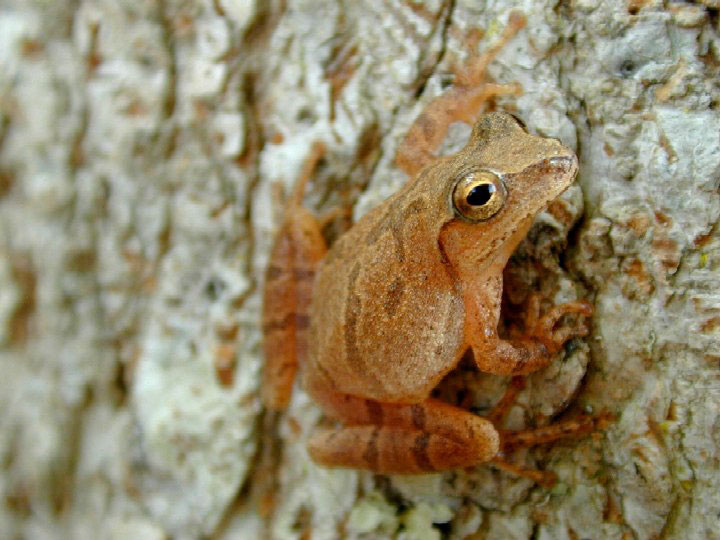 Spring PeeperPseudacris crucifer
Compare
Questions and answers
What is the scientific name of the Black-eyed Tree Frog?
The scientific name of the Black-eyed Tree Frog is Exerodonta melanomma. Written with its author, the full name is Exerodonta melanomma (Taylor, 1940).
Which family does the Black-eyed Tree Frog belong to?
Exerodonta melanomma belongs to the family Hylidae, in the order Anura and the class Amphibia.
Where is the Black-eyed Tree Frog found?
Checklists and occurrence records place Exerodonta melanomma in 1 country: Mexico.
What is the conservation status of the Black-eyed Tree Frog?
The IUCN Red List category recorded for Exerodonta melanomma is Vulnerable (VU).
Sources
Passages the profile rests on
- The species inhabits subtropical or tropical moist montane forests. Source passage: “Its natural habitats are subtropical or tropical moist montane forests, rivers, and intermittent rivers.” — English Wikipedia
- The species inhabits rivers. Source passage: “Its natural habitats are subtropical or tropical moist montane forests, rivers, and intermittent rivers.” — English Wikipedia
- The species inhabits intermittent rivers. Source passage: “Its natural habitats are subtropical or tropical moist montane forests, rivers, and intermittent rivers.” — English Wikipedia
- The species occurs in cloud forests. Source passage: “Scientists have seen it between 900 and 2000 meters above sea level in cloud forests and pine-oak forests.” — simple.wikipedia.org
- The species occurs in pine-oak forests. Source passage: “Scientists have seen it between 900 and 2000 meters above sea level in cloud forests and pine-oak forests.” — simple.wikipedia.org
- The species has been recorded at elevations between 900 and 2,000 meters above sea level. Source passage: “Scientists have seen it between 900 and 2000 meters above sea level in cloud forests and pine-oak forests.” — simple.wikipedia.org
- Habitat loss threatens the species. Source passage: “It is threatened by habitat loss.” — English Wikipedia
Data
- Catalogue of Life, 2026-10-16 XR cc by
- Global Biodiversity Information Facility CC BY 4.0
- Wikidata CC0
- GeoNames CC BY 4.0
- Within the Catalogue of Life, this name comes from The Integrated Taxonomic Information System cc0
This species in other databases
Page built on 29 November 2026. See how the catalog is made and all sources and licences.
Cite this page
ScientificNames.org. (2026). Exerodonta melanomma (Black-eyed Tree Frog). Retrieved November 29, 2026, from https://scientificnames.org/species/exerodonta-melanomma
“Exerodonta melanomma (Black-eyed Tree Frog).” ScientificNames.org, 2026, scientificnames.org/species/exerodonta-melanomma. Accessed 29 Nov. 2026.
ScientificNames.org. “Exerodonta melanomma (Black-eyed Tree Frog).” Accessed November 29, 2026. https://scientificnames.org/species/exerodonta-melanomma.
@misc{scientificnames_exerodonta_melanomma_black_eyed_tree_frog,
  author = {{ScientificNames.org}},
  title = {Exerodonta melanomma (Black-eyed Tree Frog)},
  year = {2026},
  url = {https://scientificnames.org/species/exerodonta-melanomma},
  note = {Accessed 2026-11-29}
}