Species · Amphibians
Sumichrast's Treefrog Exerodonta sumichrasti
The scientific name of the Sumichrast's Treefrog is Exerodonta sumichrasti. It is a species of amphibian in the family Hylidae (hylids), order Anura. The name dates from 1879.
- Scientific name
- Exerodonta sumichrasti Brocchi, 1879
- Common name
- Sumichrast's Treefrog
- Genus
- Exerodonta
- Family
- Hylidae (Hylids)
- Order
- Anura
- Class
- Amphibia
- Red List category
- LC Least Concern
- Recorded in
- 1 country
- Name status
- accepted in the Catalogue of Life
Overview
Exerodonta sumichrasti is endemic to Mexico and occurs on the Pacific slopes of southern Mexico in Guerrero, Oaxaca, and Chiapas, as well as in the Chiapan highlands. It has a broad, flat head, a long, pointed snout, and dorsal coloration ranging from pale green to pale brown.
Written 27 November 2026 from the sources listed below. Each statement was checked against the passage it cites; statements that could not be supported were removed.
Appearance
Sumichrast's Treefrog has a broad, flat head and a long, pointed snout when viewed from above. Its tympanum is distinct but may be partly concealed by skin on its posteroventral side.[1][2]
Its arms are short and robust, with stout fingers bearing moderately large discs. Its fingers are partially webbed.[3][4]
Its legs are relatively short and robust, while its toes are moderately long and slender. The toe discs are slightly smaller than the finger discs, and the toes are three-quarters webbed.[5][6][7][8]
Its dorsal coloration varies from nearly uniform pale green or grayish green to yellowish tan or pale brown. Some individuals have tiny, darker flecks on their dorsal coloration.[9][10]
Adult males measure 23–28 mm in snout–vent length. Adult females measure 29–33 mm in snout–vent length.[11][12]
Habitat
Sumichrast's Treefrog inhabits sub-humid oak and pine forests at elevations of 200–2,000 m above sea level.[13][14]
During the dry season, it is often found in arboreal bromeliads.[15]
Reproduction and life cycle
Sumichrast's Treefrog breeds in streams.[16]
Conservation
Habitat loss threatens Sumichrast's Treefrog despite its being common.[17]
Classification of the Sumichrast's Treefrog
| Kingdom | Animalia |
|---|---|
| Phylum | Chordata |
| Subphylum | Vertebrata |
| Infraphylum | Gnathostomata |
| Parvphylum | Osteichthyes |
| Megaclass | Tetrapoda |
| Class | Amphibia (Amphibians) |
| Order | Anura (Frogs) |
| Family | Hylidae (Hylids) |
| Genus | Exerodonta (Highlands Treefrogs) |
| Species | Exerodonta sumichrasti Brocchi, 1879 |
Where the Sumichrast's Treefrog is found
Checklists and occurrence records place Exerodonta sumichrasti in 1 country. GBIF holds 1,032 georeferenced records of it.
Countries
Regions and cities with the most records
- Oaxaca, Mexico 393
- Chiapas, Mexico 249
- Guerrero, Mexico 62
- Berriozábal, Mexico 43
- Ocozocoautla de Espinosa, Mexico 42
- Atoyac de Álvarez, Mexico 39
- Arriaga, Mexico 35
- Santo Domingo Tehuantepec, Mexico 29
- Tonalá, Mexico 27
- Salina Cruz, Mexico 21
- Matías Romero Avendaño, Mexico 12
- Tuxtla, Mexico 9
- Arcelia, Mexico 8
- Ixtepec, Mexico 8
- Comitán, Mexico 7
- Chiapa de Corzo, Mexico 5
- Coalcomán de Vázquez Pallares, Mexico 4
- Heroica Ciudad de Juchitán de Zaragoza, Mexico 4
- Michoacán, Mexico 4
- Morelos, Mexico 4
- Suchiapa, Mexico 4
- Chilapa de Álvarez, Mexico 3
- Juchitepec de Mariano Rivapalacio, Mexico 3
- Ozumba de Alzate, Mexico 3
- Yautepec, Mexico 3
- Yecapixtla, Mexico 3
A number beside a place is its count of GBIF occurrence records. A place without a number comes from a checklist alone. Records show where a species has been observed or collected, which can include escapes and vagrants.
Common names
English
- Sumichrast's Treefrog
Names in 2 other languages
- Czech
- rosnička Sumichrastova
- Spanish
- Rana de árbol, Rana-de árbol de sumichrast
Synonyms
3 other scientific names have been used for this species and are now treated as synonyms of Exerodonta sumichrasti.
- Hyla sumichrasti (Brocchi, 1879)
- Hylella platycephala Cope, 1879
- Hylella sumichrasti (Brocchi, 1879)
Related species
-
 Emerald TreefrogExerodonta smaragdina
- Black-eyed Tree FrogExerodonta melanomma
- Perkins' TreefrogExerodonta perkinsi
- Chimalapa TreefrogExerodonta chimalapa
- Puebla TreefrogExerodonta xera
-
 Río Aloapan TreefrogExerodonta abdivita
- Chiapan Highlands TreefrogExerodonta bivocata
-
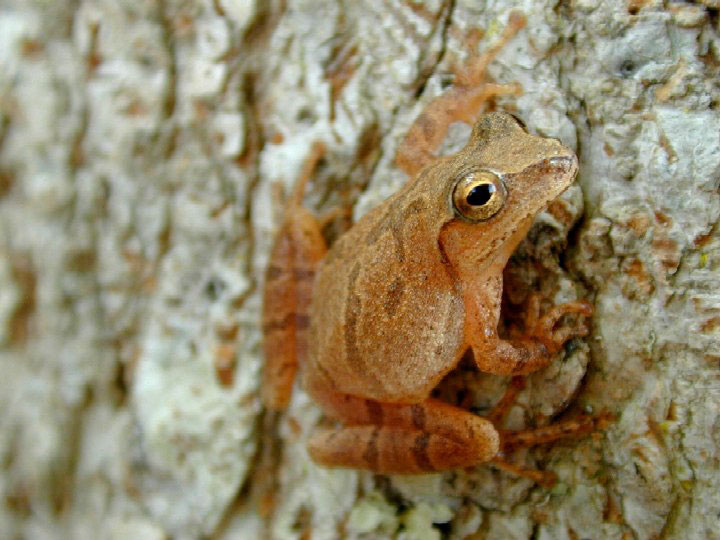 Spring PeeperPseudacris crucifer
Compare
Questions and answers
What is the scientific name of the Sumichrast's Treefrog?
The scientific name of the Sumichrast's Treefrog is Exerodonta sumichrasti. Written with its author, the full name is Exerodonta sumichrasti Brocchi, 1879.
Which family does the Sumichrast's Treefrog belong to?
Exerodonta sumichrasti belongs to the family Hylidae, in the order Anura and the class Amphibia.
Where is the Sumichrast's Treefrog found?
Checklists and occurrence records place Exerodonta sumichrasti in 1 country: Mexico.
What is the conservation status of the Sumichrast's Treefrog?
The IUCN Red List category recorded for Exerodonta sumichrasti is Least Concern (LC).
Sources
Passages the profile rests on
- The species has a broad, flat head and a long, pointed snout when viewed from above. Source passage: “The head is broad and flat and with a long and pointed snout in dorsal profile.” — English Wikipedia
- Its tympanum is distinct but may be partly concealed by skin on its posteroventral side. Source passage: “The tympanum is distinct but sometimes covered by skin posteroventrally.” — English Wikipedia
- Its arms are short and robust, with stout fingers bearing moderately large discs. Source passage: “The arms are short and robust, with short and stout fingers bearing moderately large discs;” — English Wikipedia
- Its fingers are partially webbed. Source passage: “the fingers are partially webbed.” — English Wikipedia
- Its legs are relatively short and robust. Source passage: “The legs are also relatively short and robust.” — English Wikipedia
- Its toes are moderately long and slender. Source passage: “The toes are moderately long and slender.” — English Wikipedia
- Its toe discs are slightly smaller than its finger discs. Source passage: “They bear discs that are slightly smaller than the finger discs;” — English Wikipedia
- Its toes are three-quarters webbed. Source passage: “the toes are three-quarters webbed.” — English Wikipedia
- Its dorsal coloration varies from nearly uniform pale green or grayish green to yellowish tan or pale brown. Source passage: “The dorsal coloration is variable, ranging from a nearly uniform pale green or grayish green to yellowish tan or pale brown.” — English Wikipedia
- Some individuals have tiny, darker flecks on their dorsal coloration. Source passage: “Some specimens have minute, darker flecks.” — English Wikipedia
- Adult males measure 23–28 mm in snout–vent length. Source passage: “Adult males measure 23–28 mm (0.91–1.10 in) and adult females 29–33 mm (1.1–1.3 in) in snout–vent length.” — English Wikipedia
- Adult females measure 29–33 mm in snout–vent length. Source passage: “Adult males measure 23–28 mm (0.91–1.10 in) and adult females 29–33 mm (1.1–1.3 in) in snout–vent length.” — English Wikipedia
- The species inhabits sub-humid oak and pine forests. Source passage: “Its natural habitats are sub-humid oak and pine forests” — English Wikipedia
- The species occurs at elevations of 200–2,000 m above sea level. Source passage: “at elevations of 200–2,000 m (660–6,560 ft) above sea level.” — English Wikipedia
- During the dry season, the species is often found in arboreal bromeliads. Source passage: “It is often found in arboreal bromeliads in the dry season.” — English Wikipedia
- The species breeds in streams. Source passage: “Breeding takes place in streams.” — English Wikipedia
- Habitat loss threatens the species despite its being common. Source passage: “Although a common species, it is threatened by habitat loss.” — English Wikipedia
Data
- Catalogue of Life, 2026-10-16 XR cc by
- Global Biodiversity Information Facility CC BY 4.0
- Wikidata CC0
- GeoNames CC BY 4.0
- Within the Catalogue of Life, this name comes from The Integrated Taxonomic Information System cc0
This species in other databases
Page built on 27 November 2026. See how the catalog is made and all sources and licences.
Cite this page
ScientificNames.org. (2026). Exerodonta sumichrasti (Sumichrast's Treefrog). Retrieved November 27, 2026, from https://scientificnames.org/species/exerodonta-sumichrasti
“Exerodonta sumichrasti (Sumichrast's Treefrog).” ScientificNames.org, 2026, scientificnames.org/species/exerodonta-sumichrasti. Accessed 27 Nov. 2026.
ScientificNames.org. “Exerodonta sumichrasti (Sumichrast's Treefrog).” Accessed November 27, 2026. https://scientificnames.org/species/exerodonta-sumichrasti.
@misc{scientificnames_exerodonta_sumichrasti_sumichrasts_treefrog,
  author = {{ScientificNames.org}},
  title = {Exerodonta sumichrasti (Sumichrast's Treefrog)},
  year = {2026},
  url = {https://scientificnames.org/species/exerodonta-sumichrasti},
  note = {Accessed 2026-11-27}
}