Species · Flowering plants
Leopard-plant Farfugium japonicum
The scientific name of the Leopard-plant is Farfugium japonicum. It is a species of flowering plant in the family Asteraceae (composite), order Asterales.
- Scientific name
- Farfugium japonicum (L.) Kitam.
- Common name
- Leopard-plant
- Genus
- Farfugium
- Family
- Asteraceae (Composite)
- Order
- Asterales
- Class
- Magnoliopsida
- Recorded in
- 8 countries
- Name status
- accepted in the Catalogue of Life
Overview
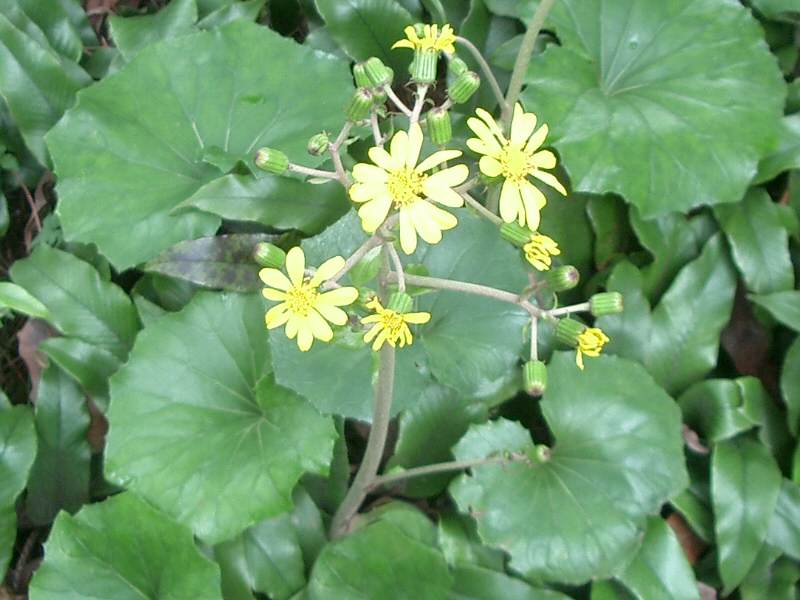
The leopard-plant is native to coastal areas of Japan, Korea, and Taiwan. The plant is distinguished by its large, glossy, round leaves and yellow daisy-like flowers.
Written 26 November 2026 from the sources listed below. Each statement was checked against the passage it cites; statements that could not be supported were removed.
Appearance
The leopard-plant has large, round or kidney-shaped leaves with a slightly fleshy texture. Its leaves are glossy and shiny, and some cultivars have deep green foliage with bright yellow spots.[1][2][3]
The plant produces daisy-like yellow flowers that appear in autumn. The flowers measure approximately 2.5–5 cm across.[4][5][6]
The plant grows approximately 60 cm tall and 60 cm wide.[7]
Habitat
The species is native to streams, seashores, and rocky coastal areas of Japan, Korea, and Taiwan.[8][9]
The plant grows best in moist, rich soil and partial sun to shade. It is suitable for shady woodland gardens, boggy areas, pond banks, container gardens, and perennial borders.[10][11]
Behaviour
The leopard-plant is an evergreen perennial that grows in clumps and spreads through rhizomes. It can wilt if the soil dries out, and excessive sunlight can cause its leaves to wilt and burn.[12][13][14]
The plant generally experiences few insect or disease problems, although slugs and snails occasionally cause problems.[15]
Reproduction and life cycle
Bees and butterflies pollinate the flowers. The plant produces seeds that can be collected for sowing.[16][17]
The leopard-plant can be propagated by dividing its clumps in spring. Seeds can also be sown in a cold frame or greenhouse during winter or early spring.[18][19]
Conservation
The species is generally hardy in USDA hardiness zones 7–10.[20]
Uses
The leopard-plant is cultivated as an ornamental plant in gardens and containers. Variegated cultivars are used to brighten shaded garden settings.[21][22]
The plant can be used as a groundcover beneath ornamental shrubs and trees or as a back-of-the-border planting in small garden beds and containers.[23][24]
Classification of the Leopard-plant
| Kingdom | Plantae |
|---|---|
| Subkingdom | Pteridobiotina |
| Phylum | Tracheophyta |
| Class | Magnoliopsida |
| Order | Asterales |
| Family | Asteraceae (Composite) |
| Subfamily | Asteroideae |
| Tribe | Senecioneae |
| Subtribe | Tussilagininae |
| Genus | Farfugium |
| Species | Farfugium japonicum (L.) Kitam. |
Where the Leopard-plant is found
Checklists and occurrence records place Farfugium japonicum in 8 countries across Asia and Europe. GBIF holds 5,437 georeferenced records of it.
Countries where it is native or its origin is not stated
Countries where it has been introduced
Regions and cities with the most records
- Neihu, Taiwan 988
- Xizhi, Taiwan 988
- Taipei, Taiwan 904
- New Taipei City, Taiwan 837
- Sanzhi, Taiwan 829
- Danshui, Taiwan 812
- Banqiao, Taiwan 716
- Keelung, Taiwan 595
- Tokyo, Japan 574
- Komae, Japan 552
- Noborito, Japan 545
- Chōfu, Japan 542
- Sekimachi-minami, Japan 534
- Musashino, Japan 533
- Kamiigusa, Japan 521
- Shimoigusa, Japan 507
- Asagaya-minami, Japan 503
- Ōizumi-gakuenchō, Japan 480
- Azamino, Japan 469
- Nishi-Tokyo-shi, Japan 465
- Taiwan, Taiwan 457
- Inagi, Japan 447
- Koganei, Japan 447
- Fuchū, Japan 424
- Higashikurume, Japan 422
- Kokubunji, Japan 397
- Kodaira, Japan 396
- Kiyose, Japan 382
- Ōizumimachi, Japan 362
- Den’enchōfu, Japan 359
- Taipei, Taiwan 344
- Yamato, Japan 323
- Ōta, Japan 323
- Ebara, Japan 322
- Nakano, Japan 318
- Tokyo, Japan 315
9 more countries have a few records outside this range
These countries hold a few records of Farfugium japonicum but lie outside the range the checklists give for it. Such records are often zoo or garden specimens, museum material or vagrants, so the species is not counted as occurring there.
Range as the checklists state it
Sicily [I]; Madeira [I]; Canary Isl. [I] (Gran Canaria [I]); China (?Anhui, Fujian, Guangdong, Guangxi, Hubei, Hunan, ?Jiangsu, Zhejiang); South Korea; Japan (Honshu, Shikoku, Kyushu); Ryukyu Isl.; Ogasawara Isl. (Ogasawara Isl.); Taiwan; India [c]
A number beside a place is its count of GBIF occurrence records. A place without a number comes from a checklist alone. Records show where a species has been observed or collected, which can include escapes and vagrants.
Common names
English
- Leopard-plant
- Tractor Seat Plant
- Green Leopard Plant
- Leopardplant
Names in 10 other languages
- Chinese
- da wu feng cao, 大吳風草、橐吾, 山菊
- Danish
- japansk følfod
- Finnish
- japaninnauhio
- German
- Leopardenpflanze
- Japanese
- tsuwabuki, ツワブキ, ツワブキ(広義), 石蕗
- Korean
- 털머위
- Norwegian Bokmål
- høstnøkketunge
- Russian
- Бузульник туссилаговидный, Мать-и-мачеха японская, Фарфугиум японский
- Slovak
- podbeľovec japonský
- Swedish
- tigertass
Synonyms
24 other scientific names have been used for this species and are now treated as synonyms of Farfugium japonicum.
- Arnica tussilaginea Burm.fil.
- Farfugium giganteum Dammann
- Farfugium grande Lindl.
- Farfugium japonicum f. aligulatum Konta
- Farfugium japonicum f. japonicum
- Farfugium japonicum var. formosanum (Hayata) Kitam.
- Farfugium japonicum var. japonicum
- Farfugium japonicum var. nokozanense (Yamam.) Kitam.
- Farfugium kaempferi (Siebold & Zucc.) Benth.
- Farfugium tussilagineum (Burm.fil.) Kitam.
- Farfugium tussilagineum var. formosanum (Hayata) Kitam.
- Ligularia farfugium K.Koch
- Ligularia formosana (Hayata) Masam.
- Ligularia kaempferi Siebold & Zucc.
- Ligularia nokozanensis Yamam.
- Ligularia tussilaginea (Burm.fil.) Makino
- Ligularia tussilaginea var. formosana Hayata
- Ligularia tussilaginea var. tussilaginea
- Senecio farfugium K.Koch
- Senecio kaempferi (Siebold & Zucc.) DC.
- Senecio sieboldii Sch.Bip.
- Senecio tussilagineus (Burm.fil.) Kuntze
- Tussilago japonica L.
- Senecio japonicus Less. ambiguous synonym
Subspecies and varieties
Related species
- Farfugium hiberniflorum
-
 Jerusalem ArtichokeHelianthus tuberosus
-
 ChicoryCichorium intybus
-
 Absinthe WormwoodArtemisia absinthium
-
 Common SunflowerHelianthus annuus
-
 Common YarrowAchillea millefolium
-
 LettuceLactuca sativa
-
 TarragonArtemisia dracunculus
Compare
Questions and answers
What is the scientific name of the Leopard-plant?
The scientific name of the Leopard-plant is Farfugium japonicum. Written with its author, the full name is Farfugium japonicum (L.) Kitam..
Which family does the Leopard-plant belong to?
Farfugium japonicum belongs to the family Asteraceae, in the order Asterales and the class Magnoliopsida.
Where is the Leopard-plant found?
Checklists and occurrence records place Farfugium japonicum in 8 countries, including Japan, Taiwan, South Korea, China, Hong Kong and India.
What other names does the Leopard-plant have?
Farfugium japonicum is also known in English as Tractor Seat Plant, Green Leopard Plant and Leopardplant.
Do leopard plants like sun or shade?
Leopard-plants grow best in partial sun to shade. Excessive sunlight can cause their leaves to wilt and burn.[10][14]
How do you take care of a Leopard Plant?
Grow the plant in moist, rich soil in partial sun to shade. Avoid allowing the soil to dry out, as the plant can wilt, and protect its leaves from excessive sunlight.[10][13][14]
How often does a Leopard Plant bloom?
The plant produces yellow flowers that appear in autumn.[4][5]
Does Farfugium prefer sun or shade?
Farfugium grows best in partial sun to shade. Excessive sunlight can cause its leaves to wilt and burn.[10][14]
Do Leopard Plants do well in pots?
The species is cultivated in containers and is suitable for container gardens.[11][21]
Are Leopard Plants evergreen?
Yes. The leopard-plant is an evergreen perennial.[12]
Sources
Passages the profile rests on
- The plant has large, round or kidney-shaped leaves with a slightly fleshy texture. Source passage: “with large round or kidney-shaped leaves that are slightly fleshy in texture.” — English Wikipedia
- The leaves are round and shiny. Source passage: “The round shiny leaves have also given rise to the common name “tractor seat plant”.” — hgic.clemson.edu
- Some cultivars have deep green glossy leaves with bright yellow spots. Source passage: “‘Aureomaculata’ is known for deep green glossy foliage with bright yellow spots” — hgic.clemson.edu
- The plant produces daisy-like yellow flowers. Source passage: “Daisy-like yellow flowers, 2.5–5 cm (1–2 in) across” — English Wikipedia
- The plant has glossy green foliage and showy yellow flowers that appear in autumn. Source passage: “Leopard plants (Farfugium japonicum) have showy yellow flowers in autumn that rise above the glossy green foliage.” — hgic.clemson.edu
- The flowers measure approximately 2.5–5 cm across. Source passage: “Daisy-like yellow flowers, 2.5–5 cm (1–2 in) across” — English Wikipedia
- The plant grows approximately 60 cm tall and 60 cm wide. Source passage: “growing in a loose clump about 60 cm (24 in) tall and wide” — English Wikipedia
- The species is native to streams and seashores in Japan. Source passage: “It is native to streams and seashores of Japan” — English Wikipedia
- The species is native to rocky coastal areas of Japan, Korea, and Taiwan. Source passage: “Native to the rocky coastal areas of Japan, Korea, and Taiwan” — hgic.clemson.edu
- The plant grows best in moist, rich soil and partial sun to shade. Source passage: “Farfugium prefers moist, rich soil but is not fussy about pH and grows best in partial sun to shade.” — hgic.clemson.edu
- The plant is suitable for shady woodland gardens, boggy areas, pond banks, container gardens, and perennial borders. Source passage: “Farfugium adds rich texture and deep glossy foliage to shady woodland gardens, boggy areas, pond banks, container gardens, and perennial borders.” — hgic.clemson.edu
- The species is an evergreen perennial that grows in clumps and spreads through rhizomes. Source passage: “It is a rhizomatous evergreen perennial” — English Wikipedia
- The plant can wilt if it is allowed to dry out. Source passage: “Farfugium requires consistent moisture and will wilt if allowed to dry out.” — hgic.clemson.edu
- Excessive sunlight can cause the leaves to wilt and burn. Source passage: “Too much sun can wilt and burn leaves” — hgic.clemson.edu
- The plant generally experiences few insect or disease problems, although slugs and snails occasionally cause problems. Source passage: “insects or diseases problems are rare, with the occasional problem with slugs and snails.” — hgic.clemson.edu
- Bees and butterflies pollinate the flowers. Source passage: “Bees and butterflies pollinate the flowers” — hgic.clemson.edu
- The seeds produced by the plant can be collected for sowing. Source passage: “the resulting seeds can be collected for sowing.” — hgic.clemson.edu
- The plant can be propagated by dividing its clumps in spring. Source passage: “Divide this clumping perennial in spring” — hgic.clemson.edu
- The plant can be propagated by sowing seeds in a cold frame or greenhouse during winter or early spring. Source passage: “sow the seeds in a cold frame or greenhouse in winter or early spring to increase your plants.” — hgic.clemson.edu
- The species is generally hardy in USDA hardiness zones 7–10. Source passage: “Farfugium is generally hardy in zones 7-10.” — hgic.clemson.edu
- The species is cultivated as an ornamental plant in gardens and containers. Source passage: “Farfugium japonicum is grown as an ornamental plant for garden planting and containers.” — English Wikipedia
- Variegated cultivars are used to brighten shaded garden settings. Source passage: “The variegated cultivars are often used to brighten shade garden settings.” — English Wikipedia
- The species can be planted as a groundcover beneath ornamental shrubs and trees. Source passage: “it can be massed as a groundcover in front of ornamental shrubs and under the canopy of trees.” — hgic.clemson.edu
- The plant is used as a back-of-the-border planting in small garden beds and containers. Source passage: “In small beds and containers, it is a great back of the border plant.” — hgic.clemson.edu
Data
- Catalogue of Life, 2026-10-16 XR cc by
- Global Biodiversity Information Facility CC BY 4.0
- Wikidata CC0
- GeoNames CC BY 4.0
- Wikimedia Commons per image; credit shown with each image
- Within the Catalogue of Life, this name comes from Synonymic Checklists of the Vascular Plants of the World cc by
References
- Kitam. (1). Acta Phytotax. Geobot. 8(4): 268 9(1): 35 (1939). where the name was published
This species in other databases
- Catalogue of Life 3DV29
- Wikidata Q1072335
- iNaturalist 322755
- World Flora Online wfo-0000134933
- GRIN 446933
Page built on 29 November 2026. See how the catalog is made and all sources and licences.
Cite this page
ScientificNames.org. (2026). Farfugium japonicum (Leopard-plant). Retrieved November 29, 2026, from https://scientificnames.org/species/farfugium-japonicum
“Farfugium japonicum (Leopard-plant).” ScientificNames.org, 2026, scientificnames.org/species/farfugium-japonicum. Accessed 29 Nov. 2026.
ScientificNames.org. “Farfugium japonicum (Leopard-plant).” Accessed November 29, 2026. https://scientificnames.org/species/farfugium-japonicum.
@misc{scientificnames_farfugium_japonicum_leopard_plant,
  author = {{ScientificNames.org}},
  title = {Farfugium japonicum (Leopard-plant)},
  year = {2026},
  url = {https://scientificnames.org/species/farfugium-japonicum},
  note = {Accessed 2026-11-29}
}