Species · Birds
Black-throated Antshrike Frederickena viridis
The scientific name of the Black-throated Antshrike is Frederickena viridis. It is a species of bird in the family Thamnophilidae (antbird), order Passeriformes. The name dates from 1816.
- Scientific name
- Frederickena viridis (Vieillot, 1816)
- Common name
- Black-throated Antshrike
- Genus
- Frederickena
- Family
- Thamnophilidae (Antbird)
- Order
- Passeriformes
- Class
- Aves
- Red List category
- LC Least Concern
- Recorded in
- 5 countries
- Name status
- accepted in the Catalogue of Life

Overview
Frederickena viridis occurs from eastern Bolívar state in Venezuela eastward through the Guianas and north of the Amazon in northeastern Amazonian Brazil.
Written 27 November 2026 from the sources listed below. Each statement was checked against the passage it cites; statements that could not be supported were removed.
Appearance
The Black-throated Antshrike is predominantly slate gray as an adult male, with a black head, throat, and breast. It has a small, usually concealed white patch between its scapulars and faint white bars on its tail.[1][2][3]
Adult females have a rufous crest, nape, upperparts, and wings. Their forehead, head sides, underparts, and tail have pale buff to white and blackish-brown barring, and their flanks have a rufous tinge.[4][5][6]
Subadult males have mixed gray and brown upperparts and underparts resembling those of adult females.[7]
The male has uniformly dark plumage, while the female is distinguishable by a solid rufous cap and back.[8][9]
The species measures 19–22 cm in length and weighs 65–75 g.[10][11]
Habitat
The Black-throated Antshrike inhabits lowland evergreen forests, particularly those on sandy soils and in terra firme. It favors dense understorey vegetation, especially around openings created by fallen trees.[12][13]
It occurs from sea level to 700 m across most of its range, but reaches only 500 m in Venezuela. It is described as an uncommon rainforest-edge antbird.[14][15]
Diet
Its known diet includes large insects and other arthropods.[16]
Behaviour
The Black-throated Antshrike forages alone or in pairs, mainly close to the ground in dense foliage and vine tangles. It moves deliberately between branches and along the ground by hopping.[17][18]
It captures prey by reaching or jumping from perches to glean it from vegetation and ground debris. It occasionally follows army ant swarms to capture prey disturbed by the ants.[19][20]
The species is shy and difficult to observe. It is presumed to remain in its range throughout the year.[21][22]
Reproduction and life cycle
In Suriname, the Black-throated Antshrike breeds between October and March. The breeding season outside Suriname has not been established.[23][24]
The one documented nest was a basket suspended from a branch fork in a low shrub. It contained two creamy-white eggs with purplish markings.[25][26]
Conservation
The IUCN classifies the Black-throated Antshrike as Least Concern. It has a large geographic range, but its population size is unknown and believed to be declining.[27][28]
The species is uncommon to rare across most of its range. No immediate threats have been identified, and its distribution includes extensive areas of intact suitable habitat.[29][30][31]
The species occurs in at least two protected areas in Venezuela. Its most recent IUCN Red List assessment was in 2024.[32][33]
Similar species
The Black-throated Antshrike shares the genus Frederickena with the Undulated Antshrike and Fulvous Antshrike.[34]
Classification of the Black-throated Antshrike
| Kingdom | Animalia |
|---|---|
| Phylum | Chordata |
| Subphylum | Vertebrata |
| Infraphylum | Gnathostomata |
| Parvphylum | Osteichthyes |
| Megaclass | Tetrapoda |
| Class | Aves (Bird) |
| Order | Passeriformes (Passerine) |
| Family | Thamnophilidae (Antbird) |
| Genus | Frederickena (Frederickena Antshrikes) |
| Species | Frederickena viridis (Vieillot, 1816) |
Where the Black-throated Antshrike is found
Checklists and occurrence records place Frederickena viridis in 5 countries across South America. GBIF holds 1,160 georeferenced records of it.
Countries
Regions and cities with the most records
- Amazonas, Brazil 284
- Potaro-Siparuni, Guyana 169
- Brokopondo District, Suriname 109
- Upper Takutu-Upper Essequibo, Guyana 81
- Sipaliwini District, Suriname 63
- Manaus, Brazil 62
- Bolívar, Venezuela 60
- Amapá, Brazil 40
- Presidente Figueiredo, Brazil 20
- Pará, Brazil 16
- Saint-Laurent-du-Maroni, French Guiana 16
- Kourou, French Guiana 14
- Para District, Suriname 14
- Oiapoque, Brazil 13
- Pedra Branca do Amapari, Brazil 13
- Barima-Waini, Guyana 12
- Roraima, Brazil 10
- Cuyuni-Mazaruni, Guyana 8
- Paramaribo, Suriname 6
- Demerara-Mahaica, Guyana 5
- Lelydorp, Suriname 5
- Upper Demerara-Berbice, Guyana 4
- Óbidos, Brazil 4
- Commewijne District, Suriname 3
- Porto Grande, Brazil 3
Range as the checklists state it
South America
A number beside a place is its count of GBIF occurrence records. A place without a number comes from a checklist alone. Records show where a species has been observed or collected, which can include escapes and vagrants.
Common names
English
- Black-throated Antshrike
Names in 24 other languages
- Catalan
- batarà golanegre
- Chinese
- 黑喉蚁鵙, 黑喉蟻鵙
- Croatian
- crnoprsa mravarica
- Czech
- mravenčík velkozobý
- Danish
- Sortstrubet Myretornskade
- Dutch
- Zwartkeelmierklauwier
- Esperanto
- nigragorĝa formikulo
- Finnish
- isomuura
- French
- Batara à gorge noire
- German
- Schwarzkehl-Ameisenwürger
- Italian
- Averla formichiera golanera
- Japanese
- カンムリアリモズ, キイロカンムリアリモズ
- Lithuanian
- juodagurklė kuoduotoji skruzdlesė
- Norwegian
- svartbrystmaurvarsler
- Polish
- mrówkodzierzb czarnogardły
- Portuguese
- borralhara-do-norte, formigueiro-guianense
- Russian
- Черногорлая тараба, Черногорлая хохлатая муравьеловка
- Serbian
- Crnogrli mravlji svračak
- Slovak
- batara čiernohrdlá
- Spanish
- Batará Gorginegro, Batará gorjinegro
- Swedish
- svartbröstad myrtörnskata
- Turkish
- Kara Gerdanlı Karıncaavcısı
- Ukrainian
- кущівник-чубань східний
- Welsh
- morgrugydd gyddfddu
Synonyms
One other scientific name has been used for this species and is now treated as a synonym of Frederickena viridis.
- Thamnophilus viridis Vieillot, 1816
Related species
-
 Undulated AntshrikeFrederickena unduliger
-
 Fulvous AntshrikeFrederickena fulva
-
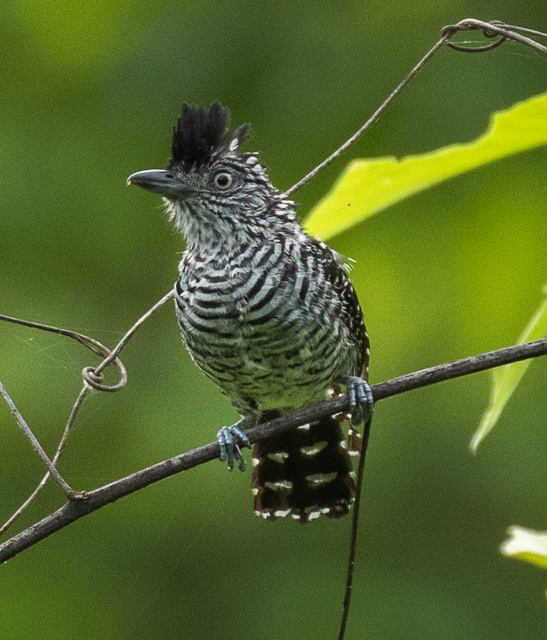 Barred AntshrikeThamnophilus doliatus
-
 Great AntshrikeTaraba major
-
 Black-crowned AntshrikeThamnophilus atrinucha
-
 Ocellated AntbirdPhaenostictus mcleannani
-
 Bicolored AntbirdGymnopithys bicolor
-
 Fasciated AntshrikeCymbilaimus lineatus
Compare
Questions and answers
What is the scientific name of the Black-throated Antshrike?
The scientific name of the Black-throated Antshrike is Frederickena viridis. Written with its author, the full name is Frederickena viridis (Vieillot, 1816).
Which family does the Black-throated Antshrike belong to?
Frederickena viridis belongs to the family Thamnophilidae, in the order Passeriformes and the class Aves.
Where is the Black-throated Antshrike found?
Checklists and occurrence records place Frederickena viridis in 5 countries: Brazil, Guyana, Suriname, French Guiana and Venezuela.
What is the conservation status of the Black-throated Antshrike?
The IUCN Red List category recorded for Frederickena viridis is Least Concern (LC).
Where is the Black-throated Antshrike found?
It occurs from eastern Bolívar state in Venezuela eastward through the Guianas. In northeastern Amazonian Brazil, its range extends north of the Amazon from the lower Rio Negro east to the Atlantic in Amapá.[35][36]
What does the Black-throated Antshrike eat?
Its known diet includes large insects and other arthropods.[16]
How does the Black-throated Antshrike forage?
It forages alone or in pairs, mainly close to the ground in dense foliage and vine tangles. It gleans prey from vegetation and ground debris and occasionally follows army ant swarms.[17][19][20]
Sources
Passages the profile rests on
- Adult males are predominantly slate gray, with a black head, throat, and breast. Source passage: “Adult males are mostly slate gray with a black head, throat, and breast” — English Wikipedia
- Adult males have a small, usually concealed white patch between their scapulars. Source passage: “a usually hidden small white patch between their scapulars” — English Wikipedia
- Adult males have faint white bars on their tails. Source passage: “faint white bars on their tail” — English Wikipedia
- Adult females have a rufous crest, nape, upperparts, and wings. Source passage: “Adult females have a rufous crest, nape, upperparts, and wings.” — English Wikipedia
- Adult females have pale buff to white and blackish-brown barring on their forehead, head sides, underparts, and tail. Source passage: “Their forehead, sides of their head, underparts, and tail are barred with pale buff to white and blackish brown” — English Wikipedia
- Adult females have a rufous tinge on their flanks. Source passage: “their flanks have a rufous tinge.” — English Wikipedia
- Subadult males have mixed gray and brown upperparts and underparts resembling those of adult females. Source passage: “Subadult males have mixed gray and brown upperparts and underparts like adult females'” — English Wikipedia
- The male has uniformly dark plumage. Source passage: “Male is uniformly dark” — ebird.org
- The female is distinguishable by a solid rufous cap and back. Source passage: “female told by solid rufous cap and back” — ebird.org
- The Black-throated Antshrike measures 19–22 cm in length. Source passage: “19 to 22 cm (7.5 to 8.7 in) long” — English Wikipedia
- The species weighs 65–75 g. Source passage: “weighing 65 to 75 g (2.3 to 2.6 oz).” — English Wikipedia
- The species inhabits lowland evergreen forests, particularly those on sandy soils and in terra firme. Source passage: “It inhabits lowland evergreen forest, typically those on sandy soils and in terra firme.” — English Wikipedia
- The species favors dense understorey vegetation, especially around openings created by fallen trees. Source passage: “It favors dense vegetation in the understorey, especially at openings such as those formed by fallen trees.” — English Wikipedia
- The species occurs from sea level to 700 m across most of its range, but reaches only 500 m in Venezuela. Source passage: “In elevation it ranges from sea level to 700 m (2,300 ft) in most of its range but only to 500 m (1,600 ft) in Venezuela.” — English Wikipedia
- The species is described as an uncommon rainforest-edge antbird. Source passage: “Large, uncommon antbird of rainforest edge.” — ebird.org
- Its known diet includes large insects and other arthropods. Source passage: “is known to include large insects and other arthropods.” — English Wikipedia
- The species forages alone or in pairs, mainly close to the ground in dense foliage and vine tangles. Source passage: “It forages singly or in pairs, mostly low to the ground or on it in dense foliage and vine tangles.” — English Wikipedia
- The species moves deliberately between branches and along the ground by hopping. Source passage: “It hops deliberately from branch to branch and along the ground” — English Wikipedia
- The species captures prey by reaching or jumping from perches to glean it from vegetation and ground debris. Source passage: “reaching or jumping from a perch to glean prey from leaves, stems, branches, leaf litter, and rotten logs.” — English Wikipedia
- The species occasionally follows army ant swarms to capture prey disturbed by the ants. Source passage: “It occasionally follows army ant swarms to catch prey disturbed by the ants.” — English Wikipedia
- The species is presumed to remain in its range throughout the year. Source passage: “is presumed to be a year-round resident throughout its range.” — English Wikipedia
- The species is shy and difficult to observe. Source passage: “Shy and difficult to see.” — ebird.org
- In Suriname, the species breeds between October and March. Source passage: “The black-throated antshrike breeds between October and March in Suriname” — English Wikipedia
- The breeding season outside Suriname has not been established. Source passage: “but its season is not known elsewhere.” — English Wikipedia
- The one documented nest was a basket suspended from a branch fork in a low shrub. Source passage: “The one known nest was a basket suspended in a branch fork in a low shrub.” — English Wikipedia
- The documented nest contained two creamy-white eggs with purplish markings. Source passage: “It contained two eggs that were creamy white with purplish markings.” — English Wikipedia
- The IUCN classifies the Black-throated Antshrike as Least Concern. Source passage: “The IUCN has assessed the black-throated antshrike as being of Least Concern.” — English Wikipedia
- The species has a large geographic range, but its population size is unknown and believed to be declining. Source passage: “It has a large range; its population size is not known and is believed to be decreasing.” — English Wikipedia
- No immediate threats to the species have been identified. Source passage: “No immediate threats have been identified.” — English Wikipedia
- The species is uncommon to rare across most of its range. Source passage: “It is considered uncommon to rare in most of its range.” — English Wikipedia
- Its distribution includes extensive areas of intact suitable habitat. Source passage: “includes large areas of intact suitable habitat” — English Wikipedia
- The species occurs in at least two protected areas in Venezuela. Source passage: “It occurs in at least two protected areas in Venezuela” — English Wikipedia
- The species was most recently assessed for the IUCN Red List in 2024. Source passage: “Black-throated Antshrike Frederickena viridis has most recently been assessed for The IUCN Red List of Threatened Species in 2024.” — iucnredlist.org
- The species shares the genus Frederickena with the Undulated Antshrike and Fulvous Antshrike. Source passage: “The black-throated antshrike shares genus Frederickena with the undulated antshrike (F. unduliger) and fulvous antshrike (F. fulva).” — English Wikipedia
- The species occurs from eastern Bolívar state in Venezuela eastward through the Guianas. Source passage: “found from eastern Bolívar state in Venezuela east through the Guianas” — English Wikipedia
- In northeastern Amazonian Brazil, its range extends north of the Amazon from the lower Rio Negro east to the Atlantic in Amapá. Source passage: “through northeastern Amazonian Brazil north of the Amazon from the lower Rio Negro east to the Atlantic in Amapá.” — English Wikipedia
Data
- Catalogue of Life, 2026-10-16 XR cc by
- Global Biodiversity Information Facility CC BY 4.0
- Wikidata CC0
- GeoNames CC BY 4.0
- Wikimedia Commons per image; credit shown with each image
- Within the Catalogue of Life, this name comes from The Integrated Taxonomic Information System cc0
References
- Gill, Frank, & and Minturn Wright. (2006). Birds of the World: Recommended English Names.
This species in other databases
Page built on 28 November 2026. See how the catalog is made and all sources and licences.
Cite this page
ScientificNames.org. (2026). Frederickena viridis (Black-throated Antshrike). Retrieved November 28, 2026, from https://scientificnames.org/species/frederickena-viridis
“Frederickena viridis (Black-throated Antshrike).” ScientificNames.org, 2026, scientificnames.org/species/frederickena-viridis. Accessed 28 Nov. 2026.
ScientificNames.org. “Frederickena viridis (Black-throated Antshrike).” Accessed November 28, 2026. https://scientificnames.org/species/frederickena-viridis.
@misc{scientificnames_frederickena_viridis_black_throated_antshrike,
  author = {{ScientificNames.org}},
  title = {Frederickena viridis (Black-throated Antshrike)},
  year = {2026},
  url = {https://scientificnames.org/species/frederickena-viridis},
  note = {Accessed 2026-11-28}
}