Species · Birds
Southern Fulmar Fulmarus glacialoides
The scientific name of the Southern Fulmar is Fulmarus glacialoides. It is a species of bird in the family Procellariidae (fulmars), order Procellariiformes. The name dates from 1840.
- Scientific name
- Fulmarus glacialoides (A. Smith, 1840)
- Common name
- Southern Fulmar
- Genus
- Fulmarus
- Family
- Procellariidae (Fulmars)
- Order
- Procellariiformes
- Class
- Aves
- Red List category
- LC Least Concern
- Environment
- marine, terrestrial
- Recorded in
- 13 countries
- Name status
- accepted in the Catalogue of Life

Overview
Fulmarus glacialoides breeds along the mainland coast of Antarctica and on the South Sandwich Islands, South Orkney Islands, South Shetland Islands, Bouvet Island and Peter I Island. It has pale silvery-grey upperparts, white underparts and wings with blackish tips, a large white patch and a dark rear edge.
Written 26 November 2026 from the sources listed below. Each statement was checked against the passage it cites; statements that could not be supported were removed.
Appearance
The Southern Fulmar has predominantly pale silvery-grey upperparts and white underparts. Its head is white, with a pale grey crown.[1][2]
Its wings have blackish tips, a large white patch and a dark rear edge. Its legs and feet are pale blue.[3][4]
Its bill is pink with a black tip and dark bluish naricorns. First-year birds have slimmer bills than adults.[5][6]
Habitat
Breeding colonies occur on cliffs in ice-free areas. During summer, the species mainly inhabits the outer edge of pack ice in waters with temperatures between −1.5 and 0.5 °C.[7][8]
Diet
Krill and other crustaceans are the principal components of the Southern Fulmar's diet. It also eats Antarctic silverfish and squid belonging to the genera Psychroteuthis, Gonatus and Galiteuthis.[9][10][11]
The species generally collects food from the water's surface, although it occasionally dives to obtain food.[12][13]
Behaviour
The Southern Fulmar flies using alternating shallow wingbeats and extended glides. While flying, it often looks down to scan the water.[14][15]
The species is usually silent but produces loud cackling calls at nests and in feeding flocks. Courting individuals produce soft droning and guttural croaking calls.[16][17]
Southern Fulmars frequently form feeding flocks with other seabird species, including Cape petrels.[18]
Reproduction and life cycle
Southern Fulmars arrive at their breeding colonies in October. Colonies can contain hundreds of birds.[19][20]
The nest is a shallow scrape lined with stone chips. Nests are built in wind-sheltered locations on ledges, scree slopes or in crevices.[21][22]
Females lay a single white egg during late November or early December. The egg measures 76 by 51 mm and weighs approximately 103 g.[23][24][25]
Egg incubation lasts approximately 45 days. Both parents incubate the egg in shifts lasting 3–9 days.[26][27]
Young Southern Fulmars fledge at approximately 52 days of age. Poor weather can cause high mortality among eggs and chicks.[28][29]
Breeding success increases from 48% at ages 6–8 to 87% at ages 18–20.[30]
Conservation
The global population of Southern Fulmars is estimated to contain at least four million individuals. Approximately one million breeding pairs occur on the South Sandwich Islands.[31][32]
The species is classified as Least Concern by BirdLife International.[33]
Similar species
The northern fulmar (Fulmarus glacialis) is identified as a close relative of the Southern Fulmar.[34]
Classification of the Southern Fulmar
| Kingdom | Animalia |
|---|---|
| Phylum | Chordata |
| Subphylum | Vertebrata |
| Infraphylum | Gnathostomata |
| Parvphylum | Osteichthyes |
| Megaclass | Tetrapoda |
| Class | Aves (Bird) |
| Order | Procellariiformes (Petrels) |
| Family | Procellariidae (Fulmars) |
| Genus | Fulmarus (Fulmars) |
| Species | Fulmarus glacialoides (A. Smith, 1840) |
Where the Southern Fulmar is found
Checklists and occurrence records place Fulmarus glacialoides in 13 countries. GBIF holds 28,879 georeferenced records of it.
Countries
- Antarctica 17,083
- Argentina 1,937
- Australia 1,193
- Bouvet Island 15
- Brazil 70
- Chile 5,610
- Falkland Islands 1,373
- French Southern Territories 67
- Heard Island and McDonald Islands 437
- New Zealand 434
- Peru 9
- South Georgia and the South Sandwich Islands 603
- Uruguay 48
Regions and cities with the most records
- Punta Arenas, Chile 1,609
- Ushuaia, Argentina 691
- Stanley, Falkland Islands 672
- Tierra del Fuego, Argentina 593
- Santa Cruz, Argentina 375
- Río Gallegos, Argentina 307
- Puerto Natales, Chile 187
- Victoria, Australia 168
- Concón, Chile 162
- Quintero, Chile 122
- Río Grande, Argentina 112
- Tasmania, Australia 104
- Puerto Montt, Chile 100
- Los Lagos Region, Chile 98
- South Australia, Australia 87
- New South Wales, Australia 77
- Valparaíso, Chile 74
- Talcahuano, Chile 73
- San Pedro de la Paz, Chile 70
- Hualpén, Chile 69
- Valparaiso, Chile 66
- Viña del Mar, Chile 65
- Puerto Varas, Chile 50
- Quilpué, Chile 47
- Calbuco, Chile 44
- Aysén, Chile 43
- Cartagena, Chile 39
- Valdivia, Chile 37
- Los Ríos Region, Chile 36
- El Quisco, Chile 35
- Grytviken, South Georgia and the South Sandwich Islands 33
- Sydney, Australia 33
- Concepción, Chile 32
- Northland, New Zealand 31
- Western Australia, Australia 30
- Wollongong, Australia 29
4 more countries have a few records outside this range
These countries hold a few records of Fulmarus glacialoides but lie outside the range the checklists give for it. Such records are often zoo or garden specimens, museum material or vagrants, so the species is not counted as occurring there.
Range as the checklists state it
Antarctica/Southern Ocean
A number beside a place is its count of GBIF occurrence records. A place without a number comes from a checklist alone. Records show where a species has been observed or collected, which can include escapes and vagrants.
Common names
English
- Southern Fulmar
- Antarctic Fulmar
- Silver-grey Petrel
Names in 33 other languages
- Afrikaans
- Silwerstormvoël
- Arabic
- فلمار جنوبي, كاسر العظام الجنوبي
- Breton
- Karamell ar su
- Bulgarian
- Южен буревестник, Южен фулмар
- Chinese
- 南方暴風鸌〔銀灰暴風鸌〕, 银灰暴风鹱
- Croatian
- Južni fulmar, antarktički burnjak
- Czech
- buřňák jižní
- Danish
- Sydlig Mallemuk
- Dutch
- grijze stormvogel
- Esperanto
- suda fulmaro
- Estonian
- hõbe-tormilind
- Finnish
- etelänmyrskylintu
- French
- Fulmar antarctique, Fulmar argenté
- German
- Antarktischer Eissturmvogel, Silbersturmvogel
- Hebrew
- פולמאר דרומי
- Hungarian
- déli sirályhojsza
- Indonesian
- Fulmar Selatan
- Irish
- Fulmaire deisceartach
- Italian
- Fulmaro australe
- Japanese
- ギンフルマカモメ
- Lithuanian
- pietinis fulmaras
- Norwegian
- sørhavhest
- Persian
- مرغ باران بدبوی جنوبی
- Polish
- fulmar południowy
- Portuguese
- Pardelão-prateado, fulmar-austral, pombalete-do-sul
- Russian
- Антарктический глупыш
- Serbian
- Južni burnjak
- Slovak
- fulmar strieborný
- Spanish
- Fulmar austral, Petrel plateado
- Swedish
- sydstormfågel
- Turkish
- Güney Fırtınakuşu
- Ukrainian
- буревісник південний
- Welsh
- Aderyn drycin y De
Synonyms
6 other scientific names have been used for this species and are now treated as synonyms of Fulmarus glacialoides.
- Fulmarus antarctica Stephens, JF, 1826
- Priocella antarctica Stephens, JF, 1826
- Priocella antarctica addenda Mathews, GM, 1915
- Priocella glacialoides Smith, A, 1840
- Procellaria glacialoides A. Smith, 1840
- Thalassidroma glacialina Heine, F; Reichenow, A, 1890
Related species
-
 Northern FulmarFulmarus glacialis
-
 Manx ShearwaterPuffinus puffinus
-
 Southern Giant PetrelMacronectes giganteus
-
 Short-tailed ShearwaterArdenna tenuirostris
-
 Sooty ShearwaterArdenna grisea
-
 Cory's ShearwaterCalonectris borealis
-
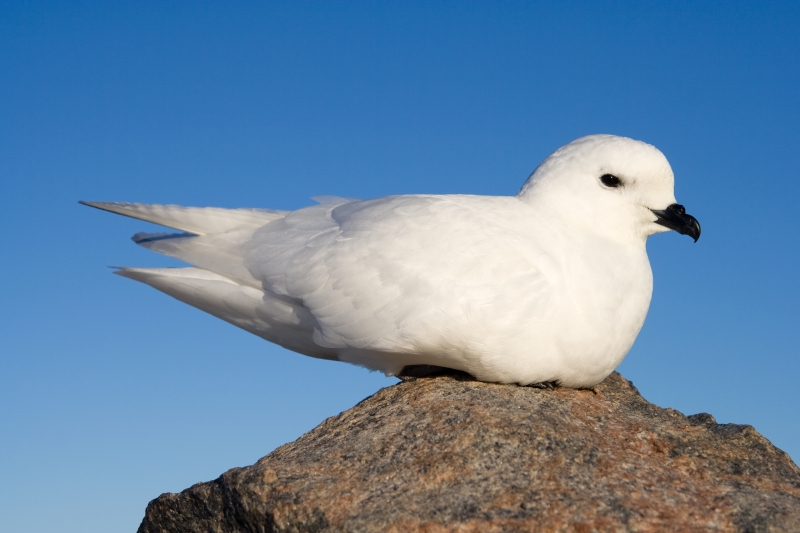 Snow PetrelPagodroma nivea
-
 Bermuda PetrelPterodroma cahow
Compare
Questions and answers
What is the scientific name of the Southern Fulmar?
The scientific name of the Southern Fulmar is Fulmarus glacialoides. Written with its author, the full name is Fulmarus glacialoides (A. Smith, 1840).
Which family does the Southern Fulmar belong to?
Fulmarus glacialoides belongs to the family Procellariidae, in the order Procellariiformes and the class Aves.
Where is the Southern Fulmar found?
Checklists and occurrence records place Fulmarus glacialoides in 13 countries, including Antarctica, Chile, Argentina, Falkland Islands, Australia and South Georgia and the South Sandwich Islands.
What is the conservation status of the Southern Fulmar?
The IUCN Red List category recorded for Fulmarus glacialoides is Least Concern (LC).
What other names does the Southern Fulmar have?
Fulmarus glacialoides is also known in English as Antarctic Fulmar and Silver-grey Petrel.
What does fulmar mean?
Fulmar derives from the Old Norse word Fúlmár, meaning foul-mew or foul-gull.[35]
Where do fulmar birds live?
The Southern Fulmar breeds along the mainland coast of Antarctica and on the South Sandwich Islands, South Orkney Islands, South Shetland Islands, Bouvet Island and Peter I Island. During winter, it regularly ranges north to approximately 40°S latitude and reaches Peru in the cool waters of the Humboldt Current. Small numbers occur off the coasts of South Africa, southern Australia and New Zealand.[36][37][38][39][40][41]
Sources
Passages the profile rests on
- The southern fulmar has predominantly pale silvery-grey upperparts and white underparts. Source passage: “The plumage is mainly pale silvery-grey above and white below.” — English Wikipedia
- The southern fulmar has a white head and a pale grey crown. Source passage: “The head is white with a pale grey crown.” — English Wikipedia
- Its wings have blackish tips, a large white patch and a dark rear edge. Source passage: “The wingtips are blackish with a large white patch and the wings have a dark rear edge.” — English Wikipedia
- Its legs and feet are pale blue. Source passage: “The legs and feet are pale blue.” — English Wikipedia
- Its bill is pink with a black tip and dark bluish naricorns. Source passage: “The bill is pink with a black tip and dark bluish naricorns.” — English Wikipedia
- First-year birds have slimmer bills than adults. Source passage: “First-year birds have a more slender bill than the adults.” — English Wikipedia
- Breeding colonies occur on cliffs in ice-free areas. Source passage: “The breeding colonies may contain hundreds of birds and are on cliffs in ice-free areas” — English Wikipedia
- During summer, the species mainly inhabits the outer edge of pack ice in waters with temperatures between −1.5 and 0.5 °C. Source passage: “At sea, it mainly occurs along the outer edge of the pack ice in summer with water temperatures of −1.5 to 0.5 °C (29.3 to 32.9 °F).” — English Wikipedia
- Krill and other crustaceans are the principal components of the southern fulmar's diet. Source passage: “Krill and other crustaceans are the most important component of the diet” — English Wikipedia
- The species eats Antarctic silverfish. Source passage: “small fish such as the Antarctic silverfish” — English Wikipedia
- The southern fulmar feeds on squid belonging to the genera Psychroteuthis, Gonatus and Galiteuthis. Source passage: “squid such as Psychroteuthis, Gonatus and Galiteuthis.” — English Wikipedia
- The species occasionally dives to obtain food. Source passage: “Food is usually picked from the surface of the water but the bird will occasionally dive.” — English Wikipedia
- The species generally collects food from the water's surface. Source passage: “Food is usually picked from the surface of the water” — English Wikipedia
- The southern fulmar flies using alternating shallow wingbeats and extended glides. Source passage: “The bird flies with a mixture of shallow flaps and long glides” — English Wikipedia
- While flying, the bird often looks down to scan the water. Source passage: “often looking down to scan the water.” — English Wikipedia
- The species is usually silent but produces loud cackling calls at nests and in feeding flocks. Source passage: “It is usually silent but has loud, cackling calls which are uttered at the nest or in feeding flocks.” — English Wikipedia
- Courting individuals produce soft droning and guttural croaking calls. Source passage: “Courting birds produce soft droning and guttural croaking calls.” — English Wikipedia
- Southern fulmars frequently form feeding flocks with other seabird species, including Cape petrels. Source passage: “Southern fulmars frequently gather in flocks, often with other species of seabird such as Cape petrels” — English Wikipedia
- Southern fulmars arrive at their breeding colonies in October. Source passage: “with the birds arriving in October.” — English Wikipedia
- Breeding colonies can contain hundreds of birds. Source passage: “The breeding colonies may contain hundreds of birds” — English Wikipedia
- The nest is a shallow scrape lined with stone chips. Source passage: “The nest is a shallow scrape lined with stone chips.” — English Wikipedia
- Nests are built in wind-sheltered locations on ledges, scree slopes or in crevices. Source passage: “It is built in a spot sheltered from the wind on a ledge or scree slope or in a crevice.” — English Wikipedia
- Females lay a single white egg during late November or early December. Source passage: “A single, white egg is laid during late November or early December.” — English Wikipedia
- The egg measures 76 by 51 mm. Source passage: “It measures 76 by 51 mm (2.99 by 2.01 in)” — English Wikipedia
- The egg weighs approximately 103 g. Source passage: “and weighs about 103 g (3.6 oz).” — English Wikipedia
- Egg incubation lasts approximately 45 days. Source passage: “It is incubated for about 45 days” — English Wikipedia
- Both parents incubate the egg in shifts lasting 3–9 days. Source passage: “with both parents taking turns in stints of 3–9 days.” — English Wikipedia
- Young southern fulmars fledge at approximately 52 days of age. Source passage: “The young fledge after around 52 days.” — English Wikipedia
- Poor weather can cause high mortality among eggs and chicks. Source passage: “Poor weather can lead to high mortality rates among eggs and chicks” — English Wikipedia
- Breeding success increases from 48% at ages 6–8 to 87% at ages 18–20. Source passage: “improving from 48% at age 6–8 to 87% at age 18–20.” — English Wikipedia
- The global population of southern fulmars is estimated to contain at least four million individuals. Source passage: “It is a common species with a population of at least 4 million individuals.” — English Wikipedia
- Approximately one million breeding pairs occur on the South Sandwich Islands. Source passage: “About a million pairs breed on the South Sandwich Islands alone.” — English Wikipedia
- The species is classified as Least Concern by BirdLife International. Source passage: “The species is not thought to be at risk of extinction and is classed as least concern by Birdlife International.” — English Wikipedia
- The northern fulmar (Fulmarus glacialis) is identified as a close relative of the southern fulmar. Source passage: “Fulmarus glacialis may be most closely related to Antarctic fulmars ( Fulmarus glacialoides ).” — animaldiversity.org
- The genus name Fulmarus derives from the Old Norse word Fúlmár, meaning foul-mew or foul-gull. Source passage: “The genus name comes from the Old Norse Fúlmár meaning "foul-mew" or "foul-gull"” — English Wikipedia
- The species breeds along the mainland coast of Antarctica. Source passage: “The bird also breeds at several sites along the mainland coast of Antarctica.” — English Wikipedia
- Breeding colonies occur on the South Sandwich Islands, South Orkney Islands and South Shetland Islands. Source passage: “There are colonies on a number of the islands around Antarctica such as the South Sandwich Islands, South Orkney Islands, South Shetland Islands” — English Wikipedia
- The species also breeds on Bouvet Island and Peter I Island. Source passage: “Bouvet Island, and Peter I Island.” — English Wikipedia
- During winter, the species regularly ranges north to approximately 40°S latitude. Source passage: “In winter, it regularly ranges north to around 40°S latitude.” — English Wikipedia
- The southern fulmar reaches Peru in the cool waters of the Humboldt Current. Source passage: “It occurs further north in the cool waters of the Humboldt Current, reaching Peru.” — English Wikipedia
- Small numbers occur off the coasts of South Africa, southern Australia and New Zealand. Source passage: “Small numbers are seen off the coasts of South Africa, southern Australia and New Zealand.” — English Wikipedia
Data
- Catalogue of Life, 2026-10-16 XR cc by
- Global Biodiversity Information Facility CC BY 4.0
- Wikidata CC0
- GeoNames CC BY 4.0
- Wikimedia Commons per image; credit shown with each image
- Within the Catalogue of Life, this name comes from The Integrated Taxonomic Information System cc0
References
- Gill, Frank, & and Minturn Wright. (2006). Birds of the World: Recommended English Names.
This species in other databases
- Catalogue of Life 6K48R
- Wikidata Q181326
- iNaturalist 4184
- WoRMS urn:lsid:marinespecies.org:taxname:212638
- Avibase souful1
Page built on 27 November 2026. See how the catalog is made and all sources and licences.
Cite this page
ScientificNames.org. (2026). Fulmarus glacialoides (Southern Fulmar). Retrieved November 27, 2026, from https://scientificnames.org/species/fulmarus-glacialoides
“Fulmarus glacialoides (Southern Fulmar).” ScientificNames.org, 2026, scientificnames.org/species/fulmarus-glacialoides. Accessed 27 Nov. 2026.
ScientificNames.org. “Fulmarus glacialoides (Southern Fulmar).” Accessed November 27, 2026. https://scientificnames.org/species/fulmarus-glacialoides.
@misc{scientificnames_fulmarus_glacialoides_southern_fulmar,
  author = {{ScientificNames.org}},
  title = {Fulmarus glacialoides (Southern Fulmar)},
  year = {2026},
  url = {https://scientificnames.org/species/fulmarus-glacialoides},
  note = {Accessed 2026-11-27}
}