Species · Birds
Common Gallinule Gallinula galeata
The scientific name of the Common Gallinule is Gallinula galeata. It is a species of bird in the family Rallidae (rail), order Gruiformes. The name dates from 1818.
- Scientific name
- Gallinula galeata (M. H. C. Lichtenstein, 1818)
- Common name
- Common Gallinule
- Genus
- Gallinula
- Family
- Rallidae (Rail)
- Order
- Gruiformes
- Class
- Aves
- Red List category
- LC Least Concern
- Environment
- freshwater, terrestrial
- Recorded in
- 55 countries
- Name status
- accepted in the Catalogue of Life

Overview
Gallinula galeata occurs throughout the Americas and inhabits well-vegetated marshes, ponds, canals, and other wetlands. Adults have dark plumage, a white undertail, yellow legs, and a red frontal shield.
Written 26 November 2026 from the sources listed below. Each statement was checked against the passage it cites; statements that could not be supported were removed.
Conservation
The Common Gallinule remains plentiful and widespread despite habitat loss in some parts of its range. It can be locally common where suitable marsh habitat persists within its historical range.[1][2]
Appearance
Adults have dark plumage, a white undertail, yellow legs, and a red frontal shield. Juveniles have browner plumage and lack the red frontal shield.[3][4]
The species measures 32–35 cm in length, weighs 310–456 g, and has a wingspan of 54–62 cm.[5][6][7]
Habitat
The Common Gallinule inhabits well-vegetated marshes, ponds, canals, and other wetlands throughout the Americas. It commonly breeds in marsh environments and lakes with abundant vegetation.[8][9]
The species occurs throughout the Americas. Populations in southern Canada and the northern United States migrate to warmer regions when local waters freeze.[10][11]
Diet
The Common Gallinule consumes a varied diet of plant material and small aquatic animals.[12]
Behaviour
The species forages beside and within water and sometimes tips its body forward to feed underwater. Its broad feet enable it to move by hopping across lily pads.[13][14]
The species produces various gargling calls and loud hissing sounds when threatened. It is often secretive, although individuals can become tame in some locations.[15][16]
Individuals actively fight to protect their territories. When threatened, young birds may cling to a parent's body while the adult carries them to safety in flight.[17][18]
Reproduction and life cycle
The Common Gallinule builds basket-shaped nests on the ground among dense vegetation. In temperate regions of the Northern Hemisphere, egg laying begins between mid-March and mid-May.[19][20]
Females generally lay approximately eight eggs early in the breeding season. Later broods generally contain five to eight eggs or fewer, and different females may reuse the same nest.[21][22][23]
Incubation lasts approximately three weeks, and both parents participate in incubating the eggs and feeding the young.[24][25]
Young birds leave the nest after approximately 40–50 days and generally become independent a few weeks after fledging. Young individuals may produce their first brood in the following spring.[26][27][28]
Classification of the Common Gallinule
| Kingdom | Animalia |
|---|---|
| Phylum | Chordata |
| Subphylum | Vertebrata |
| Infraphylum | Gnathostomata |
| Parvphylum | Osteichthyes |
| Megaclass | Tetrapoda |
| Class | Aves (Bird) |
| Order | Gruiformes (Rails) |
| Family | Rallidae (Rail) |
| Genus | Gallinula (Moorhen) |
| Species | Gallinula galeata (M. H. C. Lichtenstein, 1818) |
Where the Common Gallinule is found
Checklists and occurrence records place Gallinula galeata in 55 countries across North America, Oceania and South America. GBIF holds 1,741,123 georeferenced records of it.
Countries
- Anguilla 473
- Antigua and Barbuda 1,456
- Argentina 44,438
- Aruba 4,264
- Bahamas 8,003
- Barbados 5,265
- Belize 1,527
- Bermuda 9,764
- Bolivia 2,846
- Bonaire, Saint Eustatius and Saba 1,358
- Brazil 57,012
- British Virgin Islands 240
- Canada 74,537
- Cayman Islands 8,036
- Chile 4,170
- Colombia 28,594
- Costa Rica 3,679
- Cuba 8,541
- Curacao 3,321
- Dominica 206
- Dominican Republic 7,736
- Ecuador 8,642
- El Salvador 525
- French Guiana 219
- Greenland 3
- Grenada 1,169
- Guadeloupe 5,057
- Guatemala 5,704
- Guyana 29
- Haiti 614
- Honduras 2,769
- Jamaica 2,977
- Martinique 484
- Mexico 47,898
- Montserrat 619
- Nicaragua 2,419
- Panama 6,216
- Paraguay 1,519
- Peru 25,202
- Puerto Rico 21,566
- Saint Barthelemy 128
- Saint Kitts and Nevis 540
- Saint Lucia 661
- Saint Martin 1,412
- Saint Pierre and Miquelon 6
- Saint Vincent and the Grenadines 211
- Sint Maarten 1,044
- Suriname 27
- Trinidad and Tobago 3,295
- Turks and Caicos Islands 381
- U.S. Virgin Islands 3,252
- United States 1,311,801
- United States Minor Outlying Islands 19
- Uruguay 6,063
- Venezuela 3,186
Regions and cities with the most records
- Florida, United States 632,767
- Texas, United States 181,654
- California, United States 117,232
- Arizona, United States 59,010
- Pinellas Park, United States 53,114
- Lealman, United States 52,692
- South Carolina, United States 52,533
- Seminole, United States 52,177
- West and East Lealman, United States 51,900
- St. Petersburg, United States 50,262
- Greenacres City, United States 48,917
- Lake Worth Corridor, United States 47,460
- Safety Harbor, United States 47,431
- Largo, United States 47,148
- Palm Springs, United States 46,830
- Clearwater, United States 45,284
- Lake Worth Beach, United States 43,649
- Boca Del Mar, United States 42,954
- Sandalfoot Cove, United States 42,927
- Boynton Beach, United States 42,203
- Delray Beach, United States 41,621
- Bayshore Gardens, United States 39,597
- Sarasota, United States 39,191
- Ocoee, United States 38,640
- Titusville, United States 38,618
- Apopka, United States 38,186
- New York, United States 37,485
- Gainesville, United States 36,846
- Boca Raton, United States 35,534
- Dunedin, United States 35,421
- Winter Garden, United States 33,671
- Deerfield Beach, United States 33,018
- Quebec, Canada 32,846
- Ontario, Canada 32,687
- Wekiwa Springs, United States 32,475
- Pine Hills, United States 30,957
1 more country has a few records outside this range
These countries hold a few records of Gallinula galeata but lie outside the range the checklists give for it. Such records are often zoo or garden specimens, museum material or vagrants, so the species is not counted as occurring there.
Range as the checklists state it
Middle America
North America
South America
Caribbean
A number beside a place is its count of GBIF occurrence records. A place without a number comes from a checklist alone. Records show where a species has been observed or collected, which can include escapes and vagrants.
Common names
English
- Common Gallinule
- American Common Moorhen
- American Moorhen
- Common Moorhen
- Florida Gallinule
- Laughing Gallinule
- Laughing Moorhen
- Water Chicken
Names in 30 other languages
- Arabic
- دجاج الماء الشائع
- Catalan
- polla d'aigua americana
- Chinese
- 普通水雞, 美洲黑水鸡, 黑水鸡
- Croatian
- američka mlakuša
- Czech
- slípka americká
- Danish
- Amerikansk Rørhøne, Florida rørhøne
- Dutch
- Amerikaans Waterhoen
- Esperanto
- amerika galinolo
- Estonian
- Ameerika tait
- Finnish
- amerikanliejukana
- French
- Gallinule d'Amérique, Gallinule d’Amérique
- German
- Amerikanisches Teichhuhn, Amerikateichhuhn
- Greek
- Αμερικανική Νερόκοτα
- Hawaiian
- 'Alae 'ula, ‘Alae ‘Ula
- Irish
- Cearc uisce Meiriceánach
- Italian
- Gallinella americana
- Japanese
- アメリカバン
- Korean
- 아메리카쇠물닭
- Norwegian
- amerikasivhøne
- Papiamento
- Gaito Pico Còrá, Gaitu Pik Kòrá
- Polish
- kokoszka amerykańska
- Portuguese
- Frango-d'água comum, galinha-d'água, galinha-d'água-americana, galinha-de-água-americana
- Russian
- Американская камышница
- Serbian
- Američka barska kokica
- Slovak
- sliepočka nahana
- Spanish
- Gallareta Frentirroja, Gallareta común, Gallareta pico rojo, Gallineta Frente Roja, Gallineta americana, Polla de Agua Común, Polla de agua, Polla gris
- Swedish
- amerikansk rörhöna
- Turkish
- Amerika Sutavuğu
- Ukrainian
- курочка латиноамериканська
- grn
- Ñahana
Synonyms
One other scientific name has been used for this species and is now treated as a synonym of Gallinula galeata.
- Crex galeata M. H. C. Lichtenstein, 1818
Subspecies and varieties
- Gallinula galeata barbadensis (Barbados Gallinule) subspecies
- Gallinula galeata cachinnans (North American Common Gallinule) subspecies
- Gallinula galeata cerceris (Common Gallinule) subspecies
- Gallinula galeata galeata (South American Common Gallinule) subspecies
- Gallinula galeata garmani (Altiplano Common Gallinule) subspecies
- Gallinula galeata pauxilla (Subandean Gallinule) subspecies
- Gallinula galeata sandvicensis (Hawaiian Common Moorhen) subspecies
Related species
-
 Common MoorhenGallinula chloropus
-
 Dusky MoorhenGallinula tenebrosa
-
 Gough MoorhenGallinula comeri
-
 Tristan MoorhenGallinula nesiotis
- Makira WoodhenGallinula silvestris
-
 Samoan MoorhenGallinula pacifica
-
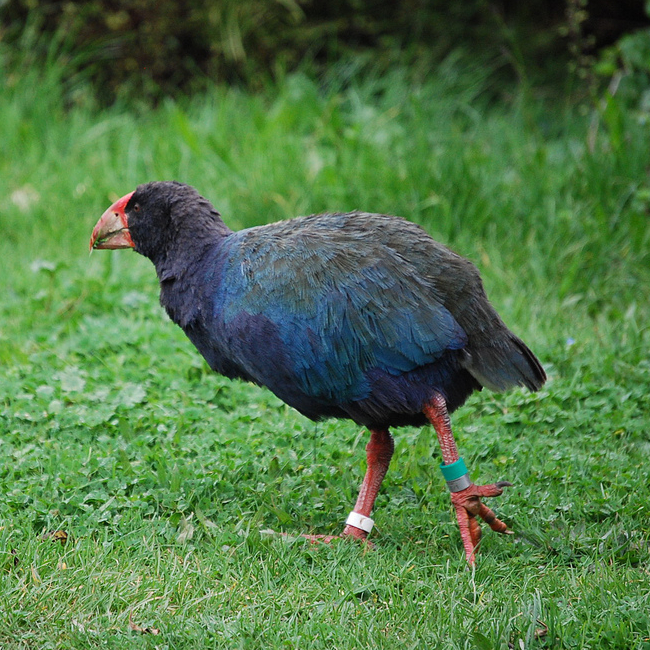 TakahēPorphyrio hochstetteri
-
 Australasian SwamphenPorphyrio melanotus
Compare
Questions and answers
What is the scientific name of the Common Gallinule?
The scientific name of the Common Gallinule is Gallinula galeata. Written with its author, the full name is Gallinula galeata (M. H. C. Lichtenstein, 1818).
Which family does the Common Gallinule belong to?
Gallinula galeata belongs to the family Rallidae, in the order Gruiformes and the class Aves.
Where is the Common Gallinule found?
Checklists and occurrence records place Gallinula galeata in 55 countries, including United States, Canada, Brazil, Mexico, Argentina and Colombia.
What is the conservation status of the Common Gallinule?
The IUCN Red List category recorded for Gallinula galeata is Least Concern (LC).
What other names does the Common Gallinule have?
Gallinula galeata is also known in English as American Common Moorhen, American Moorhen, Common Moorhen, Florida Gallinule, Laughing Gallinule and Laughing Moorhen.
What do common gallinules eat?
Common Gallinules consume plant material and small aquatic animals.[12]
Sources
Passages the profile rests on
- The species remains plentiful and widespread despite habitat loss in some parts of its range. Source passage: “Despite loss of habitat in parts of its range, the common gallinule remains plentiful and widespread.” — English Wikipedia
- The species remains widespread and can be locally common where suitable marsh habitat persists within its historical range. Source passage: “Still widespread and may be locally common where good marsh habitat exists within historical range.” — audubon.org
- The adult bird has dark plumage, a white undertail, yellow legs, and a red frontal shield. Source passage: “The gallinule has dark plumage apart from the white undertail, yellow legs and a red frontal shield.” — English Wikipedia
- Juveniles have browner plumage and lack the red frontal shield. Source passage: “The young are browner and lack the red shield.” — English Wikipedia
- The species measures 32–35 cm in length. Source passage: “Length: 32–35 cm (12+1⁄2–14 in)” — English Wikipedia
- The species weighs 310–456 g. Source passage: “Weight: 310–456 g (10+7⁄8–16+1⁄8 oz)” — English Wikipedia
- The species has a wingspan of 54–62 cm. Source passage: “Wingspan: 54–62 cm (21+1⁄2–24+1⁄2 in)” — English Wikipedia
- The species inhabits well-vegetated marshes, ponds, canals, and other wetlands throughout the Americas. Source passage: “It lives around well-vegetated marshes, ponds, canals, and other wetlands in the Americas.” — English Wikipedia
- The species commonly breeds in marsh environments and lakes with abundant vegetation. Source passage: “This is a common breeding bird in marsh environments and well-vegetated lakes.” — English Wikipedia
- The species occurs throughout the Americas. Source passage: “It lives around well-vegetated marshes, ponds, canals, and other wetlands in the Americas.” — English Wikipedia
- Populations in southern Canada and the northern United States migrate to warmer regions when local waters freeze. Source passage: “Populations in areas where the waters freeze, such as southern Canada and the northern USA, will migrate to more temperate climes.” — English Wikipedia
- The species consumes a varied diet of plant material and small aquatic animals. Source passage: “This species will consume a wide variety of vegetable material and small aquatic creatures.” — English Wikipedia
- The species forages both beside and within water and sometimes tips its body forward to feed underwater. Source passage: “It forages beside or in the water, sometimes upending in the water to feed.” — English Wikipedia
- Its broad feet enable it to move by hopping across lily pads. Source passage: “Its wide feet allow it to hop about on lily pads.” — English Wikipedia
- The species produces various gargling calls and loud hissing sounds when threatened. Source passage: “It has a wide range of gargling calls and will emit loud hisses when threatened.” — English Wikipedia
- The species is often secretive, although individuals can become tame in some locations. Source passage: “It is often secretive, but can become tame in some areas.” — English Wikipedia
- Individuals actively fight to protect their territories. Source passage: “The common gallinule will fight to defend its territory.” — English Wikipedia
- When threatened, young birds may cling to a parent's body while the adult carries them to safety in flight. Source passage: “When threatened, the young may cling to a parent's body, after which the adult birds fly away to safety, carrying their offspring with them.” — English Wikipedia
- The species builds basket-shaped nests on the ground among dense vegetation. Source passage: “The nest is a basket built on the ground in dense vegetation.” — English Wikipedia
- In temperate regions of the Northern Hemisphere, egg laying begins between mid-March and mid-May. Source passage: “Laying starts in spring, between mid-March and mid-May in northern hemisphere temperate regions.” — English Wikipedia
- Females generally lay approximately eight eggs early in the breeding season. Source passage: “About 8 eggs are usually laid per female early in the season” — English Wikipedia
- Later broods generally contain five to eight eggs or fewer. Source passage: “a brood later in the year usually has only 5–8 or even fewer eggs.” — English Wikipedia
- Different females may reuse the same nest. Source passage: “Nests may be re-used by different females.” — English Wikipedia
- Incubation lasts approximately three weeks. Source passage: “Incubation lasts about three weeks.” — English Wikipedia
- Both parents participate in incubating the eggs and feeding the young. Source passage: “Both parents incubate and feed the young.” — English Wikipedia
- Young birds leave the nest after approximately 40–50 days. Source passage: “These fledge after 40–50 days” — English Wikipedia
- Young birds generally become independent a few weeks after fledging. Source passage: “become independent usually a few weeks thereafter” — English Wikipedia
- Young individuals may produce their first brood in the following spring. Source passage: “and may raise their first brood the next spring.” — English Wikipedia
Data
- Catalogue of Life, 2026-10-16 XR cc by
- Global Biodiversity Information Facility CC BY 4.0
- Wikidata CC0
- GeoNames CC BY 4.0
- Wikimedia Commons per image; credit shown with each image
- Within the Catalogue of Life, this name comes from The Integrated Taxonomic Information System cc0
References
- Dickinson, E. C., and J. V. Remsen Jr., eds. (2013). The Howard and Moore Complete Checklist of the Birds of the World, 4th Edition, Vol. 1 Non-Passerines.
This species in other databases
- Catalogue of Life CNSCZ
- Wikidata Q1263469
- iNaturalist 144479
- WoRMS urn:lsid:marinespecies.org:taxname:1443791
- Avibase comgal1
Page built on 27 November 2026. See how the catalog is made and all sources and licences.
Cite this page
ScientificNames.org. (2026). Gallinula galeata (Common Gallinule). Retrieved November 27, 2026, from https://scientificnames.org/species/gallinula-galeata
“Gallinula galeata (Common Gallinule).” ScientificNames.org, 2026, scientificnames.org/species/gallinula-galeata. Accessed 27 Nov. 2026.
ScientificNames.org. “Gallinula galeata (Common Gallinule).” Accessed November 27, 2026. https://scientificnames.org/species/gallinula-galeata.
@misc{scientificnames_gallinula_galeata_common_gallinule,
  author = {{ScientificNames.org}},
  title = {Gallinula galeata (Common Gallinule)},
  year = {2026},
  url = {https://scientificnames.org/species/gallinula-galeata},
  note = {Accessed 2026-11-27}
}